

On June 18th the Textile Research Centre gave a workshop on pharaoh Tutankhamun’s clothing, as part of the Tutankhamun month organised by Huis van Horus, a society for Egyptology in the Netherlands and Flanders.
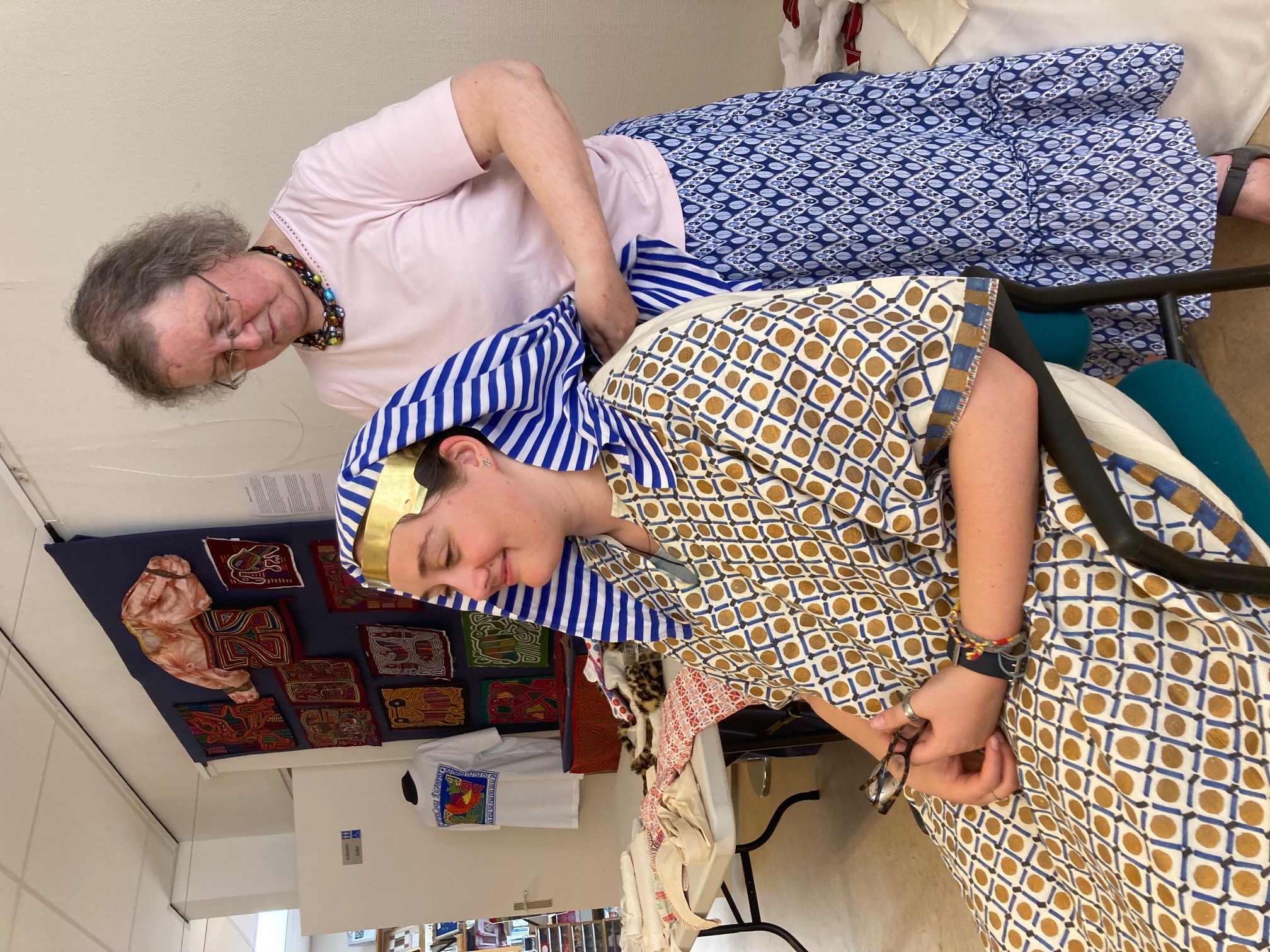 Gillian Vogelsang helping a participant to wear a (replica) nemes headdress. Photograph by Gerton Hermers.When Howard Carter discovered Tutankhamun’s tomb in 1922, he didn’t just find coffins and gold, but also hundreds of textiles. Dr. Gillian Vogelsang-Eastwood has done extensive research on the actual garments now housed at the Grand Egyptian Museum (GEM) in Cairo, and producing replicas of several of them to display their dazzling colours and designs and also to test how they would have been worn and used.
We were given a hands-on demonstration of a number of (replica) royal garments, starting with his Majesty’s underwear. A large linen triangle was tied around the waist of one of the workshop participants and then tucked in at the front, demonstrating that the king’s hips were probably quite wide.
A linen skirt was wrapped around the waist and fastened with a sash with a colourful, woven feather pattern. The pictures we see so often in museums and books were starting to come alive before our eyes.
Next, we were shown a tunic covered in an elaborate pattern of blue bead netting and golden buttons. While the replica version only had a painted pattern, the original must have been very heavy with all the faience and gold appliqués. Trying the tunic out on another one of the participants, we understood why only the front of the garment was decorated: it is quite impossible to sit down on a layer of beads and buttons. Alternatively, if the king is sitting down, the back of his tunic can’t be seen anyway, so there was apparently no need to decorate it.
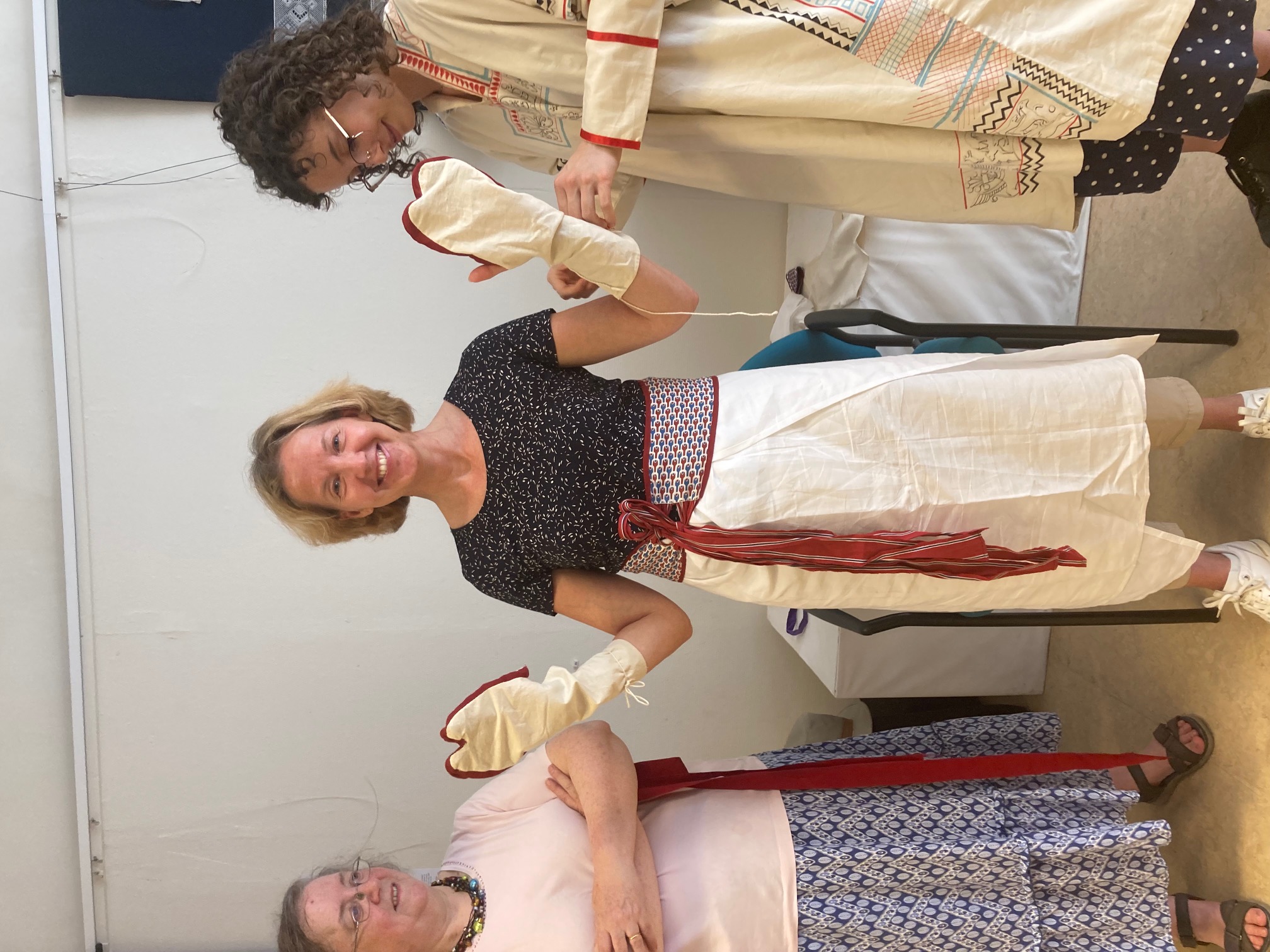 One of the participants showing the (replica) chariot gauntlets of Tutankhamun. Photograph by Gerton Hermers.
The royal regalia were complemented with a nemes headcloth. No matter how many times I’ve seen one – on the famous mask of Tutankhamun, on the sphinx of Giza and elsewhere – it is difficult to imagine quite how it looks when made from a striped linen cloth tied around the head, and then tied together with string into a kind of pony tail at the back.
Then another participant was turned into an Egyptian priest with a leopard skin slung over his shoulder, which was adorned with a leopard’s head made of gilded wood dangling down at the front.
Finally we looked at some pictures of the original objects as they were excavated and as they have been displayed in the Egyptian Museum. We also looked at some ancient Egyptian depictions of the garments being worn, which suddenly started to make a lot more sense. For example, have you ever noticed the white linen sash that ties the leopard skin’s legs together under the priest’s left arm in the Tutankhamun tomb painting? I hadn’t. And that is just one of the very interesting things I learned today.
Sandra Ottens MA Egyptology Leiden 2012 https://egyptoblogie.wordpress.com/
PS: In November 2022, one hundred years after the discovery of Tutankhamun's tomb on 4th November 1922 and the opening up of the tomb on 26th, the TRC will organise a series of events: "Getting close to Tutankhamun', focussing on the many garments discovered in his tomb.