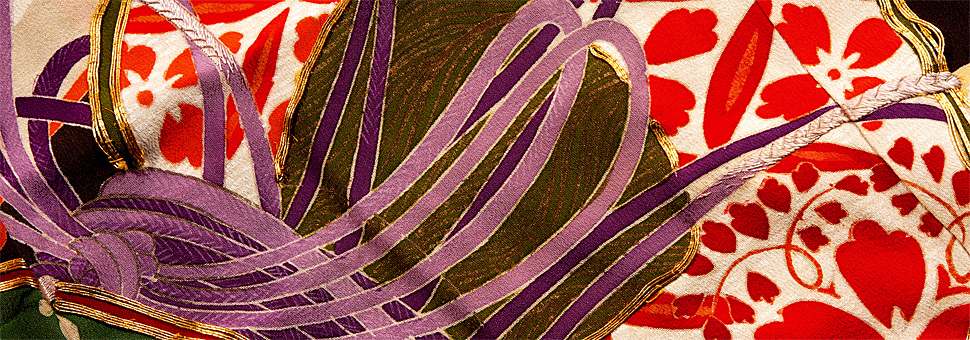


A recent acquisition of the TRC is a sampler made by a girl called ‘Sanneke’ (TRC 2022.2990). It has a familiar look: I have seen quite a few comparable examples offered for sale on online market places. Sanneke must have seen a chart, or she may even have had a kit of an original. That explains the two dates on the sampler: 1821 and 1978. The original must have been made in 1821; Sanneke's copy was finished in 1978.
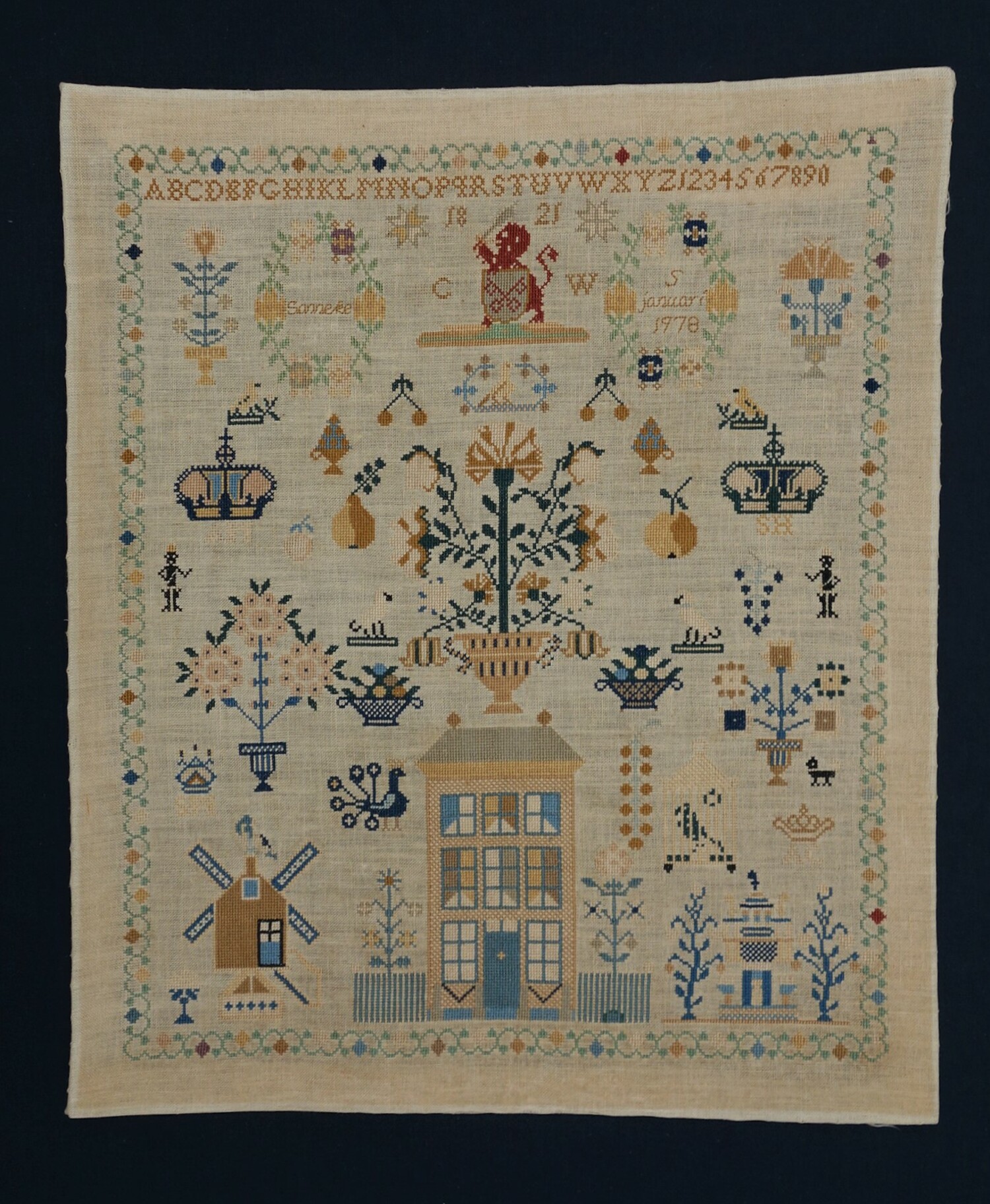 Sampler from 1978, based on original from Amsterdam from 1821 (TRC 2021.2990).
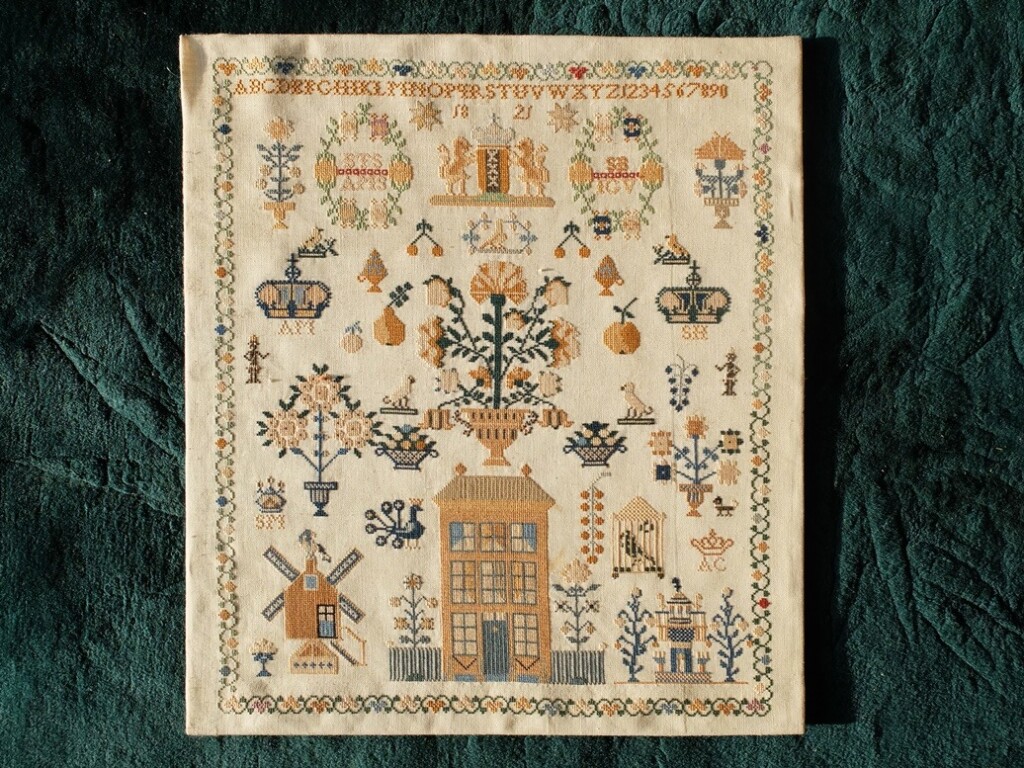 Late 20th century copy of an 1821 sampler, from Tweedehandswerk-blog, 6 Febr. 2019.Sanneke did make a few changes to the supposed original. In comparable examples I have seen – and so, presumably, in the original – the cartouches contain the initials BTS, AMS, SB and IGV. These initials, it so turns out, belong to some of the ladies who governed the Openbare Werk- en Leerschool ('Public Work and Training School'), a 19th century training establishment for poor but talented girls in Amsterdam,
The Leerschool was opened in 1808 (actually, two schools were established with the same name and structure). Their aim was to train girls for domestic service. There were some theoretical lessons, but sewing – including mending – was an important part of the curriculum. There was a lot of sewing to be done, in those days. Sewing was thought to make girls neat and industrious. One could also say the school existed by sewing: the girls earned money for the school by sewing for private customers.
A second change made by Sanneke was the replacement of the Amsterdam coat-of-arms, with its characteristic three crosses and worked in the other samplers, by the crest of the city of Leiden, marked by the two keys (the keys of St Peter, the patron saint of Leiden). Sanneke obviously had a strong link with Leiden
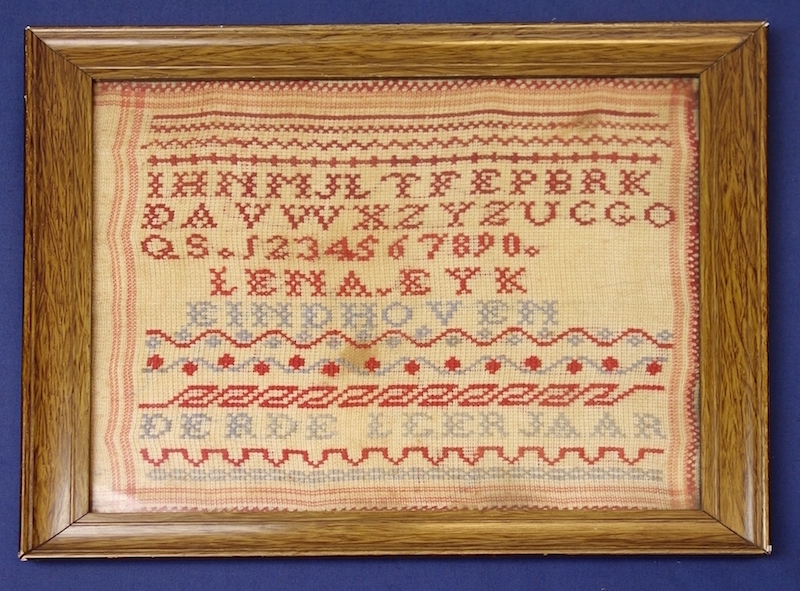 School embroidery sampler, with increasing difficulty, first square letters, then round ones, worked in 1927 (TRC 2013.0286).The surprising thing about this cloth is that it is a 'real' sampler. I know lots of darning samplers from the Amsterdam school, but hardly any embroidery samplers. Possibly this is because the Werk- en Leerschool offered purely vocational training. During the 19th century, the craft of working embroidery samplers devolved into a more simple, beginner's exercise (compare TRC 2013.0286) which would have had no place in the curriculum of the Leerschool.
I know only two embroidery samplers from this school, and both are early. The first was published in Schipper-van Lottum's book, Over Merklappen gesproken (no. 199). This sampler was in a private collection, so I know it only by a photograph. It carries the date of 1826. It has the same initials in cartouches as the suggested 1821 original of Sanneke's work, and also the stars, the date, the Amsterdam city crest and the crowned initials. Only some of the embroidered motifs are different: Some vases of flowers are embroidered in the naturalistic style of the 18th century and some landscapes in 19th century Berlin style. Sannekes sampler has mainly geometric and stylized motifs, characteristic for the 17th century.
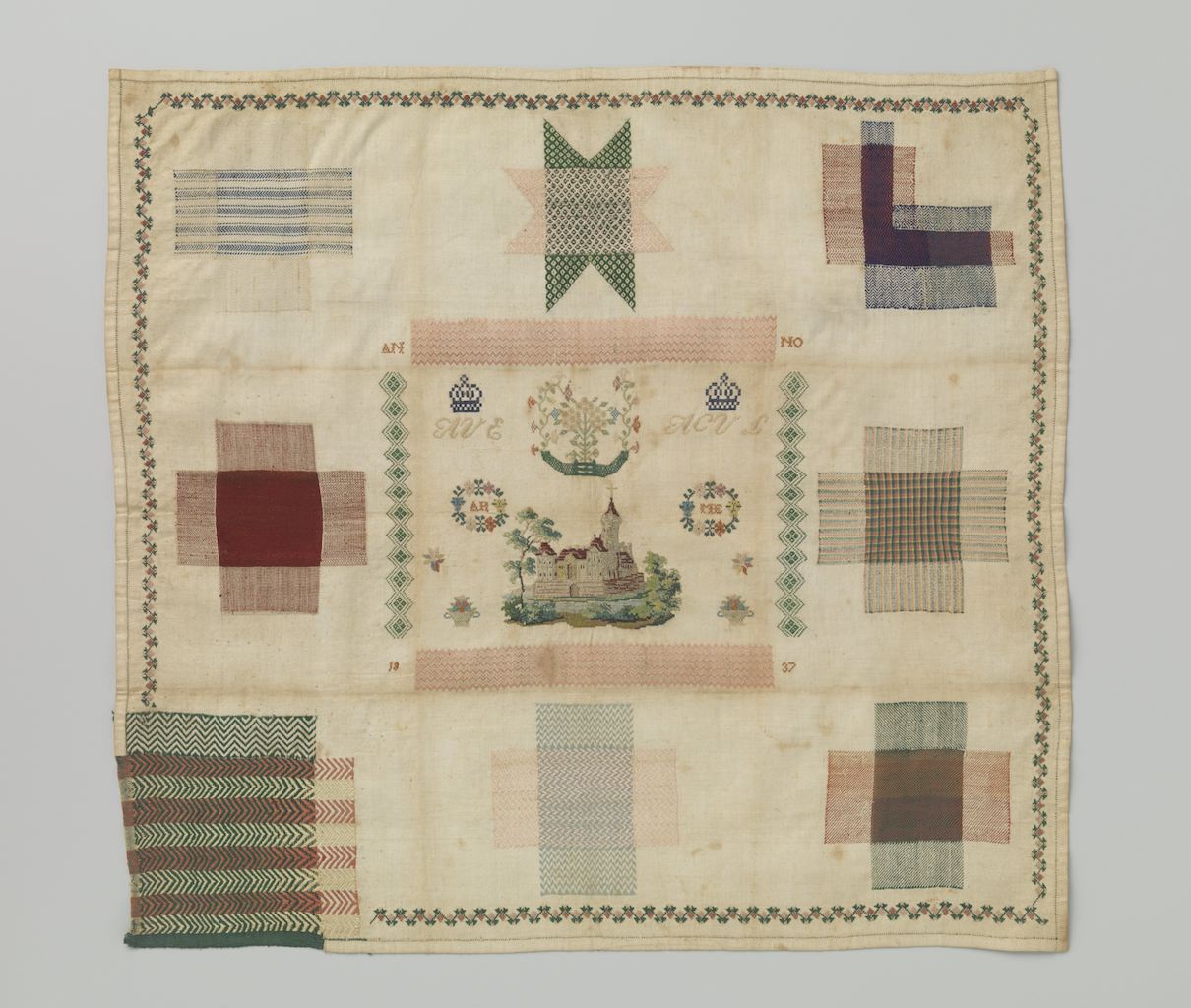 Darning sampler, worked by Maria Egersman, 1837, exercise piece for the Openbare Werk- en Leerschool, Amsterdam (courtesy Rijksmuseum Amsterdam, BK 14655). Maria Egresman was born in Amsterdam in 1822. She died in Amsterdam in 1886.
In the meantime, we do know many darning samplers made in the Amsterdam school. They are comparable to examples made in the Burgerweeshuis and the Protestants Weeshuis, both in Amsterdam. The early ones have star-shaped darning in the centre; later ones have the darns arranged outside a central rectangle with an embroidered picture (Berlin style; see illustration). Very often they have the teachers' initials, such as Alida Haring until 1861, and later Catharina Barbara (van Geldere-) Klinkmeyer.
Nelleke Ganzevoort, 8 September 2022