

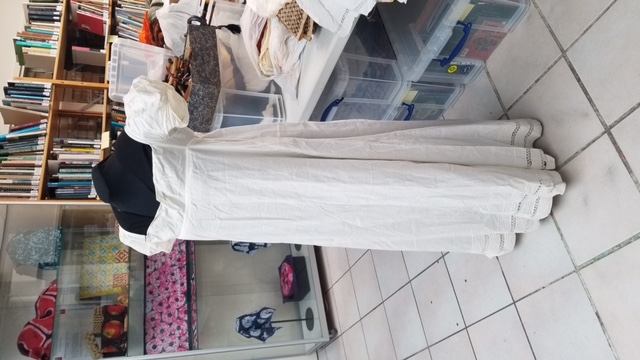
 Empire-style dress, early 19th century, recently donated to the TRC (2022.3163).Last week an interesting donation was brought to the TRC by Liesbeth Hesselink. She described it as some of the clothing that was worn by her grandmother, Quirina Cornelia Jacoba Böhtlingk, née Baning (1886-1984), when she lived in the Dutch East Indies / Indonesia with her husband, between 1914 and 1921. The donation consists of several white cotton blouses of Indonesian origin, and another made of white silk, as well as a long, hand-sewn white cotton dress.
This white dress (TRC 2022.3163) was described by Ms Hesselink as a plain underdress, but Gillian and I were uncertain due to the high position of the waistline. If this dress was worn underneath a dress typical of the 1910s or 1920s (with a low waistline), then the waistline seam would cut uncomfortably across the chest.
We therefore started to think this dress may be older than we first thought. The waistline sits only a few centimetres below the hem of the neckline, and this corresponds to a French fashion style known as an “Empire silhouette”, which was popular from around 1800-1815 after the French Revolution of 1789.
This style of dress was in complete contrast to the earlier fashion of the late 1700s, which was characterised by a lot of frills and volume. The over-the-top blinding luxury of aristocratic late eighteenth century fashion was strongly discouraged during and after the Revolution and was replaced by the encouragement of ancient virtues and simpler shapes.
The Empire dress was a revival of Greco-Roman styles and started in France, drawing inspiration from comfortable, long and loose-fitting togas and adding a neckline that emphasised the bust. The so-called Regency era in Britain (c. 1795-1837) adapted the Empire style when the fashion gained popularity and spread throughout Europe and America. The Empire/Regency style dresses have become well-known by modern television and film adaptations of Jane Austen novels.
What makes research at the TRC the most exciting is the ability to look up-close and inside a garment to examine the construction. Augusta Gunzbourg and I debated whether this dress was truly from the early 1800s or if it could possibly be a later piece. We landed on dating the dress to c. 1805-1815 for a number of reasons.
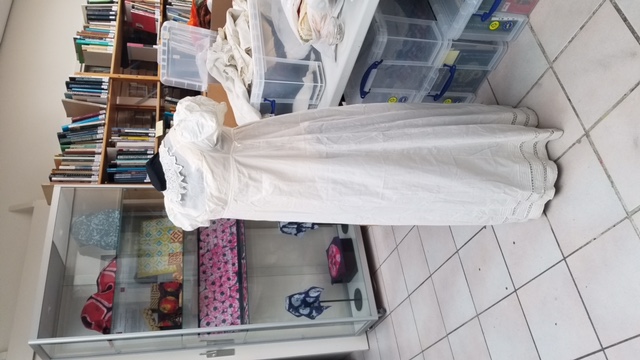 Empire-style dress with chemisette, early 19th century, recently donated to the TRC (2022.3163).One was the sheer quality of the construction. The dress is entirely hand-sewn with beautiful small and regular stitches. There are also multiple sections of small pleats and gathers, such as on the top of the sleeves and at the back of the torso, which would have taken time and dedication to sew.
The correct and complex construction of the garment also lends to its identification as an original garment. The bodice is made up of five panels that would have been well-tailored to the wearer. The hem of the skirt is made up of three sections connected by hand-appliqued lace, although a larger thread and messier stitches compared to the uniform stitches throughout the rest of the dress might imply the lace was added later.
Gillian Vogelsang was also in contact with Madelief Hohé at the Kunstmuseum in The Hague, who confirmed our dating and provided some reference fashion plates and other similar dress examples from the period for us to look at.
In order to wear this dress, proper undergarments are required. While experimenting with the silhouette, Augusta and I discovered that a replica pair of stays given to the TRC earlier this year was almost a perfect match. For the shape of the dress to work a modern-day bra cannot be worn.
Even a bra from the 1920s would not fill out the bodice section correctly and would lead to strange bunching of the fabric and an overall ill-fitting garment. Ideally a soft non-structured corset would be worn underneath with the purpose of pushing the bust upwards. A classical column-like silhouette was the goal, rather than a reduced waist.
We used Janet Arnold’s “Patterns of Fashion 1” book as a reference for dating and styling. Arnold mentions that Empire silhouette dresses could be worn with a chemisette.
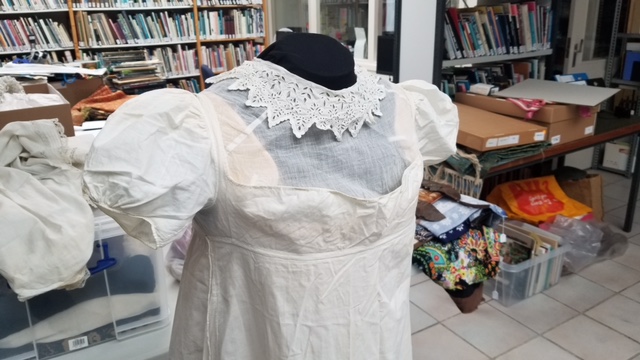 Detail of Empire-style dress, with chemisette, early 19th century, recently donated to the TRC (2022.3163).A chemisette is a small collared insert worn underneath a garment to fill the neckline giving the appearance of a blouse, but without the bulk. Excitingly, we have a number of chemisettes in the TRC collection and we tested a few to see what might work. We were excited to see the outfit come together and once styled, the dress no longer looked like a plain underdress (as we at the very start were inclined to think), but instead was a fashionable, Empire-style garment of its own!
But how did this dress from the early nineteenth century end up in the wardrobe of Ms Böhtlingk? Did she wear it at a soiree in the Dutch East Indies? We will probably never know.
We are interested in continuing research on other historical garments in the TRC collection, to properly date and identify the styles of each piece. Knowing how to style a garment is important for proper display in order to make it look as good as possible! We will also be making this information available online as per usual for the whole collection so it may be used by anyone for research or personal interest.
AJ Salter, 15 November 2022