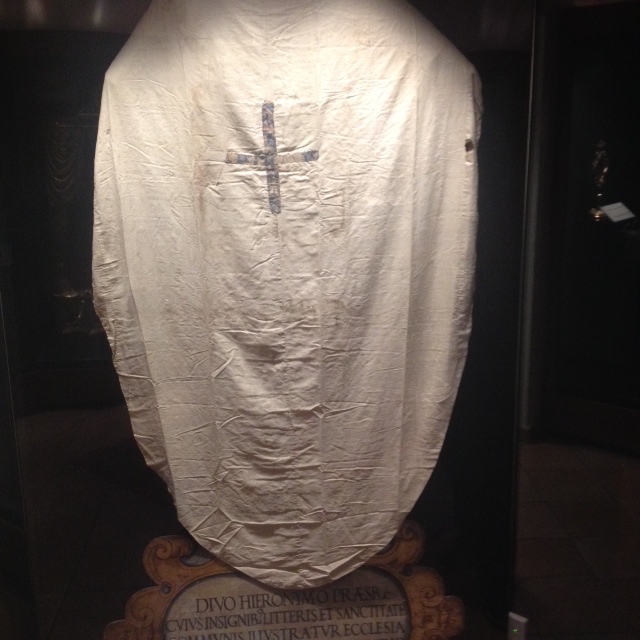
 Linen garment, ascribed to St. Jerome (d. 420), with lampas weave decoration in the shape of a cross, housed in the Museum of the Basilica of St. Maria Maggiore, Rome.Yesterday afternoon, Gillian and I, just arrived in Rome, went to see the Basilica of Santa Maria Maggiore. This time we had the chance to see the beautiful thirteenth century mosaics in the loggia above the entrance, and Bernini's floating, spiral staircase. What an extraordinary construction! Most interesting, from our point of view, was the Museum, which we had never had the chance to visit during our previous trips to Rome. It is located underneath the basilica, and you actually have to go outside to go down into the entrance hallway. What a magnificent collection of items, including some stunningly beautiful ecclesiastical vestments. But also a simple garment ascribed to St Jerome (who died in AD 420), the man who allegedly translated the Bible into Latin (the Vulgata text). He also happens to be buried in the same church. It is a simple linen vestment, but decorated with a cross applied to the chest and made of two small bands of very expensive (certainly in the fifth century) silk lampas weave. We also saw a reliquary with textiles and presumably remains attributed to Thomas Beckett (assassinated in Canterbury in 1170). And then the many chasubles, copes, stolas, etc., many of them exquisitely decorated with gold thread embroidery. These ranged in date from the sixteenth to the nineteenth centuries. There was even a pontifical outfit dating to the nineteenth century.
We bought a little booklet with the title Guide to the Museum of the Patriarchal Basilica of St. Mary Major, written by Monsignor Michal Jagosz (2003).
Gillian and Willem Vogelsang, 25 December 2016