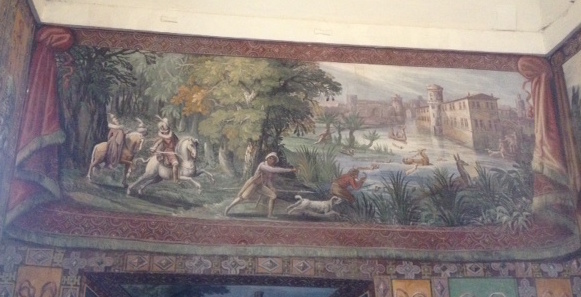
 Fresco, or imitation tapestry, showing a hunting scene, in the Villa d'Este, Italy, late sixteenth century.Two days ago Gillian and I spent a glorious Boxing Day at the Villa Hadriani and the Villa d'Este, both located some kilometres east of Rome. The Villa d'Este is particularly known for its gardens and many (some five hundred) fountains. The buildings and gardens all date to the second half of the sixteenth century; a curious twist of history is the fact that the architect of the Villa and its gardens used the ruins of the Villa Hadriani for inspiration, and for cheap building materials. Cheap? Well, not all of it. The costly coloured marble used by the Romans was equally costly, if not more so, in the sixteenth century. Admittedly, it was more or less free for grabs. The gardens are indeed spectacular.
But what struck us most inside the house were the frescoes. All the rooms, and there are many of them, are decorated with beautiful paintings of hunting scenes, mythological and legendary events, etc. These all the more underlined their use as a relatively cheap replacement for costly tapestries. Many of the frescoes in the House were clearly painted in imitation of tapestries, together with folded and draped edges, tassels, etc. It is evident that there is a close link between the cartoons used for the tapestries and those used for the frescoes at the Villa d'Este (and probably also elsewhere).
Gillian and Willem Vogelsang, 28 December 2016