

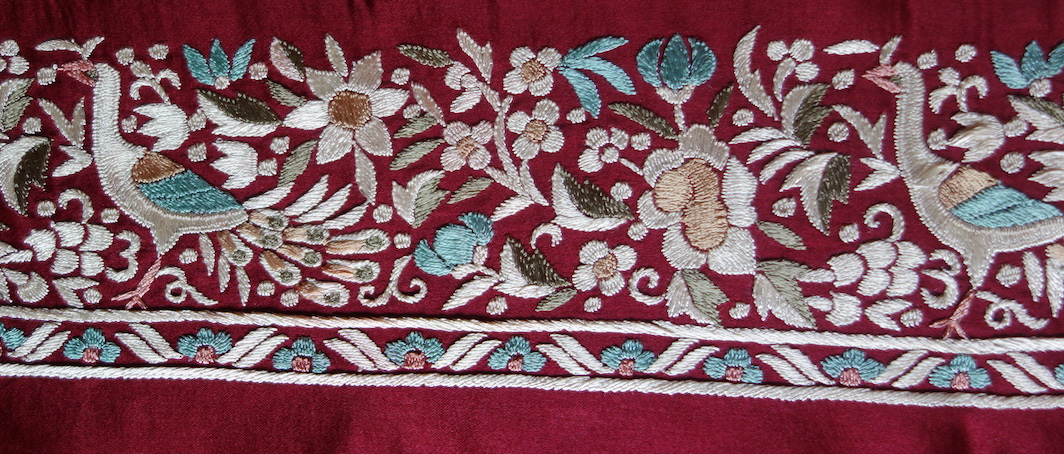
 Detail of a Chinese-style Parsi embroidery from India, made in 2017 for the TRC.For the last week Willem and I have been in New Delhi, India. Willem for work (leaving me here in Delhi while he went to Thailand for a few days) and me for, well, work if you call hunting for hand embroidery work. Actually it has been quite difficult to find any good quality items. Much is quickly made and sold at relatively high prices by and to people who have little knowledge of the subject. I was offered printed, woven and machine embroidered pieces, even a brass elephant at one point, but little hand embroidery. I would very much like to thank Pralay and Neena Kanungo for helping me chase embroideries in the state emporiums. It was fun, and certainly gave an insight into the embroideries of the many parts of India.
But as the week went on life has improved and I have been talking with various groups about hand embroidery. This information is needed for the new encyclopaedia the TRC is working on, as well as for a possible exhibition about Indian and embroidery. One of the groups I have been talking with are the Parsi, a Zoroastrian group from what is now Iran that has lived in India for a thousand years. They have long been merchants especially with China and not surprisingly, there is a strong Chinese feel (design, colour and technique wise) to much of their embroidery. In the past they also produced European Berlin wool work designs, and amazing portraits worked using ultra-fine single stranded silk threads, as well as their own versions of the Chinese embroideries. The latter combine Chinese, Persian, Indian and European elements.
In addition to talking about embroideries we also talked about Zoroastrian clothing and I have ordered some special items that are worn under normal garments, plus a beaded toran, a form of decoration that goes over the doorway to welcome visitors and protect the home. And, although it is only at the early stages, we have been discussing the possiblity of having one of their students come to the TRC for a month to learn about creating and running a small collection. Interesting days ahead!
I have also been talking with Jasleen Dhamija, the Indian grande dame of textile and embroidery studies. It has been a great privilege to meet and talk with her. Her comprehensive knowledge of Indian and indeed Asian textiles is amazing. She has also very kindly offered to help with the new encyclopaedia, which gives a lot of confidence in what we are doing. Tomorrow Willem and I go to Lucknow to look at chikan embroidery (a form of white work), and then onto Agra to see the Taj Mahal and local embroidery, and then finally onto Jaipur, which has another form of embroidery called gota (which is more of an appliqué technique than embroidery). I am beginning to wonder whether it will be necessary to buy another suitcase for the trip back....
We will certainly miss the hotel we are staying, Lutyens Bungalow along Prthviraj Road; the meals around the long table in the garden, surrounded by squirrels, birds and bats, and the ever so friendly and helpful staff have been a great support, certainly while I was on my own.
Gillian Vogelsang, 25th July 2017