
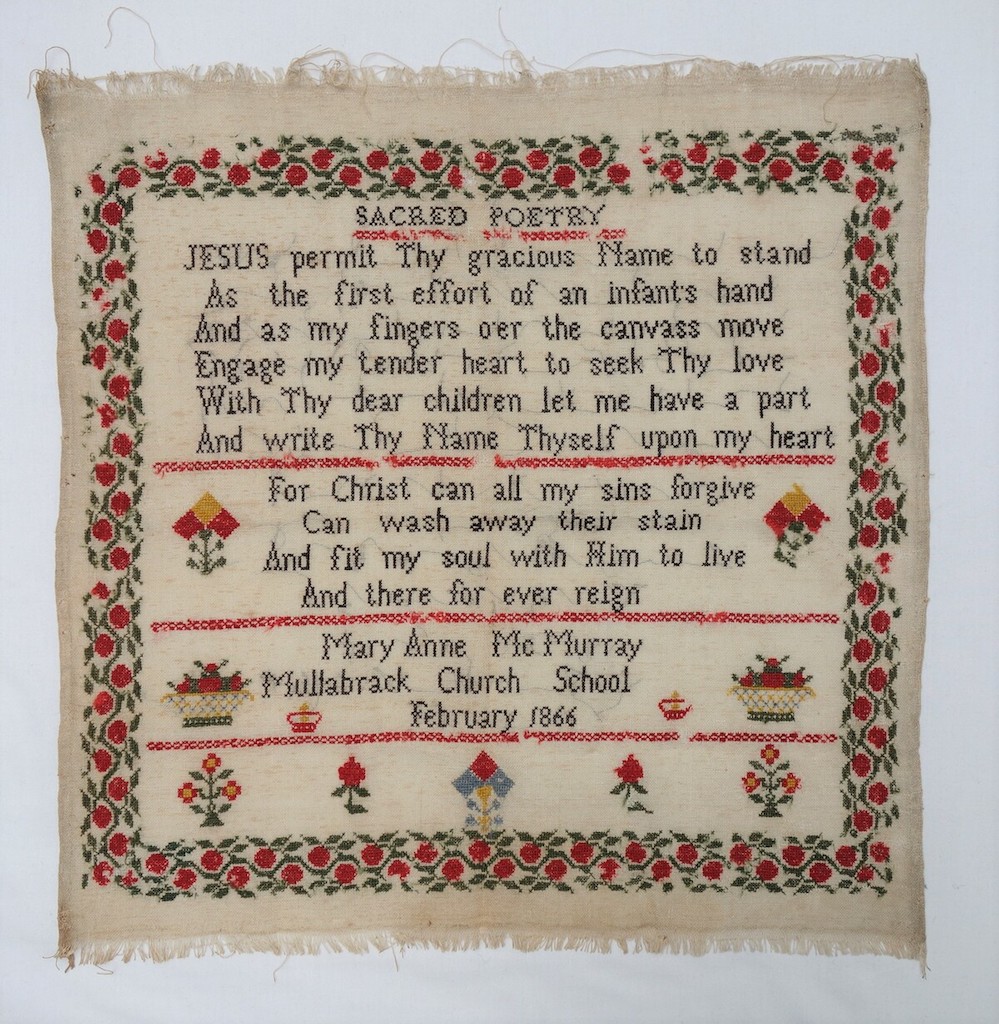
 Sampler made by Mary Anne McMurray in 1866, Ireland (TRC 2019.2023).On Thursday, 12th September 2019, Gillian Vogelsang wrote:
The TRC Leiden has just acquired a sampler (TRC 2019.2023) worked in 1866 by a girl called Mary Anne McMurray, who went to the Mullabrack Church School, in Co. Armagh, Northern Ireland.
Mary Anne McMurray may be a girl with the same name who was born in Drumachee, near Mullaghbrack, in 1856. This would make her ten years old when the sampler was stitched. The stitching, it should be added, is consistent with embroidery of a school girl of that age. If this identification is correct, then she went on to marry Wallace Coburn (1828-1906) and had three children. She died in 1897 at the age of 41 and was buried in Lisnadill, Northern Ireland.
Mullabrack Church School was a Protestant primary school in the town of Mullabrack. The building still exists, but no longer used as a school.
The sampler now in the TRC Collection is made from an open weave linen ground and worked in cross stitch using worsted yarn in various colours. The main feature of the sampler is a text called ‘Sacred Poetry’, which is worked in a black wool thread, again using cross stitch.
- SACRED POETRY
- JESUS PERMIT Thy gracious Name to stand
- As the first effort of an infant’s hand
- And as my fingers o’er the canvass move
- Engage my tender heart to seek Thy love
- With Thy dear children let me have a part
- And write Thy Name Thyself upon my heart
- For Christ can all my sins forgive
- Can wash away their stain
- And fit my soul with Him to live
- And there for ever reign
This was a popular verse during the 19th century and used for many English language samplers, now housed in a variety of British and American museum collections.
One of the earliest examples of the poem was published in The Evangelical Magazine and Missionary Chronicle, vol. 6, 1798, p. 220 (London). There are no name or initials given with the poem. The poem was also published in various other books of the period, where it was called “For a young Lady’s sampler”.
A tantalising hint as to who wrote the poem is given in a book published in 1830 called The Girl’s Week-Day Book by Dorothy White (London), who noted in Chapter III ('Samplers and Copy Books'):
"Also the following lines, written by a worthy minister, for a young lady’s sampler. I knew the good man from my childhood; and though the lines were not written for me, I felt additional pleasure in having worked them when I found they were written by him” (White 1830:58-59). Unfortunately no further details were given.