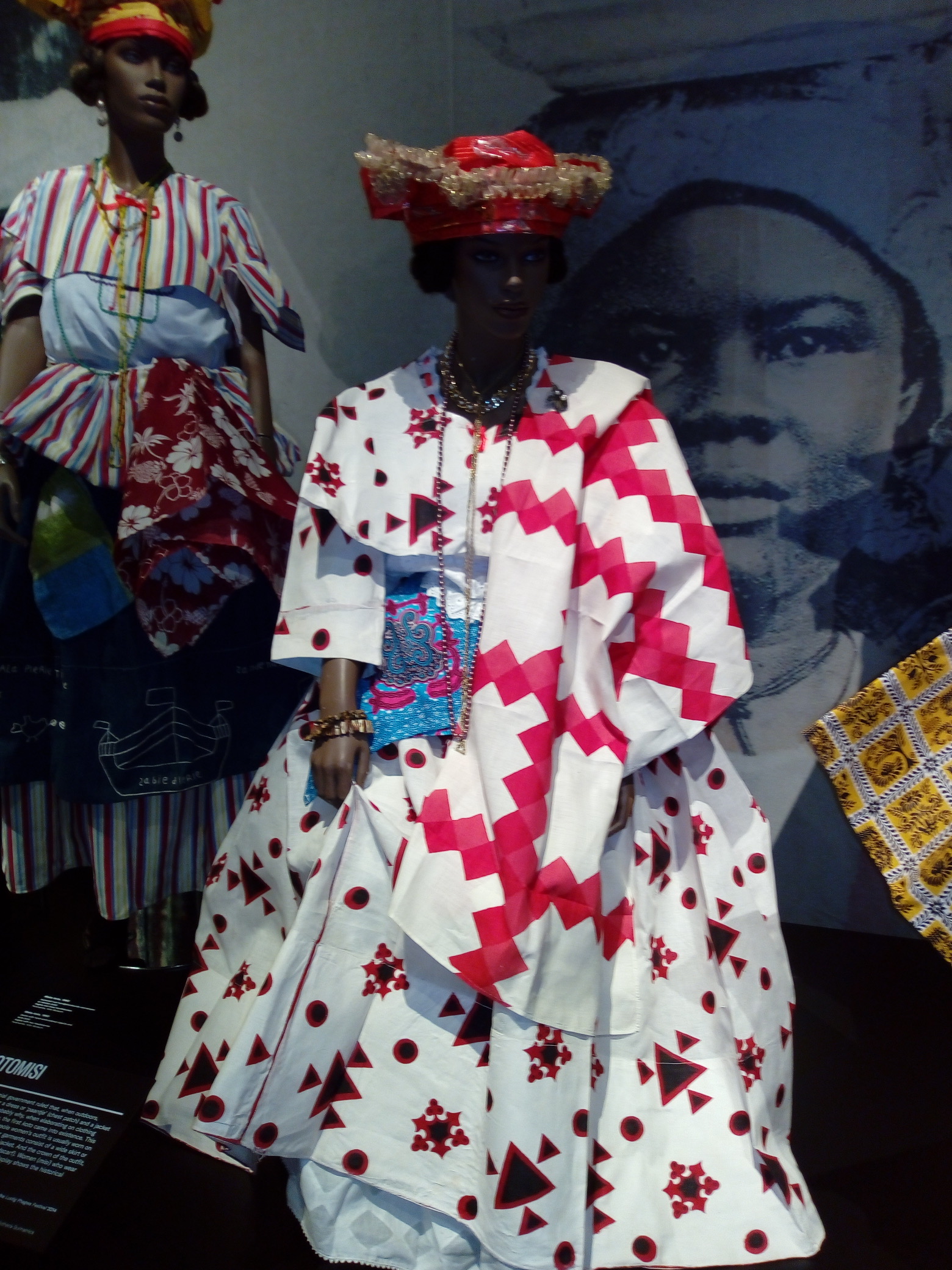
 Koto from Surinam, displated at the Great Suriname Exhibition, Nieuwe Kerk, Amsterdam.On Wednesday, 16th October, Shelley Anderson wrote:
Surinam, in South America, has a rich heritage — a heritage also reflected in its textiles. Some of this heritage can be seen in the Great Suriname Exhibition now on at the Nieuwe Kerk in Amsterdam.
The exhibit begins with a collection of objects from some of the country’s indigenous groups. Surinam’s indigenous peoples cultivated their own cotton, and spun and then dyed the resulting textiles with natural dyes. A Lokono woman’s blue cotton skirt and shawl (late 19th-20th century) are on display, along with some cotton Kari’na loincloths (pre-1912) and stunning hair and arm ornaments (late 19th to early 20th century) made from feathers, beads, palm leaves and other materials.
Perhaps Surinam’s most iconic garment is the koto, a wide skirt or dress of printed cotton, worn by Creole-Surinamese women with a short jacket and an angisa, or head wrap. There are hundreds of ways to fold an angisa, which are often used to express the wearer’s emotions or opinions. The official history of the koto dates back to 1879, when the Dutch colonial government ruled that women, when outdoors, must wear a dress or paantje (chest covering) and a jacket or gown. Now worn mostly on festive occasions, there are numerous kotos on display, from different time periods.
Traces of Surinam’s African heritage can be seen in the traditional clothing of the Maroons, enslaved people who fought their way to freedom. Maroons escaped plantations and formed their own communities in Surinam’s interior. One of the most interesting displays is that of over two dozen pangi, the long rectangular cloth worn by Maroon women around their waist. A woman’s first pangi traditionally marked her passage from girl to adult. Now often presented as a gift to a partner (and made from fabric bought in Paramaribo), pangi can be dated based on styles. The display shows pangi from the 19th to the 21st centuries. Patchwork pangi were popular at the end of the 19th century, while sewing narrow stripes of differently coloured cloth together became fashionable in the 1920s. In the 1970s, younger women began decorating their pangi with non-linear, cross stitched designs, after learning cross stitch in mission schools.
Pangis also feature in an art work by Marcel Pinas. In a style reminiscent of Judy Chicago’s 'The Dinner Party', a long dinner table has been carefully set for 38 people. Draped over each chair is a uniquely designed black and white pangi. The piece, named “Moiwana 86 Tafas”, commemorates the murders of 38 Maroon villagers during Surinam’s Civil War (1986-1992).
Another textile art piece by Razia Barsatie consists of a poem about rain written on long white cloth draped and decorated with Indian bangles. Indian saris and dhotis, and Javanese sarongs reflect the country’s East Indian roots. Also on display are seven beautifully carved wooden hair combs, made by both women and men.
Surinam’s European heritage is not neglected. There is a floor length, long sleeved gown in green silk, with beads and spangles, with the compliments of the Royal Collection in the Hague. This was the dress worn by Princess Beatrix, in 1975, in Paramaribo’s stadium when the Surinam flag was hoisted, during ceremonies celebrating the country’s independence. While this is not a textile exhibition, there are many textiles to see in The Great Suriname Exhibition, now on until 2 February 2020.