• F3
  • F2
  • F1
  • F4

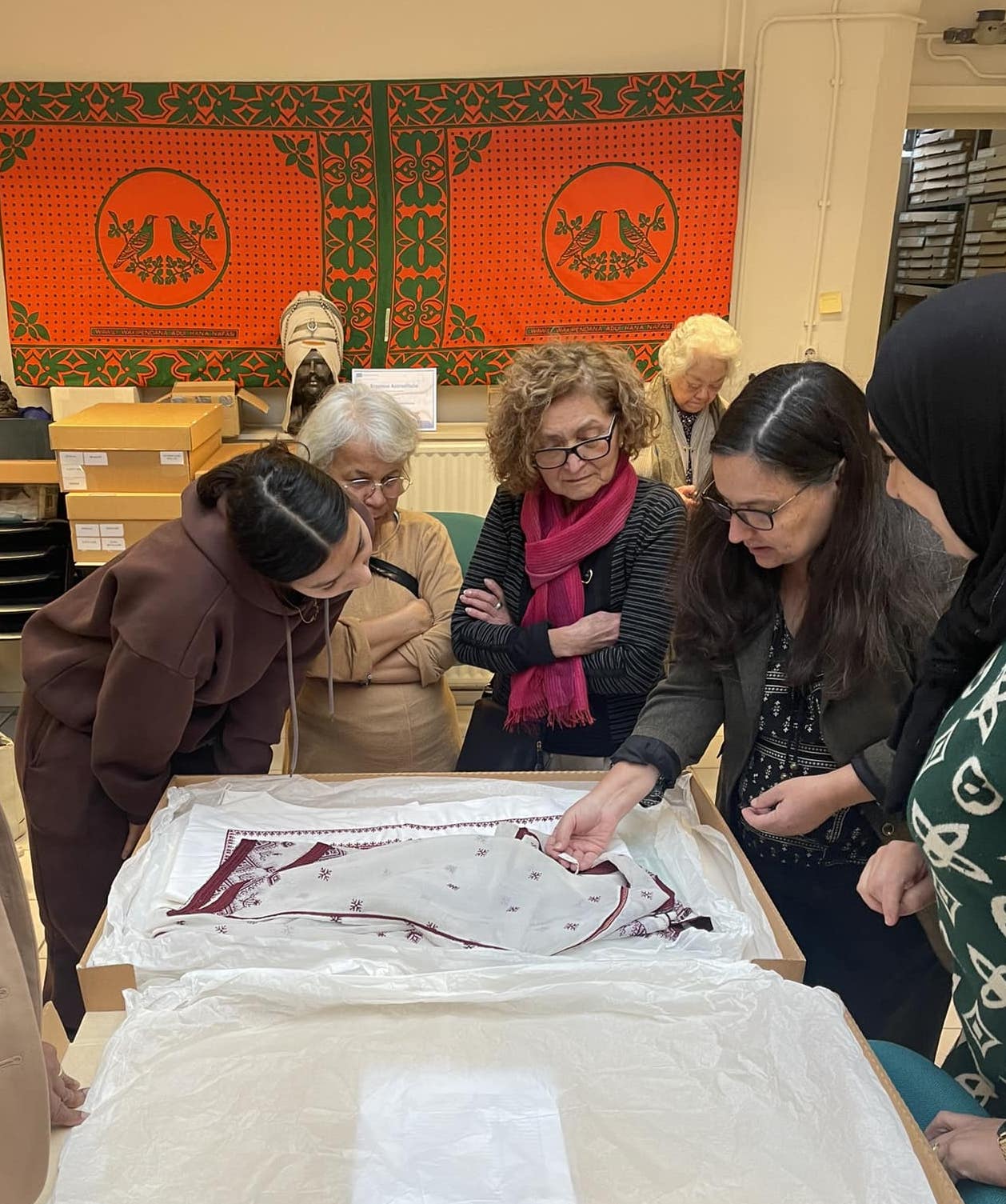
Visit to the TRC by women from the Morschwijk, Monday 27 November 2023. Photograph by Femke Bolding.Visit to the TRC by women from the Morschwijk, Monday 27 November 2023. Photograph by Femke Bolding.On Monday, 27 November 2023, the TRC welcomed an international group of women from Huis van de Buurt Morschwijk in Leiden. This is an informal group of women living in the Morschwijk, a district of Leiden. The women originally come from Colombia, India, Indonesia, Morocco and Surinam.

The meeting started with an introduction to the TRC by its director, Dr. Gillian Vogelsang-Eastwood. This led to a discussion about dress and identity, one of the main themes of the TRC's work: We study what men and women wear in order to say, consciously or not, who they are or who they want to be.
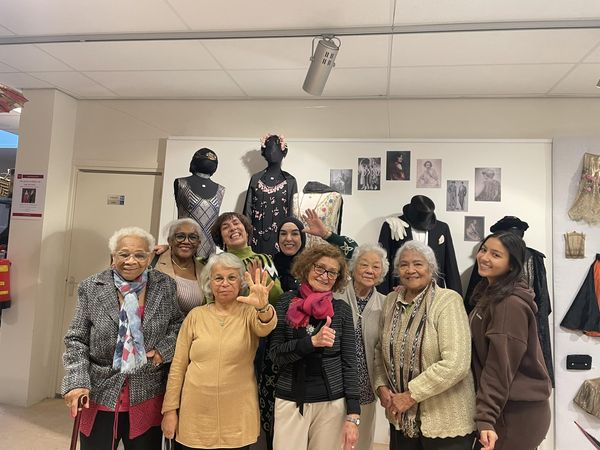
Visit by group of women from the Morschwijk, Leiden, to the TRC, Monday 27 November 2023. Photograph by Maria Linkogle.Visit by group of women from the Morschwijk, Leiden, to the TRC, Monday 27 November 2023. Photograph by Maria Linkogle.After the introduction, a tour was given of the current Fashion of the 1920s exhibition. Afterwards we had lunch when we further discussed dress and identity.

A number of our guests talked about their knowledge and experience with making their own clothes and about decorating clothes with embroidery for their own bridal outfit.
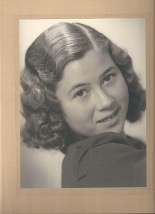
Marianne Rutten (1924-2021), photographed in c. 1942. Marianne Rutten (1924-2021), photographed in c. 1942. We have recently had a surprise donation by Jeantine van de Ven, Leiden, who popped in with several bags and boxes of textiles and other objects that belonged to her mother, Marianne Rutten (1924-2021). Among the items was a small cardboard box (TRC 2023.2567) that has led to various thoughts and reflections!

More specifically, it is a memory box that reflects life for one young woman in 1944 and 1945. The contents of the box were assembled by Marianne, who was born and brought up in Tilburg in Noord-Brabant, which lies in the south of the Netherlands and was one of the first Dutch cities to be liberated from the Nazi Germans in 1944.

It would appear that when the Prinses Irene Brigade (the Netherlands), the 15th Scottish Infantry Division and other troops arrived in Tilburg in October 1944 there were 13 days of serious fighting, but once the Germans had been forced out there were some large, public parties and the Scottish infantry provided pipe band music.

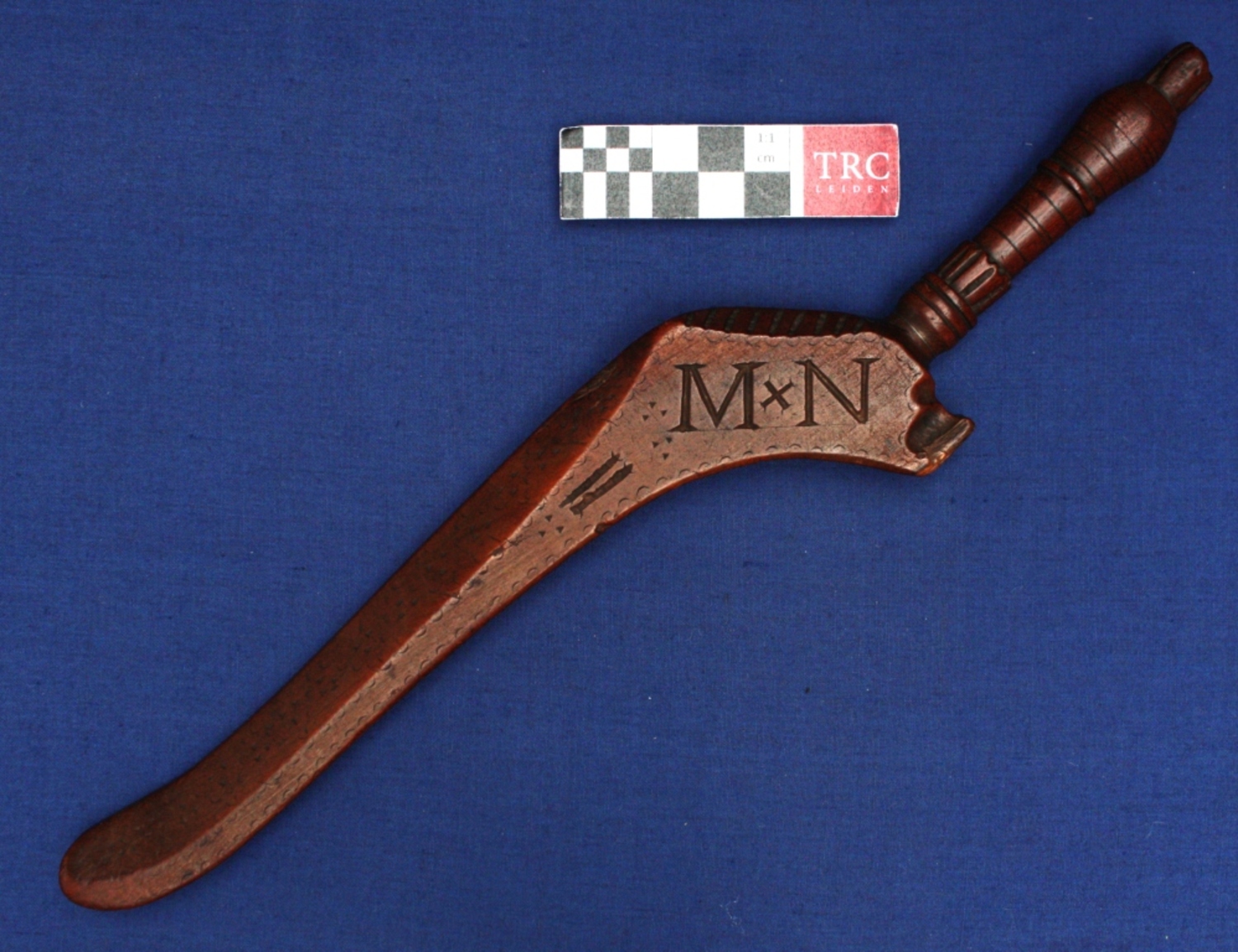
Wooden knitting sheath, Britain, c. 1900 (TRC 2015.0256).Wooden knitting sheath, Britain, c. 1900 (TRC 2015.0256).In a recent donation from the former Museum voor Naaldkunst, there was a small group of knitting sheaths. Up to then, we only had one of these objects in the TRC Collection (TRC 2015.0256), which dates to about 1900 and comes from northern England. So the opportunity to have several more that illustrate different types of sheaths fitted nicely into our plans to add depth to the TRC Collection.

Hand knitting, especially of stockings and socks, and later caps, gloves and jumpers, was an important cottage industry in many parts of Europe from the 16th to the beginning of the 20th century. Many women (and some men) knitted clothing for themselves and their family, but they could also supplement their incomes by making knitted goods for sale.

Over the centuries, in order to make the hand knitting quicker, various tools were developed including knitting sheaths, which meant the knitter could continue plain knitting while carrying out other domestic jobs, such as looking after babies, or while walking to the market or work, carrying baskets on their heads or backs, etc.

Hair pin with a stylised bat, with kingfisher feather decoration, China, 20th century (TRC 2023.2525).Hair pin with a stylised bat, with kingfisher feather decoration, China, 20th century (TRC 2023.2525).Over the last year or so, Mrs Quirina Vreeburg from Haarlem, the Netherlands, has been giving the TRC various items from her collection of Chinese textiles and dress. These included some beautiful woven and embroidered gowns for both men and women, normal and lotus shoes, as well as a range of decorative purses and caps.

There have been several blogs about this donation, namely about the lotus shoes and about some other textiles, including a jacket made from reed. We have also already created a mini-exhibition with the lotus shoes and we are planning one about the various types of purses and their decoration.

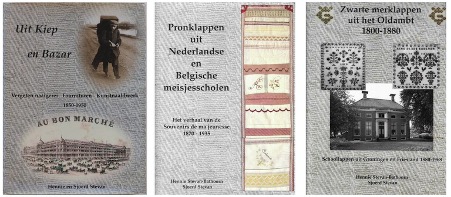
In early 2023 the TRC was contacted by Hennie Stevan-Bathoorn and Sjoerd Stevan from the former Museum voor Naaldkunst, Winschoten in the northeastern part of the Netherlands. They had run a private museum for needlework and related lace techniques, in all of their many different forms. Due to their age, the museum was closed in 2016 and since then they have been trying to identify suitable new homes for different parts of the collection.

Three book titles, published by the former Museum voor Naaldkunst, WinschotenThree book titles, published by the former Museum voor Naaldkunst, Winschoten

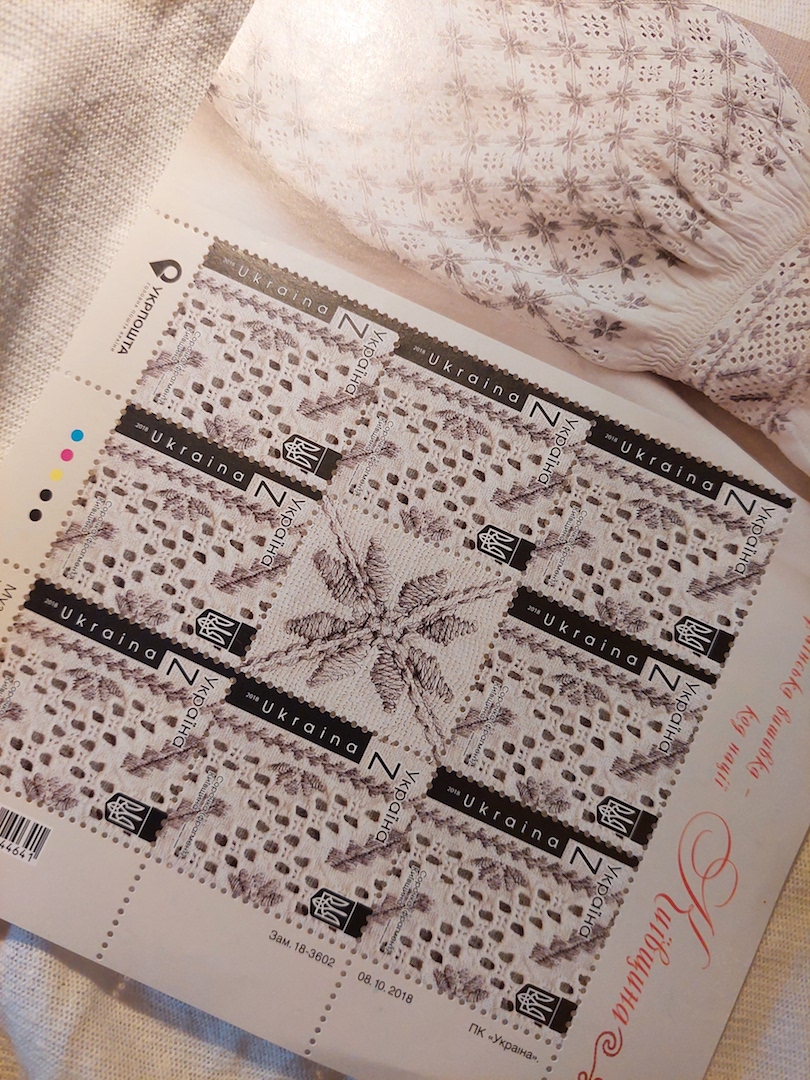
A sheet of nine Ukrainian stamps was recently donated to the TRC (TRC 2023.2460). The stamps show details of an embroidered blouse, called a vyshyvanka, including cutwork or drawn thread work in the form of small squares in a diamond-shaped pattern. This traditional woman’s blouse is very popular in Ukraine, especially since the Russian invasion.

Sheet of nine stamps from Ukraine showing the embroidery on the Ukrainian vyshyvanka blouses (TRC 2023.2460).Sheet of nine stamps from Ukraine showing the embroidery on the Ukrainian vyshyvanka blouses (TRC 2023.2460).

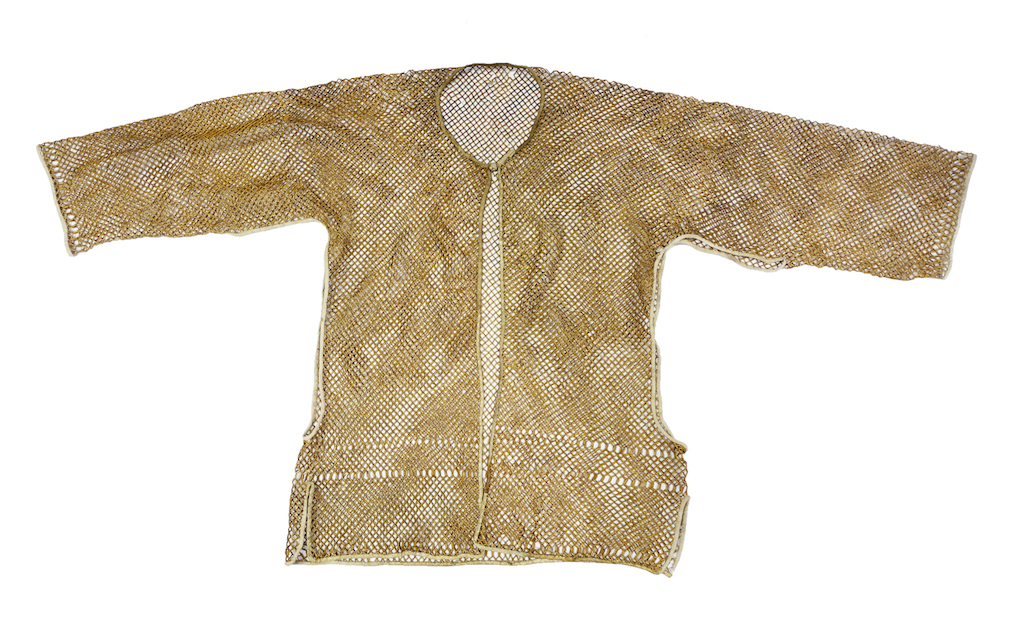
Jacket made of reed and cotton, China, 20th century (TRC 2023.2071).Jacket made of reed and cotton, China, 20th century (TRC 2023.2071).It's been an incredibly busy time at the TRC! So what's new, you may ask, it is often busy at the TRC, but this is more so than normal!

A few weeks ago, Quirina Vreeburg, from Haarlem, emailed saying she had two more boxes of Chinese textiles and garments for us. Quirina is slowly giving the TRC her collection of Chinese items that formed a small, private museum and lecturing collection (see earlier blog).

There are 67 items in the current selection, including gowns (Han and Manchu), single wrap-around skirts and double skirts, some amazingly embroidered jackets, as well as a jacket made up of small pieces of reed strung together to form a diamond net (TRC 2023.2071). There are also various embroidered panels from jackets, skirts, etc. The donation includes a pair of mourning lotus shoes in white, and two pairs of nineteenth century glasses with articulated side arms. There is a lovely headband decorated with panels of kingfisher feathers (TRC 2023.2074). And let us not forget an embroidered panel that looks like a stylised owl (TRC 2023.2078), but is it actually an owl?

(Naoko Kikuchi, 29 October 2023). Last summer I visited the city of Hirosaki, in the Tsukaru district, in northern Japan. This place is the home of kogin zashi, or simply called kogin, one of the major sashiko forms of quilting. The word kogin means 'small cloth' and zashi means 'stitches'.  Kogin stitches are worked horizontally, mostly by counting the odd number of warp threads, while sashiko stitches could run in any direction. In Hirosaki, I learned how local people are trying hard to preserve this tradition.

Cotton cushion cover, kogin-zashi, made by Misao Kimura, late 20th century, Japan (TRC 2021.1274).Cotton cushion cover, kogin-zashi, made by Misao Kimura, late 20th century, Japan (TRC 2021.1274).

Search in the TRC website

Contact

Boerhaavelaan 6
2334 EN Leiden.
Tel. +31 (0)6 28830428  
office@trcleiden.org 

facebook 2015 logo detail 

instagram vernieuwt uiterlijk en logo


Bank account number

NL39 INGB 0002 9823 59, in the name of the Stichting Textile Research Centre.

TRC closed until 4 May 2026

The TRC is closed to the public until Monday, 4 May 2026, due to our move to the Boerhaavelaan. The TRC remains in contact via the web, telephone and email. For direct contact and personal visits, please contact the TRC at office@trcleiden.org, or by mobile, 06-28830428.

Donations

The TRC is dependent on project support and individual donations. All of our work is being carried out by volunteers. To support the TRC activities, we therefore welcome your financial assistance: donations can be transferred to bank account number (IBAN) NL39 INGB 000 298 2359, in the name of the Stichting Textile Research Centre. BIC code is: INGBNL2A.

 You can also, very simply, if you have an iDEAL app, use the iDEAL button and fill in the amount of support you want to donate: 


Since the TRC is officially recognised as a non-profit making cultural institution (ANBI), donations are tax deductible for 125% for individuals, and 150% for commercial companies. For more information, click here