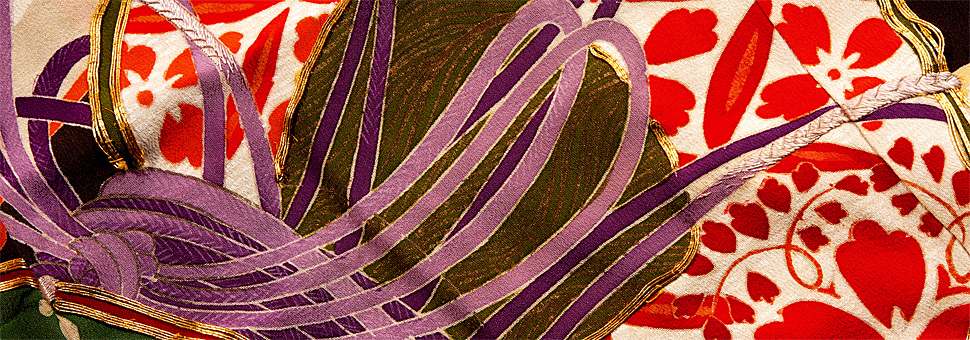


On October 30, Flora Kovacs-Wester will give a workshop introducing Japanese kasuri weaving, commonly known as Japanese ikat. Kasuri is a traditional Japanese resist dyeing and weaving technique in which threads are carefully prepared and dyed before weaving to create characteristic patterns with soft, blurred edges. The finished pattern is the result of a long and intricate process of designing, preparing, tying, dyeing, aligning, and weaving the threads. In some regional traditions, creating a single bolt of fabric involves more than 30 steps and can take several months. This workshop offers a chance to explore some of these fundamental steps on a small scale and discover how the preparation and arrangement of threads shape the final woven pattern.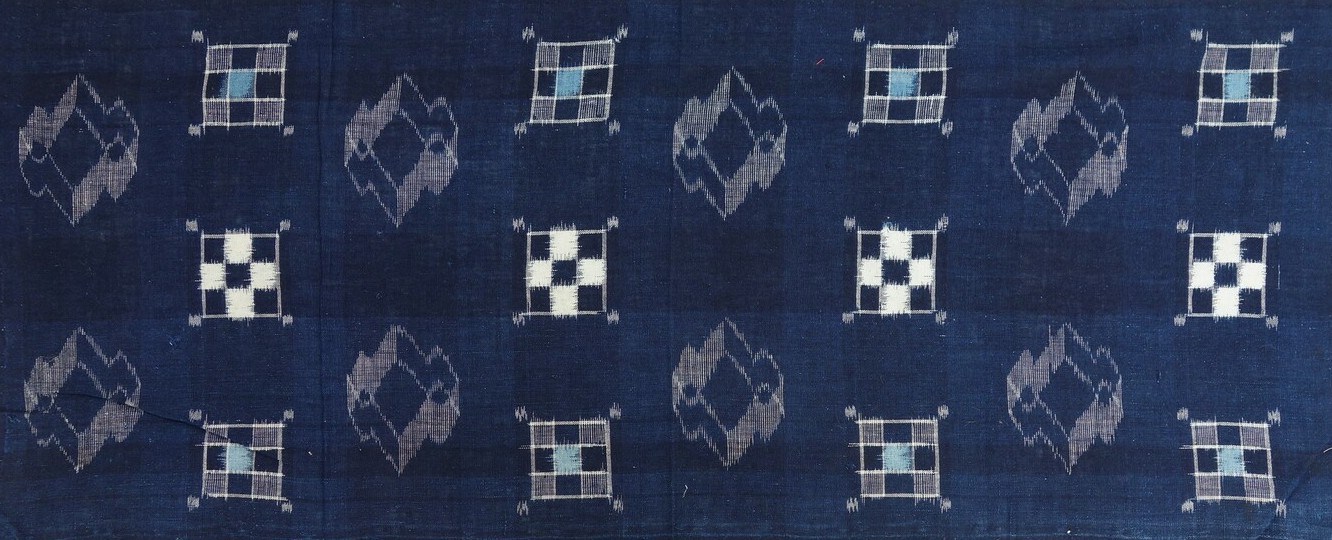 An example of Kasuri from the TRC collection, TRC.2017.1467
During the workshop, participants will be introduced to the history of kasuri and its rich regional variations across Japan. Selected kasuri samples from the TRC collection will provide a starting point for close observation and fabric reading, encouraging participants to look beyond the finished pattern and consider how it was constructed. Participants will then practice tying sections of thread to create pattern variations. For the weaving stage, they will work with pre- dyed threads, exploring how their arrangement and alignment translate into a pattern as the fabric is woven. Working on a basic frame loom, participants will create a small woven kasuri sample of their own, offering a tangible result of their experiments and a starting point for further exploration. Suitable for textile enthusiasts of all levels, the workshop offers an opportunity to develop a deeper appreciation of the skill, precision, and remarkable craftsmanship behind this long-standing Japanese weaving tradition.
Flora Kovacs-Wester is a textile and costume professional and a Junior Fellow at the TRC Leiden, where she is currently developing a research project on Japanese kasuri weaving within the framework of the The Gieskes-Strijbis Fellowship Programme. Her research focuses on the TRC Leiden Kasuri Sample Collection, examining production techniques and the ways in which regional Japanese weaving and dyeing knowledge are embedded in these textiles.
- Date: Friday, the 30th of October 2026.
- Time: 10.00 - 15.00.
- Venue: TRC Leiden, Boerhaavelaan 6, 2334 EN, Leiden.
- Teacher: Flora Kovacs-Wester
- Language: English
- Costs: 85 euros. Coffee, tea and materials are provided. Participants are asked to bring their own lunch. A 30-minute lunch break is included in the workshop schedule.
- Maximum number of participants: 8. Minimum: 4.
- If the minimum number of participants is reached, confirmation and invoices shall
be sent.
- If the minimum number of participants is reached, confirmation and invoices shall
Please register in advance: This email address is being protected from spambots. You need JavaScript enabled to view it.