



Over the last few months we have been looking at presenting more information about specific textiles or groups of objects to the public. In this context, we have been talking with various groups about a range of scientific analysis techniques that can be carried out at the TRC or elsewhere.
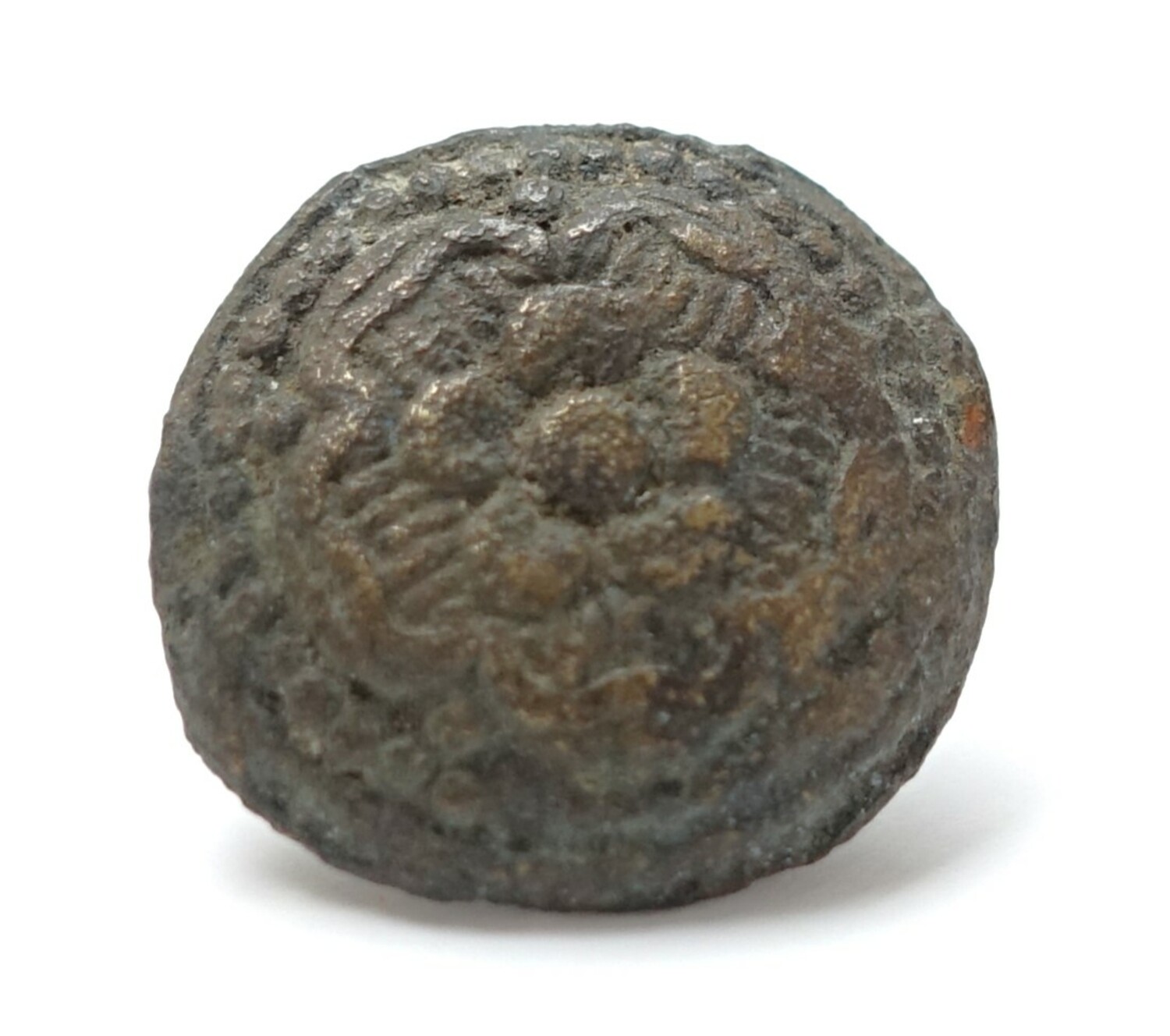 A slightly domed metal button with an alpha-type shank, with flowers within flowers inside a dotted border on the front. The Netherlands, 15th-16th century (TRC 2024.2582).We are already working with various techniques. Emilie Lambert, a TRC volunteer and archaeology student (Leiden University), for example, is examining a group of 15th to 19th century metal buttons that were found in the Netherlands. She wrote a separate blog on the subject, published on 16th October 2024.
Emilie is studying the buttons with XRF (X-ray Fluorescence). This non-destructive technique sends radioactive signals through an object, and quickly provides precise ratios of its elemental components.
The knowledge gained is often used for provenancing. With respect to the TRC buttons, this work is being carried out in order to identify what exactly they are made from and perhaps determine their provenance, but also to see if there are similarities that might indicate if any have the same profile, suggesting they might even have been made in the same workshop. The aim is to have some of the metal analysis results appearing in the TRC Database from May onwards.
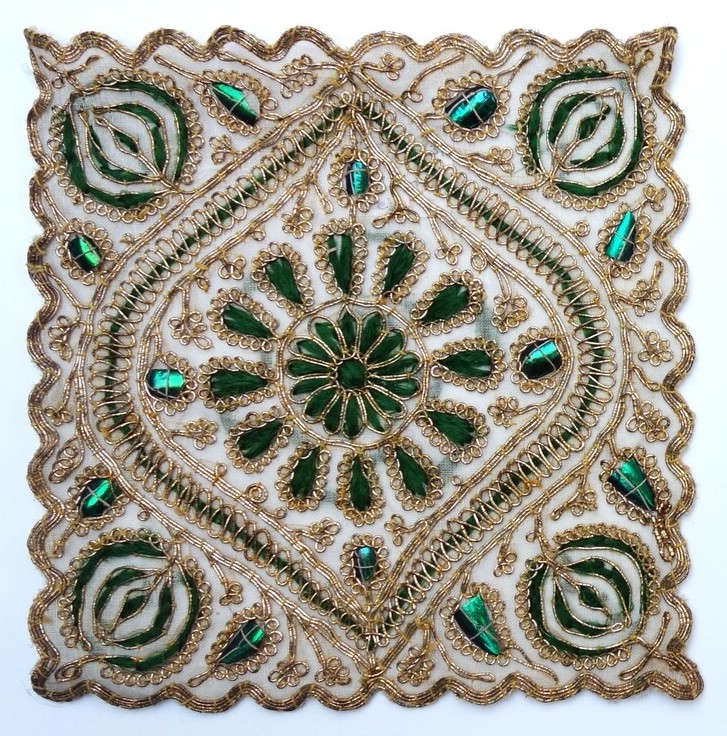 A square mat from India, 1920s, decorated with embroidered rosettes, ovals, ogees, and circles worked in green satin stitch, pieces of beetle wing casings and gold-coloured metal thread worked in various manners (TRC 2025.0331a).I am curious to see if the same techniques can be applied to our small collection of Roman and medieval needles, as well as to the much larger collection of metal threads used for woven and embroidered textiles. Then there are the metal spangles and sequins decorating some textiles, not to mention metal beads, etc.
In addition, we are taking "traditional' microscope images. We have just uploaded the first batch. We are using a Dino-Lite microscope, which is basically a monocular lens attached to a computer that enables photographic images from 4x to 500x to be easily taken, with extra details such as a scale, magnification, light conditions, etc. We are working at about 25x magnification, which is great for structural details, such as weaves and lace types.
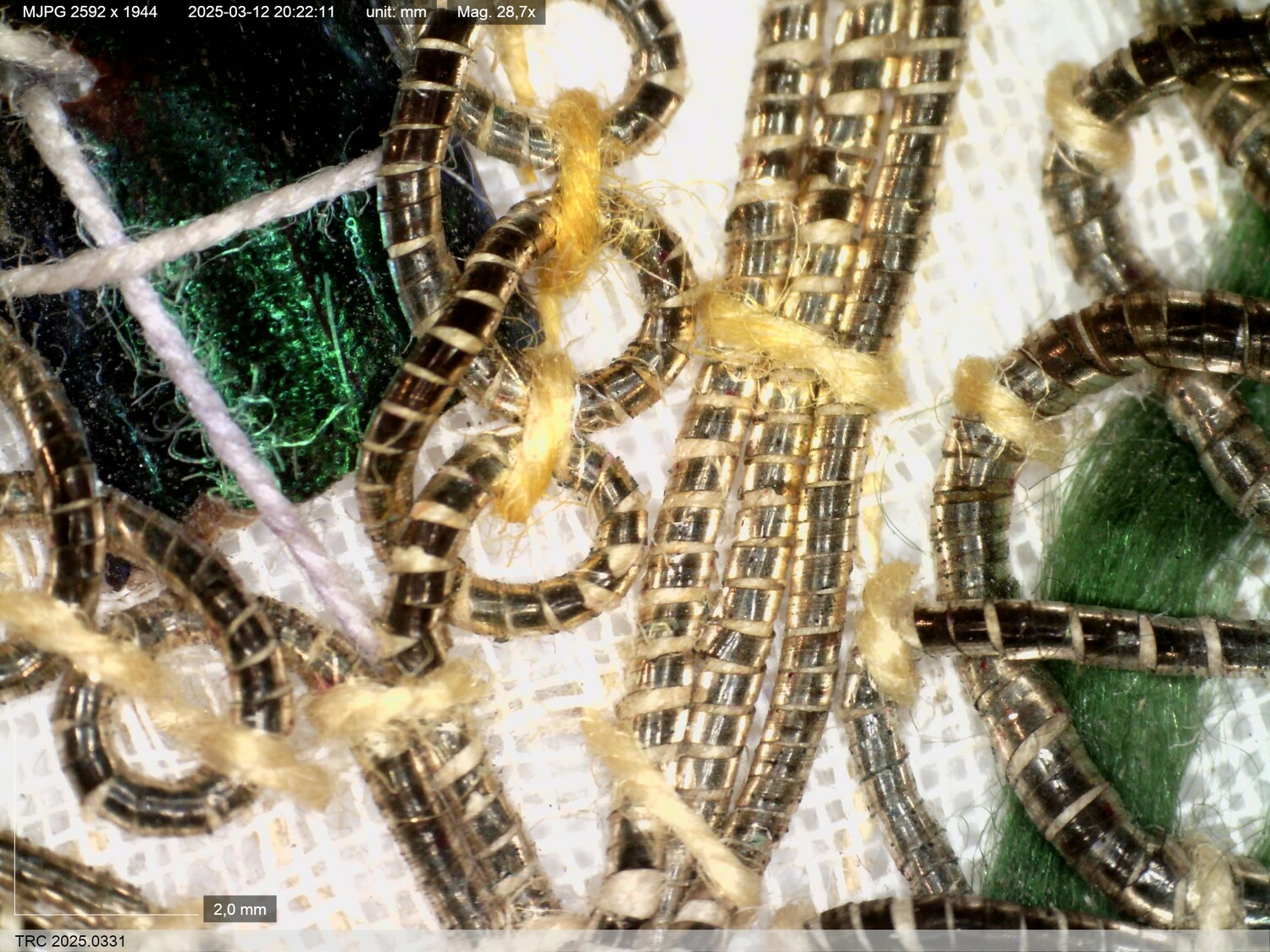 Dino-Lite image of fragment of TRC 2025.0331a, magnification 28.7x. The photograph shows details of the gold-thread embroidery and the beetle-wing casing.The TRC has two Dino-Lite microscopes of the AF series, and over the next few months we are going to put a selection of thread, weave, print and embroidery details online.
In addition, one of our interns, Paul Crochet (Amsterdam University), is going to start looking at different types of leather and leather products, also using a Dino-Lite, while Emilie, next to using XRF, has plans for looking at the construction of buttons. We cannot do images of every item currently registered on the TRC Database, but we can certainly have hundreds of images available by the end of the year.
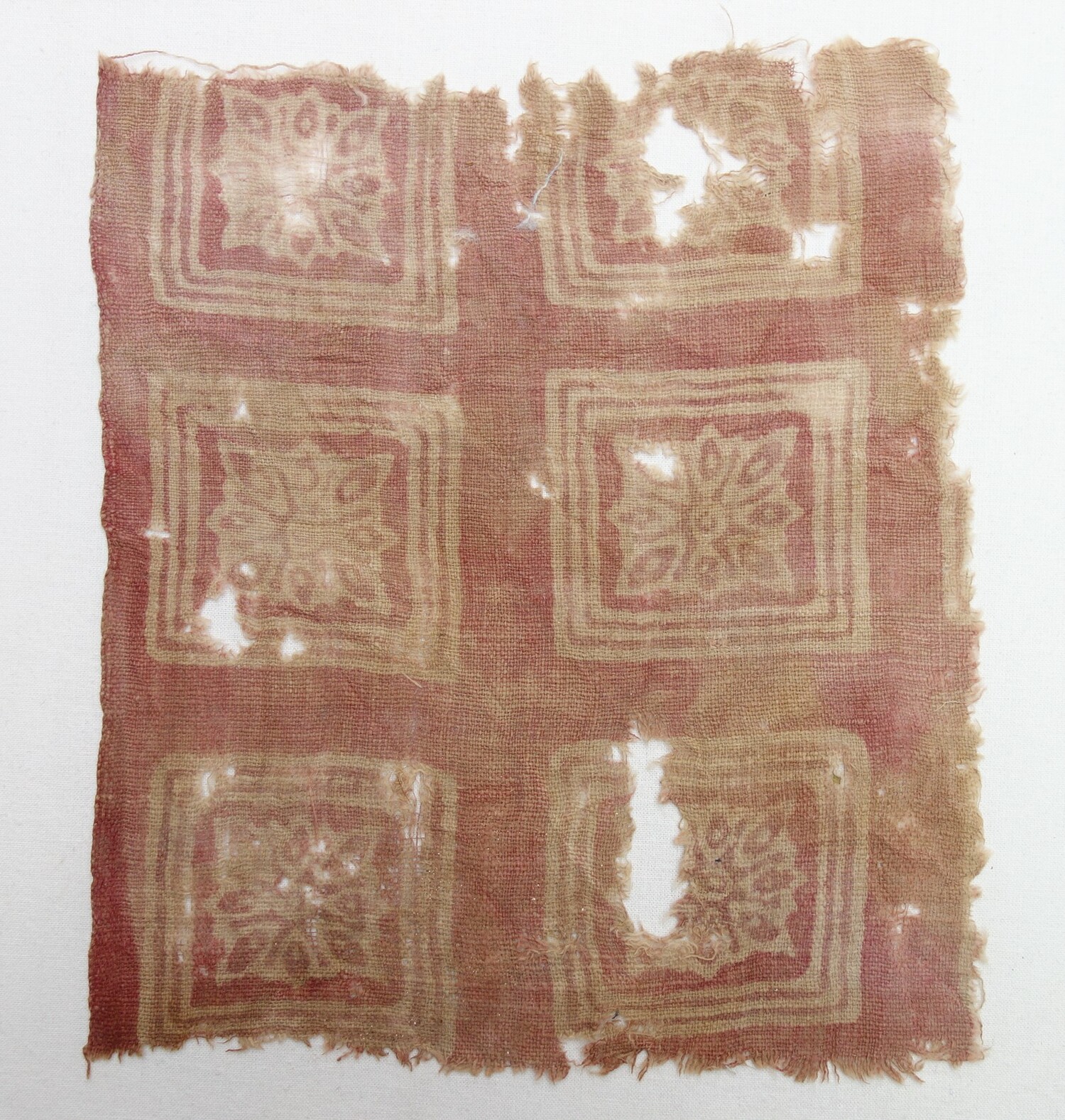 Fragment of a block printed textile using a resist technique, India, 14th century. The textile came from the 1980 excavations at Quseir al-Qadim, Egypt (TRC 2020.0251).The next stage of our plans is to publish more work carried out with other types of microscopes – we want to acquire several professional-level light monocular and stereoscopic microscopes. We also want a good quality microtome for making cross sections of fibres, which is so essential in the identification of different types, such as the various forms of silk.
As an aside, a long time ago I learnt how to make cross-sections with more simple tools, namely a split cork, tissue paper, nail polish and a razor blade! But we want to go a bit further and use a more sophisticated (and safer) method.
 Fragment of TRC 2020.0251, magnification 29.1x. The photograph shows the spin direction, weave structure and selvedge with five paired warps.Basically, all of these plans are being developed to expand our in-house textile laboratory – nothing large and fancy, but just good solid equipment that can be used to look at the TRC Collection in different and objective ways.
I must admit, plans for the future are ‘slightly’ more ambitious and include working with dye and mordant analysis techniques, in order to get a better understanding of the materials and techniques used to create and decorate the objects in the TRC Collection. Ambitious, complicated, expensive: yes! But there is nothing wrong with trying to get an even better understanding of the vast range of textiles we are in a fortunate position to be working with on a daily basis.
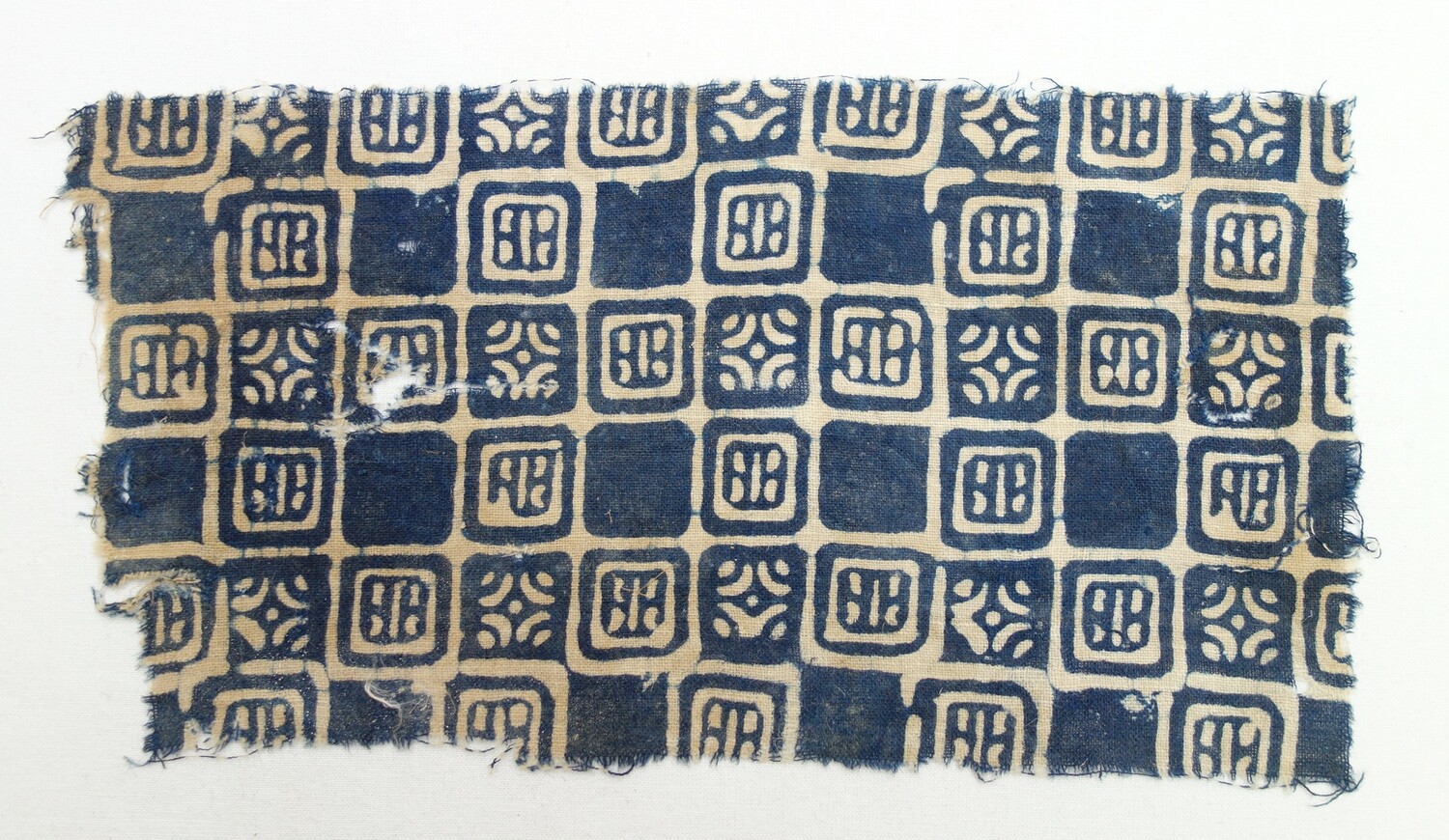 Fragment of a block printed 14th century Indian textile produced with a resist technique. The textile came from the 1980 excavations at Quseir al-Qadim, Egypt (TRC 2020.0237).
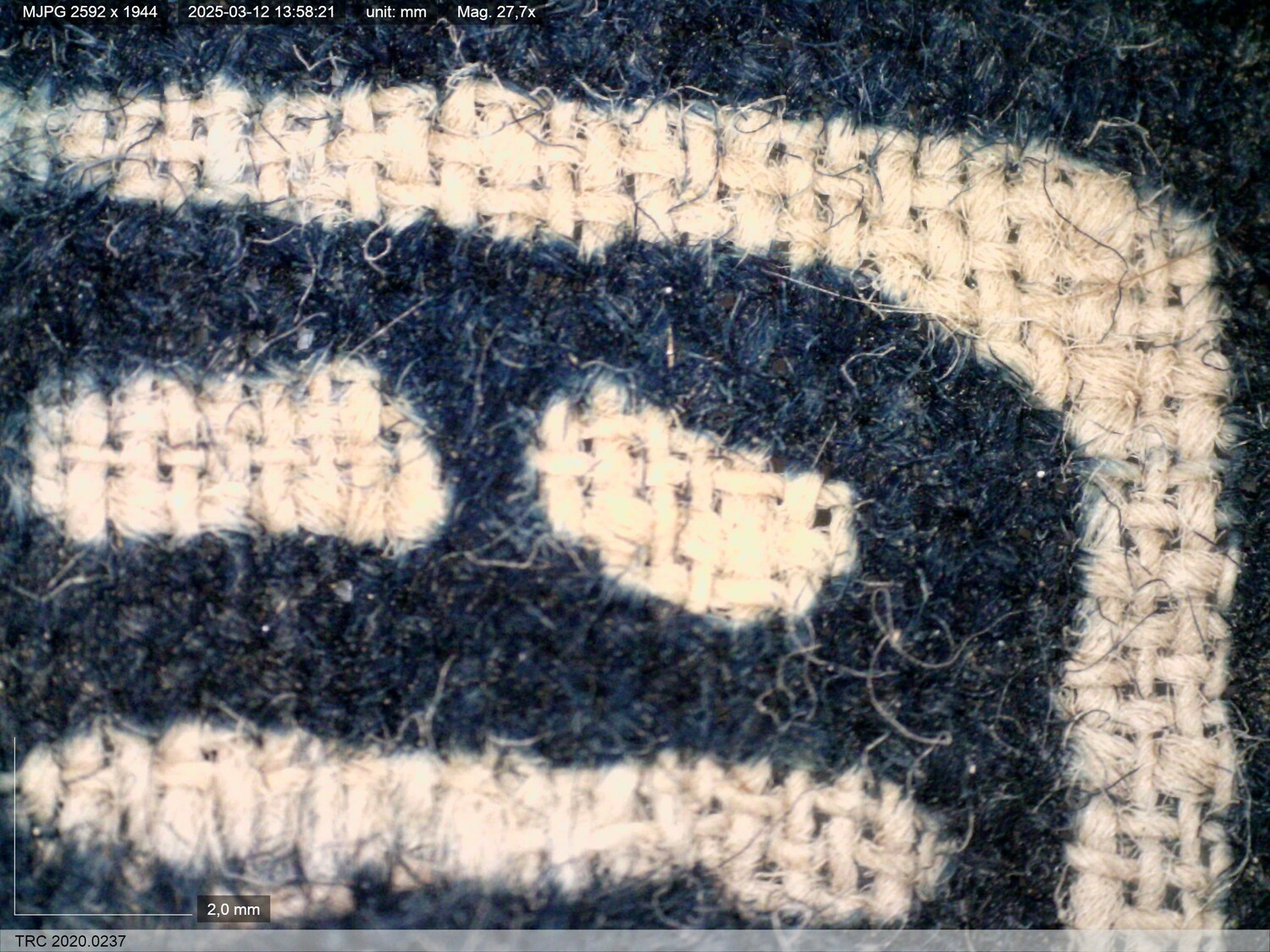 Fragment of TRC 2020.0237. Dino-Lite, magnification 27.7x.The photograph shows details of the spin direction and weave structure, as well as the effect of the resist-dyeing.
On a slightly different subject, all being well in May, we should be starting with taking the first group of 3-D images of specific garments. This work is being carried out in conjunction with ModeMuze, an online platform for museums and similar institutes in Belgium and the Netherlands which aims to put clothing collections online.
Gillian Vogelsang-Eastwood, 16 March 2025


