

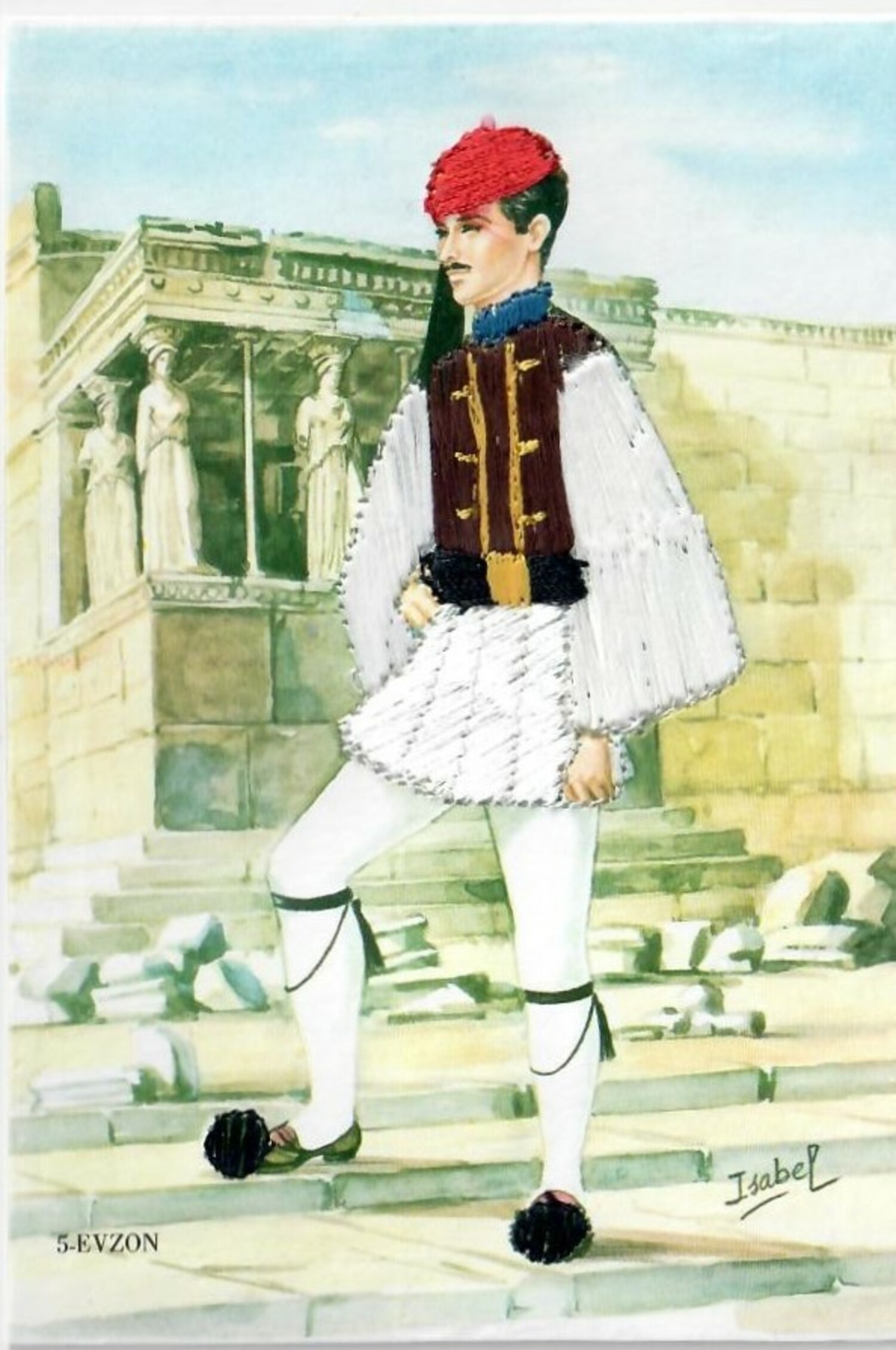
 Mid-20th century, hand embroidered postcard from Greece with a man in a Greek fustanella outfit with red cap standing in front of the Acropolis (TRC 2019.2145).Who hasn’t seen them, either in real life in Athens, or in films, photographs or postcards (TRC 2019.2145)? The strikingly dressed guards in front of the presidential palace and the Tomb of the Unknown Soldier in the Greek capital.
And what strikes most people (and is made into a popular tourist attraction, something like the Scottish kilts), is the fact that the guards are wearing a pleated skirt. I remember first seeing them in the summer of 1974, at the time that a military regime (the colonel's junta) was pushed aside and replaced by a democratically elected government. I recall joining a demonstration against the regime in the streets of Athens, and how I lost my sandals when we were chased by the police, by that time still protecting the junta.
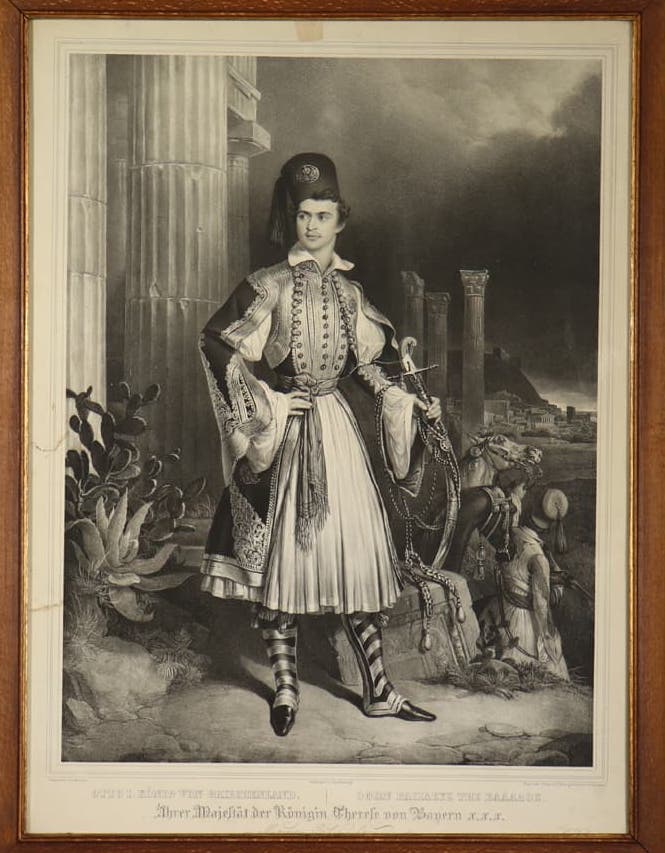 Gottlieb Bodmer (1804-1837), engraving: “Otto I. König von Griechenland”.But that is not what I want to talk about. I want to draw attention to the skirts, or fustanella, that are still being worn by the so-called Evzones or guards. Much has been written about them, and much has been said about their origins (a bit like Greek versus Turkish coffee), but a recent donation to the TRC of four Albanian men's skirts drew my attention back to this garment.
Such skirts used to be commonly worn by men from much further up north, from what is now Albania (the royal Albanian guard used to wear them before WWII), Bulgaria, Macedonia, and neighbouring lands, but, if I can believe older information, also by Albanian immigrants in Italy. You can apparently still see them there being worn on ceremonial occasions or by folkloristic groups.
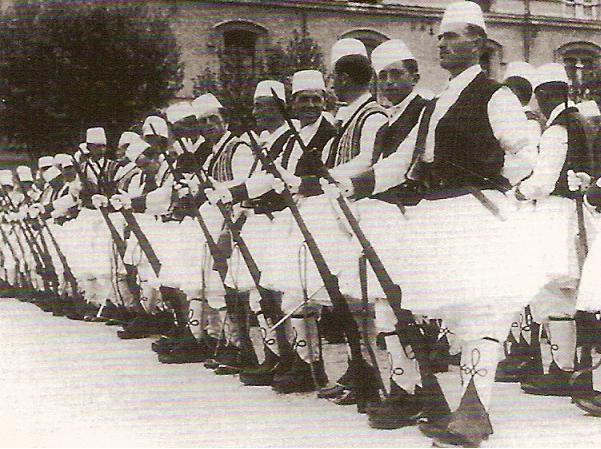 Royal Guard of Albania, before 1936.When Greece gained its independence from Ottoman Turkey, the skirt was made into an essential part of ‘national’ Greek dress, and the new king of independent Greece, the Bavarian Otto (1815-1867), even posed in such a skirt. There is even a beautiful lithograph by Gottlieb Bodmer (1804-1837), which was made into a mass-produced embroidery and which made the 'Greek' skirt a recognised feature of 'traditional' Greek dress.
The origins of the fustanella are therefore contested; some claim a Greek pedigree, others point at the skirt being commonly worn much further up north. Considering the history of Greece it seems most likely that the skirt formed part of the common men's dress in most of the Balkans, including Greece, during the Ottoman domination of much of Southeast Europe.
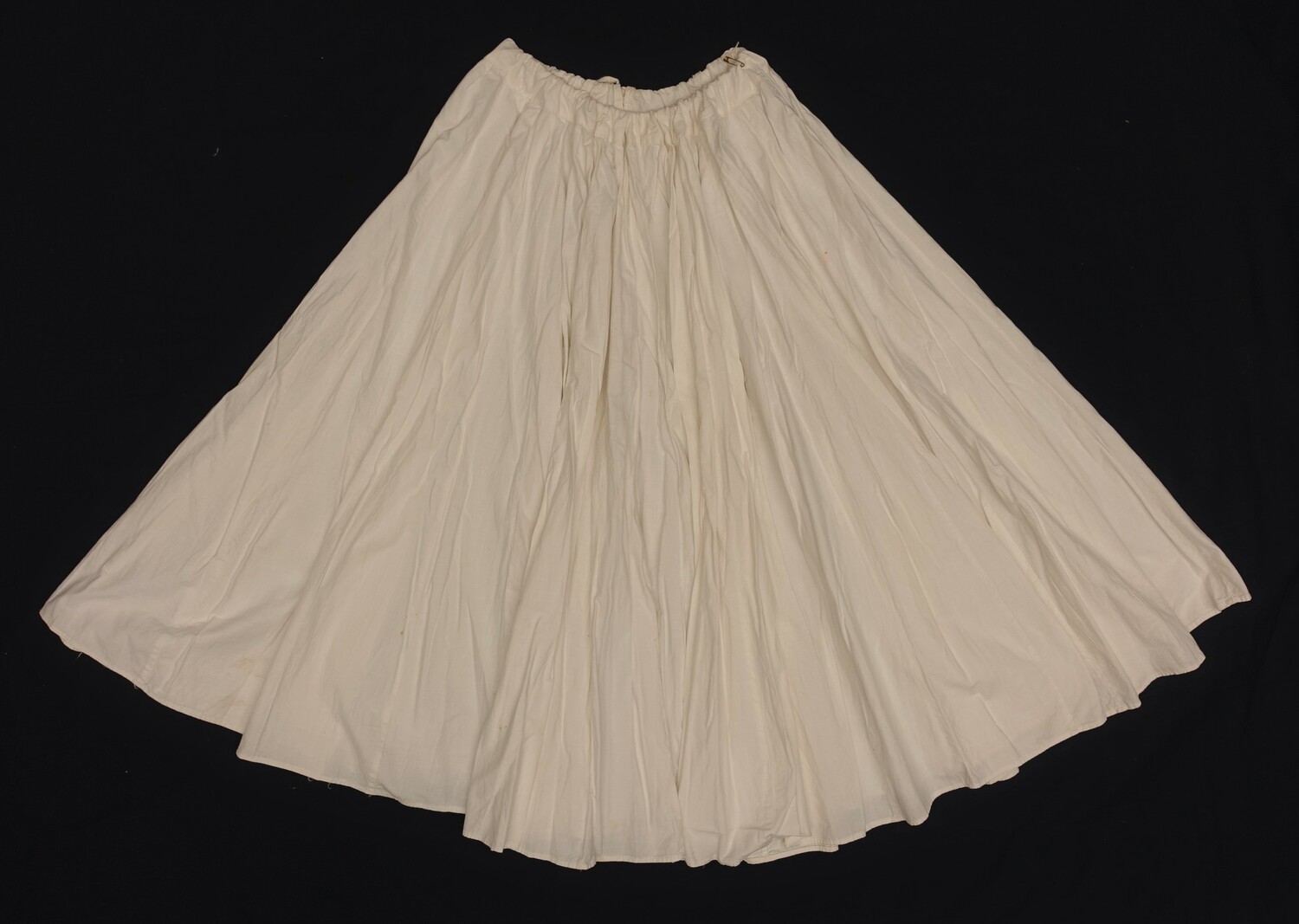 20th century fustanella skirt for a man, Albania (TRC 2022.1200).And a little side-track: the name fustanella, now used all over the Balkans and in Greece, is of Italian origin, and related to the name of the cloth that was (originally) used for the skirt, namely fustian (a linen and cotton blend), which itself is derived from the name of Fustat, which was a city near (and precursor of) Cairo in Egypt.
With Greek independence, and waves of Romanticism flooding Europe (think of Lord Byron), modern Greece was happily given 'traditional' characteristics that would mark the new state. King Otto, who briefly visited his native Bavaria in 1836 and proudly (?) showed his skirts, was all part of it (although he may have felt more comfortable in a Lederhosen)
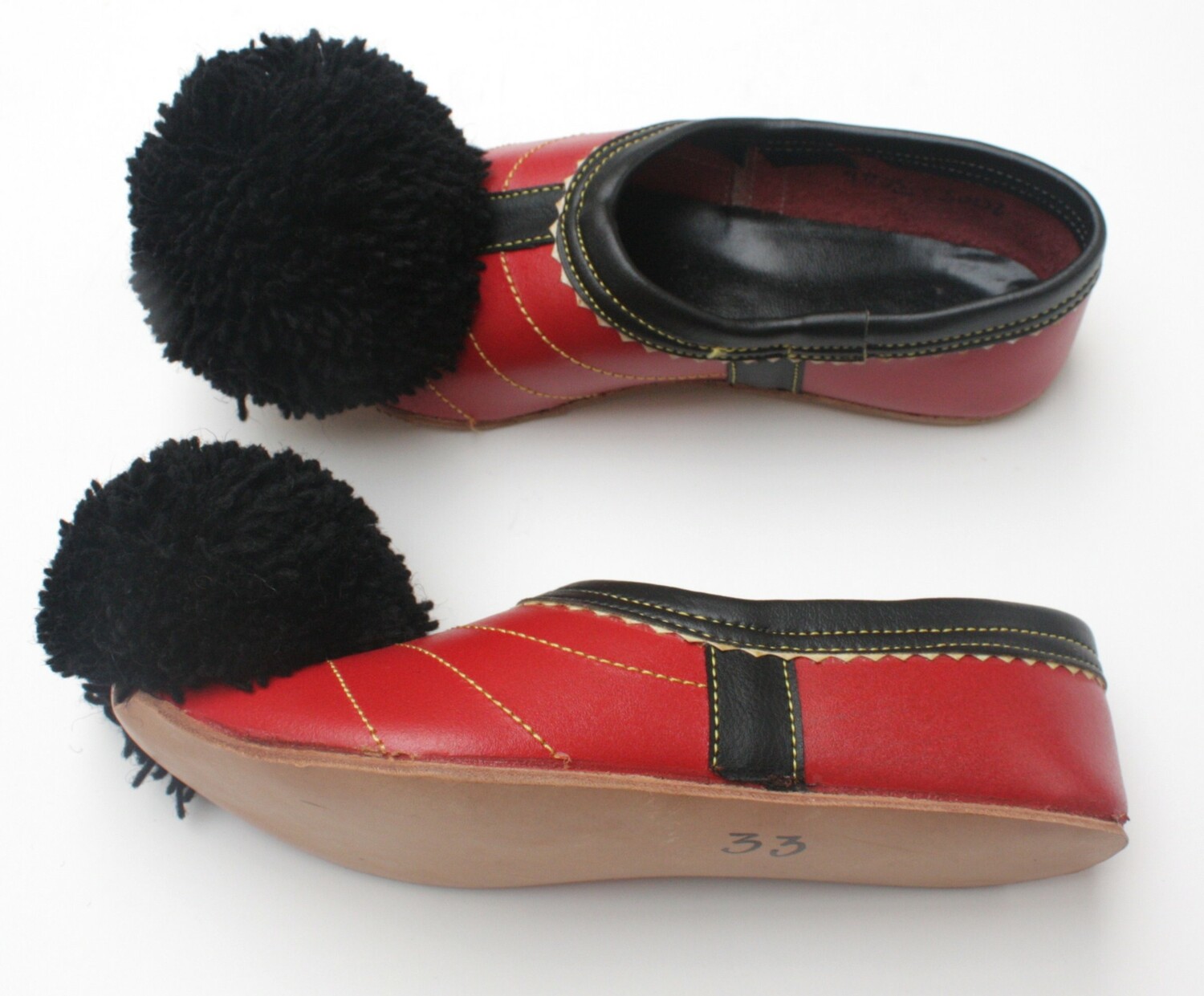 Pair of red leather shoes with big black pompoms at the toes, Greece, early 21st century (TRC 2005.0304a b).It so happens that the TRC recently received five of these skirts from Albania (TRC 2022.1137, TRC 2022.1191c, TRC 2022.1194, TRC 2022,1200, TRC 2022.1201). They date to the (late) twentieth century, are made of long lengths of white cotton, and gathered at the waist by a drawstring.
They are far simpler than the ceremonial ‘Sunday-best’ fustanella worn by the Evzones, which is white and made of numerous strips of cloth. It is also shorter (reaching to above the knees) than the skirts worn in the north, but the early fustanella worn in Greece in the nineteenth century were also longer than the modern examples.
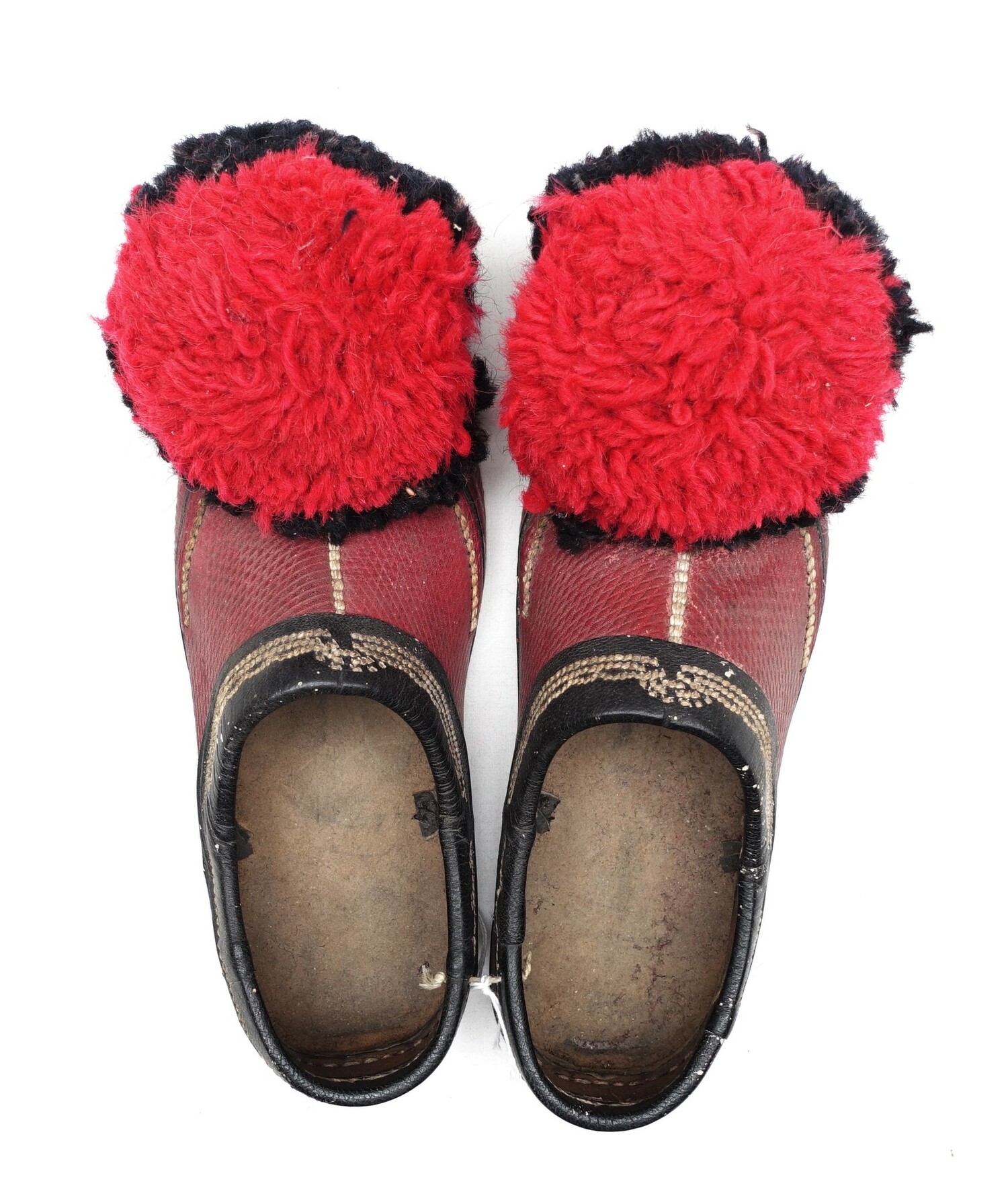 Pair of red and black leather shoes with white embroidered details, as well as two very large red and black pompoms at the toes. Albania, late 20th century (TRC 2022.1828a-b).But that is not all: Apart from their skirt, the Evzones are also known for their footwear (tsarouchia) with large )pompoms. The TRC has a pair of these shoes in its collection (TRC 2005.0304a-b). The same type of shoes, with pompoms, are also known from Albania, and the TRC has recently received three such pairs (TRC 2022.1828a-b, TRC 2022.1829a-b, and TRC 022.1830a-b).
And actually, for all the Greek/Turkish controversies, the Evzones are also wearing a red cap with a black tassel, called a fesi.....
Willem Vogelsang, 3 August 2022