

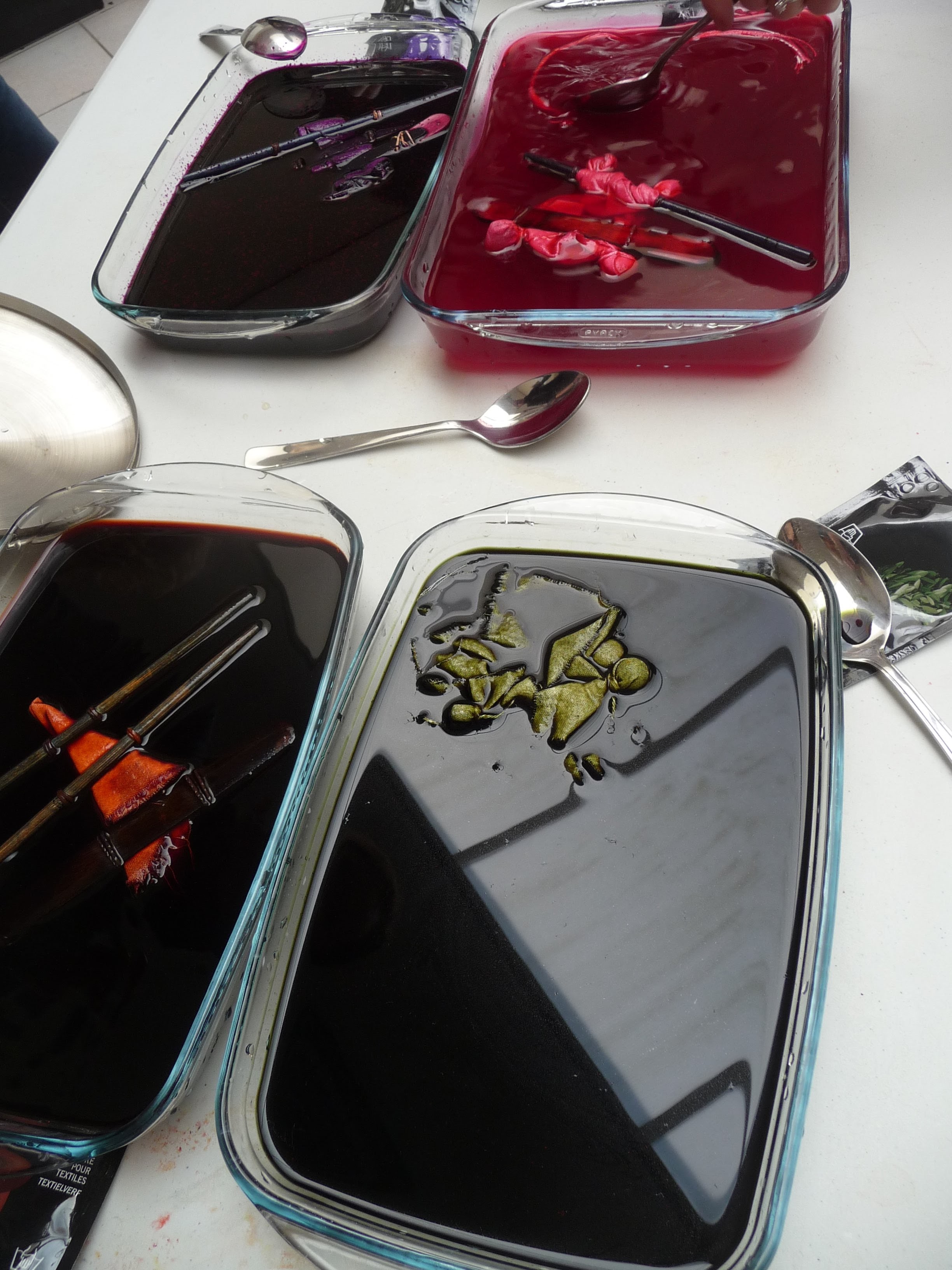
 Dyeing with woad. Photograph by Shelley Anderson.On Friday, 24 April 2020, Shelley Anderson wrote:
I have been lucky as a TRC volunteer to have been involved in several Intensive Textile Courses. One of the course’s highlights for me (other than being able to get up close and handling some beautiful textiles), is the section on dyes and dying. It is fascinating to see the incredible range of colours, and the sometimes subtle (and often not so subtle) differences that temperature, mordants or materials can make.
I became curious to explore more and bought some small packets of dye seeds in the TRC shop. My madder (used to make a red dye), alas, didn’t grow well, but the weld (also called dyer’s weed, a plant that has been used to make yellow dye since Roman times) did. What really flourished, and is still flourishing after three years, is the woad. (I learned later that woad is considered a weed in parts of the USA, and millions of dollars are spent in eradicating it). In Europe, the leaves of woad (Isatis tinctoria) have been used to make a blue dye for thousands of years. Woad dyed textiles have been discovered in Iron Age burial sites in Hallstatt (Austria), while seeds have been found in a Neolithic cave in France. Centuries later, woad was also used to make blue pigment in illuminated manuscripts.
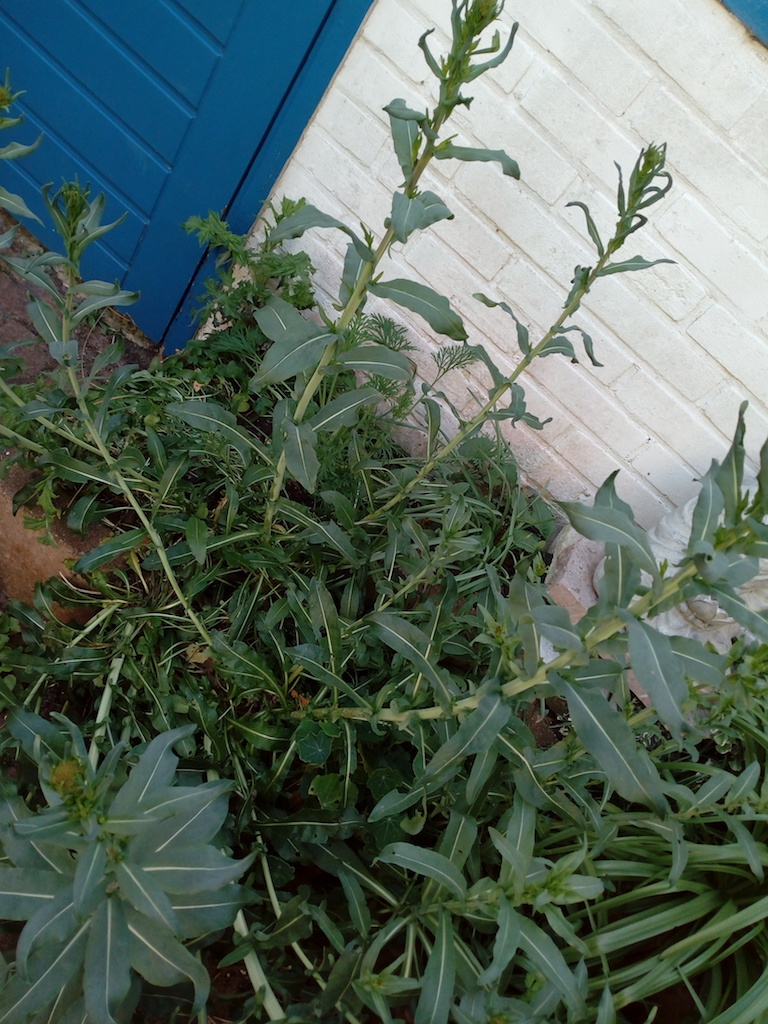 My woad plants. Photograph by Shelley Anderson.Growing and processing woad was an important industry in Germany and France. The sale of woad made merchants in the French city of Toulouse especially wealthy. A contract from the year 1286 between the British city of Norwich and woad merchants in Amiens still exists. The English also grew and processed woad, but the trade gradually declined as indigo from India became widespread.
Up until the early 1900s, however, woad was still being grown and processed in England, for sale not as a dye, but as a mordant for fixing other dyes. The plants were carefully stripped, as after another six weeks more leaves could be harvested from the same plant. The bluish green leaves were crushed and ground in a mill, then workers patted the remains into balls and air dried them. After the balls dried they were crushed into a powder, which was then taken to a ‘couching house’. There the powder was spread, up to two or three feet (approximately a metre) thick, on stone floors. This was then watered and turned repeatedly, so it could ferment for several weeks. The smell was evidently horrible. Only after all this, usually at least eight weeks, was the woad ready for sale.
I will try to make a dye with my woad plants. But even if I don’t, I enjoy looking at them and thinking of the thousands of years of history behind them.