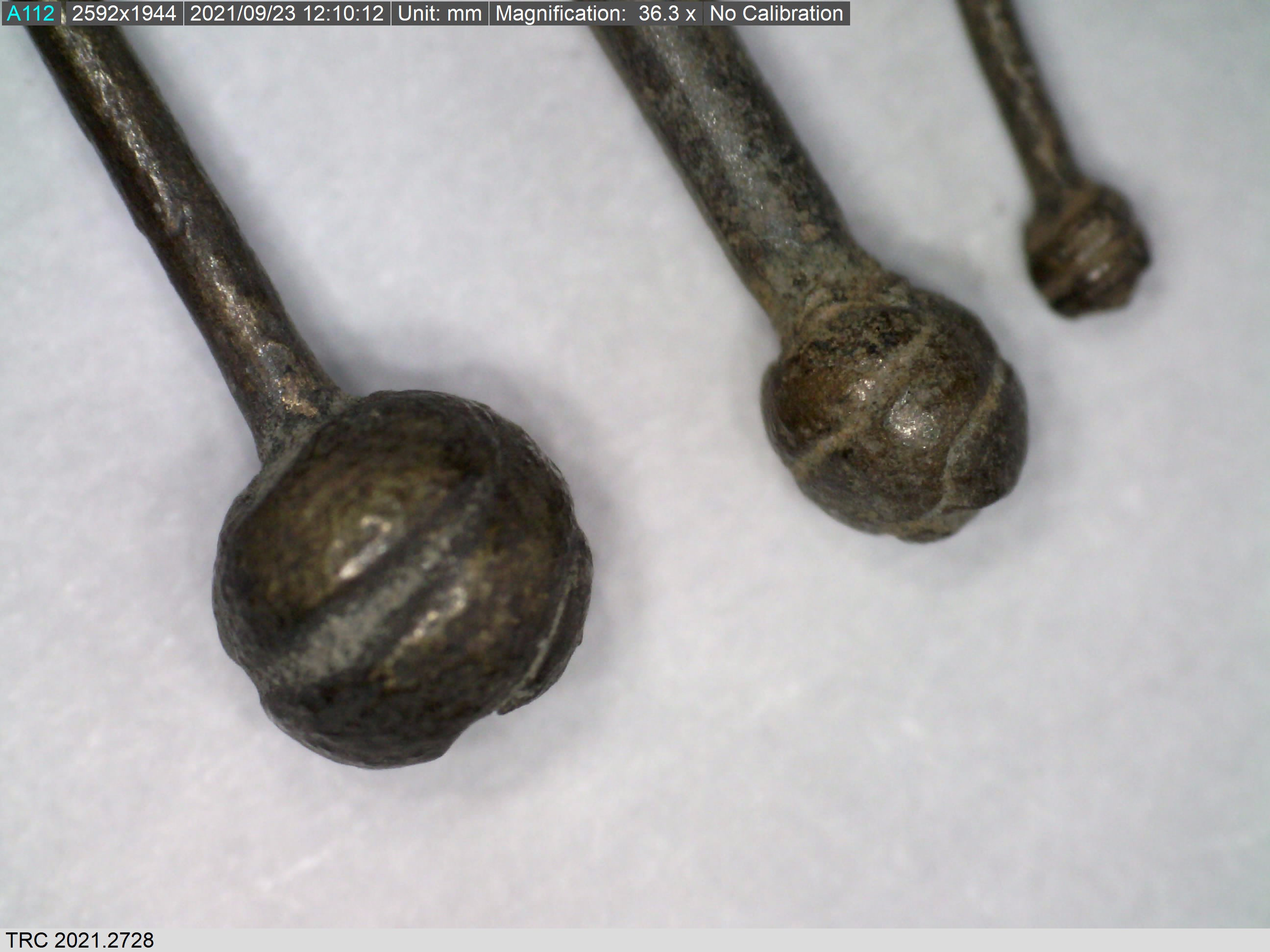
 Three wire-wrapped pin heads, pre-1532, from Zeeland. 36.3 magnification, Dino-Lite microscope (TRC 2728a-b and TRC 2021.2735a).Some medieval Christian theologians allegedly debated on the question how many angels could dance on a pin head, and I always thought such a discussion would have been a bit of a waste of time. Yet over the last few years I have become fascinated with pins and pin heads! The handmade pin heads, for example, associated with a textile linked to Napoleon Bonaparte, as well as a pin cushion from 1826 were subject of an earlier TRC Blog.
I ‘knew’ that up to the 18th century pins in Europe were handmade, rare and expensive. Hence, I assumed, the English term ‘pin money’, namely the money given by a husband to his wife to spend at the New Year fairs on buying pins. But I have long suspected this knowledge was far too general and just recently a donation by a friend of the TRC, Sytske Wijnsma from Wormer in the province of Noord-Holland, has left me wondering even more about this subject.
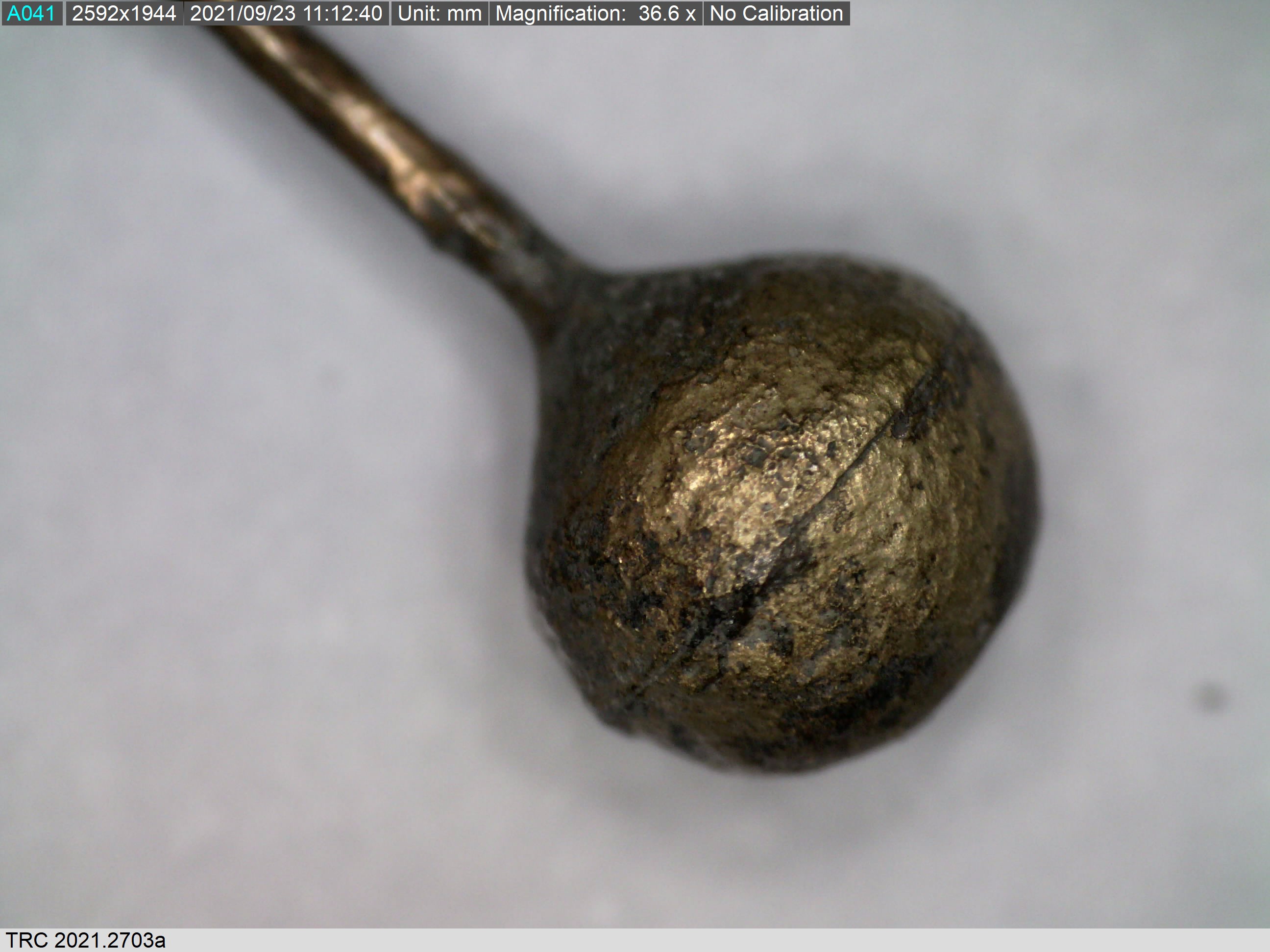 Two concave discs fastened together to make a ball shaped pin head. Zeeland, pre-1532. 36.6 magnification, Dino-Lite microscope (TRC 2021.2703a).The donation consists of a small plastic box filled with pre-1530/2 pins and related items, such as hooks and eyes. These were all made from metal, usually copper and iron, and in some cases they were gilded. There are hundreds of pins in the box and they were found by people with metal detectors in the 1970s and 1980s in Krabbendijke, Nieuwlande (Zuid-Beveland, Zeeland), in the southwest of the Netherlands.
The date of pre-1532 is based on the fact that this area of the Netherlands was flooded by seawater on several occasions in 1530 and then again in 1532 and the region was consequently uninhabitable ever since. The region is now a nature conservation area and known as the ‘Verdronken Land van Reimerswaal’ (the ‘Drowned Land of Reimerswaal’).
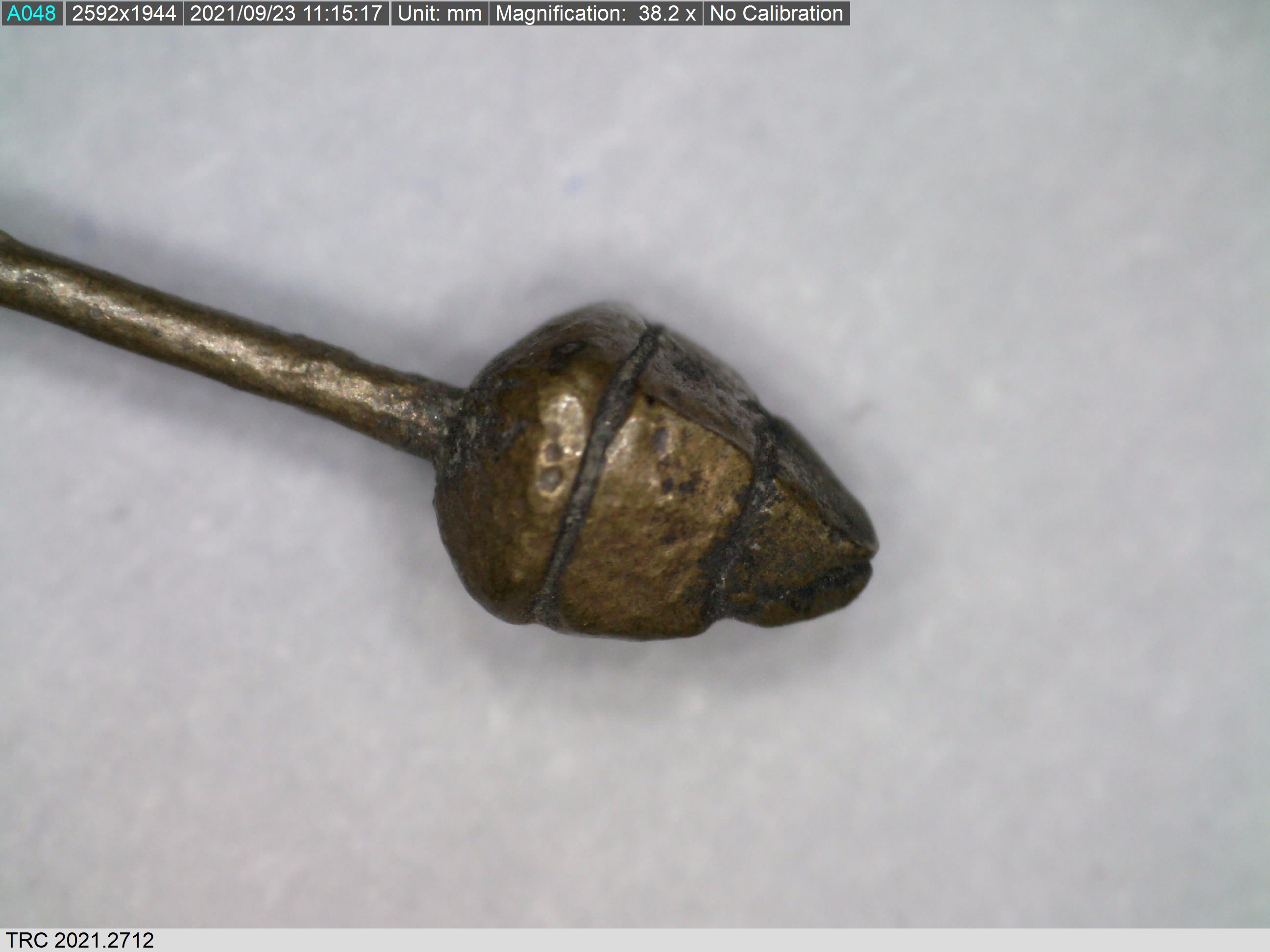 A conical wrapped pin head. Zeeland, pre-1532. 38.2 magnification, Dino-Lite microscope (TRC 2021.2712).What I find intriguing about the pins is the sheer diversity of sizes (length and diameter) with respect to the shafts and also how the heads are made. I studied the pins with a Dino-Lite microscope.
There are some pins that are only a couple of centimetres in length and very fine, while others are up to five centimetres in length and comparatively coarse. Some of the pins seem more suitable for pinning fine linens and silks prior to stitching them, while others were probably used for coarser materials, perhaps for cloaks or something similar. In other words, just as we have today, in c. 1530 there was a variety of pin sizes for different sewing tasks.
In particular I am fascinated by the methods used to make the pin heads. Most were made from a narrow wire of metal that was wrapped in various manners around one end of the shaft to produce round and concave forms. In some cases these heads were then crimped in order to give a decorative effect. In addition, some of the pin heads were made from semi-circular, concave discs. These discs were pierced and then threaded onto the metal shaft. Sometimes only one disc was used, while on other occasions two were used to create a ball-shaped head.
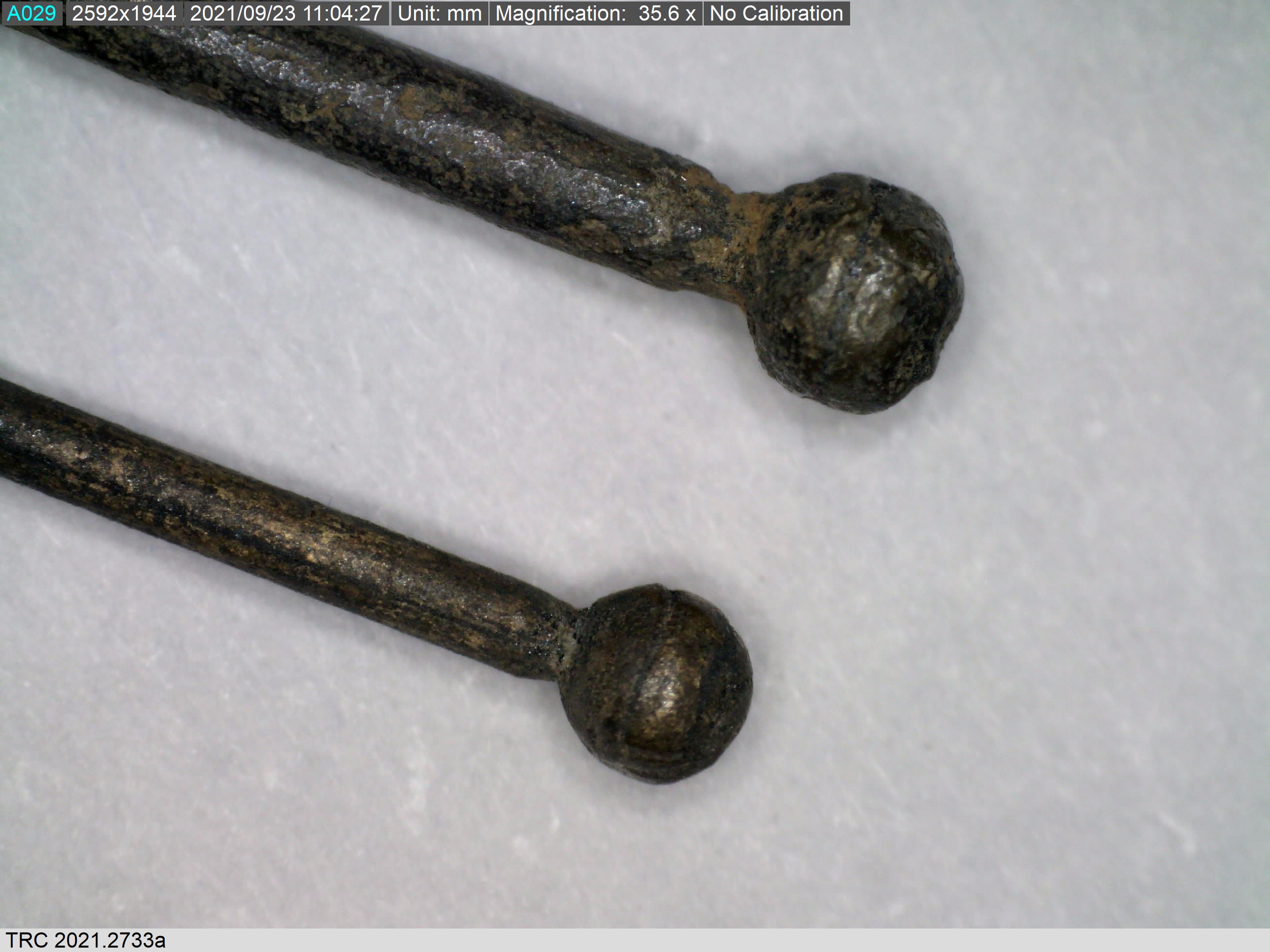 Indented shafts with wrapped heads. Zeeland, pre-1532. 35.6 magnification, Dino-Lite microscope (TRC 2021.2733a-b).What is clear is that some of these pin heads were carefully made – even down to the shaft being made slightly thinner for the head, while others were more crudely, and presumably more quickly, wrapped around the shaft leaving part of the shaft above the head still exposed (this area could catch on the cloth and potential cause a hole).
Inevitably the discovery of the pins raise several questions, such as how exactly were they made and by whom? Was it children with good eyesight in the case of the very fine pins? Also were pins really rare items in the later medieval period? They do not come across as scarce items, given so many were found in one specific area! Were all these pins found together and why? If they were a ‘hoard’ do they represent the tools of a tailor or seamstress? Or, given the poor condition of many of the pins, could it represent various groups of metal items waiting to be melted down and re-used?
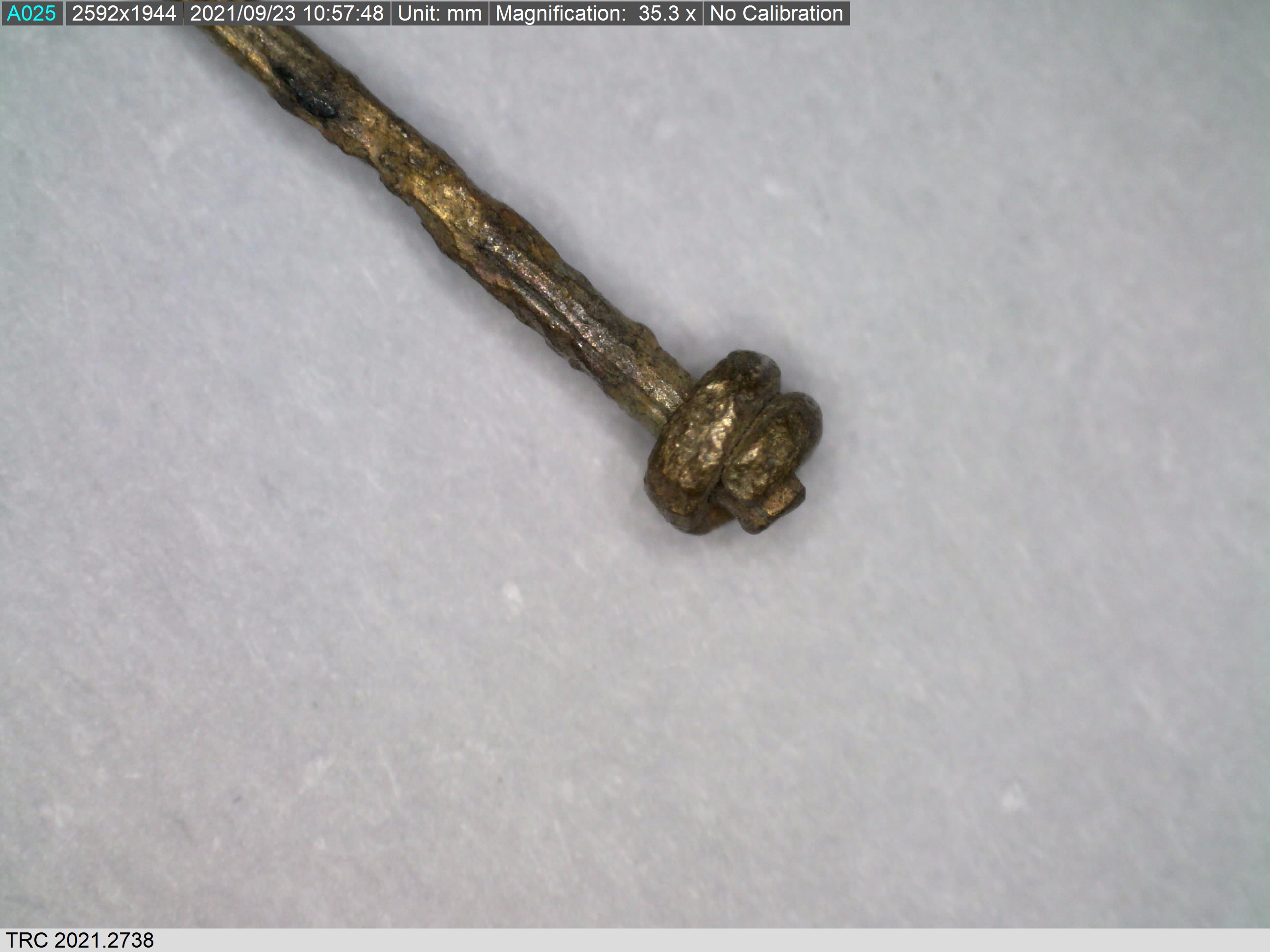 Pin with wrapped around shaft. Zeeland, pre-1532. 35.3 magnification, Dino-Lite microscope (TRC 2021.2738).And coming back to the question about the nature of ‘rare’ pins and pin money: could the ‘rare’ pins often referred to in literature actually have been the bejewelled pins in gold and silver used for pinning clothing in a decorative manner, while the simple pins in the plastic box are representative of smaller, domestic forms that were actually more common than I had previously presumed?
What is clear is that we will have to do a lot more research on these small, insignificant items, because I suspect there is a much bigger social and economic story behind them – yet again there are so many textile stories to be explored!
Gillian Vogelsang, 23 September 2021.