

We are pleased to announce that in conjunction with graphic illustrator, Martin Hense (Rotterdam) and Bloomsbury Publishing, London, and hopefully with many volunteers from all over the world, the TRC Leiden is building a new Portal for Embroidery Stitches. In doing so we hope to complement the entries on stitches in the TRC Needles, both as regards the stitches themselves and additional information.
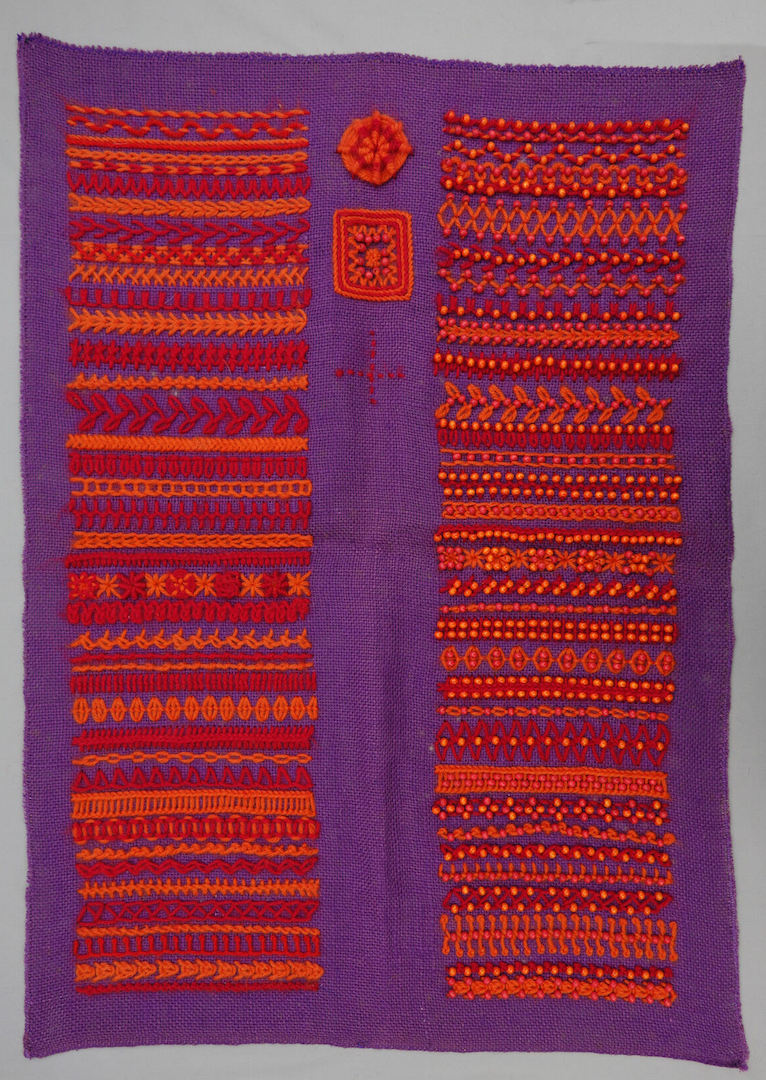 Sampler with a variety of stitches, embroidered by Grethe la Croix in the Netherlands, 1960s (TRC 2017.0216). To the left are different rows of stitches, and to the right the same stitches, but with added beads.
The Portal will include all the stitches mentioned in Needles, but will be far more concise and focused on their appearance. This planned interactive and international project will provide a more visual access to the stitches and encourage embroiderers from all over the place to help the TRC in providing further information about embroidery stitches in general, both for the Portal and for TRC Needles.
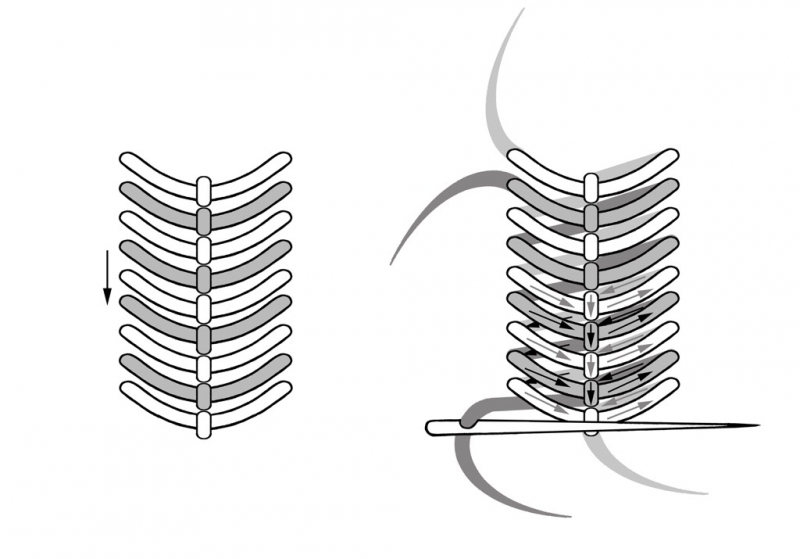 Schematic drawing of the bi-coloured fly stitch (drawing by Martin Hense).
Over the last five years, and as part of preparing the Bloomsbury World Encyclopedia of Embroidery series, we have been actively 'collecting' embroidery stitches from around the world as a means of quickly identifying the main types of stitches and composite stitches, including, of course, sometimes very obscure examples. It may sound a bit boring, but it is not, as the stitches are an essential element in any embroidery, and can lead the maker and viewer into many stories and sources of information about textiles and cultural heritage in general. And of course as a source of inspiration.
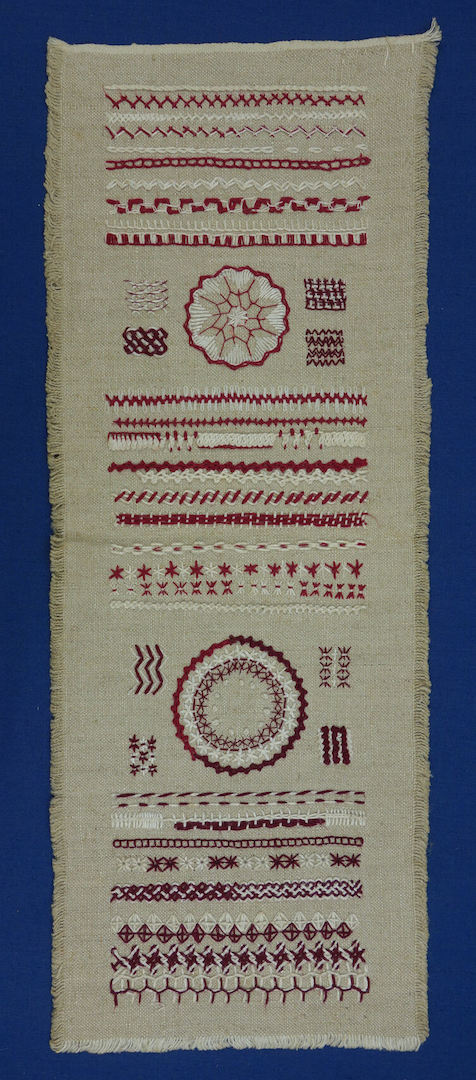 Sampler by Grethe la Croix, 1960s, the Netherlands (TRC 2017.0223), with many different stitches.So what do we want to do? In the Portal, all the stitches will be grouped into stitch families (knotted stitches, looped stitches, straight stitches, etc.). For each stitch there will be the English name and its variants (if available), names in other languages, a drawing of the front, back and finished appearance of the stitch, as well as a photograph of the stitch in use. I expect we will soon include over 300 stitches, but many more may be encountered. Each stitch in the Portal will be linked to the relevant entry in TRC Needles, which gives a wider range of cultural, historical and social information, and which also refers to actual examples in the TRC Collection and other collections.
The Portal will also contain a list of the stitches in alphabetical order, and we can think about such lists in various languages. This is one of the beauties of the digital/database age, many things are possible.
Some of the stitches are well-known, such as running stitch, and used throughout the world, others are not so well-known or used, and yet others have passed into history. And many of the stitches do not even have an actual name, as the pattern they produced was regarded as more important and thus more worthy of a name (a cultural comment about Western academics and, of course, embroiderers?). These ‘unknown’ stitches will present their own, interesting challenges.
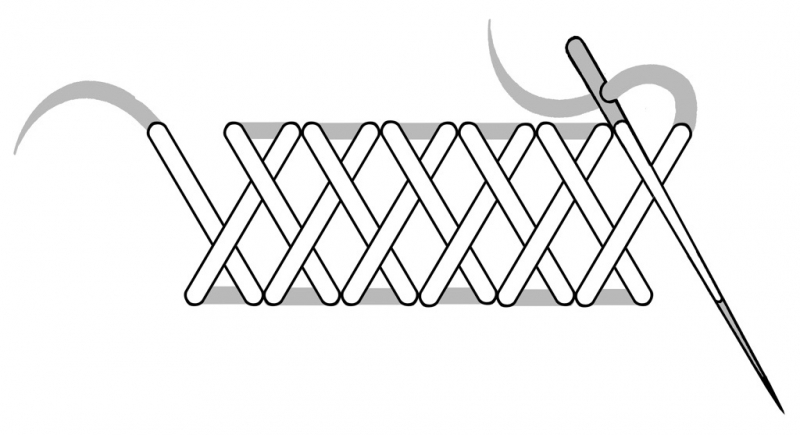 Schematic drawing of the closed herringbone stitch (drawing by Martin Hense).
The question was raised about languages: English will be the main language, but what about other languages? It was originally suggested we did the (standard) English, with Dutch, French, German, but other people (quite rightly) protested. So in order to be inclusive on a wide scale, we are going to try and get the stitch names (and their stories) in a range of languages from around the world.
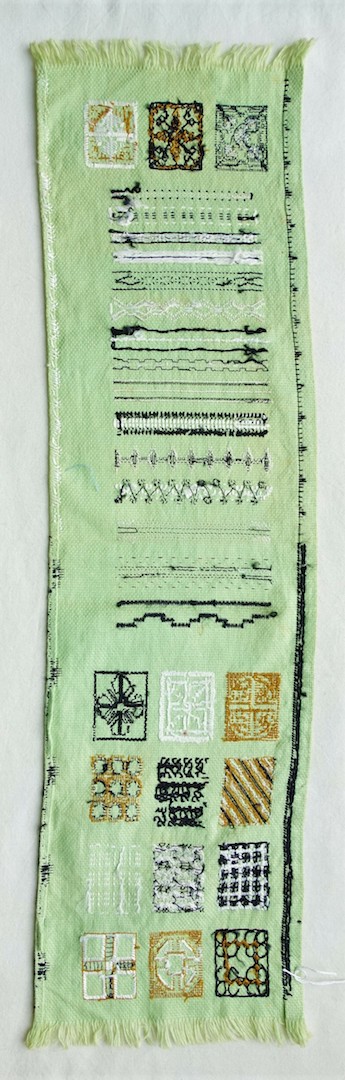 Embroidery sampler from the Netherlands, worked by C. Mooij in c. 1944, with a large variety of stitches (TRC 2020.3990r).In order to do this we will need a lot of help, as nothing has been tried on this scale before, and it will take time to collect and process the information. Expanding the entries in TRC Needles and building up the Portal will be an ongoing, interactive project, and we will need all the help we can get.
Practically, we want to continually build on the TRC Needles entries and the Portal, and ask embroiderers and others from all over to comment upon the texts, drawings and further information provided so far. All your comments will be sorted and if necessary discussed with you, and included (or not) in the updated version of the pertinent entries, for all contributiors to see and comment upon. We are planning to send everyone who is willing to participate regular notifications when a new batch of entries in Needles and in the Portal has been altered or added.
If you would be willing to help then please let me know. As said, we are planning to make this an ongoing and interactive project, whereby anyone may add, correct, or otherwise comment upon information published in TRC Needles and/or the Portal.
Other thoughts and suggestions are most welcome!
Gillian Vogelsang-Eastwood, 19 June 2022 (Dit e-mailadres wordt beveiligd tegen spambots. JavaScript dient ingeschakeld te zijn om het te bekijken.)