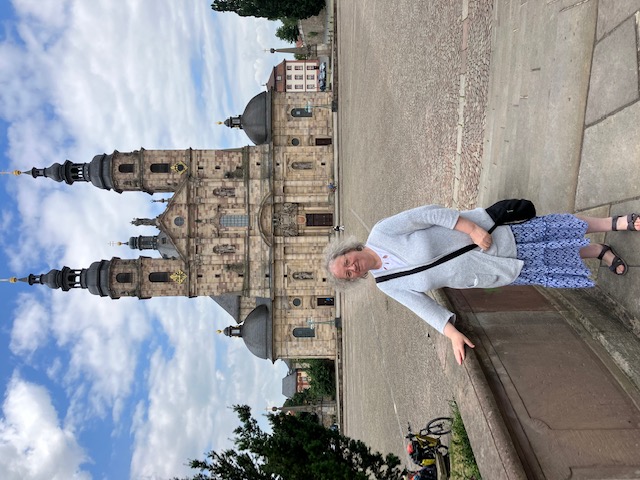
 Author standing in front of Fulda cathedral, 2 July 2023. Photograph by Willem Vogelsang.A few months ago we were contacted by Liz Kelcey about a collection of Czech, Hungarian and Romanian outfits that she and her husband had acquired over the years.
Sadly, John died recently and Liz is now sorting out their house and its contents in Czechia.
She heard about the TRC here in Leiden, the Netherlands, and about our work in building up an extensive collection of European regional dress and offered twenty outfits as a donation.
The one snag? We had to pick them up in some manner.
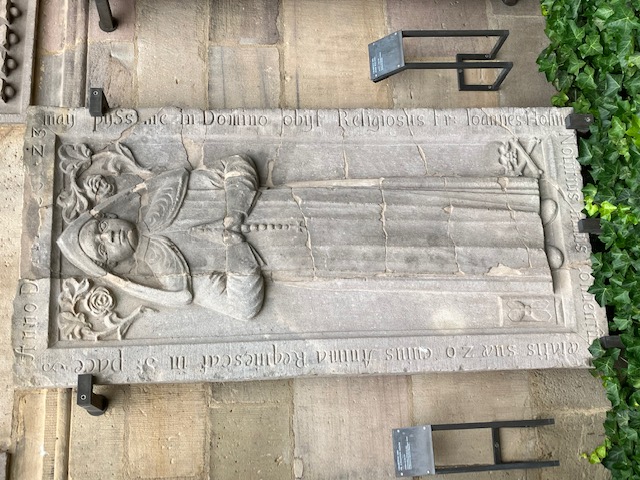 Gravestone for Frater Johannes Höhn, who died in 1701, Fulda. The stone is executed in imitation of late medieval gravestones for monks. Photograph by Willem Vogelsang.So Willem and I are on our way to Czechia! We are taking two days to travel there and en route stopping off at the cathedral cities of Fulda and Bamberg in central Germany, to see the textiles and especially the embroideries in the relevant museums, as part of our work on volume 4 of the Encyclopedia of World Embroidery (Scandinavia and Western Europe), which is very nearly finished!
This afternoon (Sunday, 2nd July) we were in the Dommuseum, next door to the cathedral, in Fulda. In the garden leading up to the museum is an 18th century grave stone with the depiction of a ‘medieval’ figure. He is holding a paternoster, a type of prayer beads, which is sometimes called a rosary (actually these are two different forms). Some years ago we carried out research into the history of prayer beads from around the world. The TRC has a collection of over 300 different examples. Perhaps it is time to put this research online! But that is a thought for another day.
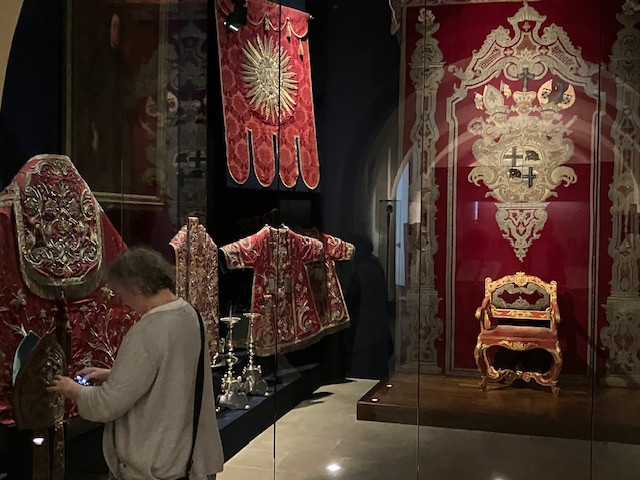 18th century liturgical garments and ornamental bishop's throne, Dommuseum, Fulda. Photograph by Willem Vogelsang.When you actually enter the museum there are large 20th century and earlier paintings, and I thought - is that it? But how wrong can you be!
As you go deeper and deeper into the museum there are various darkened galleries and corridors with 18th century and earlier religious garments, including copes, chasubles, dalmatics, stoles, maniples, etc. Many of them are complete sets. Some of the chasubles, for example, are made from fine woven silks, others are made of velvets of various types. Many were embroidered with silks and gold threads of various forms and techniques.
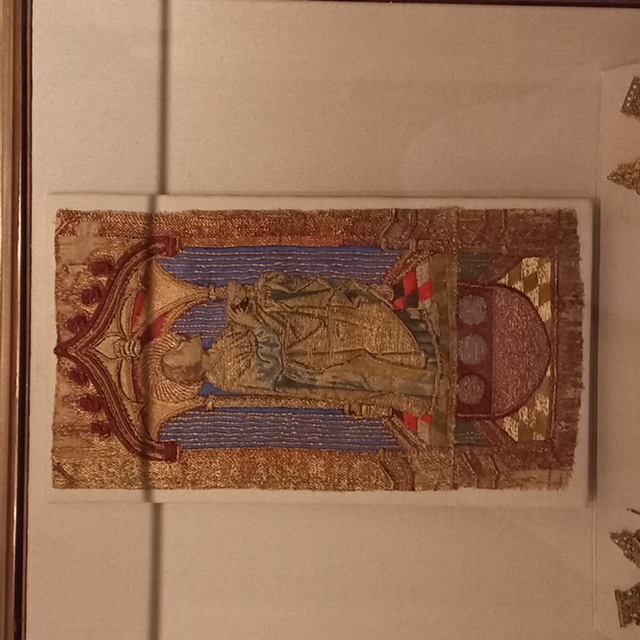 Piece of late medieval Or Nué embroidery, Flanders. Dommuseum Fulda. Photograph by author.In a sunken area of the museum, for example, there is an amazing display based around an 18th century bishop’s throne, complete with a huge baldachin with canopy and a cloth of honour hanging behind the throne. The tableau also includes various liturgical garments and a pulpit hanging, all worked in bright red velvet with heavy, gold embroidery. Stunning.
Among the other items on display are a pair of bishop’s silk stockings with embroidered clocks, as well as embroidered slippers. There were also other examples of embroidered religious scenes and figures.
Further down in the room, for example, was a small piece of embroidery tucked away in a frame with some metal necklaces (?). The embroidery included a saint in an architectural setting. On closure inspection the embroidery was a piece of Or Nué that has been dated to c. 1500 and is regarded as Flemish in origin.
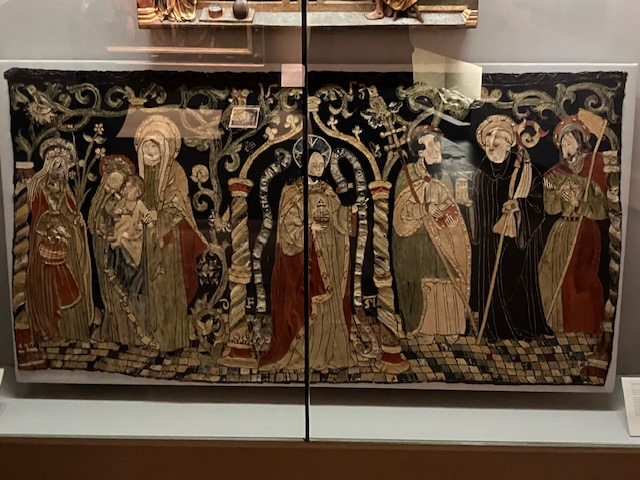 Late medieval, embroidered antependium, Dommuseum Fulda.
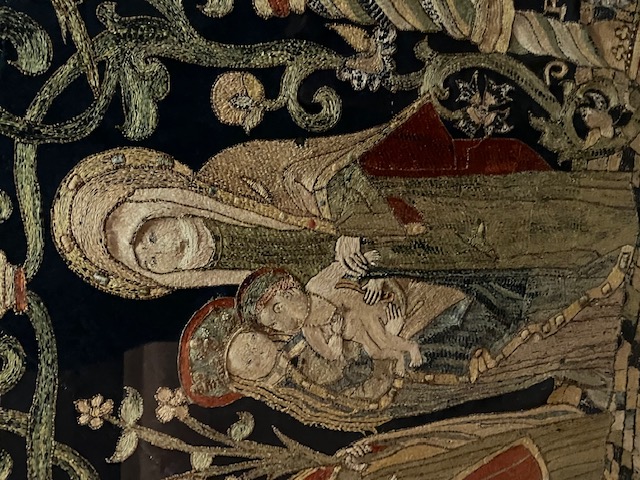 Detail of late medieval embroidered antependium, Holy Virgin with Child. Photograph by Willem Vogelsang.And then we spotted an embroidered antependium (alter frontal) dating to 1553 with a Salvator figure in the centre, flanked to his right by St Anna and her daughter, Mary, holding the Child, and St Beatrix, and on the other side by three saints, including St Boniface.
The antependium has a wool ground and is worked in multi-coloured silk worked in split stitch and filling stitch with couched thread outlines.
And then more chasubles dating to the 14th and 15th century with velvet grounds and applied embroidered bands. Bliss.
What was my favourite piece? Well I had heard about and seen photographs of medieval German embroidery with swirling backgrounds (they reminded me of Van Gogh’s painting, ‘The Starry Night’ painted in 1889 and now in the Museum of Modern Art, New York).
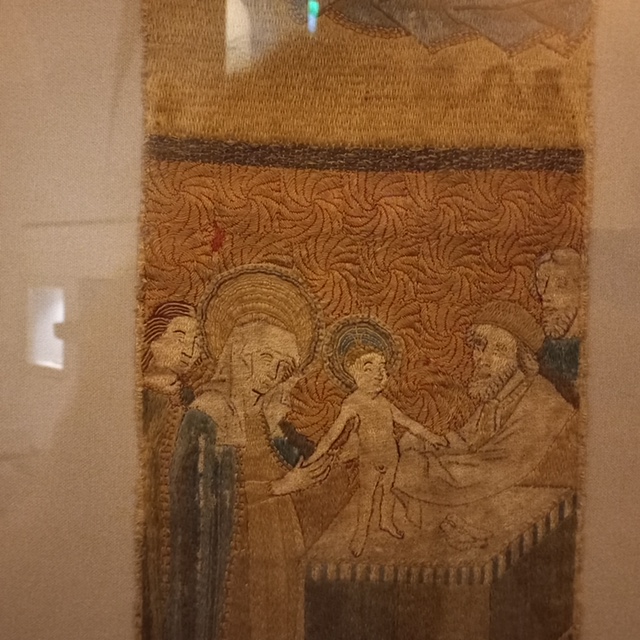 Detail of a late medieval embroidery with a ground covered in swirls, using a surface couching technique. Dommuseum Fulda. Photograph by author.There were several examples on display that date to the late 1400s. I was so pleased to have finally been able to see some actual examples.
In another part of the museum there is a room dedicated to St Boniface (673-754), an English bishop and missionary, who worked in what is now Germany and was murdered by the Friesians in the Netherlands (in Dokkum, to be precise).
His remains are in the Fulda Cathedral, but what is believed to be his skull is in the museum, partially wrapped in cloth and with an embroidered bishop’s mitre. There are more skull reliquaries flanking him, also with embroidery (the setting is 19th century in date).
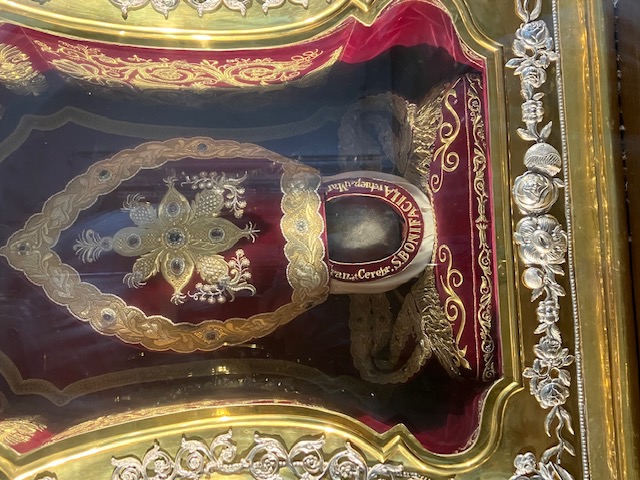 Reliquary with the skull of St Bonifatius, who in 754 was killed in the north of the Netherlands. With bishop's mitre. mid-19th century. Photograph by Willem Vogelsang.
If you have the chance to visit the museum it is worth while just to see this range of 14th century and later religious textiles, and especially the changing styles of embroidery.
Gillian Vogelsang, 2 July 2023