
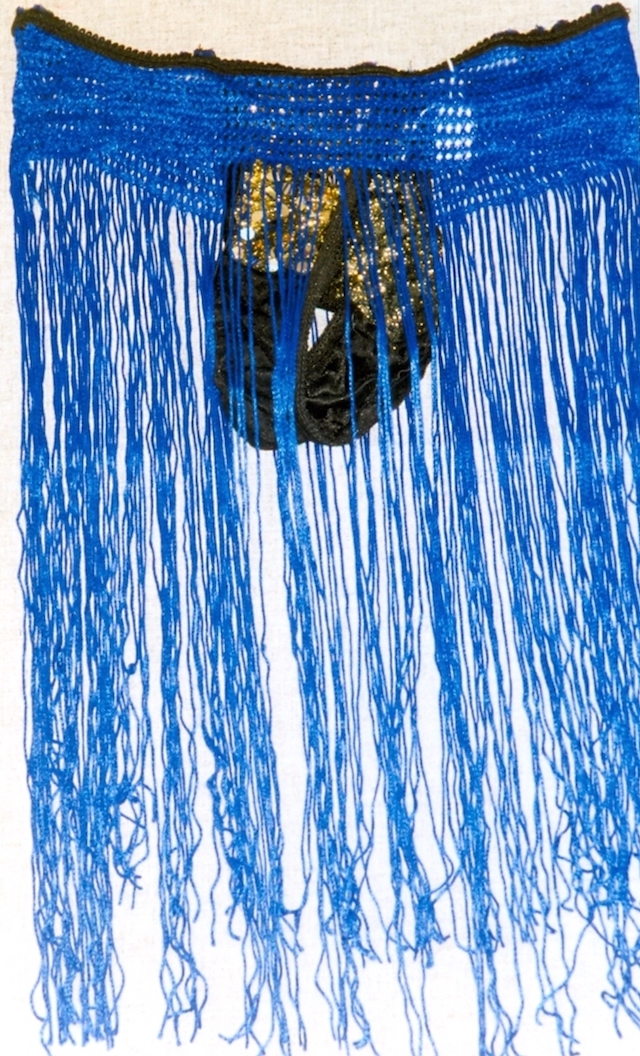
 Pair of underwear with a long, blue fringe and gold-coloured material with sequins. Cairo, Egypt, 1995 (TRC 1997.0119b).The TRC has a large collection of underwear from many countries, from Egypt to Sweden, from the Netherlands to Tanzania. I do like the 1995 Egyptian pants with a long, blue fringe and gold-coloured material with sequins (TRC 1997.0119b), although the dark red pair of panties with a decoration of pink flowers from Tanzania (TRC 2004.0164) might be easier to wear.
The TRC collection includes bras, slips, knickers, stocking belts, long johns, chemises, pantaloons, drawers and bloomers.
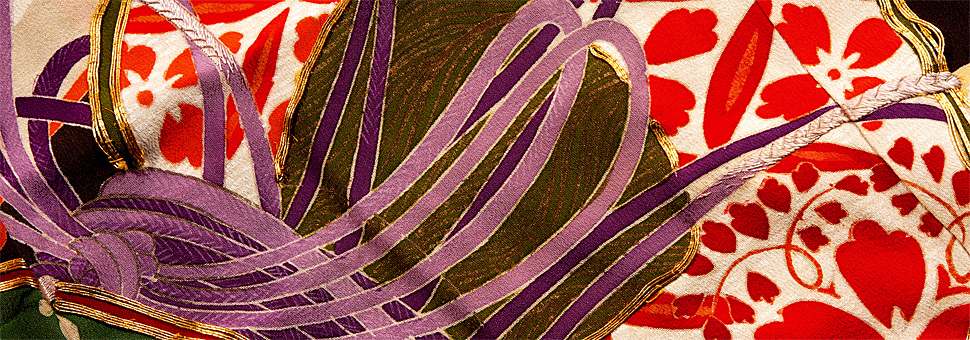
My favourites are, however, seven lingerie pouches from Japan in the 1920s-1930s, exported to the Western market to store delicate silk lingerie and scarves (TRC 2016.2172—TRC 2016.2177). The floral patterns and the more abstract Art Deco designs that decorate the pouches are lovely.
Lingerie is very present in the work of Dutch artist Lara Schnitger, who was born in Haarlem in 1969. Schnitger is a Dutch textile artist who now lives and works in Los Angeles (US).
She studied at the Koninklijke Academie van Beeldende Kunsten (Royal Academy of Visual Arts) in the Hague, and her work has been shown in Australia, Japan, Europe and America. Her latest exhibition is now showing in the modern art Museum Kranenburgh, in Bergen (NL).
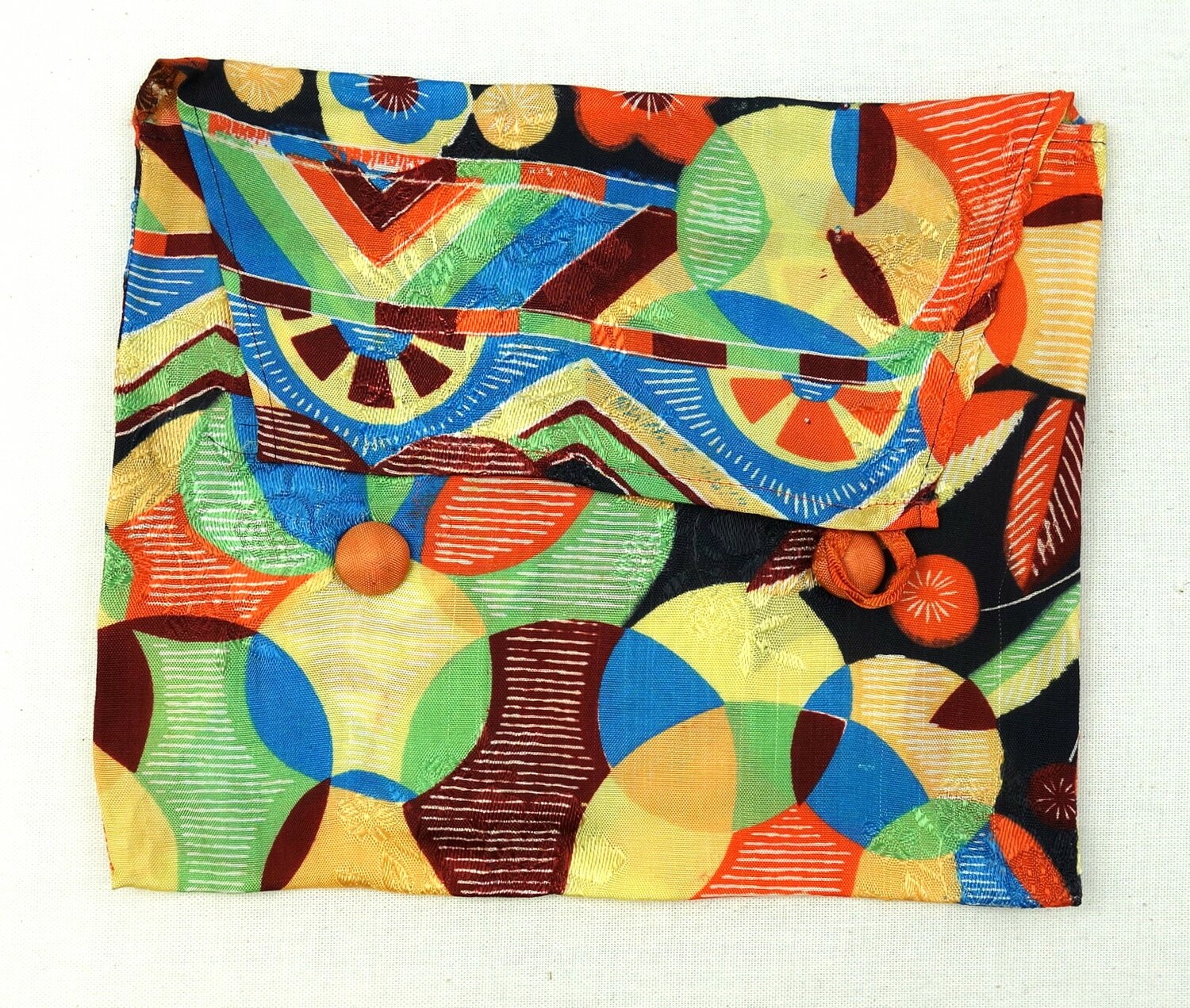 Small pouch decorated with a design of stylised flowers and circles. This type of pouch was used for storing silk lingerie and scarves. Made in Japan for the European market, 1930s (TRC 2016.2177).
The exhibition is called 'Stitch Witch' and consists of several large-scale installations, about a dozen quilts, and some whimsical stick figures. All the objects are made primarily from women’s lingerie.
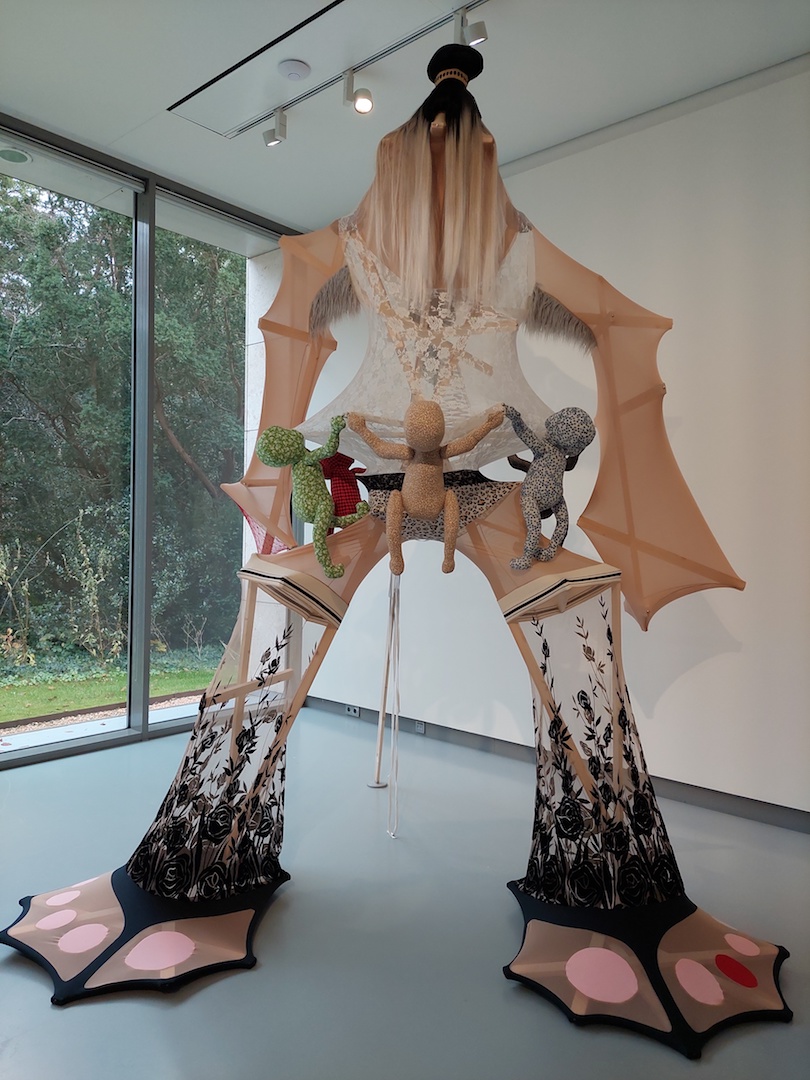 Who Saves Who?, textile sculpture by Lara Schnitger, 2024. The giant female figure protects both babies and nature, as she stands with her feet rooted in the earth (note the green between her toes). Photograph by S. Anderson Towering above the sticks is a large textile sculpture, again made from lingerie, of a giantess with several knitted yarn babies crawling around her.
While Schnitger’s work will make you laugh, she does have a serious purpose. She wants to spark conversations about the stereotypes and constraints women face; and to reclaim words, like “slut” or “witch”, that undermine women’s dignity.
Schnitger calls the stick figures 'Slut Sticks' in order to challenge the derogatory slur. In an on-going project called 'Suffragette City', she teaches participants to make Slut Sticks, stretching bras, stockings and panties into different shapes, then attaching the garments to wooden sticks. A procession of the sticks with lingerie figures is then made for art museums.
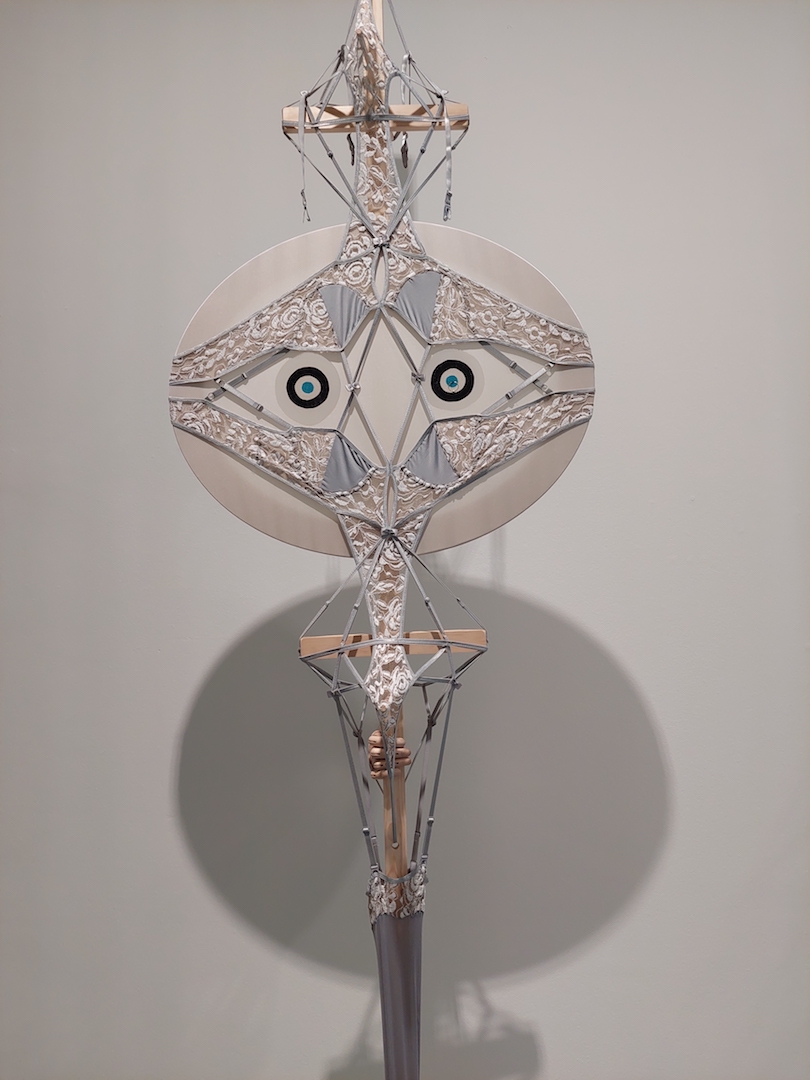 'Slut Stick' by Lara Schnitger. Photograph by S. Anderson.Such processions, deliberately reminiscent of 19th-20th century women’s suffrage marches, have taken place in Basel, Sydney, Washington DC, Berlin, New York, and elsewhere. Last year there was a procession at the Lowlands Festival in Biddinghuizen, and this year workshops and a procession will take place in Alkmaar., Noord-Holland, the Netherlands, to celebrate International Women’s Day.
The women marching with the Slut Sticks also wear special dresses and overalls, creating a link with the clothes worn by women factory workers during the Second World War. The marchers also carry quilts with slogans such as “No means NO!” or “A dress is not a yes!” The point, says Schnitger, is to offer “a timely and powerful commentary on female autonomy and solidarity.”
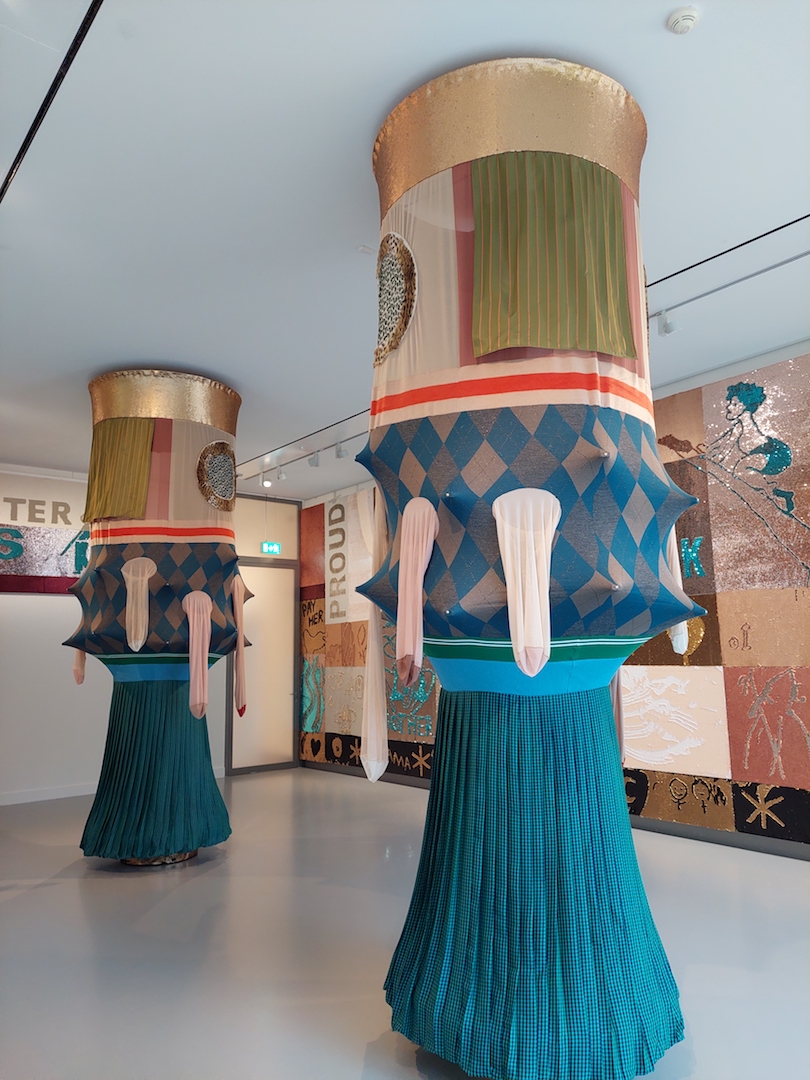 The House of Heroines, based on an Egyptian temple to Hathor, by Lara Schnitger. Photograph by S. Anderson.The pieces that moved me the most in the exhibition were the two, very large fabric installations called 'The House of Heroines', first shown in 2020 in Melbourne, Australia. Suspended from the ceiling, these sculptural columns create a sense of sacredness. The columns are made of fur, silk, sequined fabric, cotton, nylon, wood, and metal. Around the surrounding wall is a frieze of two-toned sequined fabric with messages.
The House of Heroines took inspiration from wall carvings and reliefs in an Egyptian goddess’s temple: the Temple of Hathor, in Dendera, in Egypt, which dates from the 1st century BCE. Visitors at the art installation are invited to make their own messages on the fabric panels with their fingers.
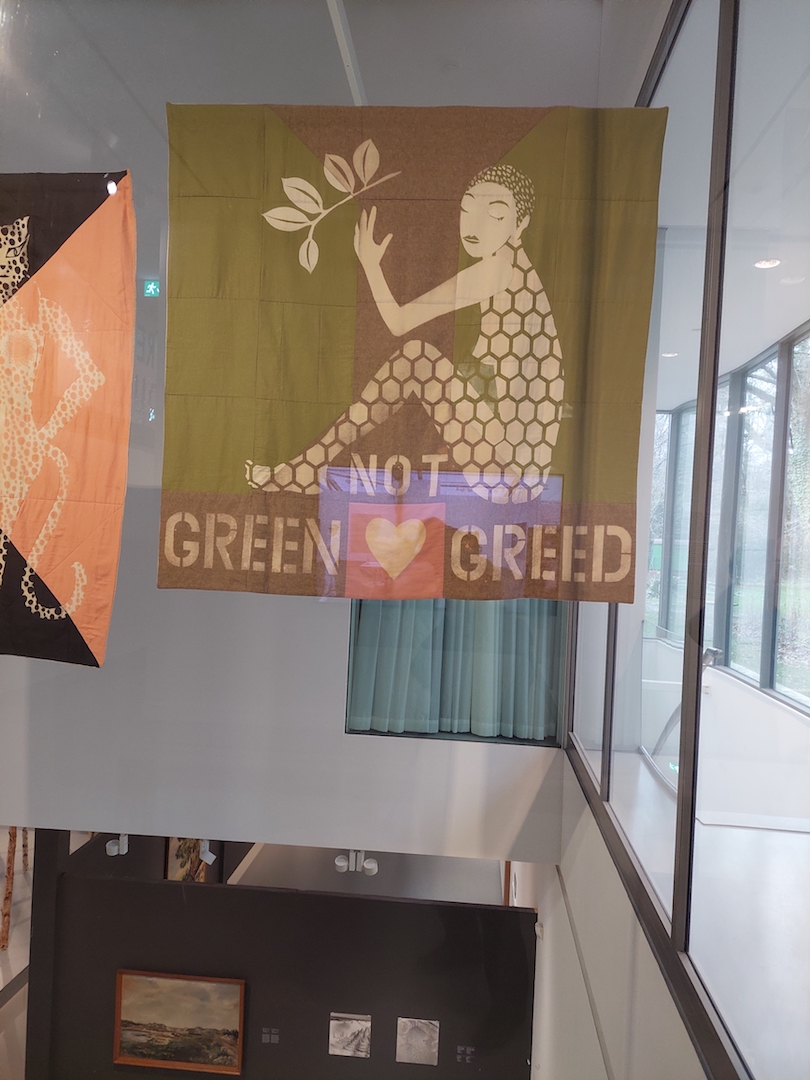 Quilts by Lara Schnitger. Photograph by S. AndersonThe quilts hang from the ceiling in another room. According to an interview with the artist, “The quilts represent community, coming together, and sharing stories.” Mostly composed of large cotton or linen blocks , they display messages such as “Love Your Boob” , “Green Not Greed”, or “A Dress is not a Yes”. The quilts have a dual purpose—they are art objects, but also serve as banners during marches.
I, for one, am looking forward to Schnitger’s workshop, and the procession, on International Women’s Day in Alkmaar.
Stitch Witch is open until 9 June 2025 at Museum Kranenburgh in Bergen, Noord-Holland, The Netherlands. For more information, including an interview with the artist, see www.kranenburgh.nl.
By Shelley Anderson, TRC volunteer, 11 January 2025.