• F1
  • F2
  • F3
  • F4

One of the outfits designed and made by Kate Askham, final year fashion show, Manchester 2019.One of the outfits designed and made by Kate Askham, final year fashion show, Manchester 2019.Where has the year gone? I look back on my time at the TRC (together with Kazna Asker) with such fondness and am so grateful for the way it shaped my studying this past year. It's been about two weeks since I graduated, which feels extremely surreal and I am now looking for employment, still in glorious Manchester.

I wanted to share with you some photos of my final collection (see here), which I ended up basing around my family living in Glasgow and Iceland during the sixties and seventies. At the very core of my research and design, was a deliberate selection of the fabric and the sourcing of the material.

I made the very first garment of my fashion show presentation with some beautiful black silk-satin that the TRC gave to me, and it set the tone for the rest of my collection entirely. I also used by-product and ethically tanned leather, which I sourced from a British warehouse. The leather I decided to use were all end-of-line pieces, so I was really pleased to give them a new lease of life.

I used only natural fibres, and I carefully selected companies that have sustainability as their key focus. Amazingly, every single piece of my collection was thus made from by-products, surplus or recycled fibres and fabric - thanks to how much the TRC taught me about fibre types, material qualities and why it's worth spending the extra time and care, in order to use something in a responsible manner.

I'm now looking at moving into product development, which will hopefully take me all around the world, and enable me to assist design teams to focus on details, sourcing of fabrics, and finding suitable ateliers with expertise to create beautiful clothes. I think within the next six months I will be in London, and am hoping to work with my tutor Kiran Gobin, who suggested I could perhaps work in his design team. I am also wanting to do some further study eventually, and some more academic writing because I so enjoyed writing my dissertation - I am so eager to be challenged.

I'd love to come and visit you all again, and see what's going on there. Thank you again for such a wonderful experience. I realise how lucky I was to get such an insight, especially at a point where I was struggling to see the value of what I was studying! It was completely eye-opening and the TRC encouraged me to being curious again.

Please give my best wishes to everyone at the TRC and all those I met there!

KINDEST regards, Kate Askham

The London based firm of Hand & Lock has been producing embroideries for court and military uniforms, and diplomatic and religious garments, since 1767.

From their current premises at 86 Margaret Street, Fitzrovia, London, they are still actively involved in producing and teaching embroidery, especially with gold and silver thread.

TRC has long been collaborating with Hand & Lock, and they recently donated a series of replicas of insignia for chivalric orders, some of which worn by the famous British admiral, Horatio Nelson (see here for more information). The latest issue of their journal, Hand & Lock, contains an article about the TRC (pp. 83-86). A PdF version of the article can be downloaded here.

To purchase this issue of Hand & Lock, please go to the attached web address.

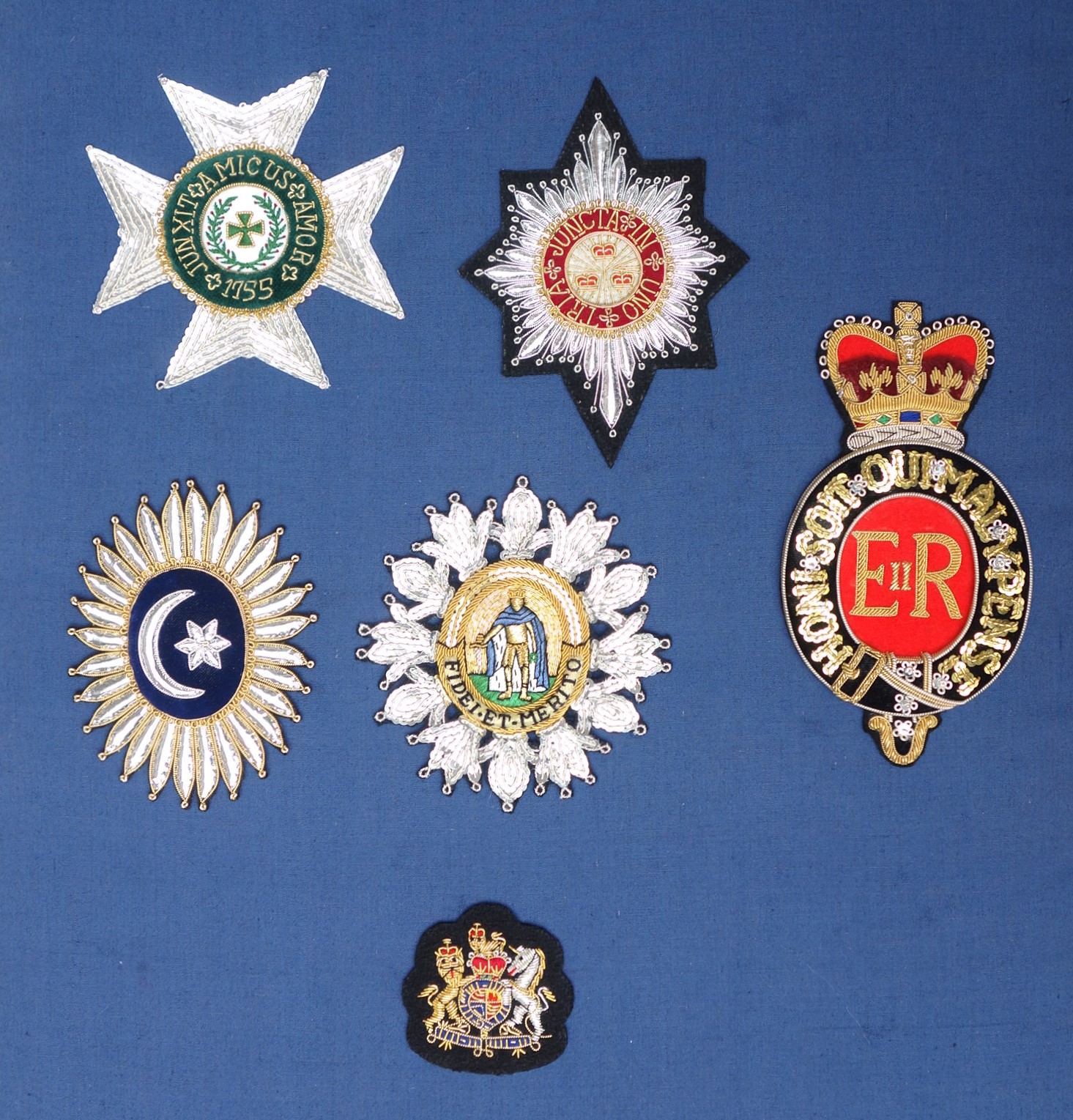
Replicas of embroidered insignia of chivalric orders, made by Hand & Lock.Replicas of embroidered insignia of chivalric orders, made by Hand & Lock.On Tuesday, 6th August 2019, Gillian Vogelsang wrote:

Yesterday the TRC received a parcel from the embroidery firm of Hand & Lock. They have been based in London since the late 18th century and are a major force in the world of elite hand and machine embroidery.

For the last few years the TRC and Hand & Lock have been working together to support research into the history of embroidery and as part of this co-operation they donated various embroidered British insignia, to be used in Volume 3 of the Encyclopedia of Embroidery, which is being published by Bloomsbury, London.

Four of the insignia are replicas of the insignia worn by the British admiral, Horatio Nelson (1758-1805), who died at the Battle of Trafalgar in 1805. The Orders are:

The Order of St. Joachim (top left) was instituted in 1755 by a group of German nobles, in order to promote religious tolerance in Europe. Horatio Nelson accepted the Grand Cross of the Order in 1802. The insignia of the Order is made of gold and silver metal thread with a silk embroidered centre on white raycott. It is surrounded by a raised green velvet garter with gold smooth purl lettering edged with gold pearl purl. The four points of the cross are worked with silver spangles caught down with silver rough purl.

The Most Honourable Order of the Bath (top centre) was instituted in 1725 by King George I of the United Kingdom. The insignia of this Order has a central crest that depicts three crowns in gold and silver wire embroidery, which is surrounded by a raised red velvet garter with gold wire lettering.

Rear-Admiral Horatio Nelson (1758-1805), by Lemuel Francis Abbott (1799). He is wearing, among others, the insignia of the Order of the Crescent; the Order of Saint Ferdinand and Merit; and the Order of the Bath (National Maritime Museum Greenwich).Rear-Admiral Horatio Nelson (1758-1805), by Lemuel Francis Abbott (1799). He is wearing, among others, the insignia of the Order of the Crescent; the Order of Saint Ferdinand and Merit; and the Order of the Bath (National Maritime Museum Greenwich).The Order of the Crescent (middle left) was instituted by the Ottoman sultan, Selim III, to honour Horatio Nelson for his defeat of the French fleet at the Battle of the Nile (1798). The insignia was worn by high ranking officers and others involved in the Napoleonic Wars. It has a raised midnight blue velvet centre depicting a silver plaited embroidered star and crescent moon. The surround is edged with gold wire. In the most recent issue of the Hand & Lock journal (summer 2019), Alice Murrell has writtten a short paper on the Order of the Crescent.

The Order of St. Ferdinand and of Merit (middle centre) was instituted in 1800 by the Kingdom of the Two Sicilies. The insignia of the Order is made with gold and silver metal thread with a silk embroidered centre depicting St. Ferdinand in a blue and white silk cloak and clutching a silver wire sword. The surrounding points of the crest features silver spangles.

In addition, Hand & Lock kindly donated a badge for a Royal Postillion (middle right), the man who rides or walks with one or more horses pulling royal carriages or the hearse during state funerals. The badge is normally worn on the left sleeve. Also included in the parcel from Hand & Lock was a military cap badge (bottom).

On Tuesday, 30th July 2019, Gillian Vogelsang wrote:

Last Sunday we visited the Holocaust Museum (Yad Vashem), a moving experience because it was so personal. It was about a generation and more of people who vanished. Many of the chronological themes were explained via objects such as photographs, travel documents, letters, a battered watch or a broken toothbrush. Other stories were told via garments, such as a blouse taken from a mound that was recognised as having belonged to a friend and neighbour, a pit full of shoes, yellow Stars of David, and most telling, the blue and white striped garments worn in the camps. This museum really shows how clothing can be used to tell hard stories and pass on messages and emotions.

Street scene in the Jerusalem bazaar, 29 July 2019. Photograph Willem Vogelsang.Street scene in the Jerusalem bazaar, 29 July 2019. Photograph Willem Vogelsang.On Monday, 29th July, Gillian Vogelsang wrote from Jerusalem:

The last two weeks have been quite a time, both at the TRC Leiden itself and for myself. It has included the Out of Asia programme in Leiden, between 14 and 19 July. A few days later I took part in a symposium at Leicester University about science and archaeological/historical textiles, and now with Willem we have a few days in the old city of Jerusalem (a holiday, of sorts).

A theme of all these events, which became clear to me the last few days, has been the passing down of knowledge and community identity through crafts, rather than solely by the written word (a skill that was long in the hands of a few, elite men).

It has left me a little sad, as it is clear that conflicts, changes in communication (spending time on telephones and watching tv), technology (computer driven machines) and that dreaded word globalization have broken the lineage of generations of craft knowledge, which will never come back.

Opening of the Out of Asia exhibition, TRC, 14th July 2019. Photograph: Willem Vogelsang.Opening of the Out of Asia exhibition, TRC, 14th July 2019. Photograph: Willem Vogelsang.On Sunday, 21st July, Gillian Vogelsang wrote:

Last week Sunday (14th July 2019) saw the opening of the TRC exhibition: Out of Asia: 2000 Years of  Textiles a pop-up exhibition that was set up to coincide with  the massive International Convention of Asia Scholars in Leiden (co-organised by the International Institute for Asian Studies) and which had as its theme: Asia and Europe, Asia in Europe.

Over fifty people came to the opening of the TRC exhibition. I gave a lecture about ancient and modern textile contacts between Asia and Europe, and about the so-called Silk Roads that led from China, through Central Asia to the Middle East and on to Europe. And of course, in some cases in the opposite direction. But not only items were transported along the Silk Roads, but they also moved from India in all directions of the compass and were often transported along many maritime trade routes. Think of chintz and Kashmir shawls, and of course, the Paisley motif (buteh) that originated in India.

Exeter cathedral, the western facade, June 2019. Photograph Willem Vogelsang.Exeter cathedral, the western facade, June 2019. Photograph Willem Vogelsang.On Sunday, 30th June, Gillian Vogelsang wrote:

Willem and I have spent the last few days in the southern English town of Exeter. He was at a Central Asian conference at the University, while I was working, following up on an earlier visit in February this year, on various textiles housed in Exeter Cathedral. The origins of this magnificent building date back for some one thousand years and it is well worth a visit in itself.

In fact, I wanted to go back to Exeter because of my work on Volume Three of the Encyclopedia of Embroidery series, about Scandinavian and Western European forms. I am studying and gathering ideas for various entries, namely one on the use of hand embroidery for military and civilian uniforms and related items, on the use of embroidery within an ecclesiastical setting and finally an entry on medieval embroidery forms. In particular, I was at Exeter to see some examples of Opus Anglicanum (OA), which is a medieval form of English embroidery that was famous throughout Europe in the 12th-15th centuries.

The first two entries being researched will include items from within the Cathedral itself, such as the flags from various regiments that have been laid up there.They include various types of metal thread embroidery and applique techniques.

I was also looking at various medieval effigies of bishops to make notes about the embroidery depicted on their vestments, episcopal slippers, and associated cushions.

Regimental flags laid up in Exeter Cathedral, June 2019. Photograph Willem Vogelsang.Regimental flags laid up in Exeter Cathedral, June 2019. Photograph Willem Vogelsang.But most importantly, there are various examples of OA in Exeter, notably the St. Petrock Pall (in the Cathedral) and the pall from St. Mary's Arches Church, now on display in the Royal Albert Memorial Museum. In both cases the cloths are correctly called palls, but in the sense of an altar covering (altar pall), rather than a cloth covering a coffin (funeral pall).

Having the chance to see OA in detail was a treat and my appreciation for the skill of these unknown embroiderers so many centuries ago has increased considerably. The visit also left me with many more questions (as normal). Such as where did the St. Petrock Pall's silk come from, who made the background cloth, did the embroiderers use more than one type of couching, which is regarded as particular to OA, namely underside couching, and how was the final object used.

The indignation of what had happened to the Cathedral’s treasures (including its vestments) during the Reformation in the 16th century is still very much alive among the people working there!

I would like to thank all at the Exeter Cathedral Archives for their kindness, help and interest during my all to brief visit. We hope to come back soon!

Zoek in TRC website

Contact

Boerhaavelaan 6
2334 EN Leiden.
Tel. +31 (0)71 5134144 (kantooruren)  
office@trcleiden.org

Het TRC is elke dag geopend tussen 10.00 en 15.00 uur.

facebook 2015 logo detail


instagram vernieuwt uiterlijk en logo


Bankrekening

NL39 INGB 0002 9823 59, t.a.v. Stichting Textile Research Centre.

Financiële giften

Het TRC is afhankelijk van project-financiering en privé-donaties. Al ons werk wordt verricht door vrijwilligers. Ter ondersteuning van de vele activiteiten van het TRC vragen wij U daarom om financiële steun:

Giften kunt U overmaken op bankrekeningnummer (IBAN) NL39 INGB 000 298 2359, t.n.v. Stichting Textile Research Centre. BIC code is: INGBNL2A

U kunt ook, heel simpel, indien u een iDEAL app heeft, de iDEAL-knop hieronder gebruiken en door een bepaald bedrag in te vullen: 


Omdat het TRC officieel is erkend als een Algemeen Nut Beogende Instelling (ANBI), en daarbij ook nog als een Culturele Instelling, zijn particuliere giften voor 125% aftrekbaar van de belasting, en voor bedrijven zelfs voor 150%. Voor meer informatie, klik hier