• F1
  • F2
  • F4
  • F3

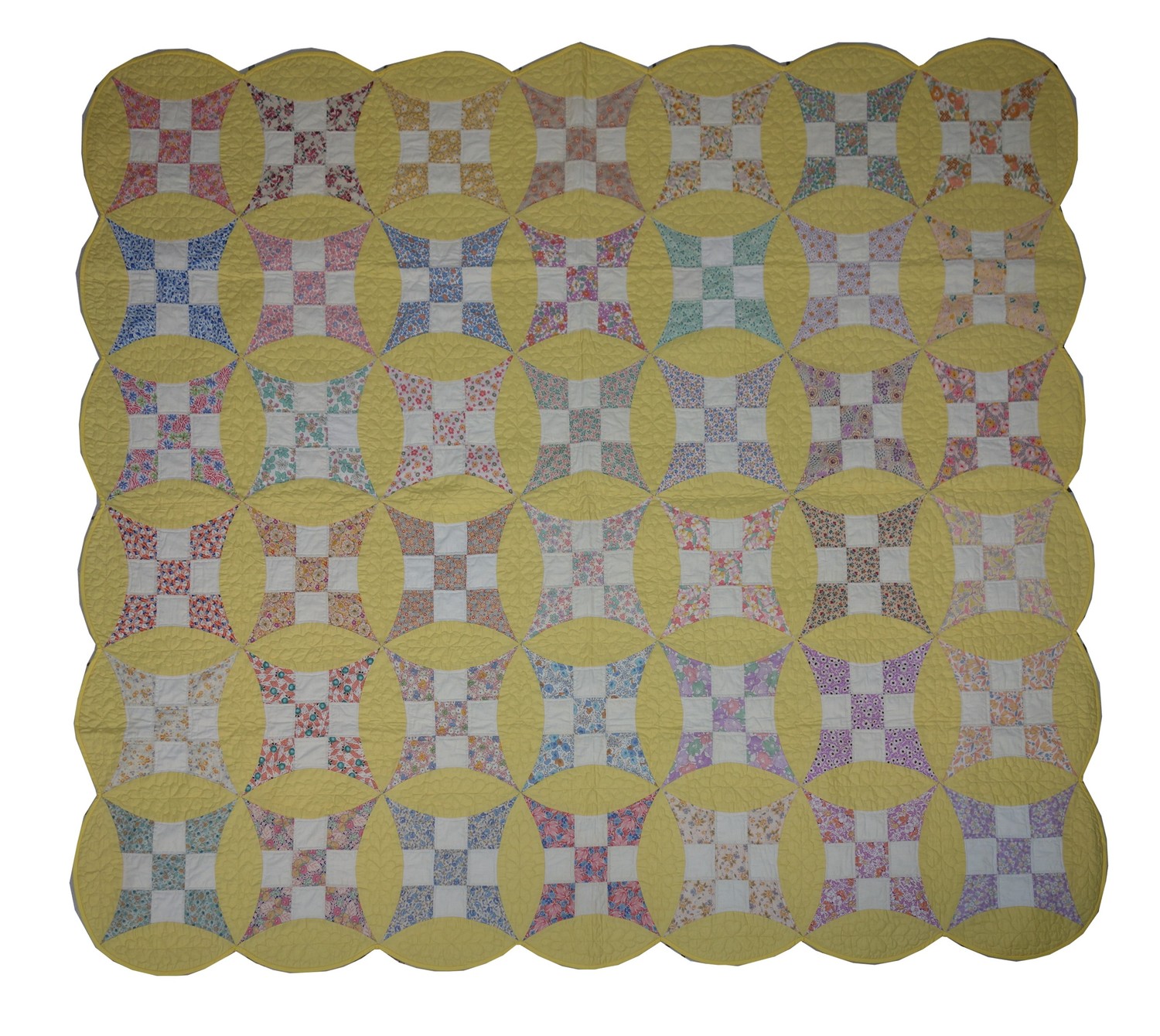
Quilt with 'cheater'  design, USA, 1960s (TRC 2018.2407).Quilt with 'cheater' design, USA, 1960s (TRC 2018.2407).The second box of US quilts, tops and related items, including some nineteenth century ‘spare’ blocks, has just arrived at the TRC. These are part of a donation of quilts by Sherry Cook, who has very kindly agreed to give some of her collection to the TRC (see previous blog about the first box, and Sherry’s blog about why she is making this donation).

The first box arrived a few weeks ago and already all the items have been put online at TRC Collection Online, nos. TRC 2018.2404 – TRC 2018.2432a. The items from the second box will come online by the beginning of August 2018.

The donation by Sherry Cook provides a fascinating look at American quilts from the late nineteenth century to about the 1980’s and includes examples made in silk, velvet, cotton, as well as synthetic materials. The designs range from Bow Tie, via Morning Glory, Pansy, Roman Square to Star Dahlia. A third box is due in a few weeks’ time! 

Gillian Vogelsang-Eastwood, Thursday 19th July 2018

Preparations for Vol. 8 of the Encyclopedia of Embroidery series, covering the Antarctic, are already well advanced. Martin Hense, the draughtsman for the full series, just completed the first illustration.Preparations for Vol. 8 of the Encyclopedia of Embroidery series, covering the Antarctic, are already well advanced. Martin Hense, the draughtsman for the full series, just completed the first illustration.During the last few months the Encyclopedia of World Embroidery series (Bloomsbury Publishing, London), has been gaining momentum. The first volume on embroidery from the Arab World came out in 2016 (see here) and to everyone’s pleasure won the prestigious international award, the Dartmouth Medal.

Since then we have been working hard on volume 2, which is about embroidery from Central Asia, the Iranian Plateau and the Indian subcontinent (see here). The manuscript for this volume has gone to Bloomsbury and the book should appear by the middle of 2020. For the Bloomsbury announcement, click here. Once again many people have been helping with advice, suggestions and with providing actual examples of embroidery. Preparations for Vol. 3 on (West) European embroidery are progressing well.

For the next few years, we are planning the following volumes: 3 – Scandinavia and Western Europe; 4 – East and Southeast Asia; 5 – Eastern Europe and Russia; 6- Sub-Saharan Africa; 7- The Americas. 


Thanks to the generosity of the Prins Bernhard Cultuurfonds and the Themafonds Digitalizering Erfgoedcollecties Zuid-Holland, the TRC Leiden has received a substantial grant to update the online catalogue of the TRC collection, improve and extend the digital database and to revamp the internet presence of the TRC in general. The work will start very shortly in re-styling the database, updating programmes, and getting even more photographs and information online!

Kangas at the exhibition “Our Kisses are Petals’, at Newcastle’s BALTIC Centre for Contemporary Art. Photograph: Shelley Anderson.Kangas at the exhibition “Our Kisses are Petals’, at Newcastle’s BALTIC Centre for Contemporary Art. Photograph: Shelley Anderson.Shelley Anderson, volunteer at the TRC, writes about a recent visit to England:

The words ‘textile’ and ‘art’ caught my eye, of course, on a recent visit to the city of Newcastle in northern England. The exhibition “Our Kisses are Petals’ was on at Newcastle’s BALTIC Centre for Contemporary Art.

The artist was Lubaina Himid (born 1954, in Zanzibar), who won last year’s prestigious Turner Prize for modern art. The exhibition consisted of over a dozen large, banner-like canvases, attached to a system of pulleys. Each canvas depicted a part of the body, for example, the eyes, tongue, or heart, and a line of poetry by a black British or American poet.

Himid herself is the first black woman to win the Turner Prize. She is also the oldest, at 63, winner in history. Visitors were encouraged to rearrange the order of the quotes on the canvases by pulling on the pulleys. The paintings were based on the East African textile known as kanga. Also worn in Oman, the kanga is a versatile garment used by women as a dress, a head wrap, and sometimes a baby carrier.

Late 19th century American 'crazy quilt', 159 x 135 cm, donated by Sherry Cook (TRC 2018.2407).Late 19th century American 'crazy quilt', 159 x 135 cm, donated by Sherry Cook (TRC 2018.2407).Sherry Cook writes from America: My husband, Darwin, and I downsized from a large home in the fall of 2014 and have had a lot of boxes in storage since that time. We are now building a barn that will have small living quarters and storage space so I can get myself and the boxes organized. We also have our 60th wedding anniversary in September, so the decision has been made to downsize even more, to get everything organized, and at a faster pace.

We have been donating textiles to the Center for American History (CAH) in Austin, Texas since 2008. You can google the “CAH” or “Sherry A Cook, Quilter” to see some of the items we have donated. But we have now decided to support and encourage the TRC Leiden. We are very impressed with TRC’s leadership team, volunteers and all their efforts to work with world textiles.

It is not often that I am hesitant to open a box of textiles, but this one has got me thinking very hard and long! By opening it we commit ourselves to increasing the USA textile and dress collection (a good thing) and to setting up the TRC Quilting Centre (also a good thing, but with lots of implications!).

The parcel comes from Sherry Cook in the USA and has eight quilts and quilt tops, plus feedsacks and other items. This is the first of several parcels, with the idea of Sherry donating many of her American quilts to the TRC in order to make a European based quilting centre that will look at quilting through the centuries from Roman times onwards, and throughout the world.

I have been discussing this idea with various colleagues, friends and quilters, and everyone things it’s the right thing to do, but it does have implications with respect to space, storage, exhibitions, workshops, etc. Within the last few days we have already been offered another collection of quilts from various countries, including Switzerland and New Zealand.

So I am taking a deep breath, drinking a cup of tea (I am British after all…..), and thinking about where further financial and logistical help can come from! But I know the TRC, we will do it and the TRC Quilting Centre will be a major addition to the study of textiles in the Netherlands (and elsewhere!). But it is going to be a very large pot of tea!

Gillian Vogelsang-Eastwood, 28th June 2018


Karen Finch (1921-2018) at the Textile Conservation Centre, Hampton Court (copyright The Guardian)Karen Finch (1921-2018) at the Textile Conservation Centre, Hampton Court (copyright The Guardian)We have just heard the sad news that Karen Finch has died. A Grande Dame in the best sense of these words. She was responsible for creating the Hampton Court Textile Conservation Centre and for bringing textile conservation into the professional world in Britain. She hammered home the message that textiles have a story to tell and should be treated with respect (and not simply as an ‘old rag’). A message that the TRC will continue to push, shout and battle for!

Karen also had an influence on me as a young student, she was always willing to answer questions, make suggestions and tell stories. When I first started as a textile archaeologist in the early 1980’s she gave me a one week ‘conservation’ course at Hampton Court – basically first-aid for textiles – free of charge and with the willing help of all her staff. A week that gave me confidence and helped me to the present day. We have kept in contact, as have many of her former students, even if it was only a Christmas card, or a quick chat at this meeting or that conference. I am proud to say I am one of her ‘girls’. Thank you Karen.

Gillian Vogelsang-Eastwood, Director, TRC Leiden.

For a full obituary of Karen Finch, click here.

Zoek in TRC website

Contact

Boerhaavelaan 6
2334 EN Leiden.
Tel. +31 (0)6 28830428  
office@trcleiden.org

facebook 2015 logo detail


instagram vernieuwt uiterlijk en logo


Bankrekening

NL39 INGB 0002 9823 59, t.a.v. Stichting Textile Research Centre.

Openingstijden

Het TRC is gesloten tot maandag 4 mei vanwege de verhuizing naar de Boerhaavelaan. We blijven bereikbaar via email (office@trcleiden.org) of telefoon: 06-28830428.

Financiële giften

Het TRC is afhankelijk van project-financiering en privé-donaties. Al ons werk wordt verricht door vrijwilligers. Ter ondersteuning van de vele activiteiten van het TRC vragen wij U daarom om financiële steun:

Giften kunt U overmaken op bankrekeningnummer (IBAN) NL39 INGB 000 298 2359, t.n.v. Stichting Textile Research Centre. BIC code is: INGBNL2A

U kunt ook, heel simpel, indien u een iDEAL app heeft, de iDEAL-knop hieronder gebruiken en door een bepaald bedrag in te vullen: 


Omdat het TRC officieel is erkend als een Algemeen Nut Beogende Instelling (ANBI), en daarbij ook nog als een Culturele Instelling, zijn particuliere giften voor 125% aftrekbaar van de belasting, en voor bedrijven zelfs voor 150%. Voor meer informatie, klik hier