• F1
  • F4
  • F2
  • F3

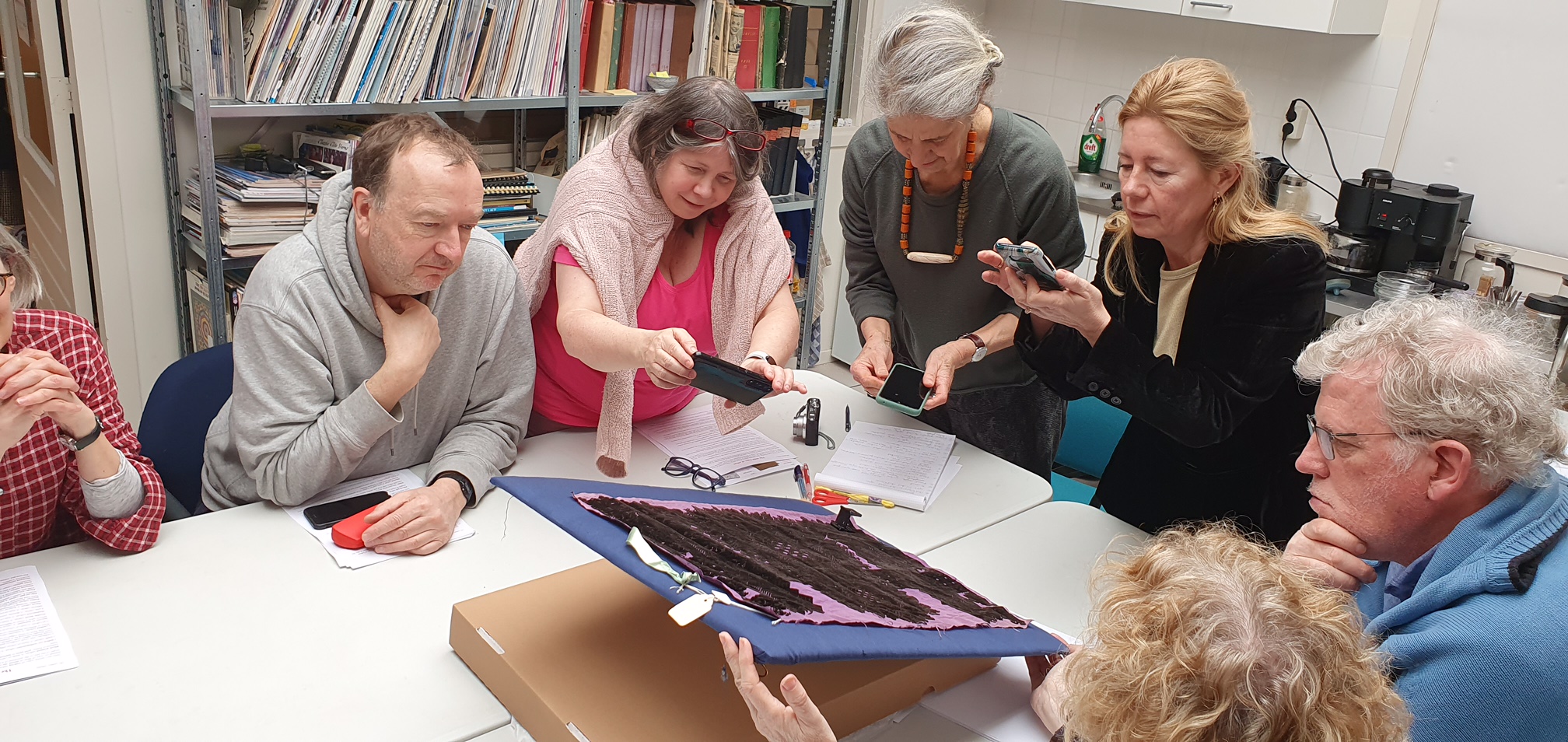
We have been waiting for this moment for some time and yesterday afternoon it finally arrived, namely the Amsel Collection from Paris. The collection was made by Prof. George Amsel and his wife Monique during most of their married life.

Equally as remarkable as the items themselves are the detailed and fascinating stories that Monique is sharing with us about the people and crafts they had encountered collecting all of it.

A small part of the Amsel collection, being prepared for cataloguing and photographing at the TRC, 21 February 2022. Photograph: Augusta de Gunzbourg.A small part of the Amsel collection, being prepared for cataloguing and photographing at the TRC, 21 February 2022. Photograph: Augusta de Gunzbourg.

Packed and prepared by TRC volunteer Augusta de Gunzbourg and the owner Monique Amsel for the past few weeks, the items were then transported from Paris to Leiden over the weekend by two other TRC volunteers, Rebecca and David Hix. In it, there are over 700 textiles and garments, mainly from Hungary and Romania.

Waistcoats and coat from the Amsel collection, 21 February 2022. Photograph: Augusta de Gunzbourg.Waistcoats and coat from the Amsel collection, 21 February 2022. Photograph: Augusta de Gunzbourg.Among other miscellaneous items in this wonderful collection: pieces from China, Central Asia, India, Thailand, as well as a group of hitherto unprovenanced textiles.  So far, we have handled a lovely early 19th century hand embroidered Kashmir shawl with numerous buteh (paisley) motifs, and various examples of mola from Panama that complement the mini-exhibition on the same subject that we are currently preparing (they will be on display from March in the TRC Gallery). There are even some raffia embroideries from the Congo.

Blouses from the Amsel collection, 21 February 2022. Photograph: Augusta de Gunzbourg.Blouses from the Amsel collection, 21 February 2022. Photograph: Augusta de Gunzbourg.A group of volunteers led by Augusta spent today starting to sort out the various groups of textiles and clothing, by tagging, numbering and hanging related items on clothing racks prior to them being fully catalogued, photographed and eventually put in the new deep freezer to prevent insect damage. A job that will take weeks to complete.

From the 1960s and '70s onwards, the Amsels regularly travelled to various regions of Hungary and Romania and deliberately collected regional costumes - from various groups such as the Csangos or Hutsuls - that reflect the diversity of Hungarian costume and its diaspora in neighbouring countries. Embroidery is certainly one of the main features of these items: numerous embroidered and beaded dresses, blouses, as well as fleece waistcoats or even belts both for men and women are all represented.

Dresses from the Amsel collection, 21 February 2022, together with one of the TRC volunteers. Photograph: Augusta de Gunzbourg.Dresses from the Amsel collection, 21 February 2022, together with one of the TRC volunteers. Photograph: Augusta de Gunzbourg.We are in contact with various groups in Hungary about this collection, such as Dr Maxim Mordovin from the Eötvös Loránd University and historian Orsolya Zay, in order to gain a deeper understanding of these items. There will be certainly be numerous embroidery charts being worked out in the following months,

One of the long-term plans is to make an online (and real-life eventually) exhibition about the Hungarian items, as well as a complete catalogue of the Hungarian pieces that will be written in conjunction with Monique Amsel. We would need about 6000 euros to make such a catalogue so if you know of a funding body that is interested in Hungarian culture, please let us know!

Over the next few months there will be a regular blog about this collection, reflecting a range of techniques, designs and functions, related to individual items or groups of objects.

Augusta de Gunzbourg and Gillian Vogelsang, 21 February 2022.

RC director interviewed for Turkish press agency, 7 February 2022RC director interviewed for Turkish press agency, 7 February 2022Knowledge about the TRC Leiden and its many textile activities is spreading! A week ago Inge Bosman of the Nederlandse Kostuumvereniging came to see what the TRC Leiden actually does (people often think they understand from the website, but when they actually see us it generally is a ‘Ahhh now I really understand’) and interviewed various members of the TRC.

Her article will appear in the next bulletin of the society. She will be stressing the role of the TRC as a ‘Textile Ark’ and a place where knowledge about textile technology and crafts, as well as dress and identity can be studied at various levels. The need for such an Ark (some might call it a textile museum) in the Netherlands is becoming very apparent as more and more people are discovering textiles and want to learn more.

We have also been talking with Polly Leonard from the international textile journal Selvedge (London) about bringing the TRC to the attention of a much wider and global public. Polly is very active in the world of textiles and has many (active) ideas.

In addition, in January Selman Aksünger, who is based in Amsterdam, but works for the Turkish Anadolu News Agency in Ankara, came to the TRC to see what we are doing. He was particularly interested in what the TRC has with respect to the various Turkish communities throughout the world, literally from Turkey itself, to Central Asia (Turkmenistan, Turkmen communities in Iran, etc) and of course, the diaspora in Europe, including Leiden.

I had to admit we are ‘short’ on Turkish regional dress and would love to find a patron willing to help build up this historic aspect of Middle Eastern and indeed Southeast European (think Ottoman Empire) textiles and dress, so that everyone here can share in this rich heritage. This is becoming even more important as we are about to receive two large collections of southeastern European textiles and dress, and understanding dress and textile traditions from this part of the world is becoming more significant.

So I am very pleased to announce that Selman Aksünger's article (in Turkish) and short film have been published and have already been translated into Arabic. It will also shortly appear in other languages.

Please click here for the link to the article and click here for the YouTube film.

Gillian Vogelsang, Director TRC, 7 February 2022

From 26 January 2022, the TRC is open to the public on Monday to Thursday from 10.00 - 15.00.  Currently there are no exhibitions on display. The gallery will shortly be used for the processing of two large collections that will soon arrive in Leiden. Along the walls however, special textiles and garments are being shown. By the late summer we will mount a large exhibition on ikat worldwide.

First workshop of 2022 at the TRC, Wednesday 19 January. For the first few months of 2022, workshops and courses will be given in the TRC gallery. The walls are decorated with specific items from the collection.First workshop of 2022 at the TRC, Wednesday 19 January. For the first few months of 2022, workshops and courses will be given in the TRC gallery. The walls are decorated with specific items from the collection.

For all visitors the protocol applies that is given below. 

We want to make sure that all our staff and all our visitors will remain healthy and not affected by the corona virus. We are following Dutch governmental guidelines, and according to the so-called 3G system, and we ask our visitors to heed the following rules:

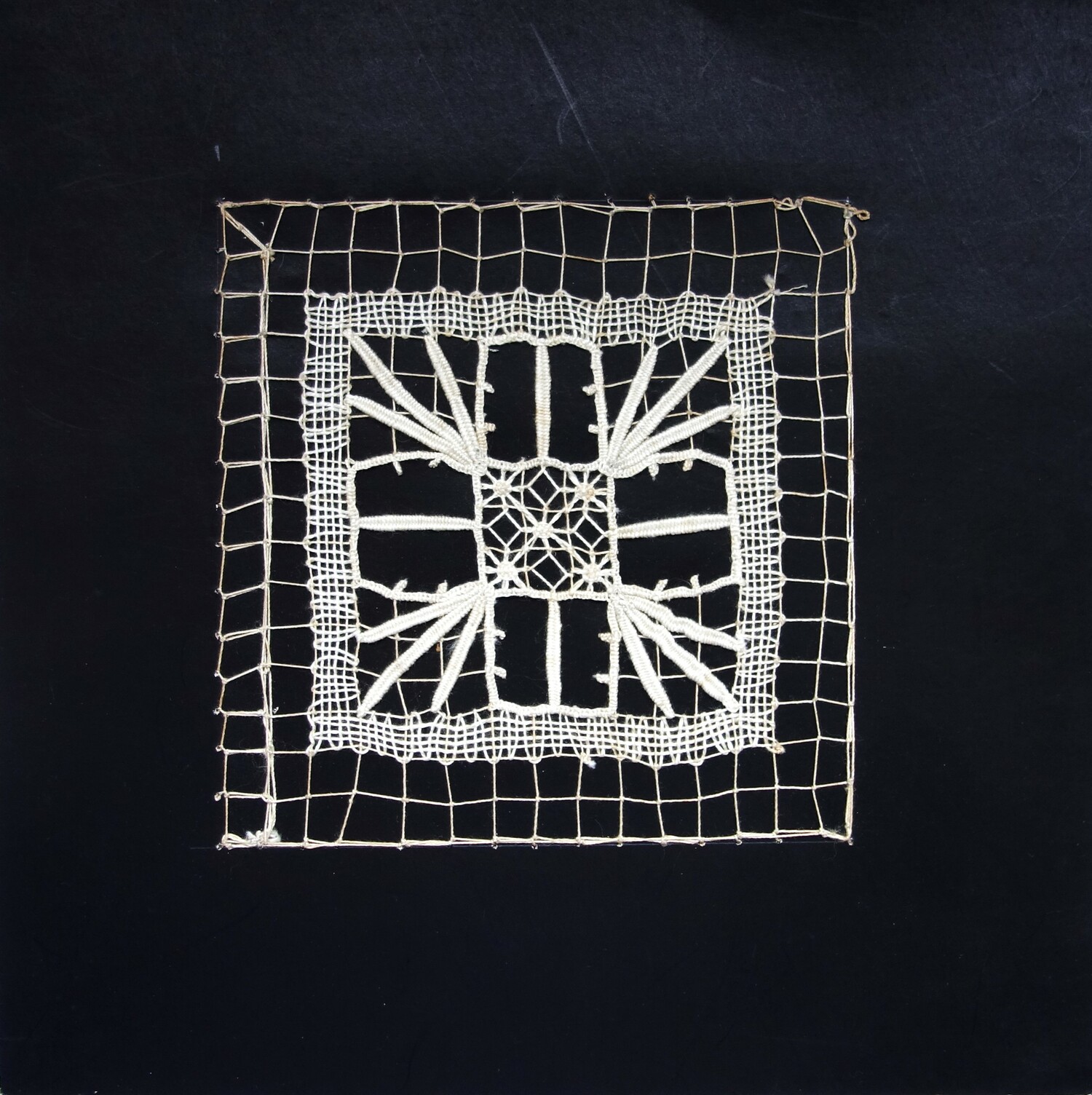
Round doily in handmade guipure bobbin lace made in three levels (TRC 2007.0582).Round doily in handmade guipure bobbin lace made in three levels (TRC 2007.0582).Guipure lace is a form of bobbin lace, whereby the patterns are connected with bars or plaits, and not with a mesh or net. The patterns, placed closely together, may be outlined with a thicker thread (gimp) and they may have an almost three-dimensional, raised appearance. It is nowadays also known as Venetian lace.

The traditional lace from Genoa (Genoese lace) was a guipure lace, and hence it was allegedly introduced to Malta, leading to the development of Maltese lace. From Malta this type of lace was taken to England, where it influenced the development of Bedfordshire (Maltese) lace. Another type of guipure lace is Cluny lace and Hollands (Dutch) lace from the early 20th century.

The course is given by Gon Homburg. She learned to make lace from her mother and from 1983 she has been officially registered as a bobbin lace teacher. She teaches enthusiasts and gives workshops to various art schools.

We are tidying up at the TRC Leiden in anticipation of various large donations that will shortly be coming to Leiden. As a result we came across some first-day covers and postage stamps in the collection, all with a textile theme, and this led to another look at these small, but sometimes very interesting objects. We already discussed the subject of stamps and textiles in an entry for TRC Needles, but we acquired new items since writing and, let's face it, there is nothing wrong with reminding people of yet another aspect of textile studies.

Sheet of six stamps depicting types of lace and tools (Spain, 1989). The lace dates from the XVth-XVIIIth century and come from the regions of Catalonia, Estremadura, Castilla la Mancha, Andalusia, Canary Islands and Galicia (TRC 2016.0284).Sheet of six stamps depicting types of lace and tools (Spain, 1989). The lace dates from the XVth-XVIIIth century and come from the regions of Catalonia, Estremadura, Castilla la Mancha, Andalusia, Canary Islands and Galicia (TRC 2016.0284).

Photograph of the astronomer, Henrietta Swan Leavitt (1868-1921), with a Brussels duchess lace collar.Photograph of the astronomer, Henrietta Swan Leavitt (1868-1921), with a Brussels duchess lace collar.Since writing about the meeting of lace makers at the TRC on the 23th October (read here) we have had several lace related ‘events’.

These include an email from America with a photographic portrait of a late 19th century woman who is wearing a large lace collar. According to the TRC lace specialist, Olga Iermomina, the collar was made from (Brussels) duchess bobbin lace. There are several, similar examples of lace in the TRC Collection, such as TRC 2007.0673, TRC 2007.0845TRC 2015.0287, and TRC 2015.0288.

In addition, there was the offer of three lace collections. One will be brought to the TRC in a few weeks time and consists of general samples, equipment and books, the others will be donated later and mainly consist of equipment, lace samples and examples of different types of Dutch lace caps. Lots of potentially interesting items!

Detail of a silk sash with Duchesse (bobbin) lace at the ends, Belgium (TRC 2007.0845).Detail of a silk sash with Duchesse (bobbin) lace at the ends, Belgium (TRC 2007.0845).

For the last few years the TRC has been slowly building up a collection of lace forms and equipment, such as lace bobbins and lace pillows, as well as items of clothing made out of lace. We currently have over 2000 lace related items, which includes many items in the general collection as well as the more specific, lace reference collections.

Sample of Duchess bobbin lace, 1920s (TRC 2015.0287).Sample of Duchess bobbin lace, 1920s (TRC 2015.0287).

So what does the TRC want to do in the long run with all this lace and related items? We have two ‘routes’. Firstly, various items are needed to support a series of lace classes as part of providing artisan lessons at the TRC and for this we need equipment, patterns and books. Secondly, we are also a knowledge centre for techniques and have an international-level collection with a wide variety of textile types from throughout the world.

Detail of a shawl with Brussels lace. It once belonged to Queen Anna Paulowna (1795-1865), wife of King Willem II of The Netherlands, and a daughter of the Russian Czar Paul I (TRC 2014.0831).Detail of a shawl with Brussels lace. It once belonged to Queen Anna Paulowna (1795-1865), wife of King Willem II of The Netherlands, and a daughter of the Russian Czar Paul I (TRC 2014.0831).

As part of the main collection we want to expand on the five basic lace reference collections that we have set up, namely:

  • Named samples of the basic types of lace, which will be used for identification purposes, including the many types of bobbin, needle and looped forms (the latter include tatted, crocheted, knitted and knotted forms).
  • Different types of pillows, bobbins, pins, hooks, shuttles, rings, etc, required for making various types of lace.
  • A range of lace patterns
  • A range of uses for lace, such as collars, cuffs, doilies, etc.
  • A collection of machine lace samples to show the difference between hand and machine forms, as well as the developments of the machine forms (this is helpful in dating items)

Board with a group of lace bobbins from various countries (TRC 2007.0494).Board with a group of lace bobbins from various countries (TRC 2007.0494).As part of this work we are also making a collection of lace types that were used for making the very diverse forms of lace caps worn in various parts of the Netherlands. This week, for example, will see the arrival of samples of all the main types of lace associated with Rijnland lace caps. These include various types of Rijsselse lace (point de Lille), ‘s Gravenmoer lace (a torchon lace) and Lier lace (tambour embroidered net).

There will also be various examples of typical lace patterns associated with the caps such as gebloemde kant (flower lace), bloempot kant (lit. Flower pot lace, i.e. flowers in ornate vases ) and lyre lace with motifs similar to the musical instrument. These samples will be on display in February 2022 as part of an exhibition of lace caps from the Leiden (Rijnland) region.

Lace pillow with bobbins and sample of torchon lace, Belgium (TRC 2012.0009).Lace pillow with bobbins and sample of torchon lace, Belgium (TRC 2012.0009).In addition to the Rijnland exhibition, we have plans for a series of workshops and courses on lace identification, looking at specific types of lace techniques, as well as one on the difference between hand and machine made laces (it is not not always easy to spot the difference!).

The latter subject has also already led to an online exhibition on the same theme. Another, relevant digital lace exhibition is about silk lace from Malta. More exhibitions are planned. We are also planning a course on the making of oya, also known as Turkish lace.

All in all, lots to think about and to organise - Lace in Leiden is becoming a reality!

Gillian Vogelsang, 2 November 2021

We are currently photographing and cataloguing a donation of stylish garments that were influenced by the fashion house of Chanel and especially by the garments that were worn by Princess Diana (1961-1997).

The pieces were donated by Ms van Dijk, a Leiden resident, and come from her personal wardrobe. They were worn at the end of the 1980s and until the mid-1990s. The donation consists of items mostly sewn by the donor's mother and a friend, supplemented with a few ready-to-wear pieces.

Princess Diana watching a polo match in Cirencester, in 1983. She is wearing a blouse with black spots, and a white skirt.Princess Diana watching a polo match in Cirencester, in 1983. She is wearing a blouse with black spots, and a white skirt.

White blouse with black spots (TRC 2021.2983b), made in imitation of Princess's Diana blouse that she wore at Cirencester, 1983.White blouse with black spots (TRC 2021.2983b), made in imitation of Princess's Diana blouse that she wore at Cirencester, 1983.

By the 1980s Ms van Dijk had just started a professional career and she felt she had to dress accordingly. At the time, suitable business clothing was difficult to find for women, especially as she was petite.

Ms van Dijk admired Diana’s style because it was traditional, but often with a dramatic twist, especially with respect to the choice of colour, colour combinations and cut. She felt that Princess Diana was never boring, so she decided that if the British princess could wear this type of clothing, so could she!

One of the outfits given to the TRC consists of a white blouse (TRC 2021.2983b) with black spots. This is based on an outfit worn by the princess in August 1983 to a polo match. The blouse was then worn by the princess on various occasions, sometimes with a white skirt, on other occasions with a black one.

The clothing donated to the TRC also includes both black and white pencil skirts that were suitable for wearing with the blouse.

Princess Diana wearing a red suit designed by Catherine Walker, mid-1990s.Princess Diana wearing a red suit designed by Catherine Walker, mid-1990s.Red jacket and skirt made in imitation of a jacket and skirt worn by Princess Diana in mid-1990s (TRC 2021.2970a-b).Red jacket and skirt made in imitation of a jacket and skirt worn by Princess Diana in mid-1990s (TRC 2021.2970a-b).A second outfit is more formal and consists of a tailored jacket (TRC 2021.2970a) with a flat collar, three large buttons down the front and short splits at the hem. The jacket was worn with a pencil skirt (TRC 2021.2970b) in the same material.

The original suit was designed by Catherine Walker (who remains a popular designer with the British royal family) and was worn in the mid-1990s for various events, including an Aids charity meeting. The outfit was worn with black tights and plain court shoes.

The entire donation will be photographed and added to the TRC Collection over the next few weeks. The collection can then be accessed online through our website

Is there someone who inspired you in the way you dress?

Joshua Verkerk and Augusta de Gunzbourg, TRC volunteers, 30 October 2021

T-shirt designed by Kazna Asker.T-shirt designed by Kazna Asker.The blog below was written by Kazna Asker, a young designer from Sheffield in the UK with deep roots in Yemen, who was trained in Manchester at the Metropolitan University and in 2019 spent three months as an intern at the TRC.

***

When viewing the Yemeni collection at the TRC, I was amazed at the wide array of garments that were worn all over Yemen and not just in the village where my family originated. It allowed me to look at Yemeni culture through a much wider perspective, from a distance. I was also able to separate myself from Yemeni clothing traditions and be inspired by the textiles in the large TRC Collection.

Detail of a T-shirt designed by Kazna Asger (TRC 2021.2654).Detail of a T-shirt designed by Kazna Asger (TRC 2021.2654).

When I returned to my Yemeni community in Sheffield, I was deeply inspired as I could see beauty in how we have adapted our Yemeni culture to modern life in Britain. We are the next generation! I used this theme as a source of inspiration for my final collection. My final BA collection linked cultural and religious silhouettes to Western garments. It was later showcased at the Graduate Fashion Week in London and the International Youth Design Competition in Beijing, where it came second place.

Various T-shirts designed by Kazna Asker.Various T-shirts designed by Kazna Asker.I have designed several graphically embellished and embroidered T-shirts, of which I have donated 100% of the profits to charity. I was initially inspired to combine Fashion and Charity when I was fundraising for Restless Development Nepal. This is a youth-led charity which helped me to work in the community of Tikabhairab, Nepal, to educate young people on a range of subjects, including social enterprise, saving and education.

In order to raise more money, I later designed three T-shirts with a focus on the theme of community. The graphics refer to my family, culture and faith alongside the embroidered text ‘COMMUNITY’ on the top of the T-shirt.

When I went back to Yemen, the situation had deteriorated drastically.  I met many families that were severely affected by the pandemic, alongside the terrible civil war. As a result, I continued to sell the T-Shirts, but decided to donate the money to Yemen – including independent British Yemeni charities that work directly on site in Yemen, such as Isra UK and Saba Relief UK.

Model wearing a T-shirt designed by Kazna Asker.Model wearing a T-shirt designed by Kazna Asker.As the designs continued to sell out, I added other forms of graphics and embroidery to my T-shirt range and included embroidered caps and printed tote bags.

My largest supporters have been the Yemeni community in Sheffield and my friends and family! My dad would take a pile of T-shirts and sell them to his friends and I would continue to sell them online via Instagram, Etsy, Facebook and at local community and charity events. We have managed to sell over 500 T-shirts and raised over £5000 profits for charity.

This initiative has been my most rewarding project and I plan on continuing the journey of combining Community, Charity and Fashion for my next projects! I have made a film about my community where you can see directly where my references and inspiration come from. The film focuses on the Muslim diaspora in the UK, in order to change narrative and break stereotypes!

For the film, click here.

You can buy a T-Shirt from my Etsy page and you can view my work on Instagram or Facebook.

Kazna Asker, 11 October 2021

Search in the TRC website

Contact

Boerhaavelaan 6
2334 EN Leiden.
Tel. +31 (0)6 28830428  
office@trcleiden.org 

facebook 2015 logo detail 

instagram vernieuwt uiterlijk en logo


Bank account number

NL39 INGB 0002 9823 59, in the name of the Stichting Textile Research Centre.

TRC closed until 4 May 2026

The TRC is closed to the public until Monday, 4 May 2026, due to our move to the Boerhaavelaan. The TRC remains in contact via the web, telephone and email. For direct contact and personal visits, please contact the TRC at office@trcleiden.org, or by mobile, 06-28830428.

Donations

The TRC is dependent on project support and individual donations. All of our work is being carried out by volunteers. To support the TRC activities, we therefore welcome your financial assistance: donations can be transferred to bank account number (IBAN) NL39 INGB 000 298 2359, in the name of the Stichting Textile Research Centre. BIC code is: INGBNL2A.

 You can also, very simply, if you have an iDEAL app, use the iDEAL button and fill in the amount of support you want to donate: 


Since the TRC is officially recognised as a non-profit making cultural institution (ANBI), donations are tax deductible for 125% for individuals, and 150% for commercial companies. For more information, click here