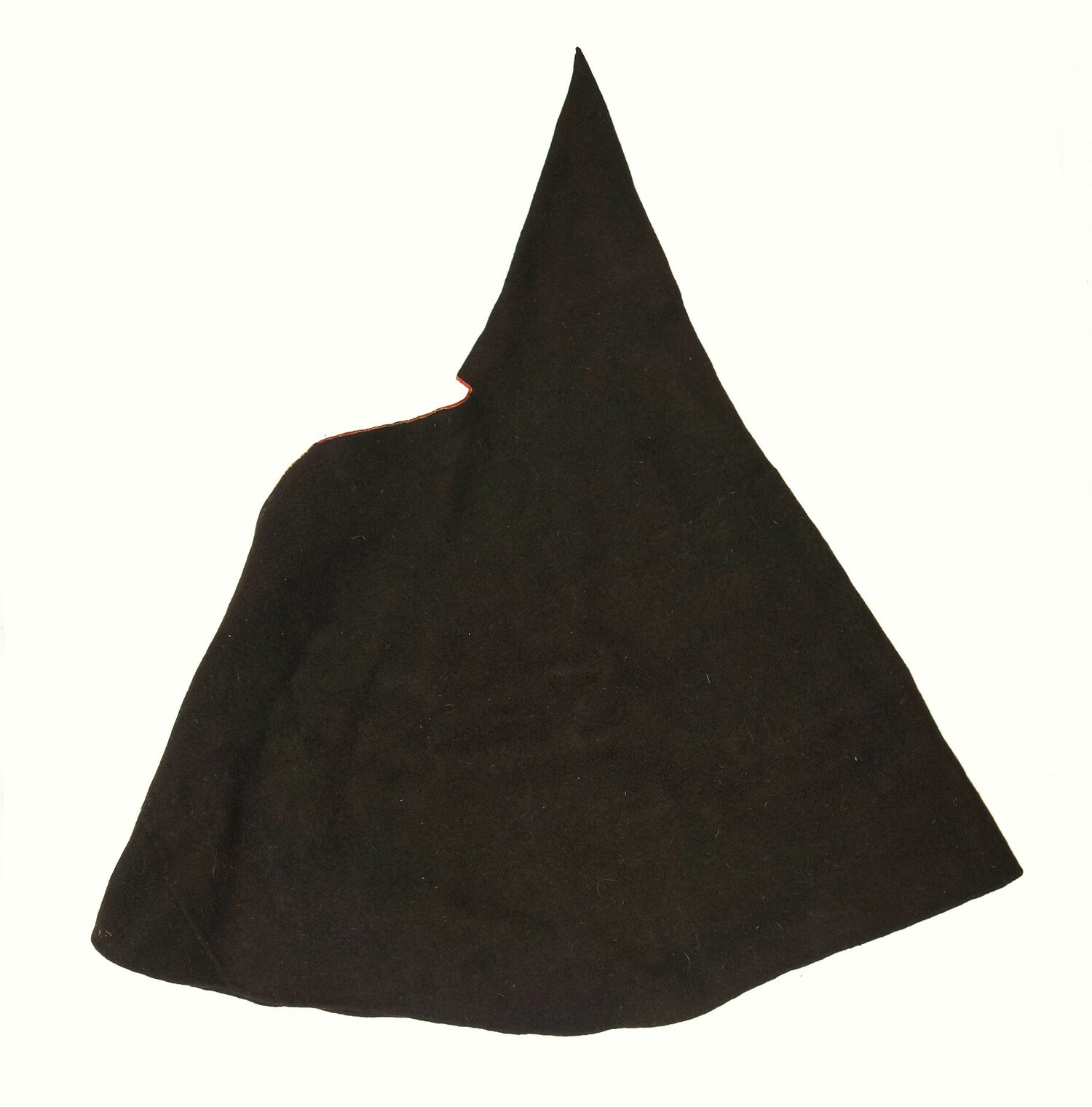
 A woollen bernos from Debre Berh, central Ethiopia (TRC 2021.0814).On the 16th March 2021, I noted in a blog that: "...last Tuesday someone from Leiden came with an Ethiopian cape with, to my eyes, an unusual shape that could accommodate a rifle. A very practical garment!"
We have been doing some more research about this garment and this led to some interesting pieces of information. The garment is called a bernos, which is the same word as the Moroccan burnous, a large woollen cloak with a hood. It is worn by men from the highlands of Ethiopia and Eritrea.
The Ethiopian example now in the TRC collection (TRC 2021.0814) was bought by Mr. Polderman (Leiden) in the 1970’s, in Debre Berh, in the Shewa Province of central Ethiopia. It is made from a thick, woollen felt and has a red leather edging on the inside of the front and neck opening. There is also a line of embroidery just below the neck opening that is used to strengthen this area of the garment.
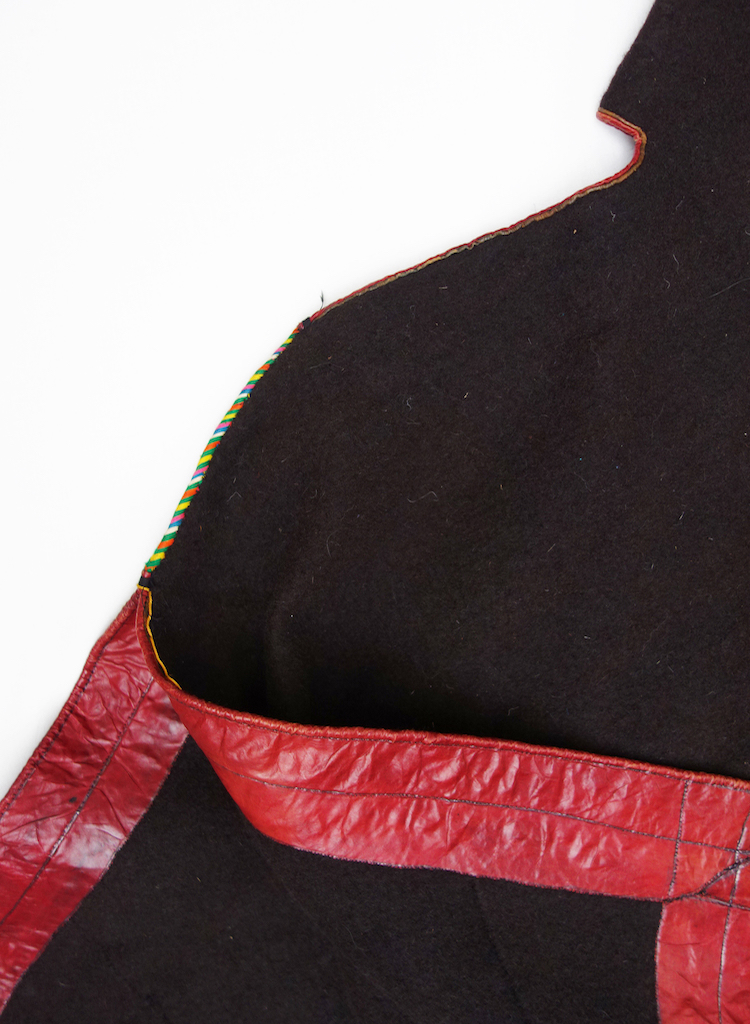 Detail showing the red edging and area of embroidery on the bernos from Debre Berh, central Ethiopia (TRC 2021.0814).The large pointed area at the top of the garment is not a hood as is sometimes suggested (see for example, a wikipedia entry), but a built-in cover for a rifle in order to prevent water from going down the barrel. There is always one peak and that is normally worn over the left shoulder. This garment appears to have been developed in the late 19th century when rifles became more widespread in Ethiopia and had certainly become popular by the 1920’s. There are images of it in the book, Ethiopia: Photographed, by Richard Pankhurst and Denis Gérard (2014, no. 206), which includes a series of photographs from 1867-1935
The TRC has recently acquired an American press photograph dating to 1927 that shows a bride and groom on donkeys or mules as part of their wedding ceremony (TRC 2021.1363). The groom is wearing one of these pointed capes. If you look in the background there are at least four other men on donkeys or mules wearing peaked cloaks as well.
 1927 American press photograph showing a bride and bridegroom in Ethiopia (TRC 2021.1363).I am not sure if it was deliberate or not, or just showing a general lack of understanding of what was happening, but the text associated with the photograph incorrectly states:
JUNE IS WEDDING TIME – STRANGE CUSTOMS IN FOREIGN LANDS. An Abyssinian couple riding donkeys to their church wedding in Addas Abeba. The bridegroom covers his faces, but the girl does not. The pride of her outfit is her parasol. Abyssinians are nominally Christian, the royal family claiming direct descent from King Solomon. By Ewing Galloway, N.Y.
Well, actually, it is the groom who is holding the parasol, which is a status symbol, and his face is uncovered, while the bride is wearing a large hat and has partially covered her face. She is also wearing a cloak, but without the peak on the left shoulder as can be seen in the man’s version.
Gillian Vogelsang-Eastwood, Director TRC, Friday, 30 April 2021