

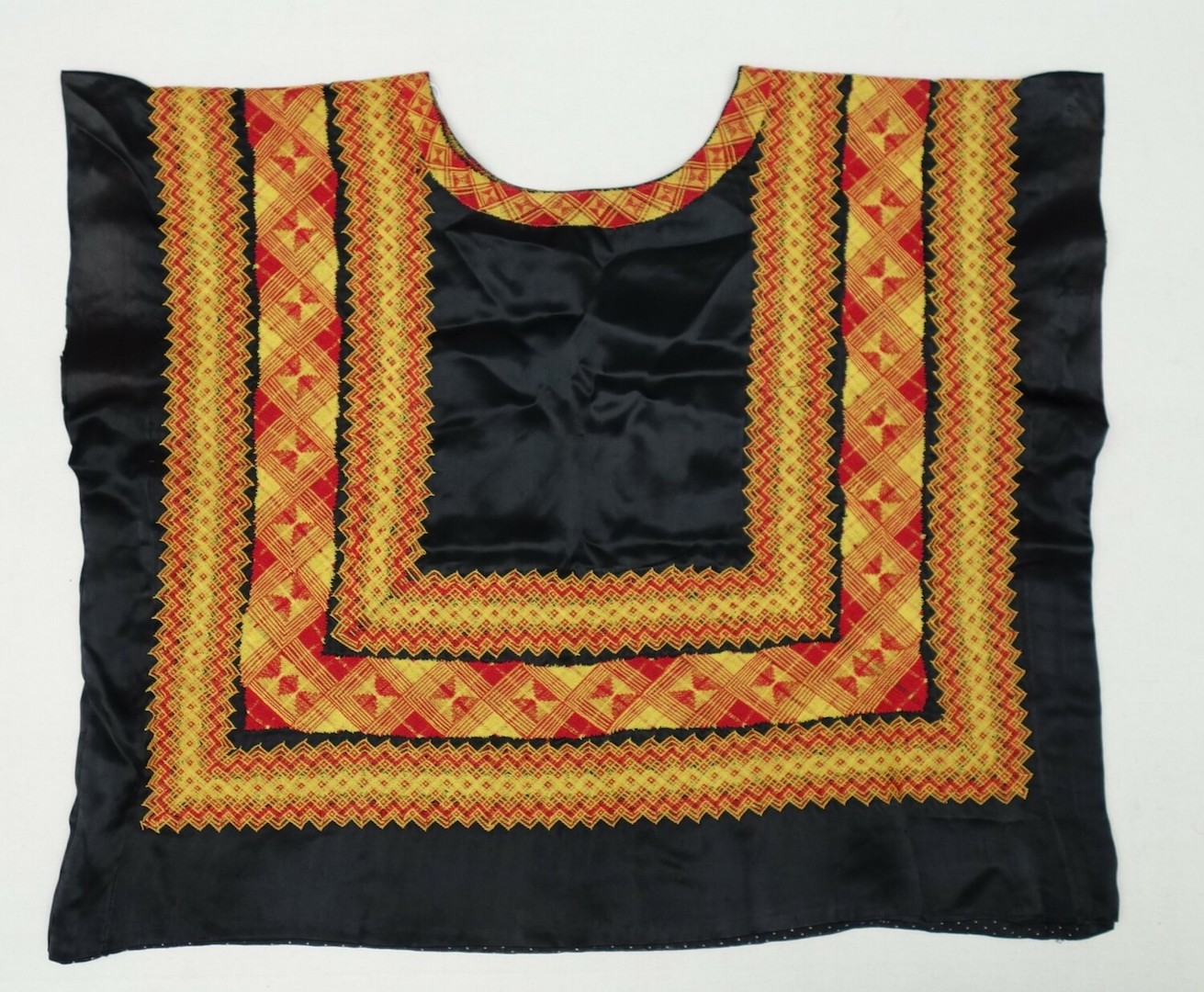
 Black satin blouse decorated on the front and back with embroidered bands of repeating geometric and lacy shapes in red and yellow. The garment was known to the Dool family as one of Diane's 'Frida Kahlo' blouses. Antilles, 1950s/1960s (TRC 2023.1218a).The TRC recently received a donation of clothing and other textiles from the Dool family here in the Netherlands. They had given other items in the past, including pieces from Central and South America, the Middle East and the Netherlands.
The latest Dool family donation includes a set of clothing, worn and for more than fifty years cherished and carefully preserved by Diane Joubert, in the style of the famous Mexican artist, Frida Kahlo (1907-1954).
The outfit consists of a blouse (TRC 2023.1218a) and matching skirt (TRC 2023.1218b), as well as a shawl (TRC 2023.1219) and was worn in the 1950s and 1960s by Diane Joubert (1939-2021), who originated from to a large and old merchant family living in Curaçao and Venezuela. The family were also involved with the artistic world of Central America.
 Long, rectangular shawl narrow stripes in green, beige and black. Some of the stripes have ikat-style dots in beige and black. The transverse ends of the shawl are decorated with long fringes with a woven pattern of diamonds in black and green. This is one of the 'Frida Kahlo' garments of Diane Joubert. Antilles, 1950s/1960s (TRC 2023.1219).
 Frieda Kahlo, by Magda Pach (1933). National Portrait Gallery, Smithsonian Institution. NPG.2015.136. Creative Commons.Diane Joubert was about 18 years old when she came to Leiden for her studies. She married in 1960 with the painter, Rein Dool (who was born in Leiden in 1933), and for a while they lived in an original wevershuisje ('weaver's house') along the Oranjegracht in the centre of town.
Through her life, both in Leiden and since the early 1970s in Dordrecht, Diane remained fascinated with textiles and creative arts. According to her daughters, a giant loom filled the entrance hall to their house. She made long journey to far-way countries, mainly to see local people, their costumes and their crafts.
She was fascinated with the surrealist painter Frida Kahlo (Magdalena Carmen Frida Kahlo y Calderón). There is a wonderful photograph in colour of her that was taken in 1939 (year of birth of Diane!) wearing a very similar huipil as the one just donated to the TRC.
 Frida Kahlo, photographed by her father Guillermo Kahlo in 1933. Public domain.This particular picture was made by the Hungarian/American photographer, Nickolas Muray (1892-1965), which is currently been shown by the Art Gallery of South Australia (AGSA) in Adelaide, for their exhibition about Frida Kahlo. The image can also be seen at The Sydney Morning Herald review of the exhibition.
The outfit worn by Frida Kahlo in that photograph is very similar to the one we have just been given by the Dool family, who for many years described these garments as the "Frida Kahlo outfit'. and I do wonder if Diane Joubert based her ‘look’ on the one worn by Frida Kahlo in the 1939 photograph. And wouldn’t it be really interesting to put the Dool outfit and the photograph together?
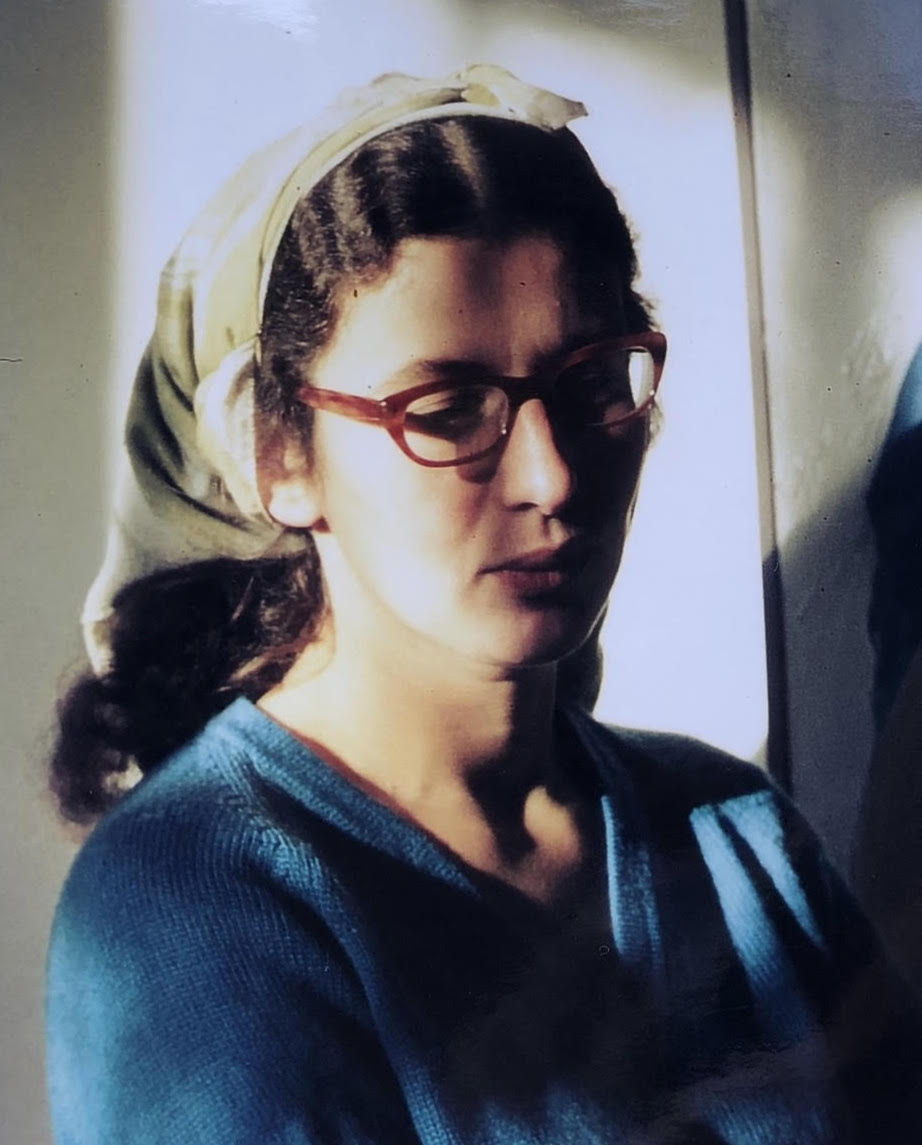 Diane Joubert, 1939-2021. Photograph courtesy Dool family.Combining the two would help to put the outfit into its proper context, explain why it was made, stress the importance of Frida Kahlo as an artist and a woman, her influence on other women, especially in the Americas, and put it all into some social and historical context. Fascinating! That is what dress studies is all about.
So, having some experience with the minefield of licensing and copyright, I wrote to AGSA in Adelaide about using the photograph. They put me into contact with the Nickolas Muray Photo Archives in the USA, who manage the Muray legacy.
After a week I received a return email from this agency, informing me that they refused permission for the TRC to use the 1939 photograph, on the grounds that Muray is "considered to be one of the greatest photographers of the 20th century and the Archives' "primary mission is to preserve and cement that legacy." Apparently this TRC blog could undermine Muray's legacy.
 Diane Joubert at a party in Leiden, dancing in her 'Frida Kahlo' outfit. Photograph courtesy Dool family.Fortunately we found another photograph of Frida Kahlo in the public domain, and we are very pleased to show this photograph, together with a painting of her, next to a photograph of Diane Joubert and especially a photograph in which she is shown wearing the blouse she was so proud of and that imitates the clothing that Frida Kahlo liked to be seen in, and that is now a fascinating addition to the TRC collection.
Gillian en Willem Vogelsang, 25 August 2023