

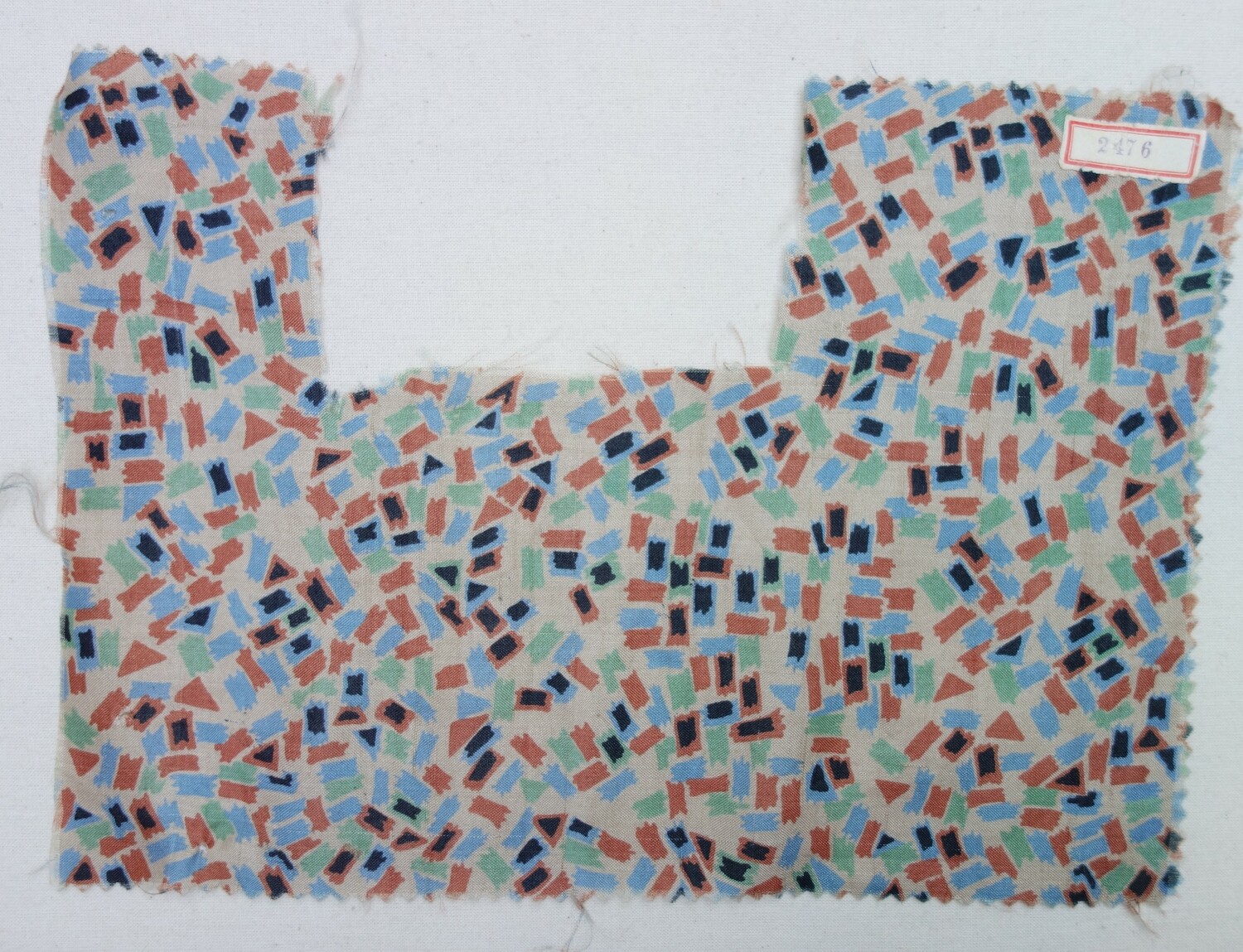
 Printed silk sample, 1920s (TRC 2023.1471).Some weeks ago we published a blog about the preparations of the upcoming TRC exhibition: The 1920s from head to toe, which is about 1920s fashion. It looks at daily, afternoon, evening and sportswear, as well as accessories such as hats, bags and shoes. All of the items come from the TRC’s collection of textiles and dress. The blog indicated that we are still actively looking for prints, images and photographs dating from the period to make the garments come ‘alive’.
As a result, we have just been given by the Dool family a collection of 23 printed silk textiles that date from the 1920s (TRC 2013.1469 - TRC 2023.1477). We are working on how to include these pieces in the exhibition. The textiles were left by Diane Joubert, wife of the artist Rein Dool. She originated from the Caribbean. She was an artist and deeply involved with textiles and featured in a recent TRC blog about some Frieda Kahlo style clothing.
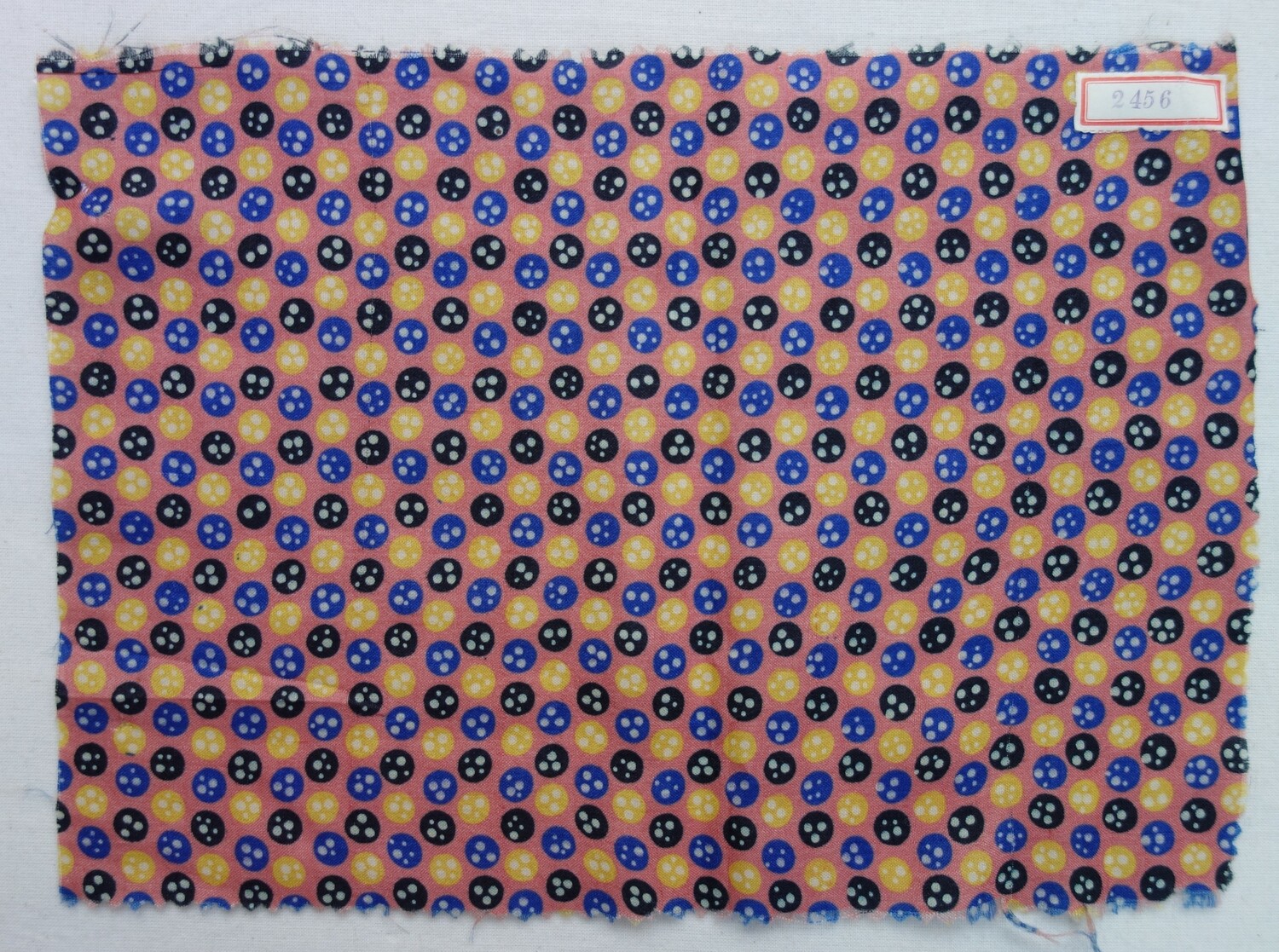 Printed silk sample, 1920s (TRC 2023.1475b).The Dool family told us about the textiles: “These silk fabric samples are a remnant of the sample books of Diane Joubert's grandfather Louis Hueck. Louis Hueck was born in 1871 and was raised in Curaçao. He was a salesman by profession. In the early twenties of the last century he sailed with luxury merchandise across the Caribbean Sea, probably from Europe and/or America. My mother told me that he took home the outdated sample books with buttons, small bottles of perfume and fabric samples, for his young daughters who, of course, loved to play with them. “
 Printed silk sample, 1920s (TRC 2023.1473b).The printed silks we have just been given are about 28 x 20 cm in size and carry a range of geometric patterns, including small blocks in brown, red, blue, green and black (TRC 2023.1471), lines of small circles (TRC 2023.1475b) in blues, browns and reds, as well as triangles in beige, black, blue and red (TRC 2023.1474a), and a trelliswork pattern enclosing wavy lines (TRC 2023.1477d). There is also a ‘Japanese’ pattern of stylised flower heads (TRC 2023.1473b).
Most of the pieces include on the front of the cloth a small paper label stuck with a main, three-digit number and a secondary number that is fainter and raised slightly higher than the other numbers. Normally speaking, these and similar numbers indicate that the textiles were commercial samples, with the first group of numbers being the design registration number within a particular textile company and the other number representing a different colourway. One textile (TRC 2023.1473b), for instance, has the number ‘247 9’ indicating that the main pattern had the number 247, while that pattern was produced in at least nine different colourways.
 Printed silk sample, 1920s, with registration numbers (TRC 2023.1477d).Alas, we do not know (yet) which company produced or were selling these textiles, but there is an intriguing ‘little’ detail. Five of the textiles have a pattern of a square trelliswork enclosing straight and wavy lines (TRC 2023.1477a-e). Most of the textiles have the pattern number 245 (such as TRC 2023.1477d). However, two of the textiles in this series have the number ‘244…’ (TRC 2023.1477b and TRC 2023.1477c). So was this a mistake or did it indicate a slightly different pattern range? To make the ‘problem’ a little more complicated there are two textiles decorated with a totally different pattern made up of squares and triangles (TRC 2023.1469a and TRC 2023.1469b) that also have the number ‘244’.
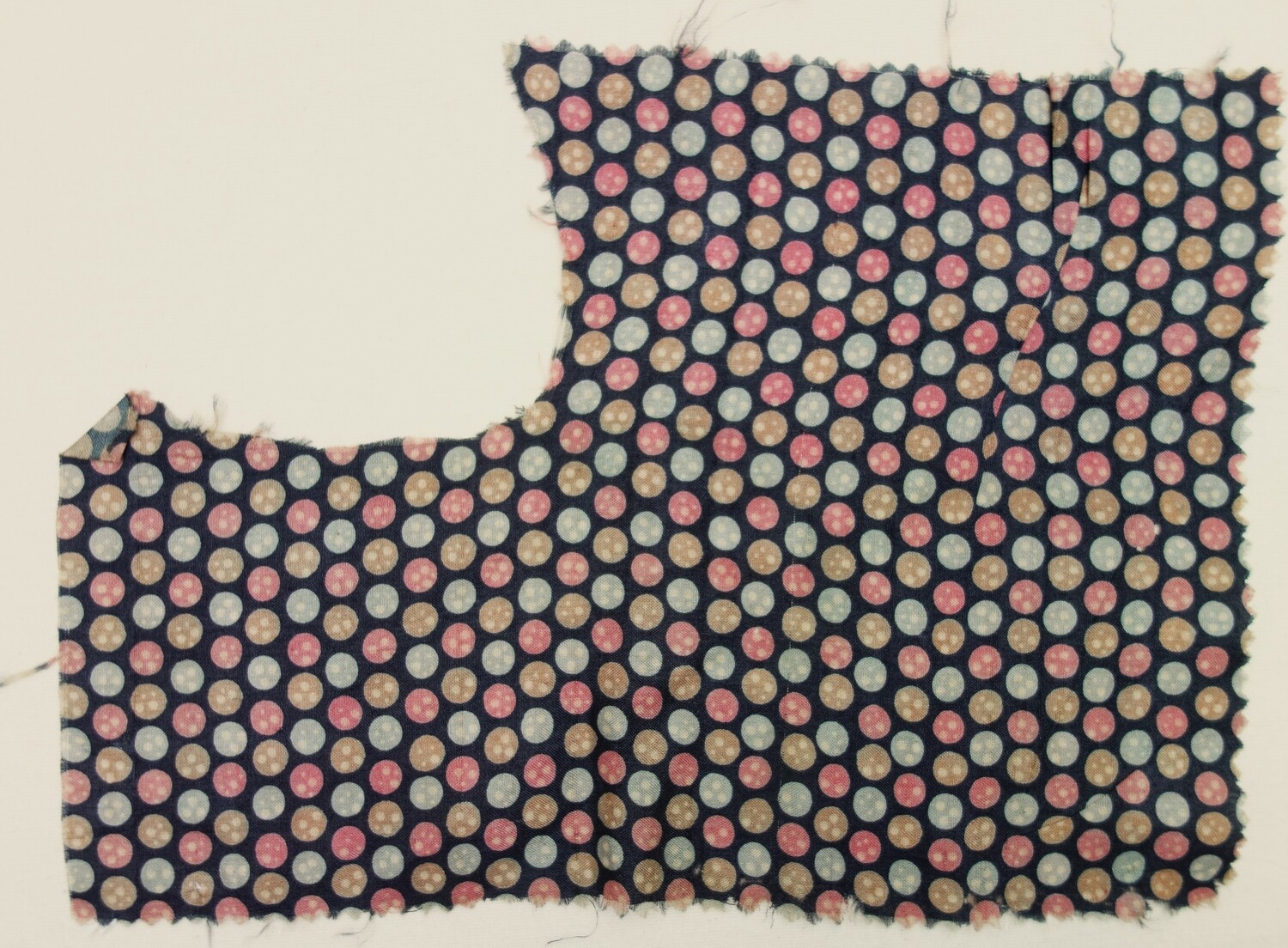 Printed silk sample, 1920s (TRC 2023.1475a).So was this a simple mistake made one hundred years ago and someone put the wrong label onto the wrong textile? Or did a few of the textiles lose their numbers and someone accidentally put the numbers back on the wrong samples? Or perhaps it was deliberate and the numbers have another meaning? Who knows, but it is fun to speculate!
Commercial samples are a fascinating part of the history of textiles and can provide dating evidence, as well as commercial, design, technical and social information. All of which can provide further depth to an important aspect of material history in general, and textile and dress studies in particular.
Gillian Vogelsang-Eastwood, 18 September 2023