




 Boreray Ram. Commons Wikimedia.It’s a good feeling to think that the TRC’s next Intensive Textile Course (23-27 February, 2026) will take place in our new home. One of the most enjoyable parts of that course was the section about fibre identification. The chance to see, touch and smell the incredible variety of plant and animal fibres that have been turned into textiles is amazing.
The TRC has samples of a wide range of animal fibres in its collection, from alpacas, camels, goats, horses, llamas, seals, silk worms (both wild and cultivated) and, of course, sheep.
The TRC recently received a donation of wool from a very rare breed of sheep—the Boreray (TRC 2025.1854a) The wool is very soft, lanolin-rich, with colours that range from white to light grey. It was collected this summer by a friend of mine, from one of the several small herds in the Orkney Islands. Because she is a spinner, she also donated some spun Boreray wool (TRC 2025.1854b).
This handful of wool has an incredible history. Boreray is an uninhabited island that, with four other small islands (Hirta, Soay, Dun and Levenish), form the St. Kilda archipelago. St. Kilda is some 100 miles off the west coast of Scotland. Humans—and their sheep—are believed to have lived on St. Kilda for 4,000 years. Sheep on both Boreray and Soay islands were feral, and only visited once a year by villagers to collect their wool.
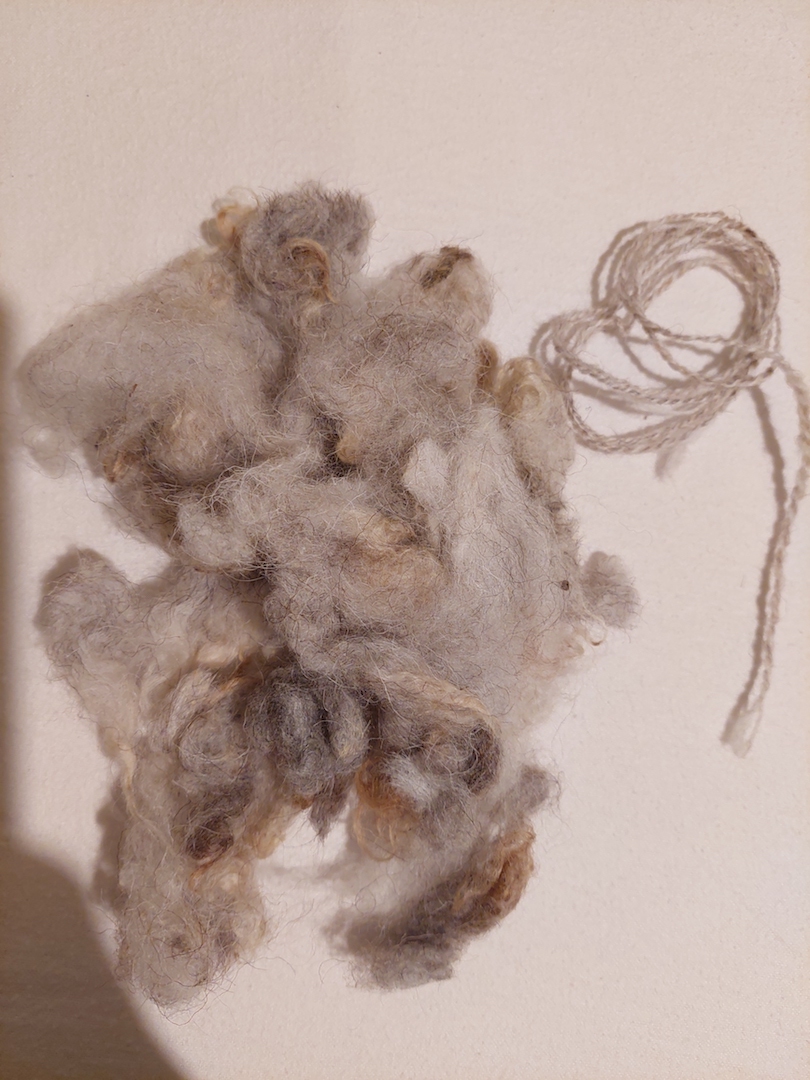 Sample of wool from a Boreray sheep, and a spun thread (2025.1854a and b).
Boreray and Soay sheep are distinct, genetically different breeds. They are classified as Northern European Short-Tailed sheep, which includes some 35 other ‘primitive’, or ancient, breeds (these breeds include Drenthe Heath (Drentse Heideschaap), Icelandic, Faroe and Shetland). The Soay is thought to be directly related to the first sheep that Neolithic farmers brought to the British Isles, circa 4000 BC. The first written mention of sheep on Boreray dates to 1697, and Boreray sheep are considered descendants of the now extinct Scottish Dunface breed.
Boreray sheep are smaller than modern sheep, with shorter tails (the result of less vertebrae). Both males and females have horns. It’s a very hardy breed, able to graze on a wide variety of land, from mountain slopes to bogs and coastal areas; and less prone to modern sheep illnesses, such as foot rot. Like other primitive breeds, Boreray sheep regularly shed their fleece. Their wool can be plucked by hand, or ‘rooed’, but not sheared. This means less work for humans. It also means that the wool is even more water repellent, because the more intact fibres have not been cut by shearing.
I learned all this and more from a fascinating book by Jane Cooper, titled The Lost Flock (Chelsea Green Publishing, London 2023). Cooper has dedicated her life to preserving the Boreray, whose numbers were down to about 100 sheep a few decades ago, The feral flock of Boreray sheep is now officially protected and no new breeds of sheep are allowed on the island.
Why the Lost Flock? It turns out that humans abandoned St. Kilda in 1930, leaving the sheep on Boreray and Soay islands completely alone. In 1971 seven sheep were brought from Boreray to a research centre in Scotland. Small flocks were gradually established, with each sheep meticulously registered by the Rare Breeds Survival Trust. While the research centre has closed, one flock of Boreray sheep ended up in the Scottish Highlands, which was thought too far away for registration purposes. While lovingly tended by a farming couple, this isolated flock, unknown to the Trust, was considered ‘lost’.
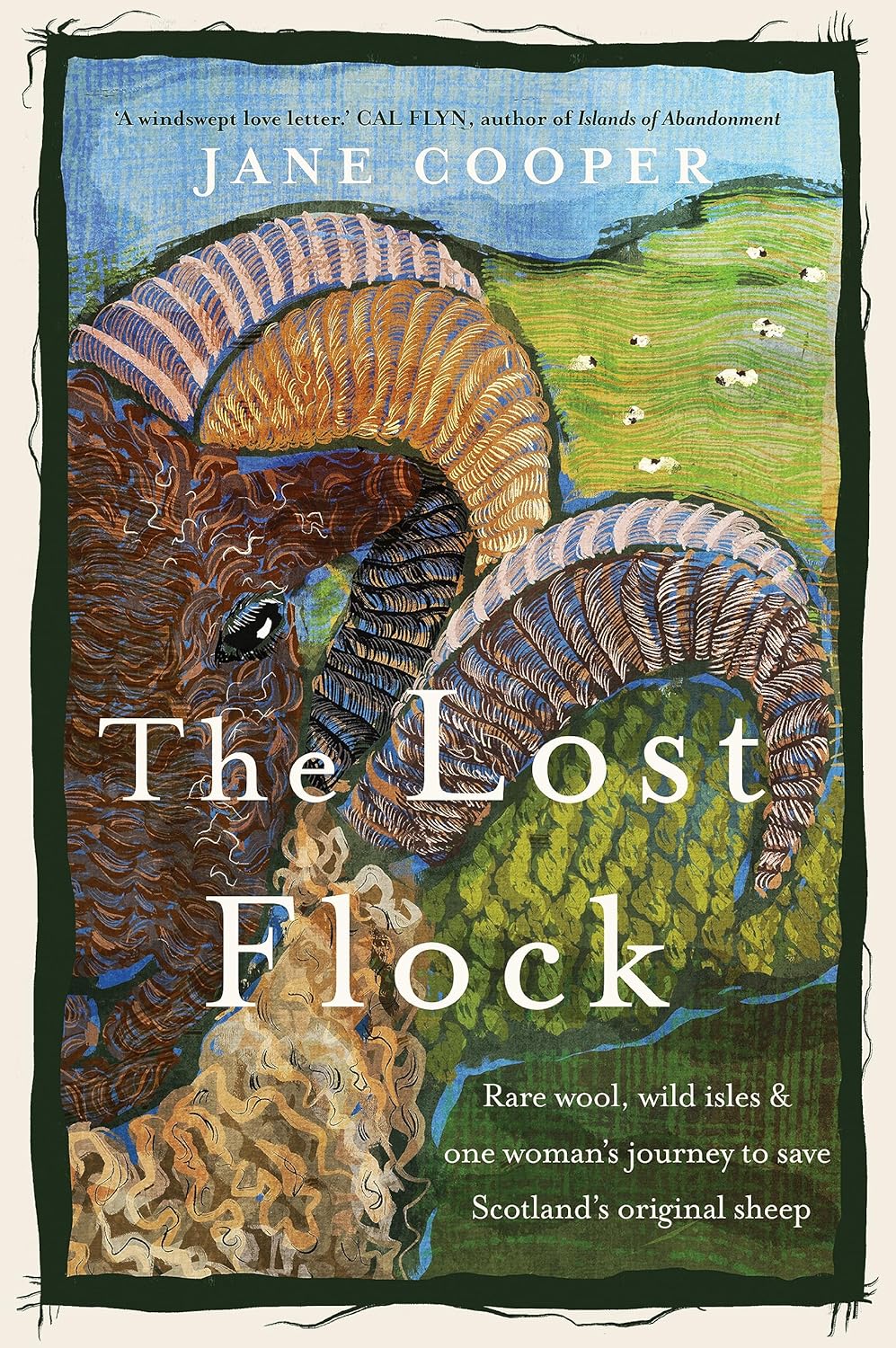 It was this ‘lost’ flock, with its unique genetic profile, that Jane Cooper inherited from the local farmer in the Highlands who could no longer look after them. Today, after her moving to the Orkney islands, Cooper has brought together a community of people at different places on the Orkneys, who are determined to preserve this rarest of British sheep. To be economically viable, a hand weaver produces scarves from their wool; while an artisan carver produces knitting needles, buttons, knife handles, and Viking-style drinking horns from their bones and horns. Boreray lamb, which has won top culinary awards, is served in Edinburgh restaurants.
***
I want to add one more interesting snippet from the book. While archaeological textiles are not its main focus, there is a fascinating section on Viking sails. These sails were often made from wool—and wool from Northern European Short Tailed breeds, like the Boreray. Research into Viking woollen sails began in 1989, when some 100 square meters of sailcloth remains were found in a medieval stone church in Trondenes, Norway. Such woollen sailcloth was produced on an industrial scale. It is estimated that the Vikings needed, by 1000 AD, at least one million square metres of sailcloth. It took two skilled women a year to produce a sail for a ship that two skilled boatbuilders could build in a few weeks.
There’s quite a history behind this handful of wool.
- For more information about Boreray sheep, see www.orkneyboreray.com and www.soayandboreraysheepsociety.org
- For an interview with Jane Cooper talking about The Lost Flock, see https://www.youtube.com/watch?v=YCKz5WlkR1M
- For examples (and sounds) of sheep bone flutes (found in Viking and Anglo-Saxon sites), see: https://www.youtube.com/watch?v=hMy40pYdP4c
By Shelley Anderson, 20 December 2025


