• F4
  • F2
  • F3
  • F1

On Thursday, 17 October 2019, Gillian Vogelsang wrote:

We have been talking for some time at the TRC about getting a digital microscope for our work with various archaeological and historical textiles, in particular for basic fibre identification, as well as weave, print and embroidery analysis. We are also curious about what caused particular types of (past) damage to the structure of some of our textiles (insects, mould, etc). More specifically we were looking for something that has a magnification of between x25-250, can be used to take publication level photographs (at least 1200 ppi) and with a magnification that is easy to adjust.

But the main question was: which microscope? There are various forms on the market, with a wide range of prices. In July 2019 Eric Boudot gave a demonstration of the Dino-lite microscope at a workshop held at the TRC as part of the ICAS Asia Conference. Based on his presentation it was decided to obtain one of these microscopes as it clearly works well with the type of textiles we are working with. One thing I was particularly impressed with was the very light-weight nature of the microscope and stand. It will not be a problem to have it in hand luggage when travelling!

Thanks to the generosity of a Friend of the TRC, we have the funding to buy a suitable microscope and equally importantly, a good quality stand that we can use to easily make minute adjustments in the height of the microscope. We contacted Michel van Rooijen of AKB Longs, a company in Zouterwoude-Rijndijk, which is very close to Leiden and they kindly agreed to give us a demonstration of the Dino-lite AM4515ZT, how it works, with a discussion concerning the advantages and disadvantages.

A group consisting of archaeologists, students, depot managers, as well the librarians from the TRC came to the demonstration and were able to ask a wide range of questions. We used various textiles from the TRC Collection, including flat textiles (a piece of mummy cloth, some Dead Sea Scroll textiles), as well as a Macedonian knitted sock with metal thread cuff to give a range of materials and textures.

I have borrowed the microscope for a week to see how it goes, and, as it stands at the moment, we are going to get one. But I think we will be getting one that can take 5 mb images rather than 1.5 mb that was demonstrated because of publication requirements. I am also looking forward to using it with the work on more detailed analysis of the medieval St. Petrock’s Pall in Exeter Cathedral, as well as looking at various items in the TRC Collection.
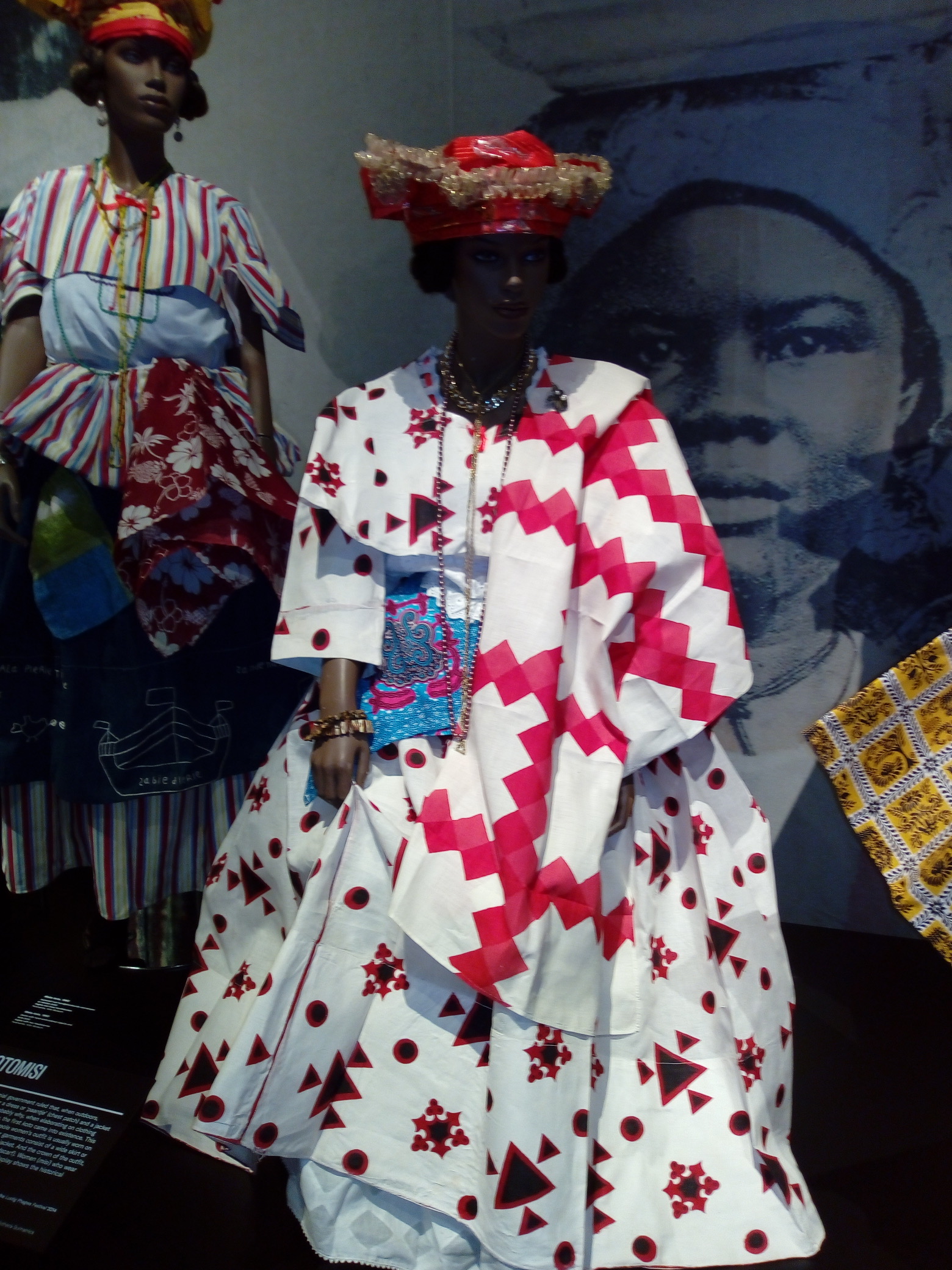
Koto from Surinam, displated at the Great Suriname Exhibition, Nieuwe Kerk, Amsterdam.Koto from Surinam, displated at the Great Suriname Exhibition, Nieuwe Kerk, Amsterdam.On Wednesday, 16th October, Shelley Anderson wrote:

Surinam, in South America, has a rich heritage — a heritage also reflected in its textiles. Some of this heritage can be seen in the Great Suriname Exhibition now on at the Nieuwe Kerk in Amsterdam.

The exhibit begins with a collection of objects from some of the country’s indigenous groups. Surinam’s indigenous peoples cultivated their own cotton, and spun and then dyed the resulting textiles with natural dyes. A Lokono woman’s blue cotton skirt and shawl (late 19th-20th century) are on display, along with some cotton Kari’na loincloths (pre-1912) and stunning hair and arm ornaments (late 19th to early 20th century) made from feathers, beads, palm leaves and other materials.

Perhaps Surinam’s most iconic garment is the koto, a wide skirt or dress of printed cotton, worn by Creole-Surinamese women with a short jacket and an angisa, or head wrap. There are hundreds of ways to fold an angisa, which are often used to express the wearer’s emotions or opinions. The official history of the koto dates back to 1879, when the Dutch colonial government ruled that women, when outdoors, must wear a dress or paantje (chest covering) and a jacket or gown. Now worn mostly on festive occasions, there are numerous kotos on display, from different time periods.

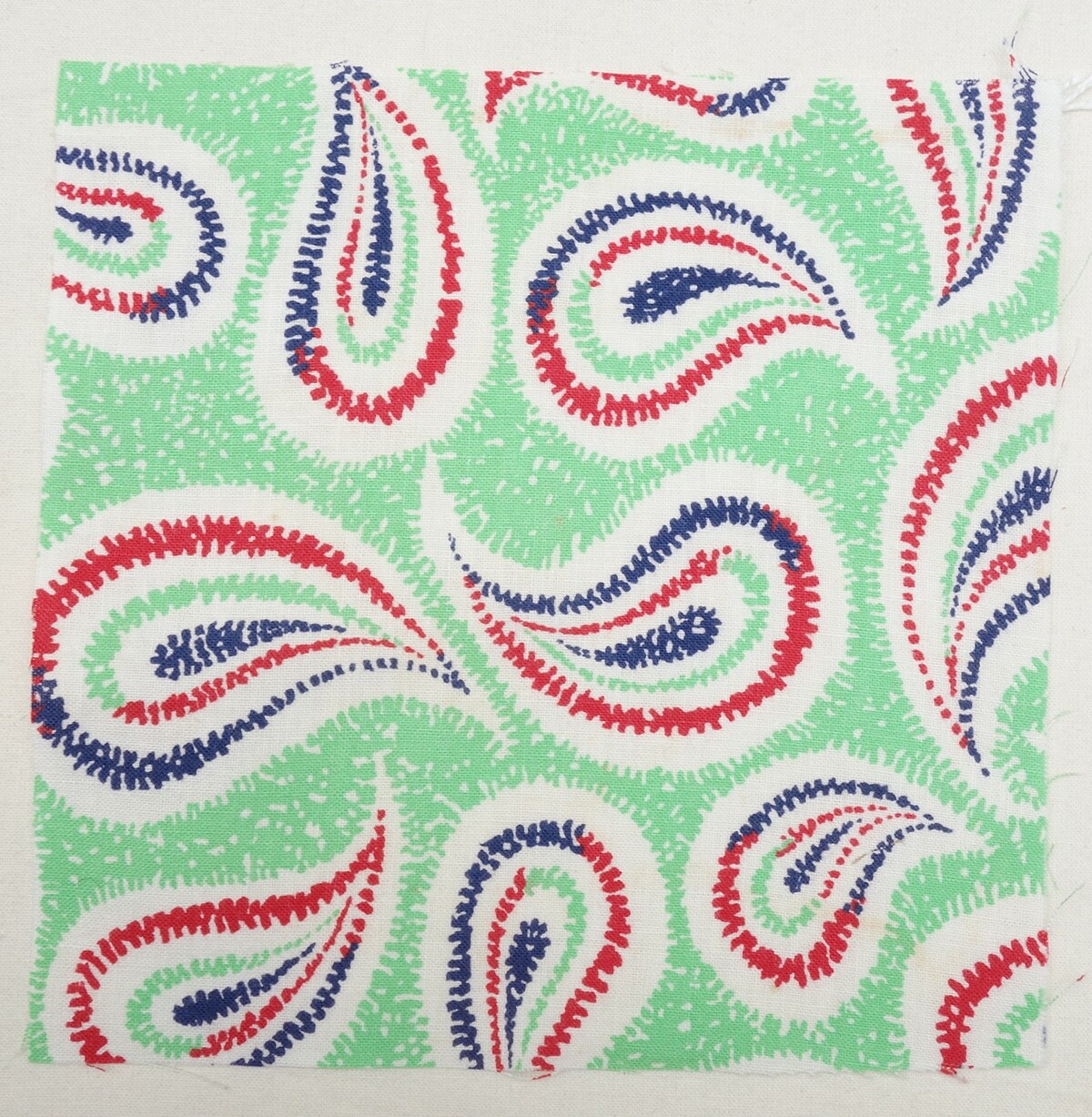
Paisley motif used on an American feedsack, 1940s (TRC 2019.1245). For more information, please click on the illustration.Paisley motif used on an American feedsack, 1940s (TRC 2019.1245). For more information, please click on the illustration.On Sunday, 13th October, Erica Riccobon, a new TRC volunteer and MA student at Leiden University, wrote:

The TRC is currently preparing a new exhibition planned to open in the second half of 2020. Its provisional title is 'From Buteh to Paisley: The History of a Global Motif.'

The exhibition highlights the worldwide diffusion and popularity of the Paisley motif, through an analysis of its travel from East to West and its reinterpretation within 20th century European fashion.

The Paisley motif first appeared in Iran under the name of buteh. Further developed for the design of the famous Kashmiri shawls, it was exported into Europe, through the (British) East India Company, from the 17th century onwards. In Europe it was copied and used in local industry, and hence again distributed across Europe. The motif, though quintessentially Eastern in origin, owes its Western name to the Scottish town of Paisley, a major weaving site during the Industrial Revolution, not far from Glasgow.

Photograph, dated 22 December 1943, with Ida van Gent - van der Meij wearing her wedding dress from 1938, now dyed in a lilac colour.Photograph, dated 22 December 1943, with Ida van Gent - van der Meij wearing her wedding dress from 1938, now dyed in a lilac colour.On Thursday, 26 September 2019, Gillian Vogelsang wrote:

Today (24 September 2019), we had a very interesting donation for the TRC’s Collection, namely a lilac coloured dress with a strong Leiden connection. The dress was initially made by Ida van der Meij (1910-1977) as her wedding dress, when she married Jan van Gent (1909-1983) in Leiden on 20 April 1938. At that time the dress was white. Ida van der Meij’s family lived at Hoge Rijndijk 254, Leiden, which actually is close to where the TRC is situated.

On 22 December 1943, when the Netherlands were occupied by German forces, her brother, Jacobus van der Meij (1917-1958), married Maria de Koning (1918-2008) from Leiderdorp, close to Leiden. It was wartime and clothing was scarce, so Ida dyed her wedding dress lilac, changed the shape of the sleeves and used this updated garment for her brother's wedding.

The dress (TRC 2019.2154) and photographs of the weddings in 1938 and 1943 will be on display in the TRC’s exhibition about textiles and clothing during the Second World War (summer 2020).


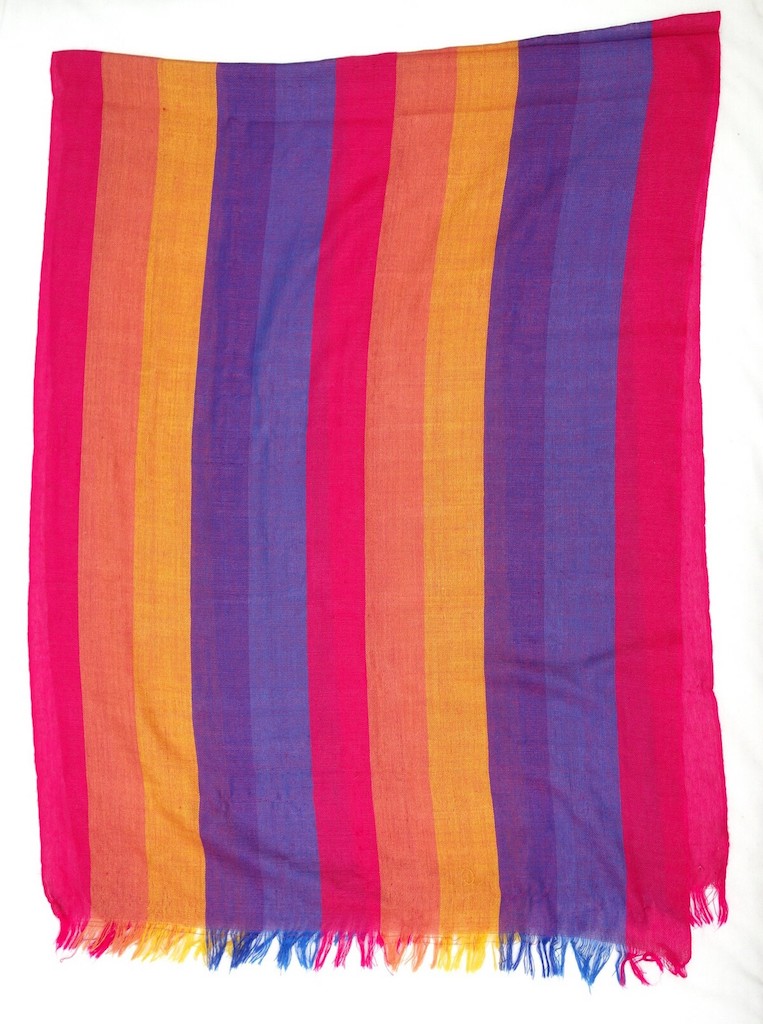
Woman's shawl inspired by the LGBTQ flag, Equador, c. 2002 (TRC 2019.1996).Woman's shawl inspired by the LGBTQ flag, Equador, c. 2002 (TRC 2019.1996).On Thursday, 12 September 2019, Shelley Anderson wrote:

Some recent colourful donations to the TRC mark the 50th anniversary of the modern movement for LGBTQ+ rights. One of these donations is a rainbow flag (TRC 2019.1995), which has been seen at celebrations around the world. The colours are reproduced on T-shirts such as the special 2019 Pride T-shirt designed by Viktor & Rolf for the HEMA department store chain (TRC 2019.1994), and the limited edition sneaker with rainbow coloured laces and soles by Converse (TRC 2019.1997a-b).

Rainbow colours are also used in the generous donation the TRC has received from the US tie company Ty-amo. They give the traditional male tie a make over and produce ties for both women and men because they want to break “…through outdated stereotypes—in society and in our closets.” Their ties, by designer Alex Summers, may be longer than the standard neckties and can be used as ties, head wraps, scarves or belts. Two special edition ties for the 2019 50th anniversary have been produced and kindly donated to the TRC for the upcoming digital exhibition on LGBTQ+ dress (TRC 2019.2002 and TRC 2019.2003).

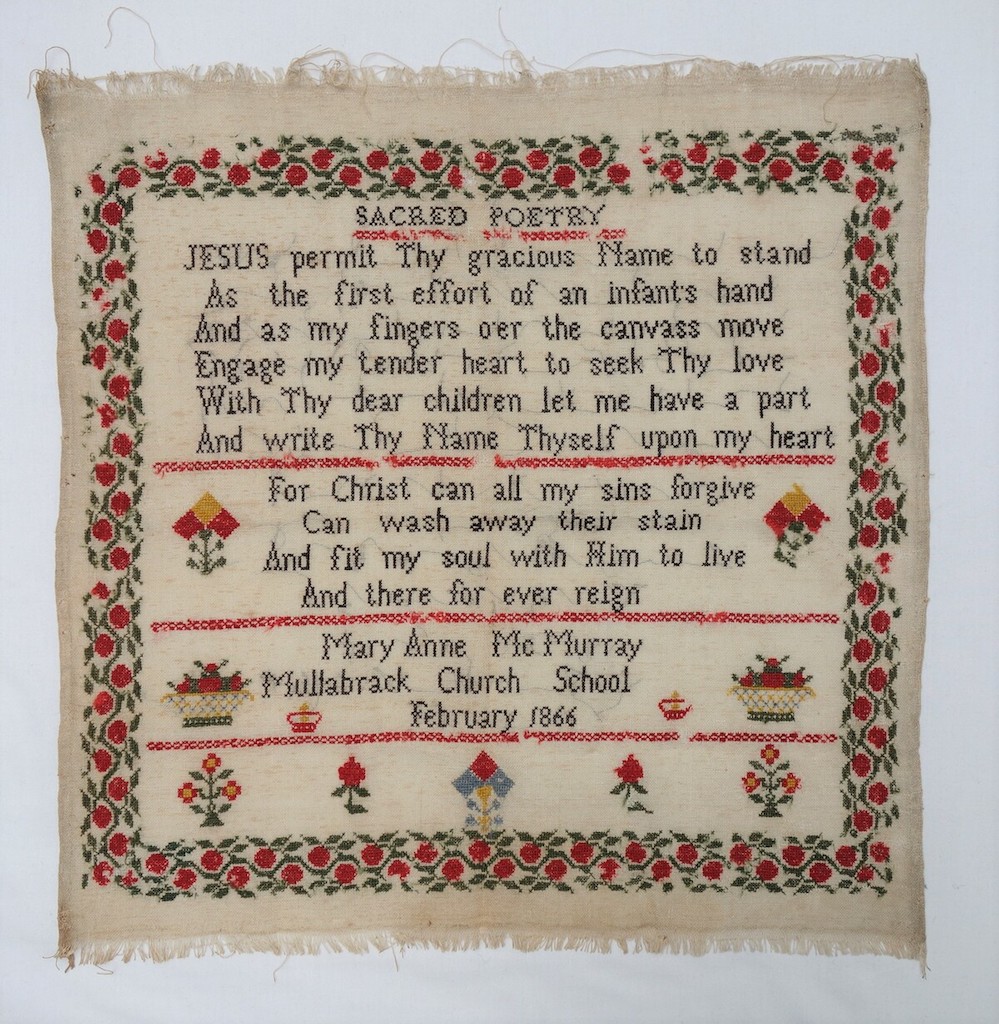
Sampler made by Mary Anne McMurray in 1866, Ireland (TRC 2019.2023).Sampler made by Mary Anne McMurray in 1866, Ireland (TRC 2019.2023).On Thursday, 12th September 2019, Gillian Vogelsang wrote:

The TRC Leiden has just acquired a sampler (TRC 2019.2023) worked in 1866 by a girl called Mary Anne McMurray, who went to the Mullabrack Church School, in Co. Armagh, Northern Ireland.

Mary Anne McMurray may be a girl with the same name who was born in Drumachee, near Mullaghbrack, in 1856. This would make her ten years old when the sampler was stitched. The stitching, it should be added, is consistent with embroidery of a school girl of that age. If this identification is correct, then she went on to marry Wallace Coburn (1828-1906) and had three children. She died in 1897 at the age of 41 and was buried in Lisnadill, Northern Ireland.

Mullabrack Church School was a Protestant primary school in the town of Mullabrack. The building still exists, but no longer used as a school.

Lies van de Wege and Amber Butchart at the opening of the Socks&Stockings exhibition. Photograph by Joost Kolkman, 2019.Lies van de Wege and Amber Butchart at the opening of the Socks&Stockings exhibition. Photograph by Joost Kolkman, 2019.On Saturday, 7th September, Gillian Vogelsang wrote:

The Socks&Stockings exhibition is now open! Thanks to the help of many people, notably Lies van de Wege and Chrystel Brandenburgh and their fantastic knitting crews, we have a very special exhibition. People are calling it colourful, warm, interesting, full of surprises and simply, it‘s GOOD.

What made everything so special was the presence of English fashion and dress historian, Amber Butchart, who officially opened the exhibition and gave a lecture on the history of European silk stockings. Twice in fact, because so many people registered for the lecture we asked Amber to do it again the following day. About 50 people came to the opening and both lectures were full with some 30 people attending each time. Her lecture was informative, well presented and not surprisingly there were many questions afterwards.

Amber had long heard about the TRC Leiden, but had never actually been before. She really liked our approach and the fact we have a ‘broad-based encyclopaedic collection’. She has already asked if she can use items from the collection for a couple of exhibitions and a book. Amber is planning to come back to Leiden on a regular basis and is more than willing to give more lectures on different aspects of European fashion history.

In addition, Amber has very kindly agreed to become an Ambassador for the TRC Leiden and tell her extensive network about what we are doing, what we can do and what we want to do in the future. Interesting days ahead! The exhibition will be open until Thursday, 19th December 2019.

Search in the TRC website

Contact

Boerhaavelaan 6
2334 EN Leiden.
Tel. +31 (0)6 28830428  
office@trcleiden.org 

facebook 2015 logo detail 

instagram vernieuwt uiterlijk en logo


Bank account number

NL39 INGB 0002 9823 59, in the name of the Stichting Textile Research Centre.

TRC closed until 4 May 2026

The TRC is closed to the public until Monday, 4 May 2026, due to our move to the Boerhaavelaan. The TRC remains in contact via the web, telephone and email. For direct contact and personal visits, please contact the TRC at office@trcleiden.org, or by mobile, 06-28830428.

Donations

The TRC is dependent on project support and individual donations. All of our work is being carried out by volunteers. To support the TRC activities, we therefore welcome your financial assistance: donations can be transferred to bank account number (IBAN) NL39 INGB 000 298 2359, in the name of the Stichting Textile Research Centre. BIC code is: INGBNL2A.

 You can also, very simply, if you have an iDEAL app, use the iDEAL button and fill in the amount of support you want to donate: 


Since the TRC is officially recognised as a non-profit making cultural institution (ANBI), donations are tax deductible for 125% for individuals, and 150% for commercial companies. For more information, click here