Constance Whitehead, 1921-2020.The TRC has just been given a donation of various textiles that belonged to Mrs. Constance Whitehead (1921-2020), who sadly died not long ago. The following account of Mrs. Whitehead and her love of textiles was written by her daughter, Ann Cable, who now lives in Leiden.
"My mother was widowed in 1945 when her husband's Mosquito plane was shot down over Germany. Her second husband, George Whitehead, was a diplomat, which led to a peripatetic life. She lived in Australia, India and Canada and travelled widely, particularly with her daughters, to places such as Pakistan and Syria.
Constance Whitehead was a remarkable needlewoman. As children our dresses were beautifully hand smocked. In Kolkata she knitted baby jackets for Mother Teresa’s clinic where she worked as a volunteer. In Canada she started making patchwork quilts. She would pore over fabrics looking to see how she could combine different textures and colours.
Whenever she travelled she would pick up different examples of the local textiles - on one occasion, while our bus was at a traffic light in Syria, she got me to haggle out of the window for a damask tablecloth which I still have. As she grew older she downsized much of the beautiful china and glass she had had in her diplomatic life, but she kept all her textiles and had many of them on display so she could be 'surrounded by beautiful things' as she said."
All of the pieces given to the TRC are currently being catalogued and it has been decided that several items from the donation will be the subject of various blogs over the next few weeks. The first of these blogs concerns a woollen wall hanging.
Not long ago (6th September 2020) we published a blog by Charles Knobler about a tapestry weaver called Michael Rohde from southern California, and in particular one of his tapestries that featured the Dalai Llama. While preparing the blog I thought about how few tapestry woven items we actually had in the TRC Collection.
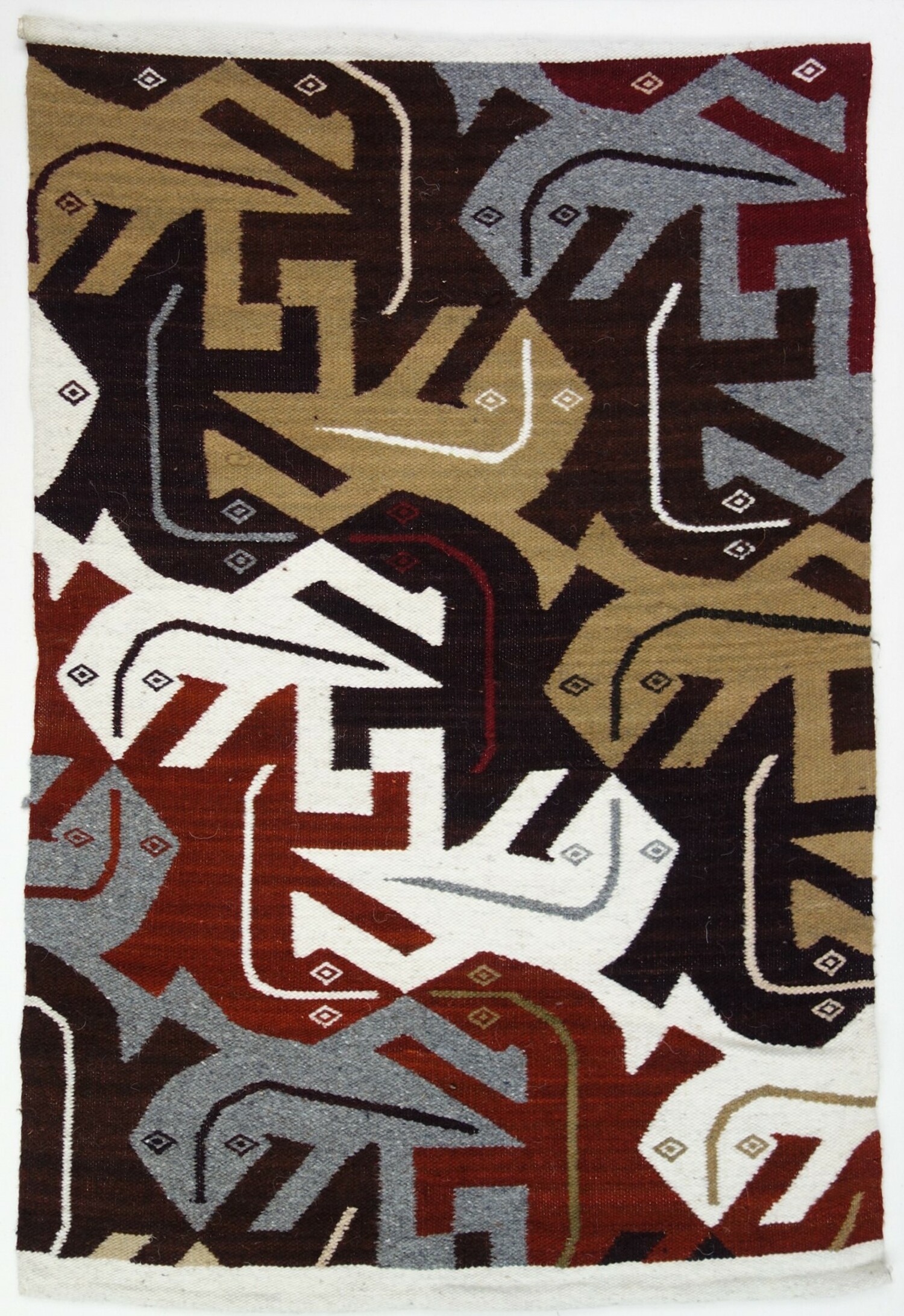 Wall hanging, mid-20th century. The design is based on a print by the Dutch artist, Maurits Cornelis Escher (1898-1972). The print is called "Reptiles" and was printed in 1943 (TRC 2020.3742).By coincidence, among the objects from Mrs Whitehead there was a tapestry panel based on an etching by the famous Dutch graphic artist, Maurits Cornelis Escher (1898-1972). In 1922 Escher visited Spain, and in particular went to the amazing Moorish palace known as the Alhambra in Granada (southern Spain).
The palace has numerous walls covered in intricate and interlocking tiles. He became intrigued by these tiles and this led to a series of designs of interlocking, repetitive patterns. He revisited the Alhambra in 1936 and continued his study of the tiles and their mathematical principles that come under the heading of tessellation. One of the first examples of Esher’s tessellation was a watercolour called ‘Study of Regular Division of the Plane with Reptiles' (1939). This was used for a lithograph called 'Reptiles' that was published in 1943.
It is this design that was used for the tapestry panel now in the TRC Collection (TRC 2020.3742). It has white cotton warps and woollen wefts in dark brown, dark red, brown, grey and white yarns, and is woven using a tapestry technique.
Unfortunately, there are no details concerning when (it must have been post 1943), where or indeed who wove the panel, but it is clear that it is very precisely woven and shows considerable skill in how the various colours and shapes were worked to re-create Escher’s intricate tessellated design.
Ann Cable and Gillian Vogelsang, 18th September 2020


 Bracelet made from Dutch silver 10 cent coins minted in Utrecht, 1941, and during the war made into a patriotic bracelet (TRC 2020.2714).


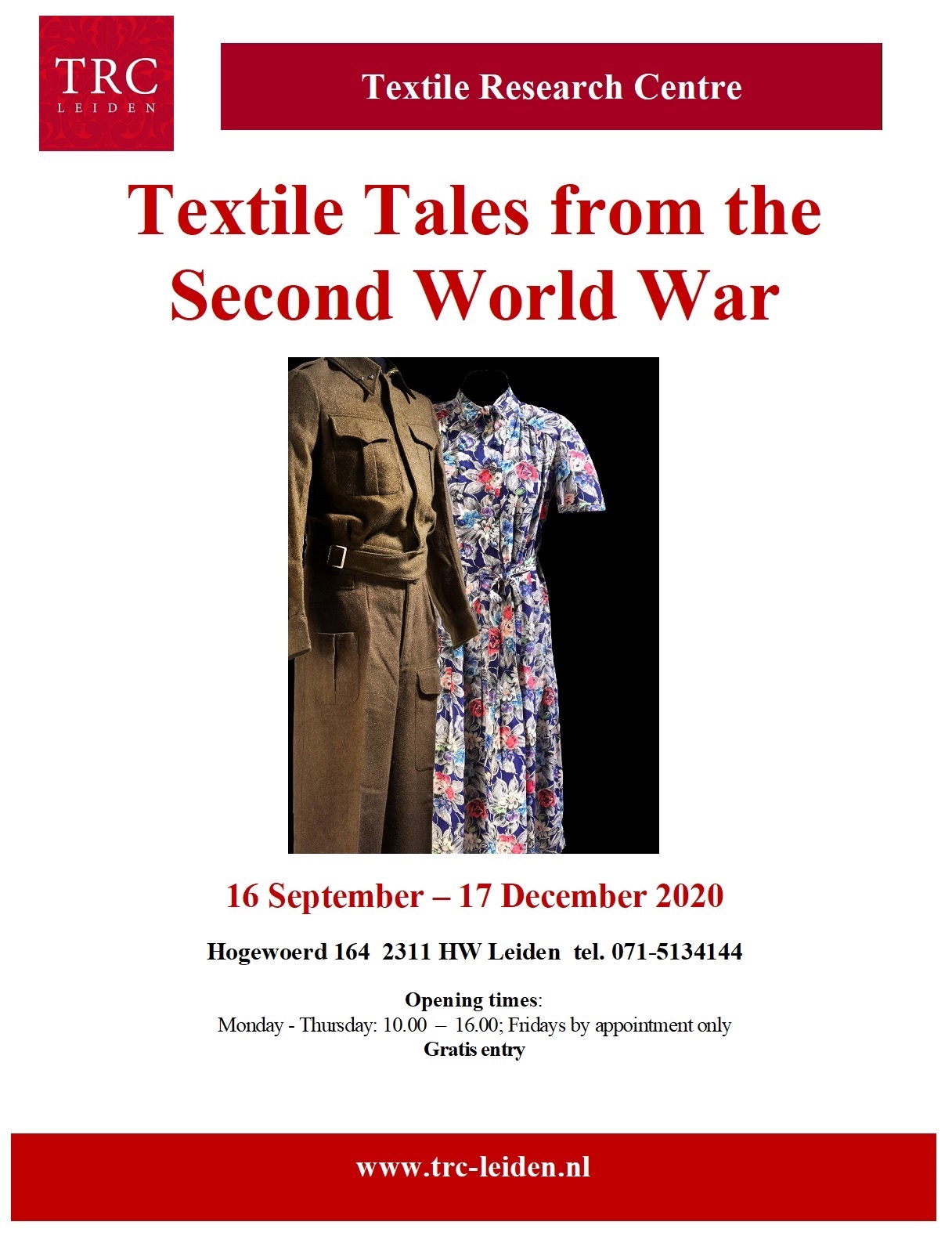 Over the last few months we have been working very hard on organising, preparing and setting up the TRC’s latest exhibtion, ‘Textile Tales from the Second World War’.