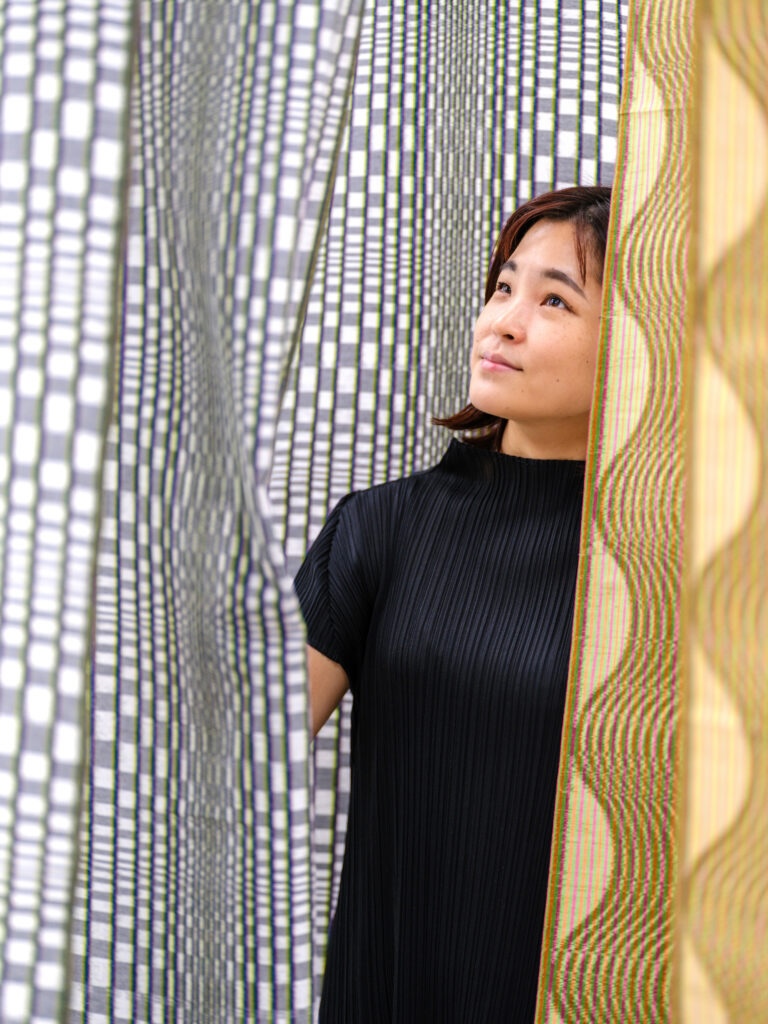
 Tokyo-based textile designer Hana Mitsui. Photograph: www.hanatextiledesign.com(Flora Kovacs-Wester,, 9 October 2026) As part of my research into Japanese kasuri weaving (see my earlier TRC blog post here), I recently had the opportunity to interview Japanese textile designer Hana Mitsui about her practice and her approach to traditional Japanese textiles.
Drawing on her experience with leading fashion and textile houses in Japan and internationally, Mitsui combines traditional weaving techniques with new approaches to materials, patterns and production. During our conversation, Mitsui generously offered to donate a selection of samples from her experiments with Kurume kasuri to the TRC. The donated samples make a meaningful addition to TRC’s existing collection of traditional kasuri textiles and enable us to expand the ways in which Kurume kasuri can be understood and researched within the TRC collection.
Mitsui’s ability to see new possibilities in fabric caught the attention of the fashion world early in her career. While studying at the Royal College of Art in London, Alexander McQueen selected her graduation textile for its Spring/Summer 2015 Paris collection.
She subsequently spent seven years at Issey Miyake, working across textile and bag design. In 2021, she established her own practice, Hana Textile Design Studio, followed by Hana Material Design Laboratory Co. and the HANA LAB product line in 2024, where she continues to explore the relationship between traditional textile techniques and contemporary design.
 Hana Mitsui stayed at Shimogawa Orimono workshop and experienced the production process of Kurume kasuri fabrics based on her own designs. Here, she is pictured with Kyozo Shimogawa, the third-generation owner of Shimogawa Orimono. Photograph: www.hanatextiledesign.com
 Mitsui with resist-dyed kasuri threads at Shimogawa Orimono. Photograph: www.hanatextiledesign.comI was particularly interested in Mitsui’s collaboration with Kyozo Shimogawa, the third-generation owner of Shimogawa Orimono, a Kurume kasuri weaving workshop founded in 1948 in Yame City, Fukuoka Prefecture. Kurume kasuri is one of Japan’s regional traditions of kasuri weaving, produced in the Chikugo region, particularly around Kurume and neighbouring areas. Its history stretches back more than 200 years, and the technique has been passed down through generations.
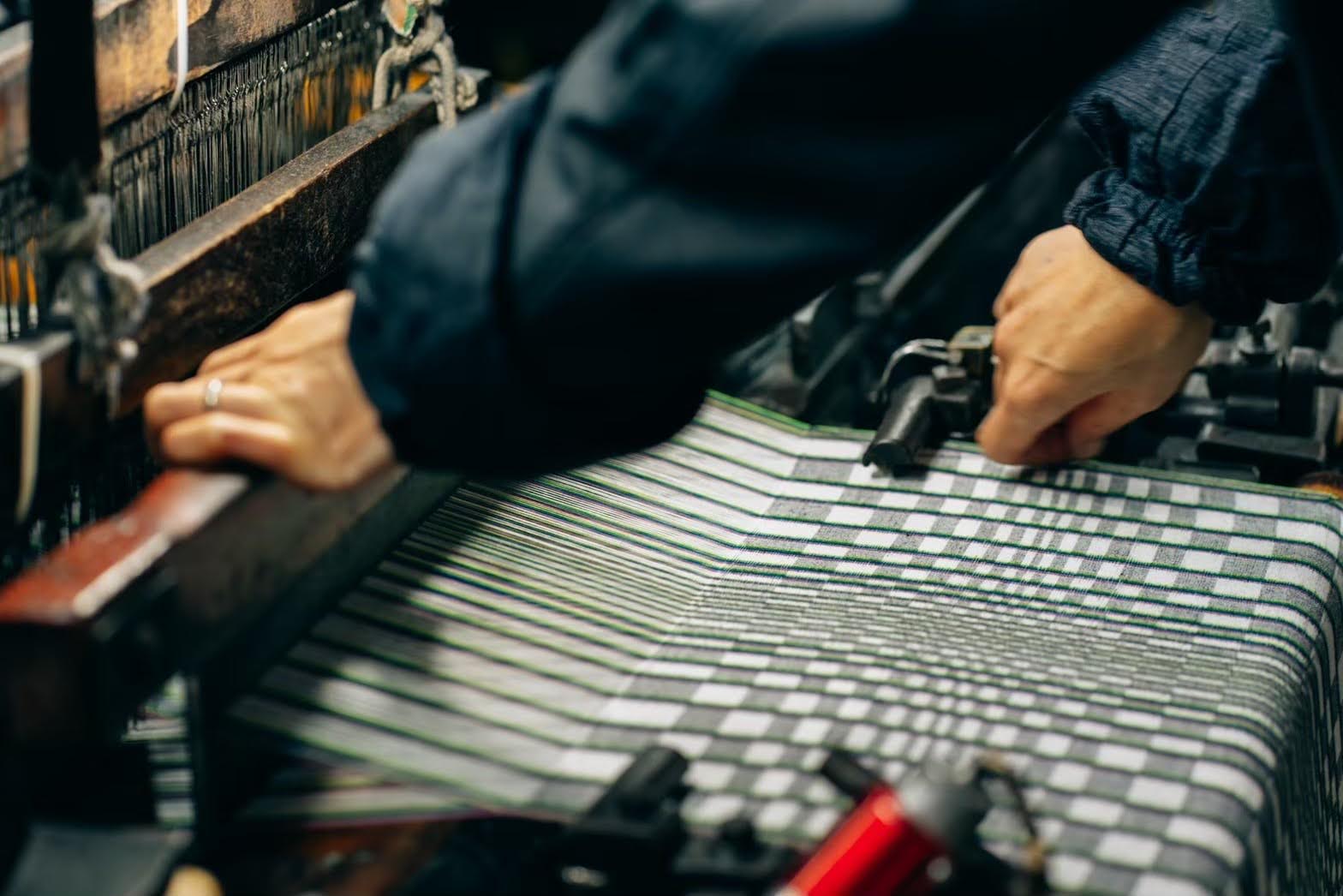 Inside the Shimogawa Orimono workshop, twenty narrow-width vintage power looms are driven by a single motor, their shuttles moving back and forth to weave the carefully prepared kasuri threads. Photograph: www.hanatextiledesign.comIn Kurume kasuri, patterns are planned in the threads before weaving, with sections of the warp and/or weft carefully bound using the kukuri (tie-resist) technique before being dyed.
Once the bindings are removed, the patterned threads are aligned on the loom so that the design emerges as the warp and weft intersect. Slight shifts in this alignment create the characteristic blurred edges for which Kurume kasuri is known. As Kyozo Shimogawa puts it, “the charm of Kurume kasuri lies in the fact that an undesigned beauty emerges from within the design”.
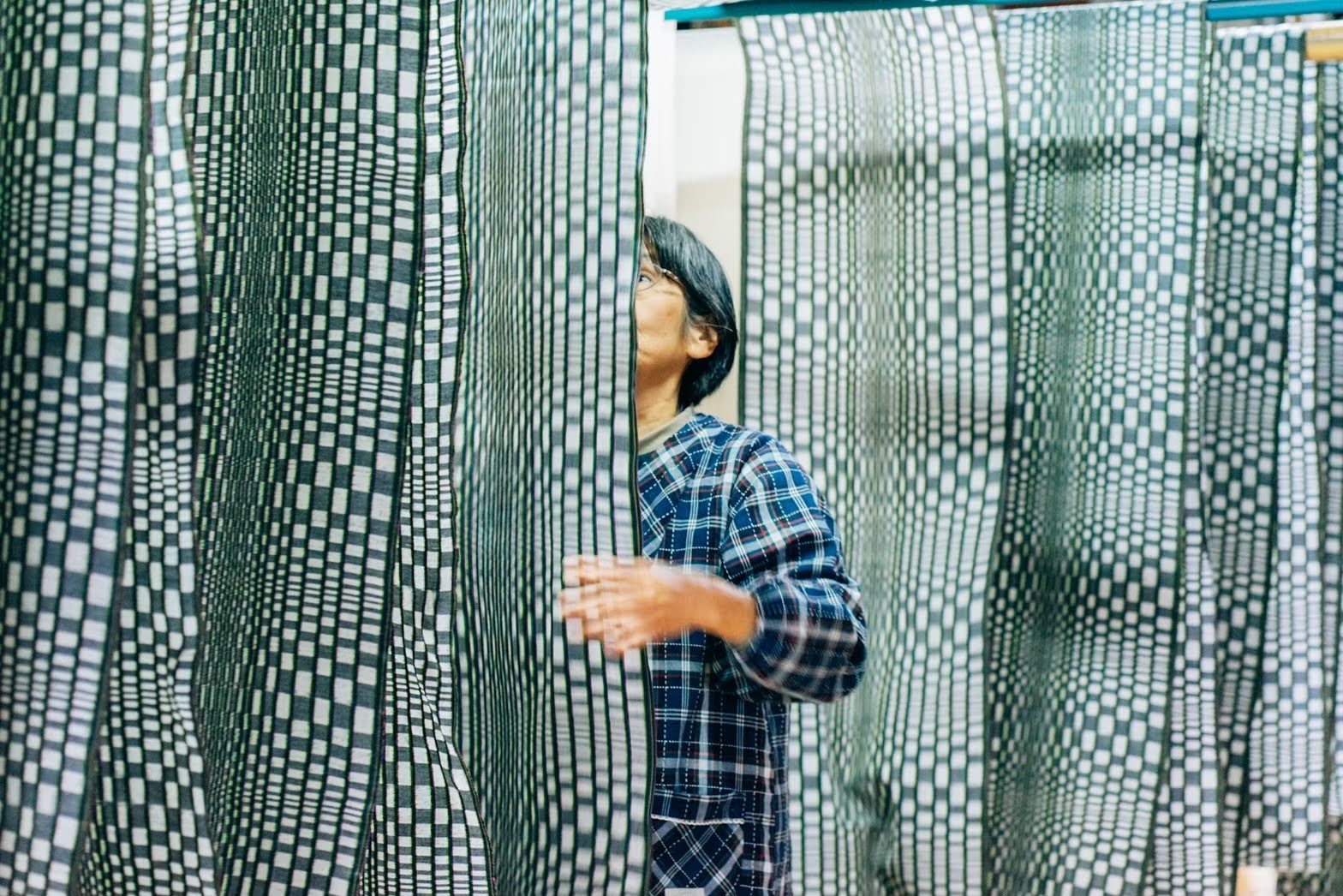 Blur Checker, from The Optical Illusion Ikat (2024), developed as part of the SHIMOGAWA Textile Collection. Photograph: www.hanatextiledesign.comKurume kasuri was once closely connected to everyday life in Japan, particularly through the production of cotton kimonos. As lifestyles changed and the wearing of cotton kimono declined, so too did demand for the fabric. Today, workshops such as Shimogawa Orimono are finding new ways to sustain and reinterpret this textile tradition, working with designers and artists to explore its possibilities beyond its traditional uses.
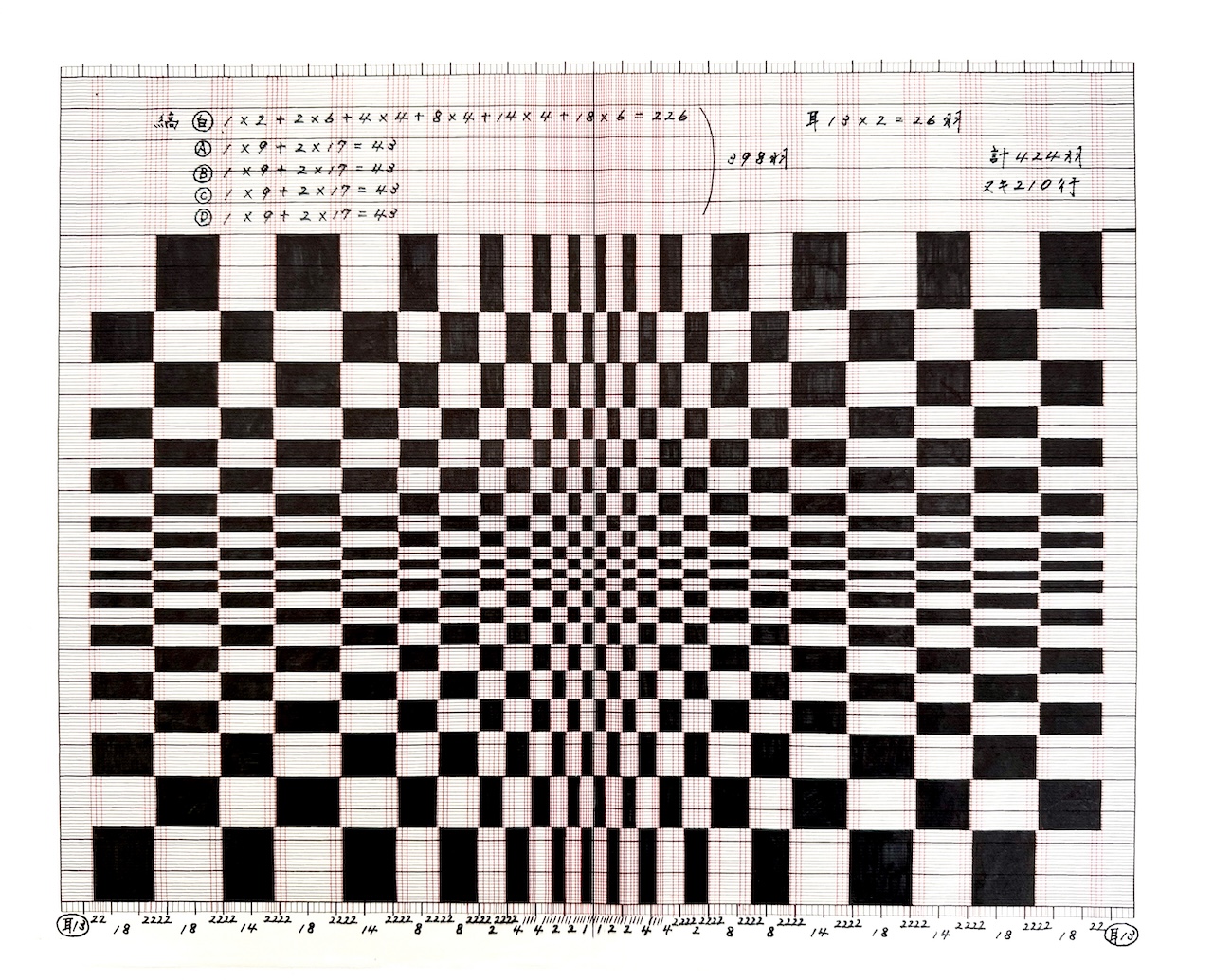 Pattern design sheet for Blur Checker (TRC 2026.2175).Mitsui’s collaboration with Shimogawa is part of this ongoing exploration, bringing the distinctive characteristics of Kurume kasuri into a contemporary design context. (An upcoming blog post will look more closely at Shimogawa Orimono, its workshop in Yame, and the family-run operation behind its continued production of Kurume kasuri.)
The samples donated to the TRC collection come from two bodies of work developed as part of the SHIMOGAWA Textile Collection: The Optical Illusion Ikat (2024) and Botanical Shadow Ikat (2025). The fabrics were woven on Shimogawa Orimono’s Toyoda Y-type looms, narrow-width power looms that the workshop continues to use in production today.
In The Optical Illusion Ikat, the slight shifts between the threads become an intentional visual effect, creating patterns that seem to move or change when viewed. The work was presented at Milan Design Week in 2024. In Botanical Shadow, the pattern remains deliberately undefined, allowing the characteristics of weft kasuri to suggest the delicate impression of a plant shadow.
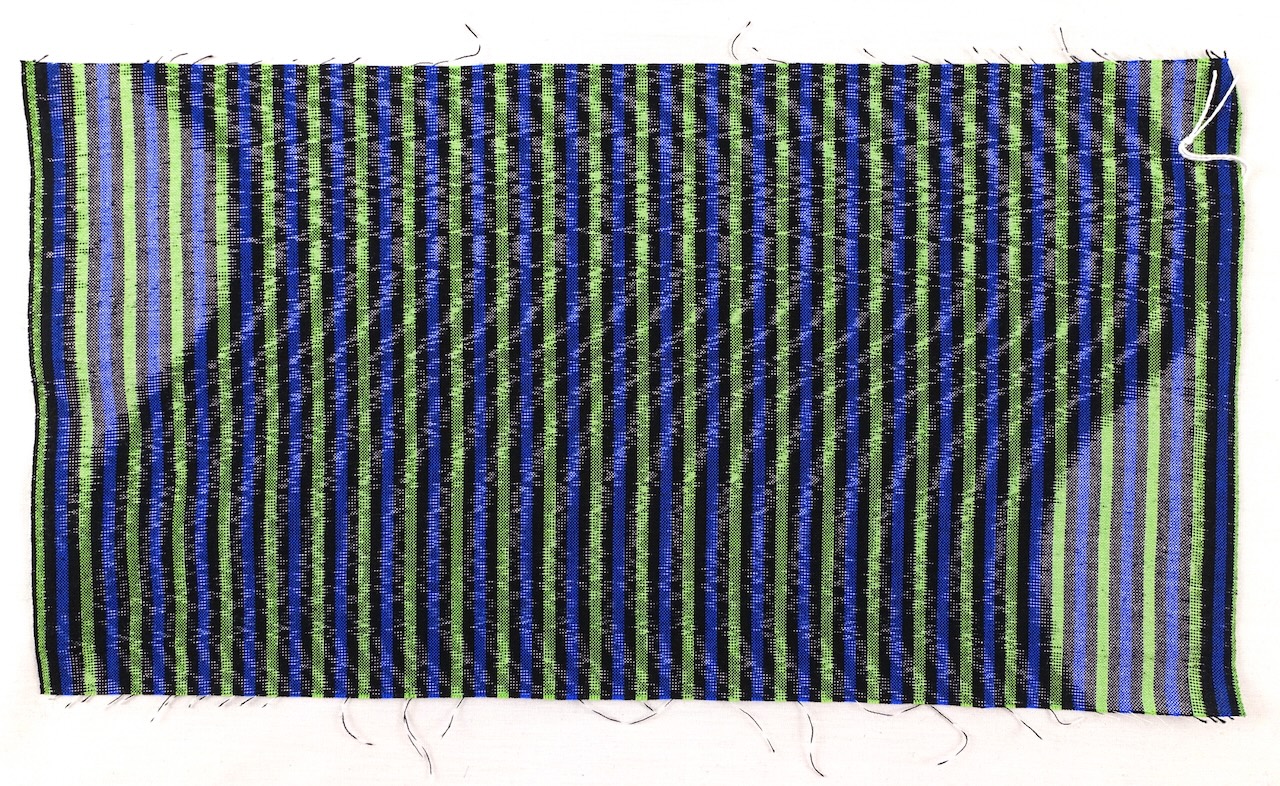 TRC blog 7We are very pleased to welcome these samples into the TRC collection. Alongside the collection’s existing kasuri textiles, they offer new opportunities to explore how a traditional textile technique can be reinterpreted through contemporary experimentation and design.
Flora Kovacs-Wester is a Junior Research Fellow at The Gieskes-Strijbis Fellowship Programme at the TRC, researching Japanese kasuri weaving examples in the TRC collection.
 See also:
- Study day: Japanese Kasuri weaving, 30 October 2026
- Looking closely at Japanese kasuri: my first two months as a Junior Fellow at TRC Leiden
#kasuri #trcleiden #ikat