
The Textile Research Centre proudly presents our first exhibition in the new building: Khayamiya: Egyptian appliqués from the Street of Tentmakers.
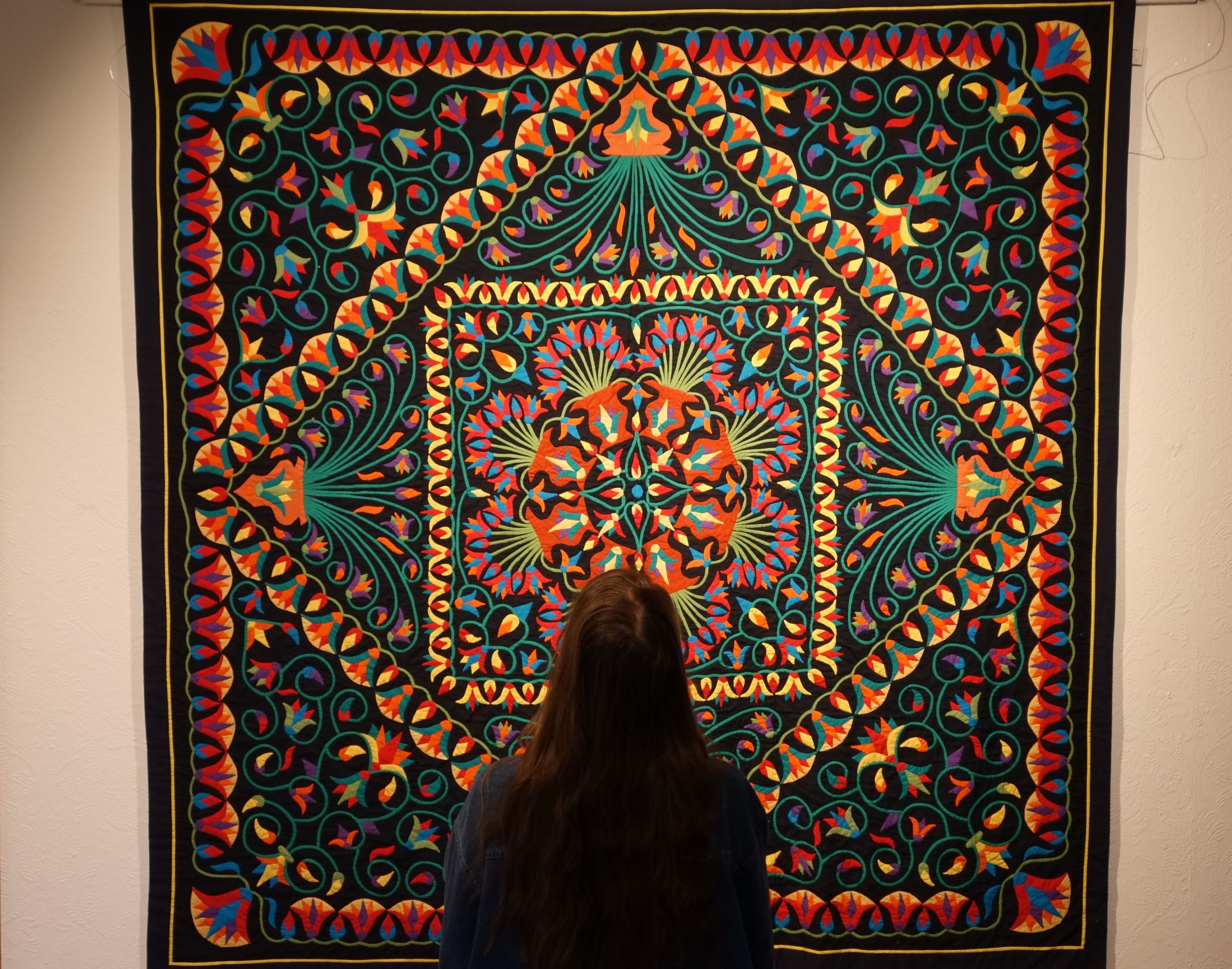
Khayamiya is a textile that is omnipresent in Egypt. The word itself is derived from the Arabic word for tent, namely khayma. Originally, this appliqué technique was mostly used for making hand-sewn tents. Nowadays, khayamiya can also be created using other techniques, such as machine-sewing or (digital) printing. In addition to, for example, tents in (religious) contexts such as weddings and funerals, khayamiya can be used in various shapes and variations. Especially before and during Ramadan, khayamiya tents and decorations are ubiquitous in the Egyptian streets.
Khayamiya, including all the techniques, is an understudied subject often framed as a traditional textile from an (art) historical approach that leaves out the lived experience. Moreover, khayamiya is embedded in an Islamic culture, since Egypt has a Muslim majority. Therefore, it fits in the Muslim world, but it is not addressed as an Islamic or a religious artefact. Khayamiya is used as an atmosphere maker that can create an Islamic setting, but can also be used by other (non-)religious groups. Since khayamiya is not seen as sacred itself, it can be used for many purposes, such as heritage in a museum or as an art project.
This exhibition is co-curated by Christina de Korte. Her interdisciplinary approach used in her research touches upon three sets of themes, namely material culture and Islam, popular culture and piety, and living heritage. By following the routes of various types of khayamiya through Cairo’s streets—focused on the contemporary usages before and during Ramadan—and taking courses in the Street of the Tentmakers, Christina de Korte analyzes in which ways khayamiya is part of an Islamic world.
Christina de Korte is a visual artist and textile researcher. She learned how to make khayamiya in the Street of the Tentmakers in Cairo whilst doing her research on the technique and the contemporary khayamiya usages before and during Ramadan. Christina recently graduated from the research master’s program in Religious Studies at Utrecht University and holds bachelor’s degrees in Fine Art from the HKU University of Arts Utrecht and Language and Culture Studies from Utrecht University.
Programme:
- 15.30: Doors open.
- 16.00: Welcoming words from Dr. Gillian Vogelsang-Eastwood.
- 16.15: Opening of the exhibition by H.E. Mr. Emad Magdy Hanna Kamel
- 16.30: Christina de Korte, co-curator, elaborates on her experience learning Khayamiya in Cairo.
- 17.00: Refreshments.
- 18.00: End of the event.
This event takes place at the Boerhaavelaan 6.
Please register through: This email address is being protected from spambots. You need JavaScript enabled to view it.