If you are expecting a dramatic story of war-torn Leiden, bombs and fighting, then stop reading now. This is a very much smaller tale of domestic up-cycling in an imaginative manner!
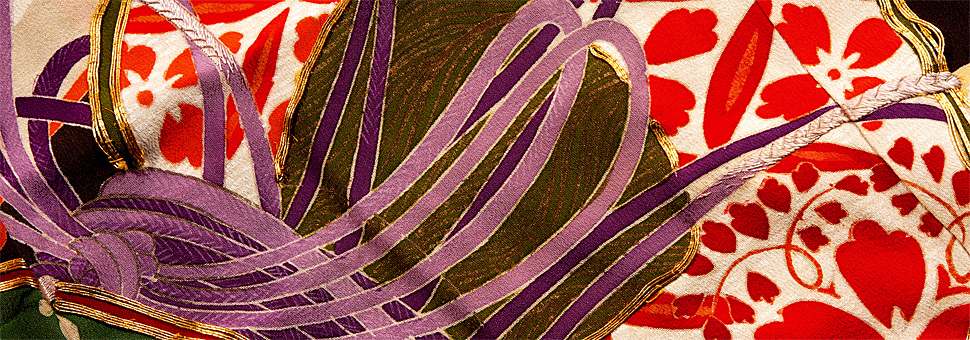
 Child's little cardigan, knitted from cotton left-overs in war-torn Leiden, September 1941 (TRC 2022.1882a).
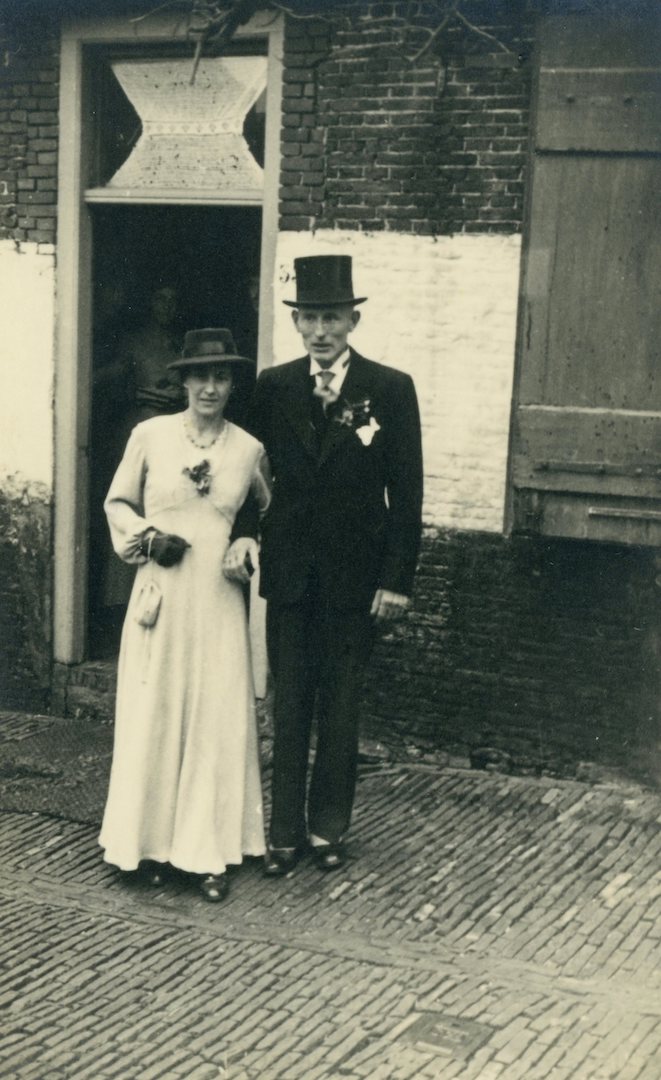 Ida van Gent, at the wedding of her brother, December 1943. The dress she is wearing is now in the TRC collection (TRC 2019.2154).A few years ago the TRC was given the wedding dress (TRC 2019.2154) of Ida van der Meij (1910-1977), which she wore when she married Jan van Gent (1909-1983) in Leiden on the 20th April 1938. Ida van der Meij’s family lived at Hoge Rijndijk 254, Leiden, not far from where the TRC is situated.
On the 22nd December 1943, while the Netherlands were occupied by German forces, Ida van Gent’s brother, Jacobus van der Meij (1917-1958), married Maria de Koning (1918-2008) from Leiderdorp, close to Leiden. It was wartime and clothing was scarce, so Ida dyed her white wedding dress lilac, changed the shape of the sleeves and used this updated garment for her brother's wedding (see also a previous blog). See the photograph of Ida at her brother's wedding.
The dress was donated to the TRC by the van Gent family and displayed in an TRC’s exhibition called Textile Tales from the Second World War (2019; see also the TRC online exhibition).
On Monday morning (27th June 2022) we were rung up by another member of the van Gent family, who was tidying up her mother’s house and had come across a little baby 'truitje' (cardigan), in Dutch also known as a 'luiertruitje', which has an intriguing family story. We 'Said Yes to the Cardigan’ and she personally delivered it a few hours later.
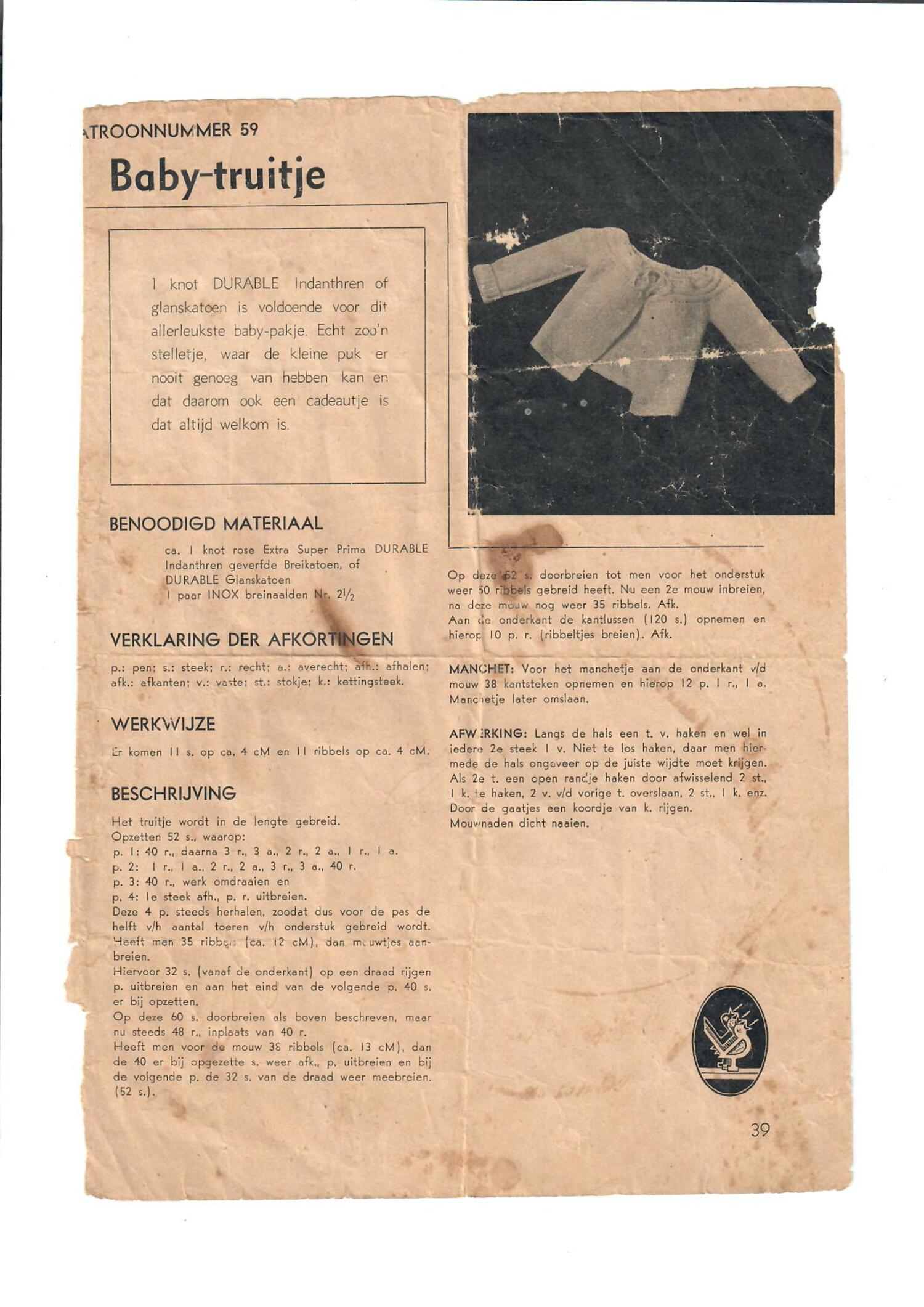 Knitting pattern for a baby's little cardigan, the Netherlands, 1930s (TRC 2022.1882b). Please note that the little jacket was worn with the opening at the back.
It is thanks to this small cardigan we can add another ‘chapter’ to Ida’s story, namely that in September 1941 she gave birth to a son, called Jan Hendrik. There is a report of his registration on the 16th September in the Leidse Courant, the local newspaper.
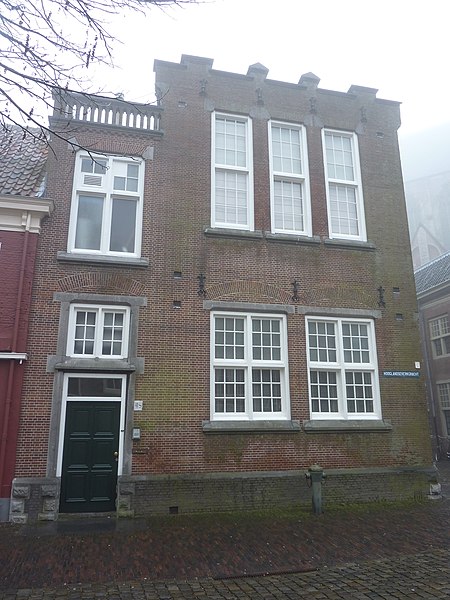 The 'Patrimonium' building, Hooglandse Kerkgracht 48, for many years after WWII the place where many Leiden people learnt ballroom dancing (including the author and her husband).At the time her husband was a caretaker of the so-called Patrimonium building, Hooglandse Kerkgracht 48 in the centre of Leiden, where he and his young wife also enjoyed living accommodation. The building was sometimes used for sales, including those of carpets. The Van Gent family therefore had the chance to collect left overs, including white cotton strings that were used to roll up and tie the carpets and rugs.
Ida had been collecting the leftover cotton threads and it was these odd lengths of yarn that were used to knit the tiny cardigan for her baby son, thereby dating the cardigan to September 1941 (it is not clear if she knitted the cardigan just before or just after the birth of Jan Hendrik). If you look on the inside you can see where the lengths of cotton yarn have been knotted together.
Not only that, the little cardigan came with the original knitting pattern (TRC 2022.1882b) that was used to make the garment - it probably dates to the 1930s! It is fascinating to have the original pattern, garment, as well as the story of wartime life, all wrapped up in one ‘small’ donation. It so happened that the cardigan was worn by the baby, and other siblings, with the opening at the back. Was that the intention of the pattern makers?
As an aside, Jan van Gent, while caretaker of the Patrimonium building, was also an assistant for wedding and funeral corteches, apparently for the firm of De Jong, who ran Leiden's first taxi and ambulance service from ........ Hogewoerd 164, now the address of the TRC.
Gillian Vogelsang-Eastwood, 27 June 2022