

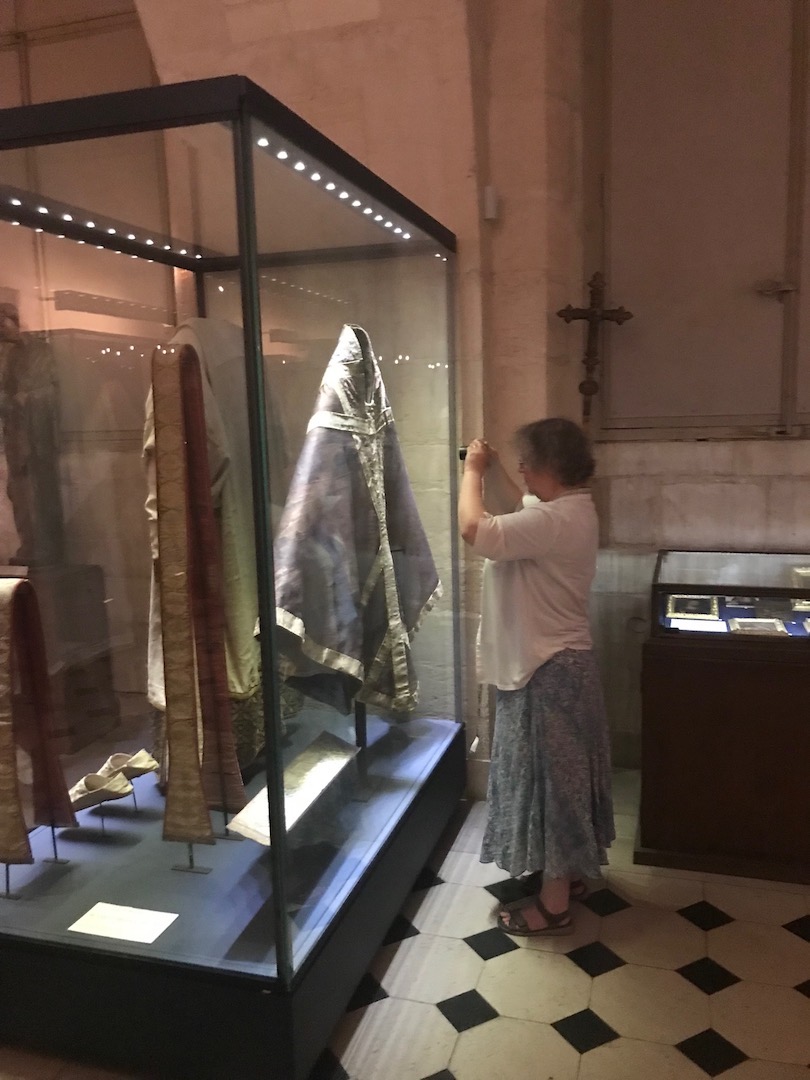
 Studying the relics of St Thomas Becket in Sens Museum (photograph Willem Vogelsang).We have just spent a lovely two days in Sens, just southeast of Paris. It’s a medieval city (with Roman remains) and well worth a visit. More importantly, from my (unbiased) point of view, Sens Museum, next to the cathedral, has one of the best collections of medieval textiles in this part of Europe!
All of which is thanks to being home to many items from Sens Cathedral (the current cathedral dates from 1135, but it is built on a much older complex). They include many finds from medieval tombs inside the cathedral, such as burial shrouds, as well as other remains such as altar furnishings of various types, reliquary coverings and bags made of cloth.
The textiles include both woven and embroidered forms from Iran, Byzantium, as well as Italy, Spain and northwestern Europe. It even houses a small, knitted bag with an Arabic text that probably dates to about the 13th century!
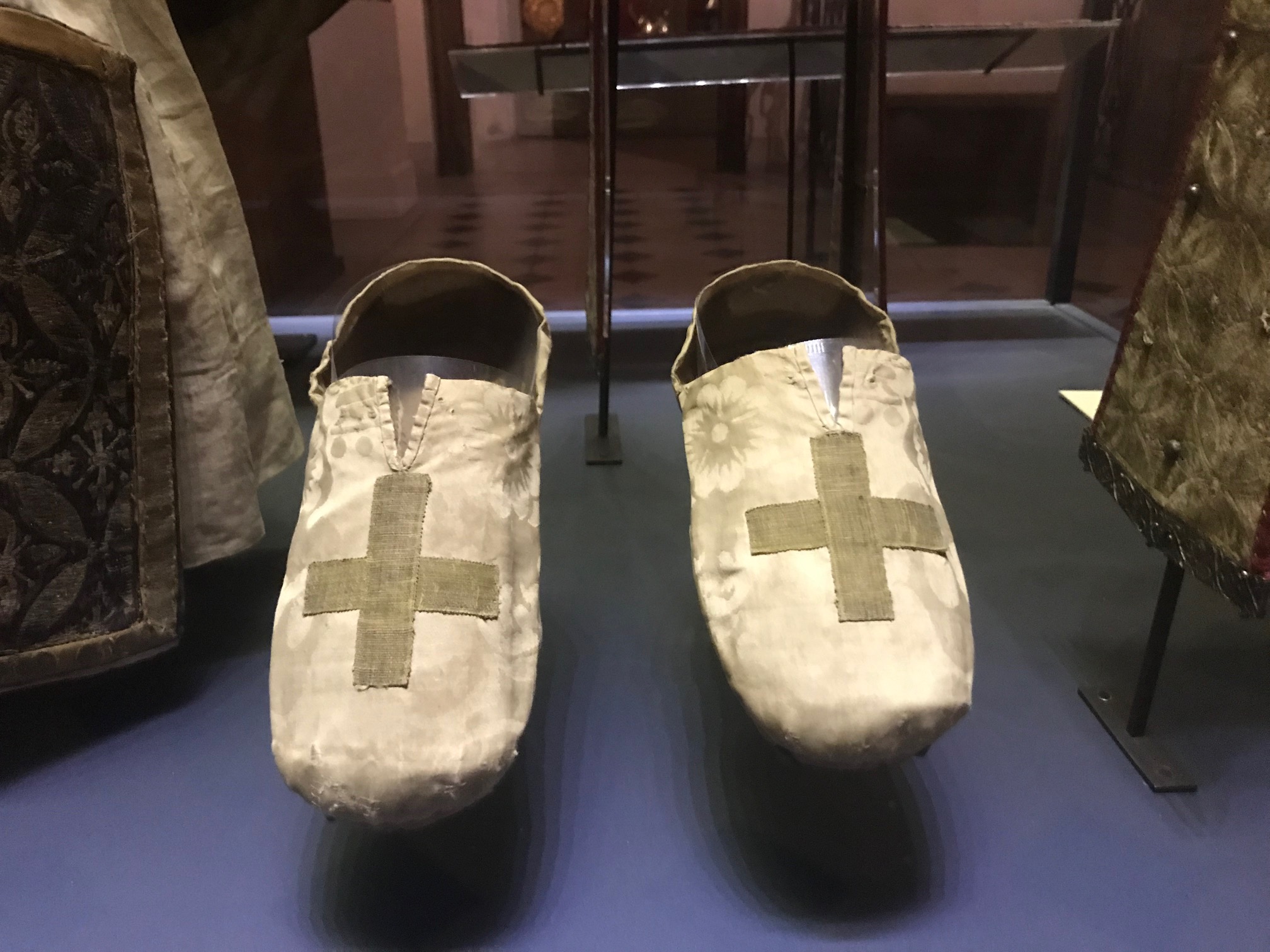 Pontifical slippers, attributed to St Thomas Becket (12th century), Courtesy Sens Museum (photograph Willem Vogelsang).
But we came to Sens primarily to see the garments associated with St Thomas Becket, who was murdered in 1170 in Canterbury Cathedral, England, and a few years later was declared a saint. Before he went to Canterbury, he was the bishop of Sens. I was particularly interested in the related embroideries for inclusion in the Bloomsbury World Encyclopedia of Embroidery (vol. 4). Thanks to the kindness of the museum authorities, Willem and I were able to visit the treasury while it was shut to the general public. We did so after a visit to the Museum archives, where we were able to consult all the relevent documents pertaining to the Becket remains.
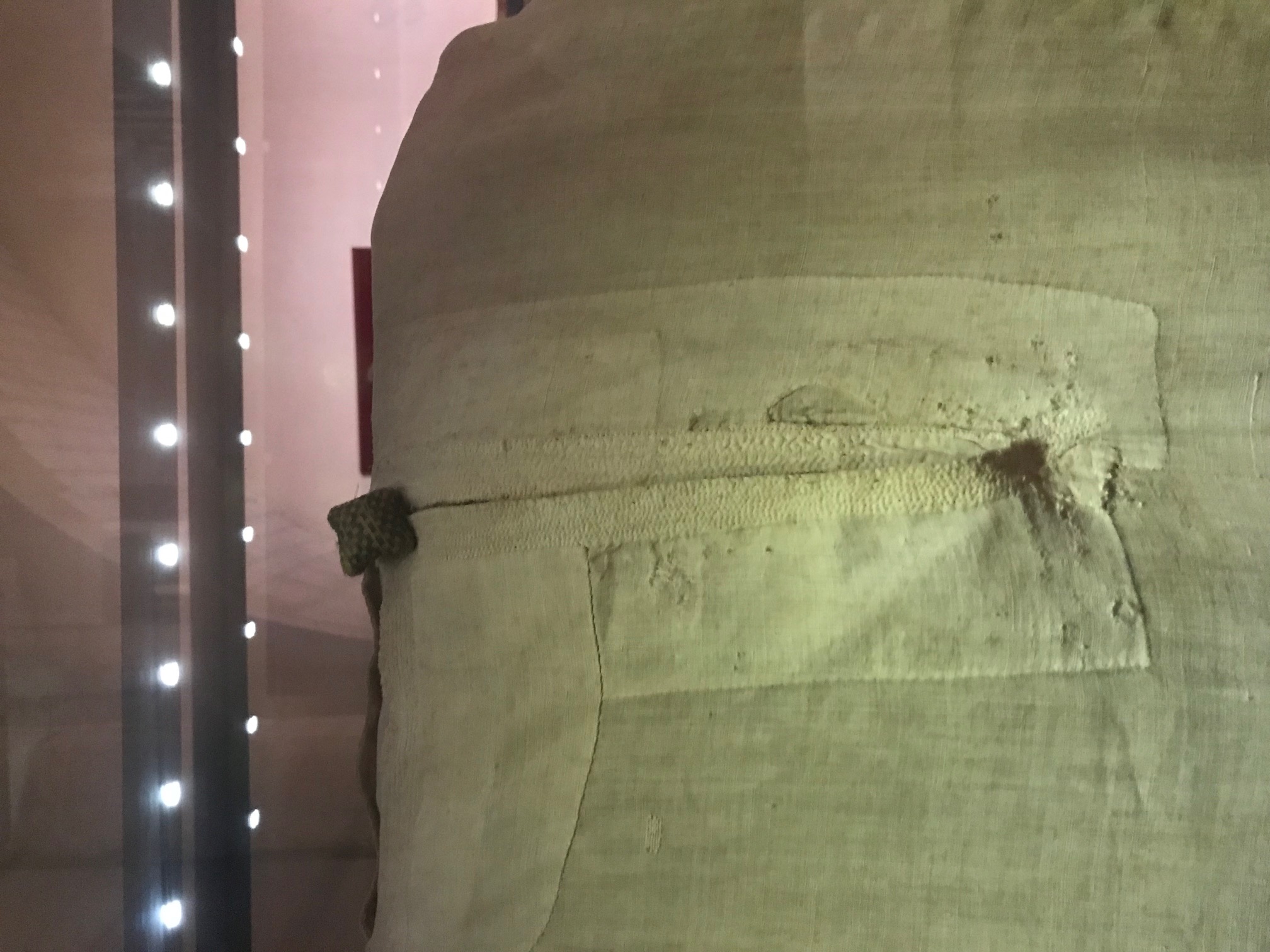 Detail of the alb, showing the neck opening. Attributed to St Thomas Becket, 12th century. Courtesy Sens Museum (photograph Willem Vogelsang). The Becket items, all contained in one large showcase, include an alb that is huge and although it would have been kept in place with a sash or cord of some kind it remains large! There are rows of back stitch in a thick linen thread around the neck opening and (Italian) shirring on the side panels, as well as embroidered bands on the sleeve hems and two panels along the front and back (skirt) hems.
There is also the stole and maniple associated with the saint, and the amice band that was used as a collar. On the other side of the showcase there is a (heavily restored) chasuble – all of the decorative bands are woven, but around the front neck opening there are four panels, two with floral scrolls, and the other two with angels. The back neck panel was also embroidered and was decorated with a scrolling, tree-like form. The showcase also includes the slippers associated with the saint.
Apart from the Becket items, the museum very kindly allowed us to examine a range of medieval embroidered reliquary bags, one, for example, with a fish on either side in split stitch, as well as another silk bag with geometric patterns worked in long-armed cross stitch. We were allowed to have a close look at the items with a Dino-lite microscope, which really brought out the small details.
There was also a 12th century bag with a knight on the front and an eagle with rabbit or hare on the back, as well as a lovely, 14th century bag with the embroidered depictions of pairs of lovers in a garden setting on the front and back.
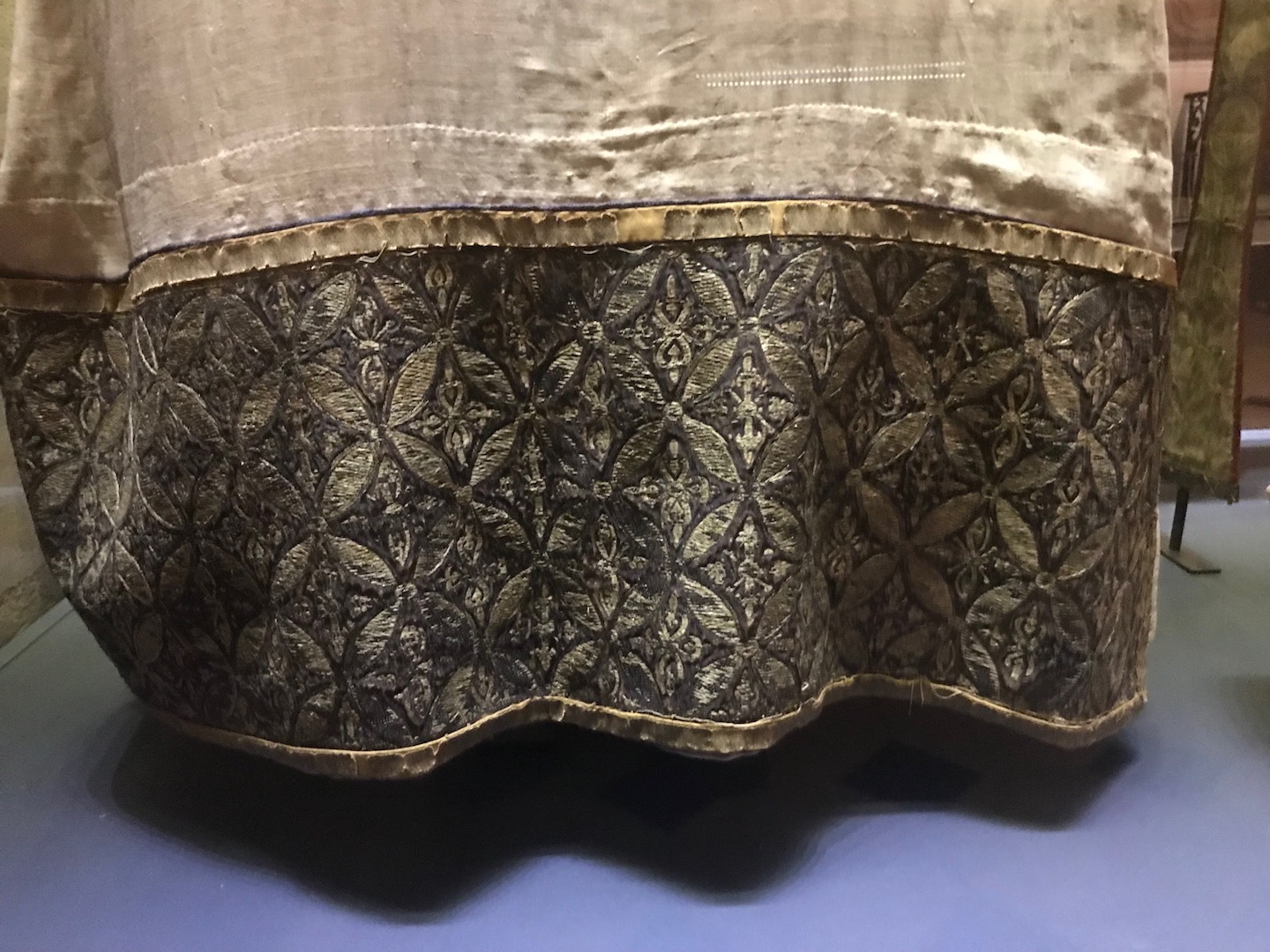 Embroidered panel from the hem area of the alb, attributed to St Thomas Becket, 12th century. Courtesy Sens Museum (photograph Willem Vogelsang).
In the same showcase there is a piece of embroidery with griffins, foliage and knot-work in red and blue chain stitch that is described as 13th century in date, but it is more likely to be a Celtic (Anglo-Saxon) piece and as such much earlier.
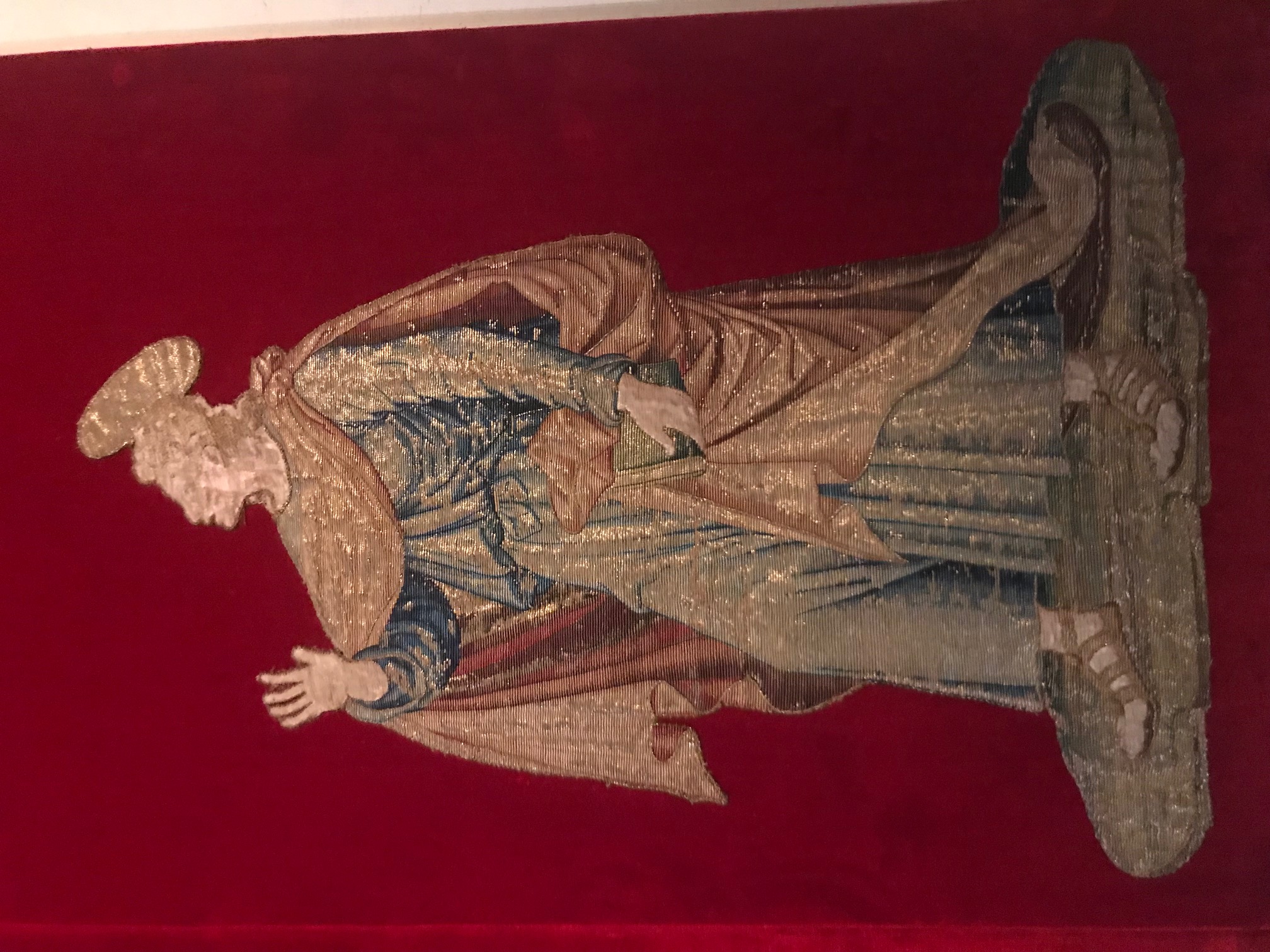 Or nué embroidery of a female saint, Courtesy Sens Museum, 15th century.Jumping a few centuries, we also saw several examples of or nué, which were not covered in glass and now I understand why this form of embroidery became so popular - it glitters as the cloth or person moves. Something I had never appreciated when looking at examples behind non-reflective glass, etc. They need movement to come alive.
In the afternoon we went to the Museum archives and reserve collection, where two more embroideries were brought out for us to see. One was a 14th century panel from an altar cloth and the depiction of Christ surrounded by saints, as well as Mary holding the Christ Child, again surrounded by saints. The vivid colours of this piece really surprised me, magenta with yellow, for example, it is not something I am used to with embroideries from further north.
The big surprise, however, was an unfinished embroidery. It's 127 x 91 cm in size and has a complex series of line drawings depicting scenes from the lives of David and Absalom (2 Samuel 14:24). Absalom was King David’s third son, whom rebelled against his father and was killed during the Battle of Ephraim’s Wood.
The various scenes include King David enthroned, a feast scene and a complicated battle scene with horses, knights and men-at-arms. All of these details were drawn in a black ink of some kind on the linen ground. Only part of the lower edge had been embroidered, for some unknown reason the project was abandoned.
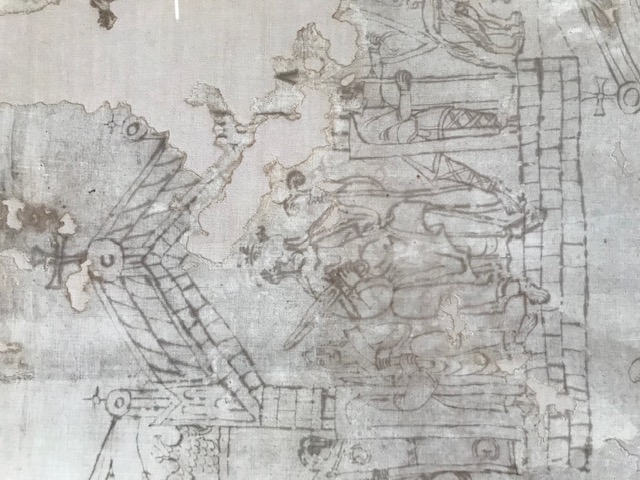 Detail of 11th/12th century, partially worked embroidered panel, showing the Biblical story of King David and his son, Absalom. The detail shows King David sitting on his throne. Courtesy Sens Museum archives (photograph Willem Vogelsang).
So, if you are in the neighbourhood of Sens, it is well worth a visit, there is amazing medieval architecture, intricate street system, not forgetting of course the cathedral and museum. The museum would like more visitors to see the textiles and I can recommend a visit to see the knitted, woven and embroidered textiles and bags.
I would really like to thank the Museum and Library for their kindness and sheer helpfulness in seeing these pieces, it is greatly appreciated. The trip to Sens was partially made possible by a travel grant from DutchCulture.
Gillian Vogelsang-Eastwood, 6 July 2022