

We were in Cluny in central France the other day and although I knew the Benedictine abbey was an important medieval religious and cultural centre, I had not realised just how big the whole complex was.
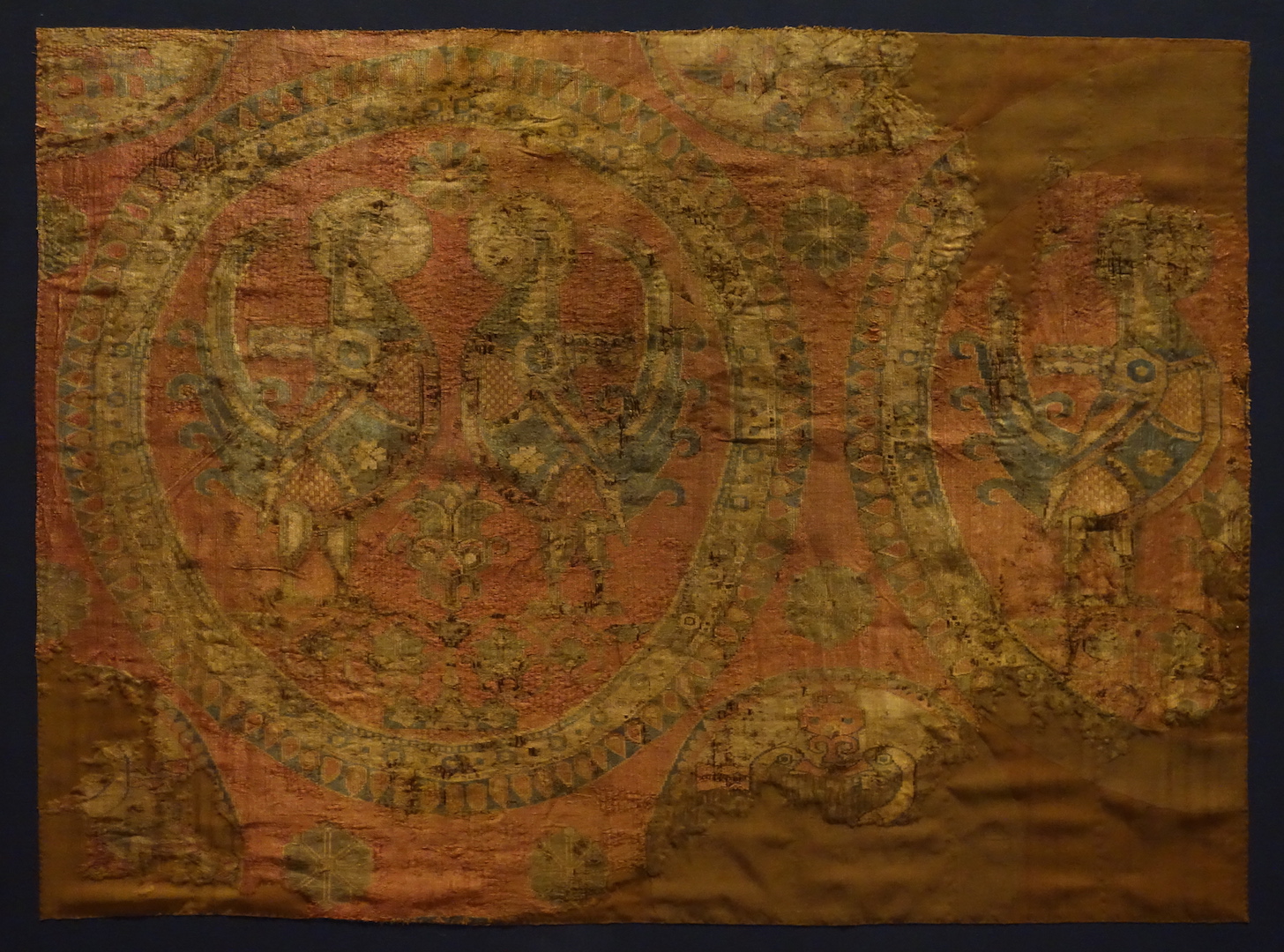 Piece of woven silk with a design of roundels enclosing cockerels. Iranian, 4th/6th century (?)
Thanks to the Huguenots in 1562, later the French Revolution and other events there is very little left of the huge church known as the Maior Ecclesia, which at one time was the largest church in Christendom. I was left wondering what had happened to all the people, their lives, and the sheer quantity of textiles that would have decorated the various churches, offices, public rooms, etc? Many items ended up in the Musée Cluny in Paris, but so little is left in Cluny itself. And over time, I suspect a considerable number vanished into private hands, while other pieces were simply discarded.
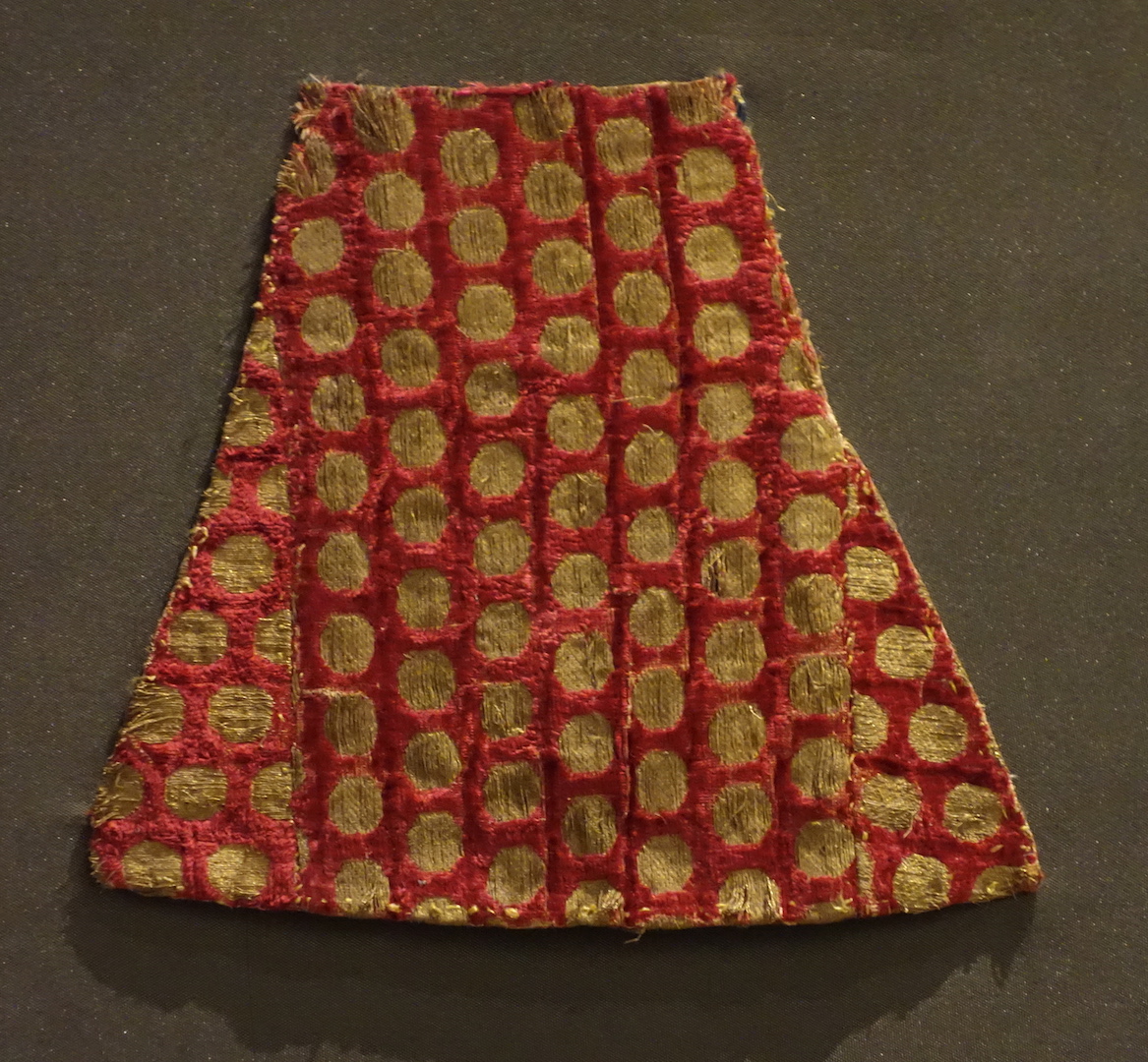 Piece of Iranian, silk velvet with gold thread dots. c. 14th century.We then went to the Musée d’Art et d’Archéologie, Cluny, hoping to see some textiles, but expecting nothing, given the emptiness in the main buildings. But there was a surprise in store. From the 20th June to the 2nd October 2022, there is a small exhibition (Sur la route de la soie. Étoffes, luxe & pouvoir) about the Silk Route with a selection of textiles representing over 1000 years of textile history.
It includes Sassanian, Mongolian, Early Persian, Islamic, Safavid Persian, as well as Indian, Egyptian, Italian (Sicilian) and Spanish items, in a variety of woven forms, including compound weaves (samit), lampas, tapestry, brocades and velvet.
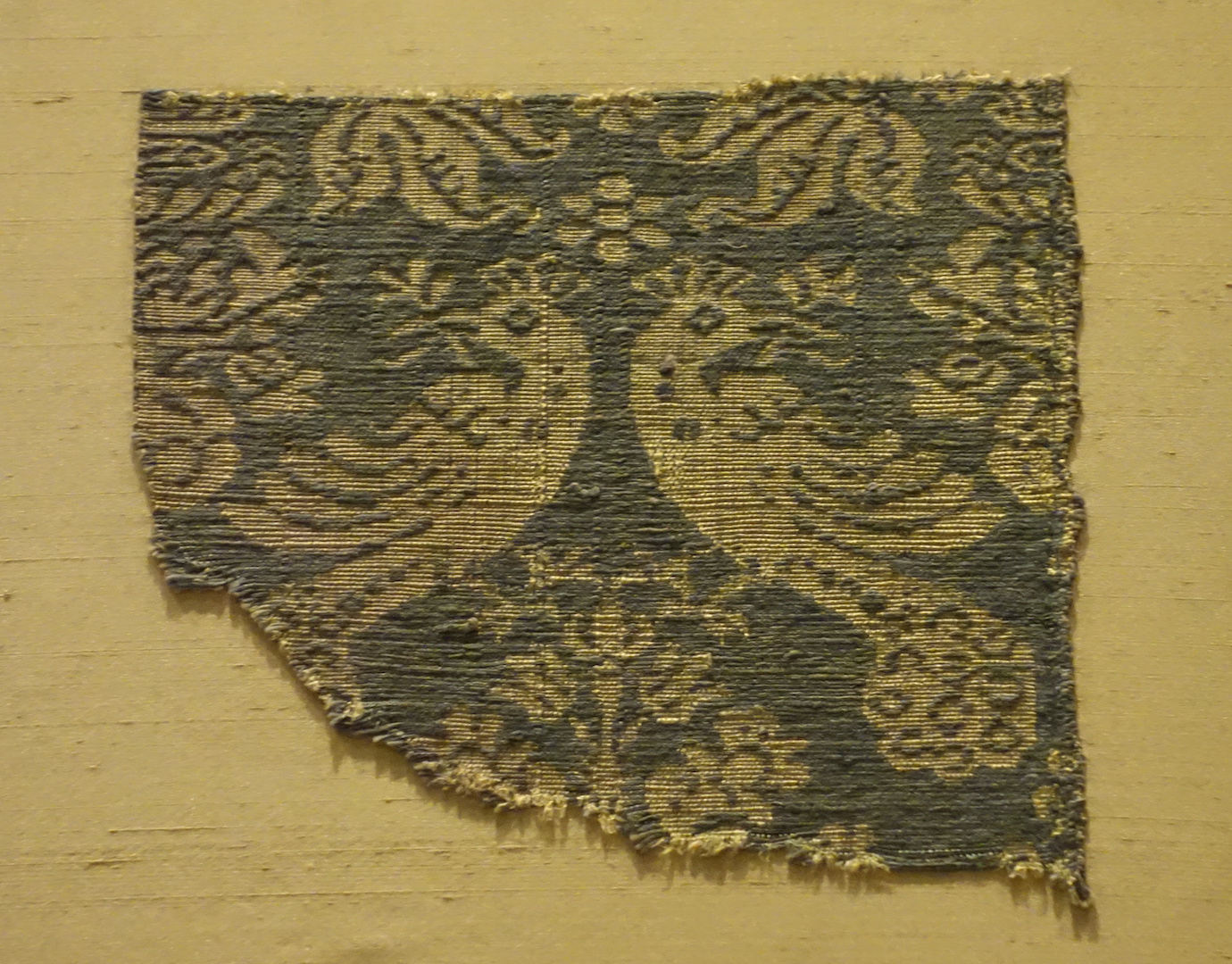 Fragment of a silk cloth with paired birds. 14th century, Italy.Some of the pieces are classic, such as Sassanian pearl roundels enclosing stylised birds, as well as a large piece of Mongolian silk lampas with a complicated interlacing design,
There a large piece of Sicilian cloth near several Fatimid and Mamluk period silks including a piece with part of an Arabic inscription, as well as two earlier ‘Coptic’ pieces all in a tapestry weave. There were also three pieces of 13th century Persian velvets with small white spots on a red ground. Just to mention some of the items.
It was amazing to see such a collection put together, apparently by one private collector. There is a small brochure to the exhibition that is in French and gives details of the various historical periods, but very little about the textiles themselves.
In addition, in the room next to the main hall upstairs, there are three copes, representing different periods, including a later damask example, a cope with an embroidered orphrey, and a most unusual (to my eyes) cope in bright orange with appliqué flowers. The latter is believed to be Polish in origin.
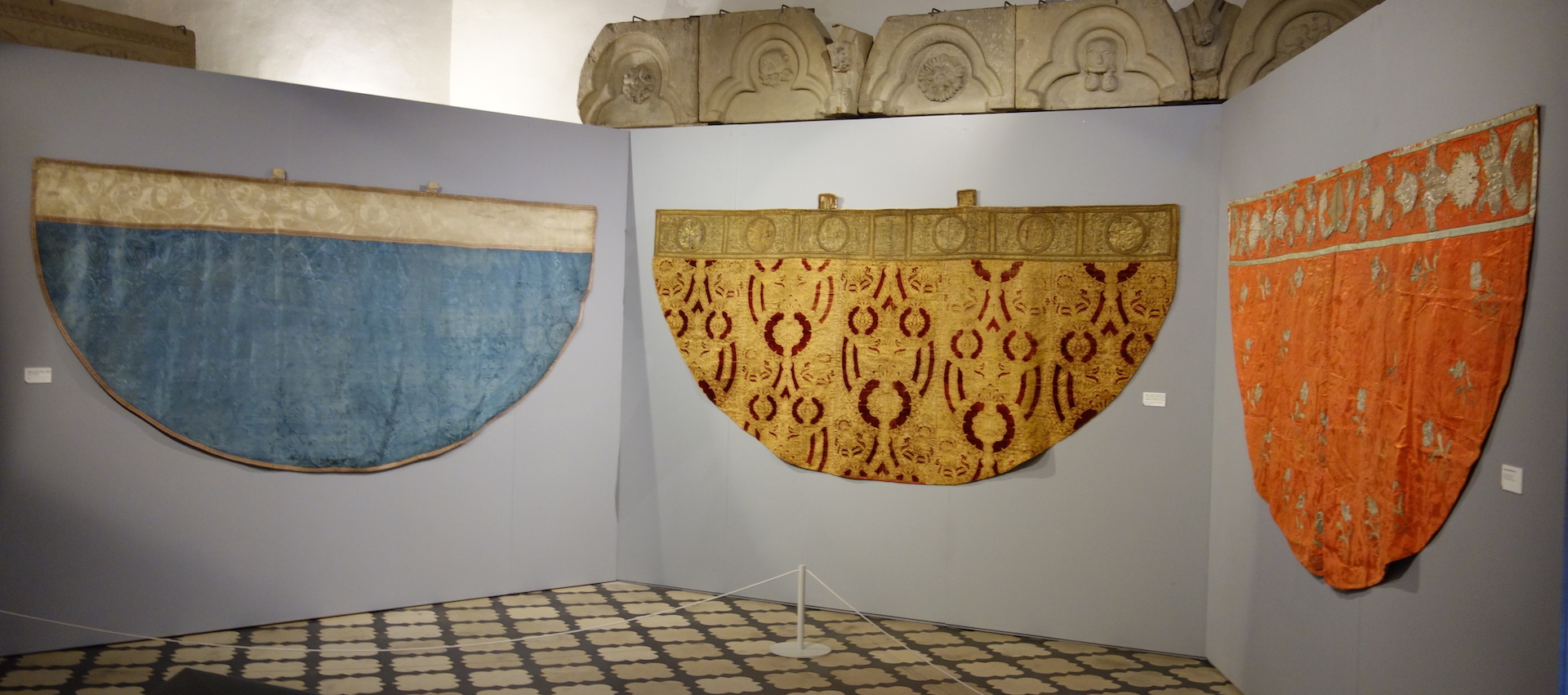 Three elaborately decorated, silk copes, on display in the Cluny Museum.
If you are in the neighbourhood and want to see a lovely collection of early silk textiles then please try to get to Cluny. Well worth the effort.
Gillian Vogelsang-Eastwood, 7 July 2022