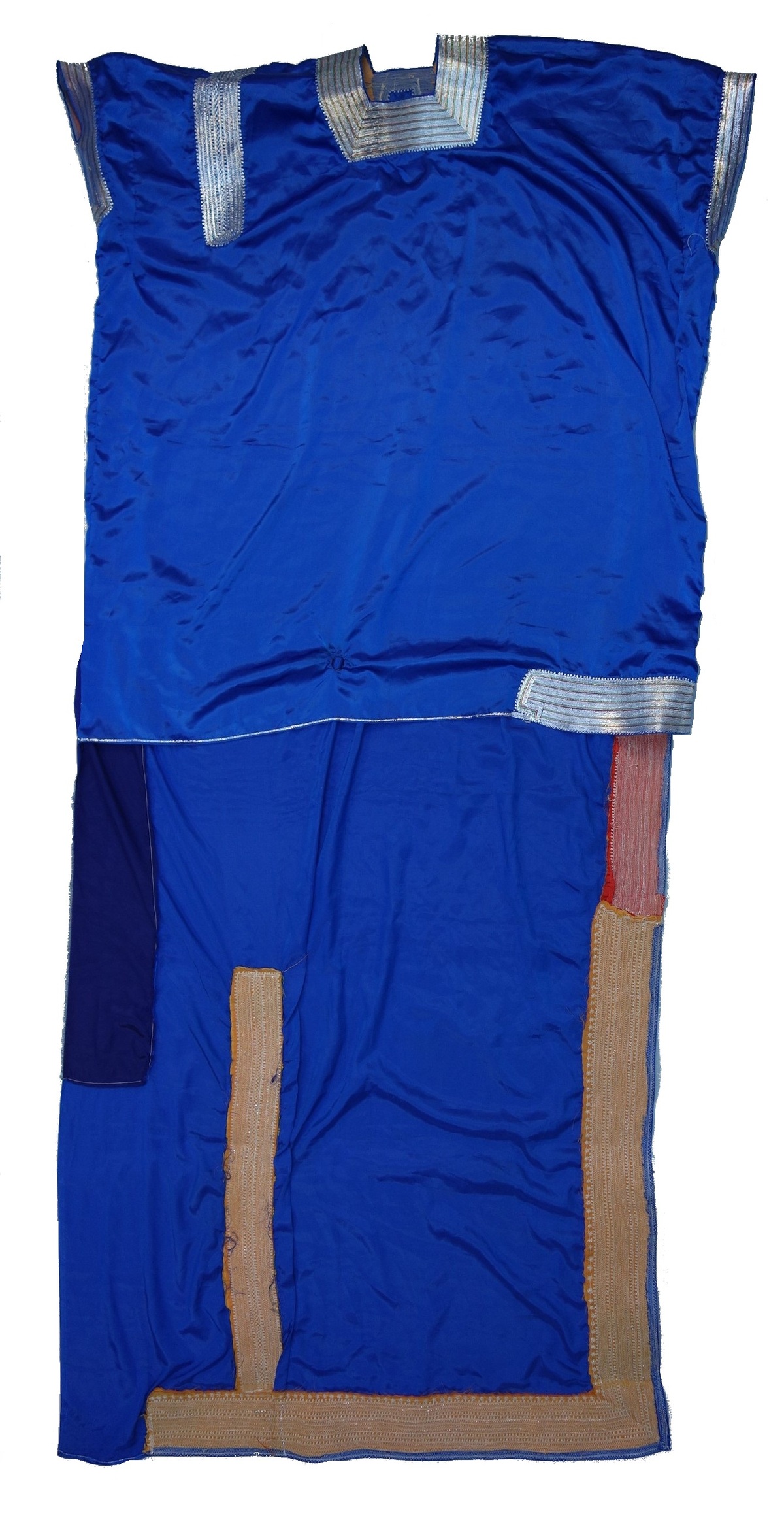
 Dress with long train from the island of Socotra (TRC 2017.0242). The dress is more than two metres long; the front reaches to the knees. The back of the dress includes the long train. Socotra is a small island in the Gulf of Aden, between the Red Sea, the Arabian Sea and the Indian Ocean. You may never have heard about it, but this weekend it reached the world’s headlines because of an attempt by some of the local people to make themselves independent of nearby Yemen. Mainland Yemen has been devastated by a civil war that still continues, so the attempt to cut links with Yemen are understandable.
I won’t go into the political details, but what struck me was the information that journalists must desparately have been collecting about this place, in order to provide some couleur locale. They could have written something about its human history, which goes back for thousands of years. The island features already in a two thousand year old sea manual for the trade between Roman Egypt and India. But what the media came up with was that the island was famous for a particular tree, the Dragon’s Blood tree, and for the Socotra cormorant, which is a type of sea-bird.
Now trees and birds are enormously important, but my well-informed spouse also knew about the island, not because of its ancient history or a type of sea-bird, but because of a particular type of dress worn by the local women. It has a very long train that is, so we assume, wrapped around the body, forming some sort of second covering. In all, the dress is more than two metres long, and decorated with embroidery and/or silver-coloured bands on the front and back.
The Textile Research Centre in Leiden has two examples of this unique form of garment, both dating to the late twentieth or early twenty-first centuries (TRC 2015.0551 and TRC 2017.0242).


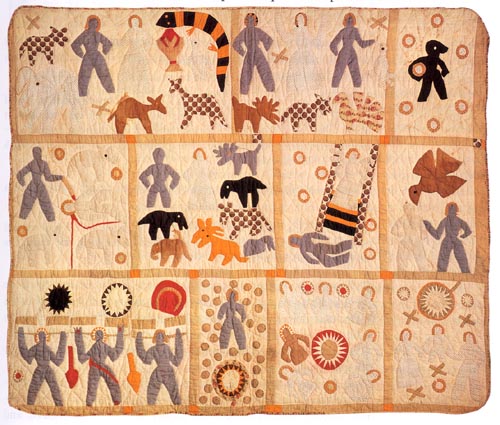 The Bible Quilt, completed by Harriet Powers in 1886.