• F2
  • F3
  • F1
  • F4


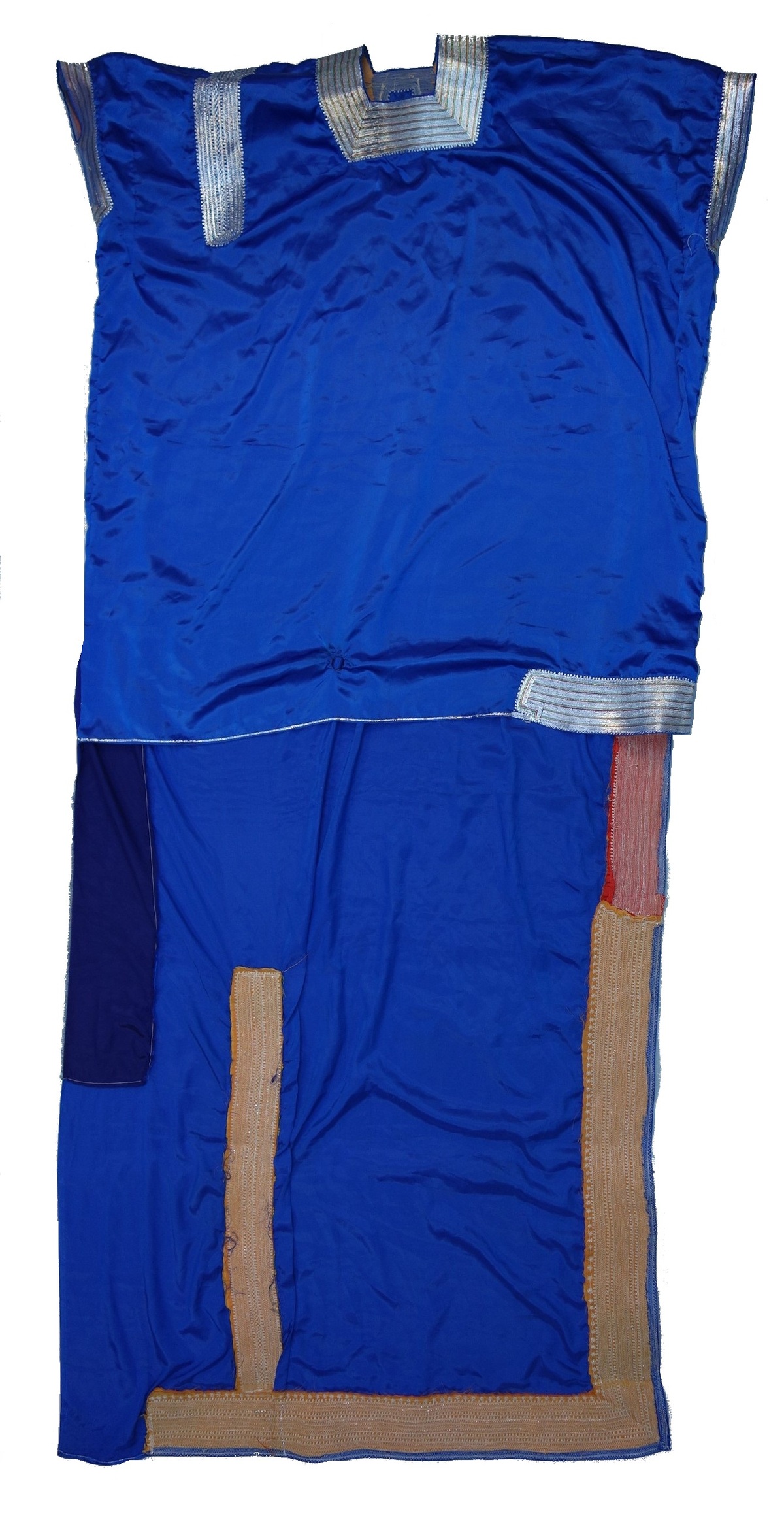
Dress designed by Karim Adduchi. Photograph by Shelley Anderson (2019).Dress designed by Karim Adduchi. Photograph by Shelley Anderson (2019).I first heard of Karim Adduchi (1988--) last year, when I saw some of his striking dresses in a fashion exhibition at the Amsterdam Museum. The dresses incorporated traditional Berber and Moroccan materials and motifs. Born in Morocco, Adduchi moved to the Netherlands to study at the Gerrit Rietveld Academie. He graduated in 2015, when he garnered praise for his collection “She Knows Why the Caged Bird Sings” during the annual Fashion Week.

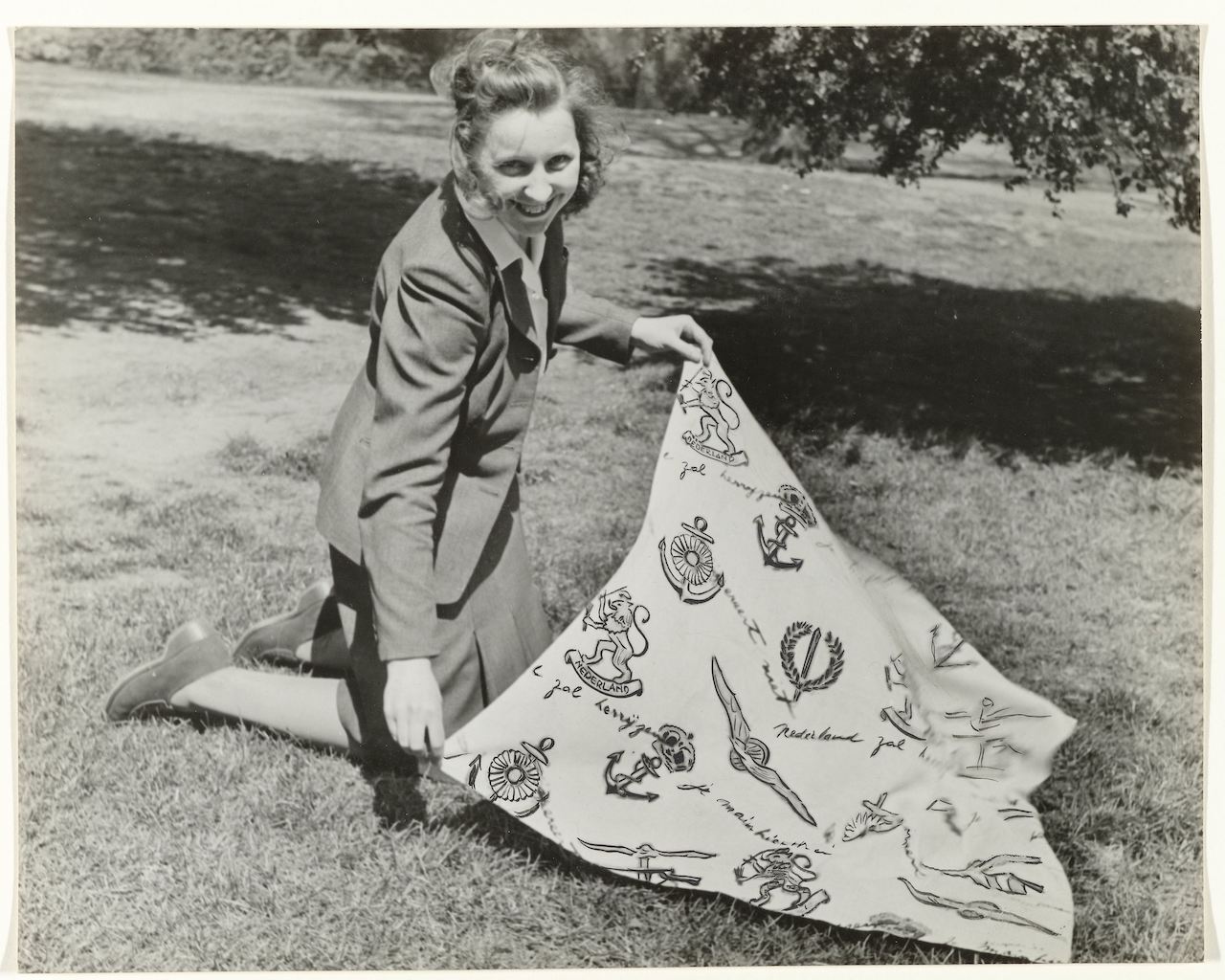
Still based in Amsterdam, Adduchi works with immigrant and refugee women, learning traditional embroidery to use in his designs. During the recent lockdown he and the World Makers Foundation started a collective embroidery project, called Project Social [Distancing] Fabric. Adduchi hand drew a design, which was sent, along with needle and floss, to participants to embroider at home and to asylum reception centres. Once finished, all the contributions will be stitched together and displayed at the Amsterdam Museum in September. The invitation to join the Project stated “Even in this period of isolation, we will have a shared memory of connection, colour and hope, a story we are all part of”.

Hand drawn design by Karim Adduchi, for the Project Social [Distancing] Fabric (2020). Photograph by Shelley Anderson.Hand drawn design by Karim Adduchi, for the Project Social [Distancing] Fabric (2020). Photograph by Shelley Anderson.

In a previous blog (Dusty the Cowboy, and other clichés), I briefly looked at a series of Sea Island Sugar sacks from the 1930’s and the cliché clothing of the dolls portrayed on the sacks. The Scots wearing a kilt, the Dutch wearing clogs, etc. In this blog I want to have a look at one particular sack with the image of a  Chinese boy.

Cut-out printed toy in the form of a Chinese toy, USA, 1935 (TRC 2019.2907).Cut-out printed toy in the form of a Chinese toy, USA, 1935 (TRC 2019.2907).

Gillian Vogelsang wrote on Monday, 4 May 2020:

During the 1930’s the American company of Sea Island Sugar (based in California) produced a series of cotton sacks to contain 10lbs of pure, granulated cane sugar. These sacks were decorated with the outlines of various animals and figures taken from historical events, stories and from around the world. Other firms followed suit, and produced comparable sacks with the depictions of toys and dolls.

These animals and figures printed onto the cotton cloth were intended to be cut out and made at home into soft toys for children, as well as being “educational cut-outs” (text on bag TRC 2019.2890). The TRC in Leiden is fortunate to have acquired a small collection of these sugar sacks with the help of the American author, Gloria Nixon, who wrote a book on the subject of these and other dolls called “Rag Darlings” (2015).

Printed doll: "Dusty, the cowboy." Sugar sack, USA, 1935 (TRC 2019.2906).Printed doll: "Dusty, the cowboy." Sugar sack, USA, 1935 (TRC 2019.2906).

At the TRC Leiden we really like having the ‘story behind’ an object. What does it tell us? In this blog I would like to highlight one such story. It concerns an American wedding dress (TRC 2020.2126) from 1942, now in the TRC collection, which was designed, made and worn by Verda Ione Grove DeCoursey (1918-2014). The following account is based on information given by Rita DeCoursey, her daughter.

American wedding dress, 1942 (TRC 2020.2126).American wedding dress, 1942 (TRC 2020.2126).

"This floor-length ivory coloured gown was designed and sewn by my mother, Verda Grove DeCoursey, in 1942 for her wedding on February 14, 1942 to Wesley F. DeCoursey (1918-2015). After graduating from McPherson College (in Kansas) in 1940 with a Bachelor’s in home economics, she taught at a small-town Kansas high school, saving enough money the first year to purchase a portable electric Singer sewing machine.

After completing the autumn 1941 semester of teaching, she returned to her parents' farm in south-central Iowa to prepare for her marriage to Wesley F. DeCoursey, whom she had met at McPherson College. It was at the farm that she sewed her gown. Money was scarce at that time, so the wedding was a very simple affair at their local country church. Verda continued to sew many of her own clothes the rest of her life. This gown is probably not representative of fashion  at the time, because my mother always had unconventional ideas about style, and always looked attractive in what she choose to wear."

On Sunday, 3 May 2020, Willem Vogelsang wrote:

When travelling with my wife (and our two boys) along both sides of the Persian Gulf, some twenty years ago, we saw for the first time women wearing the somewhat iconic battulah face masks (also known, somewhat disrespectfully, as Zorro-masks, or bikini masks). We saw them in particular in Bandar Abbas, Iran, but also in Oman, on the opposite side of the Gulf. We collected some of these items for the TRC Collection, and we used them for the book Covering the Moon: An Introduction to Middle Eastern Face Veils (Leuven: Peeters 2008).

Battulah face mask from southern Iran, late 20th century (TRC 2001.0014).Battulah face mask from southern Iran, late 20th century (TRC 2001.0014).

We learnt that comparable face masks (locally called barakoa) used to be worn by women on the island of Zanzibar, along the East African coast, when in the nineteenth century the island was administered by rulers from Oman.

On Saturday, 2 May 2020, Gillian Vogelsang wrote about miniature garments, not for dolls, but as items used to teach and learn how to sew.

Recently an American auction house sold a set of two instruction books on needlework, printed in the early 19th century in Ireland, which contained various miniature garments. Such small garments are also found on a type of sampler made in Belgium, The Netherlands and parts of Germany, in the 19th and 20th centuries. Such samplers were particularly associated with Catholic schools. They were made by a school girl, sometimes over a period of two years. The TRC Collection has several examples of these samplers.

Sampler ('Pronkstuk') made in 1909 by Cato de Keijzer (TRC 2014.0938). The sampler is more than seven metres long. Below, and as part of the sampler, is a row of miniature garments.Sampler ('Pronkstuk') made in 1909 by Cato de Keijzer (TRC 2014.0938). The sampler is more than seven metres long. Below, and as part of the sampler, is a row of miniature garments.

On Wednesday 30 April 2020, Shelley Anderson wrote:

In the 18th century embroidery known as needle painting was immensely popular. Needle painting reproduced famous works of art in thread, often against a painted background. I highlighted one famous needle painter, Mary Delany, in a recent TRC blog. The embroideress Mary Linwood (1755-1845) was even more famous.

Mary Linwood, 1755-1845, painted c. 1800 by John Hoppner. Courtesy Victoria & Albert Museum, London, acc. no. 1439-1874.Mary Linwood, 1755-1845, painted c. 1800 by John Hoppner. Courtesy Victoria & Albert Museum, London, acc. no. 1439-1874.Mary completed her first embroidered painting when she was just thirteen years old. Within a few decades her reproductions of works by artists like Gainsborough, Raphael, Reynolds and Rubens were making her famous. She worked in crewel wool, in shades especially dyed for her paintings, adding silk floss for lustre. Among landscape artist John Constable’s earliest commission was the painting of a background to one of Mary’s embroideries. She won a medal from the Society for the Encouragement of Arts for her “excellent imitation of pictures in needlework” and in 1785 was summoned to Windsor Castle by King George III (1738-1820) to show her work, which was praised by Queen Charlotte (1744-1818). By around 1800 she commissioned John Hoppner, a favourite of the Prince of Wales (later King George IV), to paint her own portrait (see illustration). She is depicted with wool yarn in her lap, holding one of her own paintings.

On Wednesday, 29 April 2020, Beverley Bennett and Susan Cave wrote about the sometimes curious names given to the types of quilt and quilt blocks in America:

Many of our TRC visitors and blog readers have asked us about quilt names. There are thousands of them, and sometimes we struggle to find the correct one for the era as fashion in quilt patterns are like children’s names when the “Emily and Charles” of one generation become “Kylie and Storm” in another. If the quilt comes with a name given by the maker, we stick to it, even if it doesn’t tally with the official block name in our reference books. That way, we keep the maker’s vision and preserve her name for it accordingly.

American quilt block, late 19th century, with 'Pine Tree' motif (TRC 2019.2047).American quilt block, late 19th century, with 'Pine Tree' motif (TRC 2019.2047).

The names of some simple blocks are obvious and have remained unchanged, such as the Four Patch (2019.2532) and the Nine Patch (2019.2473). Other block names are purely descriptive and their origins can clearly be seen. Examples in the TRC Collection include Baskets (2018.3127 and 2019.2014), the Bow Tie (2019.2046), which was a very common pattern in the 1930’s, the Pine Tree (2019.2047) and the Pinwheel (2019.2526). Stars of all descriptions are a popular choice for names. Those in our collection include the Lone Star (2018.3118) and the Feathered Star (2019.1106), along with a spectacular Starburst (2018.3119).

However, there are some names that may have been clear at the time the block was named, but not so clear to us today, such as the Churn Dash (2018.2617q), which was the name of the implement used to churn butter and looks much like the block in cross section. Also, the TRC has several Sugar Cone blocks (2017.4351a, 2017.4351b), which date back to the days when sugar was sold in a cone-shaped solid block and had to be cut to be used.

Quilt top, USA, 1930's, with 'Jacob’s Ladder' pattern ('Steps to the Altar' variation) (TRC 2018.2411).Quilt top, USA, 1930's, with 'Jacob’s Ladder' pattern ('Steps to the Altar' variation) (TRC 2018.2411).

The Bible was the most important book in early America, so it is not surprising that many quilts are named from the verses. Faith sustained families going through hardship and danger, as migration pushed them steadily across the country. Quilts made on journeys reflect this for example, with names such as Job’s Tears and Job’s Troubles. Others biblical patterns include Crown of Thorns, The Garden of Adam and Eve and Cross and Crown. The TRC has a quilt top called Jacob’s Ladder (Steps to the Altar variation) in red and white (2018.2411). The Old Testament book, Song of Solomon, was a favourite for young girls as it was slightly saucy, an example being The Rose of Sharon appliqué pattern. The TRC holds a Rose of Sharon cluster appliqué quilt (2018.2405). Designs also came from literature, Sir Walter Scott’s Lady of the Lake, and John Bunyan’s Delectable Mountains from Paradise Lost.

Pattern names changed with the move west. The Eastern Star in Pennsylvania gradually became Tippecanoe and Tyler, the Ohio Star, the Lone Star and finally the Texas Star, which follows the story of not only the pioneer family, but their contact with American Indians and adaptation to the new environment across the different Indian territories and states.

Quilt top, USA, 1930's, with 'Dutch Rose' pattern (TRC 2017.4291).Quilt top, USA, 1930's, with 'Dutch Rose' pattern (TRC 2017.4291).

The Dutch have contributed to American quilt pattern names too. Like the English migrants of the 18th century, the Dutch had a tradition of patchwork but mainly in mosaics (hexagons, triangles) which became Grandmothers Flower Garden in the New World. We have two mosaic Snow Crystal blocks – 2018.2617g, 2018.2617h – which are a variation of Grandmothers Flower Garden and a Dutch Rose quilt top (2017.4291) also known as a Carpenters Star.

Since women made the quilts, it is surprising that many of the names are seriously masculine. Barn Raising, the Anvil, Indian Hatchet and the many varieties of Sawteeth are just a few. One of the most graphic (and most beautiful, an eight-pointed star with sawteeth) is Chips and Whetstone. The whetstone was carried by the man of the house to sharpen his axe, which he then used to make wood chips out of ash, oak and hickory logs. There are also designs reflecting America’s dependence on the mercantile trade, such as Mariner’s Compass and Ocean Waves. Hardly female pursuits! However, some block names are specifically named after women. There are a series of blocks named after President's wives, such as Martha Washington’s Star and Mrs. Cleveland’s Choice, which we have in the collection (2018.2625).

Quilt top, USA, late 19th century (TRC 2018.2625). The decoration is named 'Mrs Cleveland's Choice,'Quilt top, USA, late 19th century (TRC 2018.2625). The decoration is named 'Mrs Cleveland's Choice,'

Perhaps the most significant quilt names are those where women expressed their political opinions and sentiments long before they received the vote in 1920. In an environment dominated by men, a quilt block emerged in the 1840’s called 54-40-or Fight, which signifies the latitude of the northern American boundary. Clay’s Choice is also early as the popular statesman, Henry Clay, became famous for his anti-slavery statements around the same time. Radical Rose is a block with a black centre expressing sympathy for the abolitionist movement. The Whig Rose and the Harrison Rose are clear political messages.

Quilt block names are symbols of the daily lives of Americans, infused with meaning for us to decipher and to imagine the life and times of the maker. You may think our reference books, with many thousands of patterns, would tell us everything we need to know. Ah, no. We have one block at the TRC that we simply cannot name but we live in hope, so watch this space!

Zoek in TRC website

Contact

Boerhaavelaan 6
2334 EN Leiden.
Tel. +31 (0)6 28830428  
office@trcleiden.org

facebook 2015 logo detail


instagram vernieuwt uiterlijk en logo


Bankrekening

NL39 INGB 0002 9823 59, t.a.v. Stichting Textile Research Centre.

Openingstijden

Het TRC is gesloten tot maandag 4 mei vanwege de verhuizing naar de Boerhaavelaan. We blijven bereikbaar via email (office@trcleiden.org) of telefoon: 06-28830428.

Financiële giften

Het TRC is afhankelijk van project-financiering en privé-donaties. Al ons werk wordt verricht door vrijwilligers. Ter ondersteuning van de vele activiteiten van het TRC vragen wij U daarom om financiële steun:

Giften kunt U overmaken op bankrekeningnummer (IBAN) NL39 INGB 000 298 2359, t.n.v. Stichting Textile Research Centre. BIC code is: INGBNL2A

U kunt ook, heel simpel, indien u een iDEAL app heeft, de iDEAL-knop hieronder gebruiken en door een bepaald bedrag in te vullen: 


Omdat het TRC officieel is erkend als een Algemeen Nut Beogende Instelling (ANBI), en daarbij ook nog als een Culturele Instelling, zijn particuliere giften voor 125% aftrekbaar van de belasting, en voor bedrijven zelfs voor 150%. Voor meer informatie, klik hier