• F3
  • F1
  • F2
  • F4

Modern example of tissu Provencal (TRC 2020.3198).Modern example of tissu Provencal (TRC 2020.3198).There has been considerable attention over the years for a typical type of Indian cloth generally called chintz (sitz in Dutch), its  European copies, and the popularity of these textiles in Europe in the eighteenth and nineteenth centuries. Museums such as the Victoria and Albert (London), the Metropolitan Museum of Art (New York), as well as various smaller institutions have all had exhibitions that highlight the economic, social, technical and artistic role of these textiles.

Worteldoek from The Netherlands, mid-20th century (TRC 2019.2237).Worteldoek from The Netherlands, mid-20th century (TRC 2019.2237).Often the TRC Blog looks at textiles or clothing from ‘exotic’ countries, but we have been receiving various messages about how good it is to know about European textiles, such as the Romanian dress and the British sampler from the mid-eighteenth century. So over the next few weeks some of the TRC blogs (appropriately called 'Textile Moments') are going to be about various European textiles and the stories behind them. And yes, there will be an ‘exotic’ element to many of them!

We want to celebrate adoption and adaption, and the creative nature of humans, rather than taking a narrow view of the world by saying ‘it’s from my culture, hands off’ (something that would have been regarded as very strange and unnatural by many in the past). Sadly, the opposition against cultural appropriation does at times take extreme forms.

Photograph of Martha Ann Ricks, July 1892, National Gallery, London.Photograph of Martha Ann Ricks, July 1892, National Gallery, London.What are the links between an ex-slave called Martha Ricks, the British Queen Victoria (1819-1901) and an unsolved mystery? The answer is a hand-stitched white satin quilt that was personally presented by the quilter to the Queen at Windsor Castle, in July 1892.

This is a fascinating story that provides extra background to the ongoing American Quilts exhibition at the TRC in Leiden. The same story featured prominently in a 2017 BBC World Service documentary called “Looking for Aunt Martha’s Quilt”, which described the attempt by the family of the quilter, Martha Ricks, to trace the quilt that has long been lost. Here is the story:

Martha Ann Erskine Ricks (d. 1901) was born into slavery in the USA, around 1817. Her father worked to buy his, his wife’s and their seven children’s freedom. When Martha was 13 the family sailed to Liberia. Within a year only Martha and her two brothers remained alive. Martha married and helped manage a farm where she grew coffee, cacao, sugar cane and ginger.

In her 40s, she won a national prize for a pair of cotton silk socks she made from her own cotton and the fibre of the cotton silk tree. Throughout all this time she nourished a dream—to meet a woman she admired for her help to end slavery. Martha was mocked by neighbours and her husband alike, because the woman she wanted to meet was none other than the British monarch, Queen Victoria.


TRC work on the 25th July 2020: Middle Eastern embroidery. Photogaph: Fatima Abbadi.TRC work on the 25th July 2020: Middle Eastern embroidery. Photogaph: Fatima Abbadi.Fatima Abbadi from Capelle aan den IJssel attended the July 25th July TRC workshop on Middle Eastern embroidery. She sent us the following impression:

"Finally, after months of lock down and online seminars and workshops due to the coronavirus outbreak, on Saturday, July 25, I participated in the long-awaited “Identification of Middle Eastern Embroidery” workshop held by Dr. Gillian Vogelsang-Eastwood at the TRC in Leiden.

Upon arrival at the TRC I was overwhelmed by the smell of coffee, tea and a delicious chocolate cake. We were surrounded by some fifteen boxes of embroideries from Arab countries, such as Jordan, Palestine, Egypt, Morocco, Saudi Arabia, Oman and Yemen.

Photograph dated c. 1914 of Anna Berendina Bennink (1890-1918) (TRC 2020.3535b), who made the 'pronkrol' (TRC 2020.3535a) and sadly died in the Spanish Flu pandemic of 1918-1919.Photograph dated c. 1914 of Anna Berendina Bennink (1890-1918) (TRC 2020.3535b), who made the 'pronkrol' (TRC 2020.3535a) and sadly died in the Spanish Flu pandemic of 1918-1919.A few days ago we were given a pronkstuk (also known as pronkrol; TRC 2020.3535a) that has opened up various discussions. As noted in an earlier TRC Blog, a pronkstuk is a long length of cloth, usually made up of smaller panels, that traces the needlework development of a schoolgirl. Such rolls were used as a form of diploma to show prospective employers that the girl could do a wide range of plain and decorative needlework.

This particular roll was donated to the TRC by Marjo Bennink, and it was originally made by her great-aunt, called Anna Berendina Bennink (1890-1918), who came from Brummen, near Arnhem, in the east of The Netherlands. The roll is dated to 1905 and 1906, indicating that she would have been 15-16 when she made it. It is currently 592 cm long and 26 cm wide, and unusually, part of it is double sided.

In another blog a few weeks ago we talked about the TRC’s collection of carte de visite photographs and how in these cases we had a photograph of a person, but no further details. The pronkstuk is different, because with this gift we were also given a photograph and further information about Anna Bennink, and we have added the photograph to the TRC Collection (TRC 2020.3535b). It is nice to have a face, name and an object relating to the same person.

Early 21st century quilting block with a machine embroidered depiction of a Japanese woman, The Netherlands (TRC 2020.2508).Early 21st century quilting block with a machine embroidered depiction of a Japanese woman, The Netherlands (TRC 2020.2508).A few weeks ago we were contacted by Ms Carolien Evenhuis-Ruys, asking if we were interested in some quilt books. Sadly, this generous offer followed the death of her mother, Marieke Ruys, who was a fanatic quilter and who travelled to many countries in search of knowledge, skills and inspiration for her quilts.

A few weeks ago the first ten boxes of books were delivered at the TRC in Leiden and then a few days ago some more boxes arrived with embroidery books, as well as quilting equipment and many, many samples (mostly so-called 'fat quarters') of cloth suitable for making into quilts.

Beverley, our quilt specialist, went through the boxes and was very impressed by the quality and diversity of the books, declaring it a really good library and the basis for something bigger and even better. It turned out there are well over 350 quilt books, many of them classic forms by famous quilters.

So what should we do? We have had various discussions with specialists and other volunteers of the TRC, and we have decided to:

(a) Make a dedicated quilt library, so keeping these and other books together in one place rather than splitting the quilt and quilting technique for the historical section. Any duplicate books will be sold in the TRC shop.

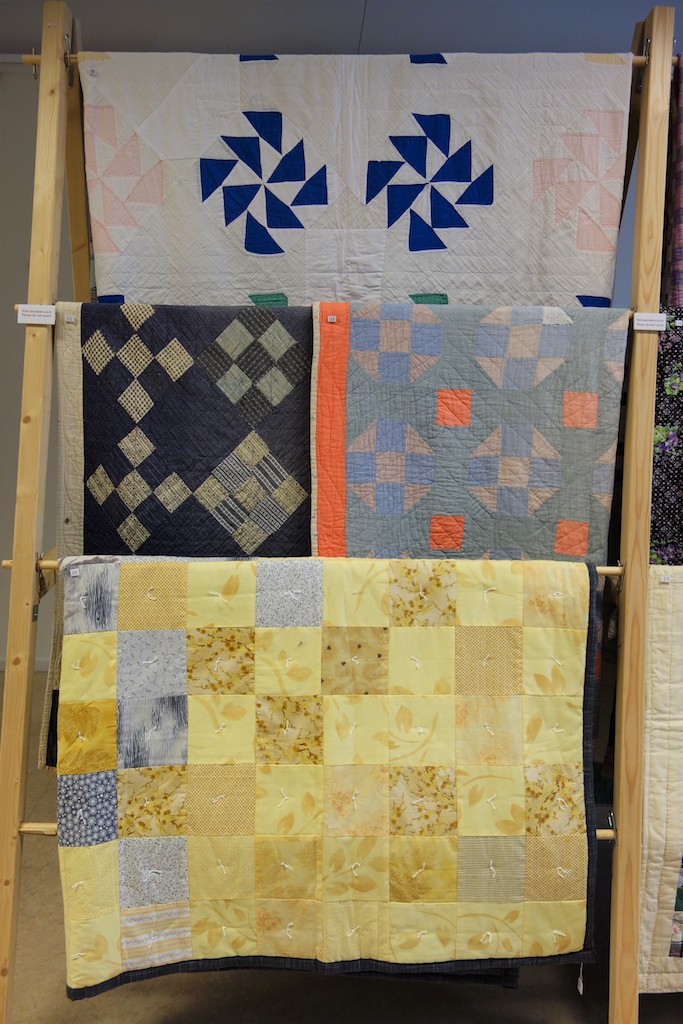
(b) To make a reference collection of quilt cloth that can be used for identifying antique, vintage as well as reproductions, and to help with the dating of cloth. In many of the samples just given there are selvedge texts that identify the name and manufacturer of the cloth, and in some cases there is a date as well. These will be housed in a special ‘REF: Quilt cloth’ section.

(c) To make a reference collection of quilt and quilting tools (‘REF Quilting tools’), so that these items can be correctly identified and accurately described in both the TRC Catalogue/Database and elsewhere.

(d) Seriously consider how we can make a European quilt and quilting centre that reflects these and other quilt related donations over the last few years, as well as providing inspiration for current and future quilters and reflecting the diverse and long history of quilting with many different forms of quilting, not ‘just’ American quilts.

Of course all of this cannot be achieved in a few days or even weeks, but it opens up many possibilities and strengthens the role of the TRC Leiden as an international centre for textile and dress studies and a major port of call for anyone searching for inspiration!

Gillian Vogelsang, 24th July 2020

Carte de visite of a German sailor, late 19th century (TRC 2019.1823).Carte de visite of a German sailor, late 19th century (TRC 2019.1823).You’ve seen them in antique stores and second-hand shops. There is an air of melancholy around the old studio portraits of women, men or children. These late 19th to early 20th century photographs are mounted on cards, usually with the name of the studio or atelier on it in an old-fashioned script.

They are called cartes de visite (visiting cards) and the TRC has almost 200 in its on-line collection. And while the people in the photographs may be sadly forgotten, cartes de visite (CDV) are a wonderful source of information about fashion and dress history, revealing details on how garments were actually worn.

We can learn about occupational dress, like the German sailor with his black tie and narrow white bow (TRC 2019.1823), or the soldier (TRC 2020.0281), the diplomat (TRC 2019.1822) and the nun (TRC 2019.2280) in our collection. Regional dress is also depicted, like the CDV of a seated woman in Hungarian dress, her tools for spinning around her (TRC 2020.3127), or the Dutch woman in Zuid Holland Islands dress (TRC 2020.2986), with her lace cap and collar (called ‘galloon’).

A Romanian dress of the 1930s, altered in the 1960s (TRC 2020.3459).A Romanian dress of the 1930s, altered in the 1960s (TRC 2020.3459).A few weeks ago we were contacted by Liesbeth Eymundsson about an embroidered dress that her grandmother, from Oegstgeest in The Netherlands, had bought while visiting Romania in the 1930’s. Ms Eymundsson, who has a husband from Iceland, also offered an embroidered shawl that belonged to her grandmother. This morning the dress and the shawl arrived at the TRC Leiden and they have been added to the TRC Catalogue (nos. TRC 2020.3459 and TRC 2020.3460).

The shawl is a Chinese export item that was popular in the earlier part of the 20th century, a fascinating subject in itself. However, because the dress has an unusual, personal history we have decided to focus on this garment.

Zoek in TRC website

Contact

Boerhaavelaan 6
2334 EN Leiden.
Tel. +31 (0)6 28830428  
office@trcleiden.org

facebook 2015 logo detail


instagram vernieuwt uiterlijk en logo


Bankrekening

NL39 INGB 0002 9823 59, t.a.v. Stichting Textile Research Centre.

Openingstijden

Het TRC is gesloten tot maandag 4 mei vanwege de verhuizing naar de Boerhaavelaan. We blijven bereikbaar via email (office@trcleiden.org) of telefoon: 06-28830428.

Financiële giften

Het TRC is afhankelijk van project-financiering en privé-donaties. Al ons werk wordt verricht door vrijwilligers. Ter ondersteuning van de vele activiteiten van het TRC vragen wij U daarom om financiële steun:

Giften kunt U overmaken op bankrekeningnummer (IBAN) NL39 INGB 000 298 2359, t.n.v. Stichting Textile Research Centre. BIC code is: INGBNL2A

U kunt ook, heel simpel, indien u een iDEAL app heeft, de iDEAL-knop hieronder gebruiken en door een bepaald bedrag in te vullen: 


Omdat het TRC officieel is erkend als een Algemeen Nut Beogende Instelling (ANBI), en daarbij ook nog als een Culturele Instelling, zijn particuliere giften voor 125% aftrekbaar van de belasting, en voor bedrijven zelfs voor 150%. Voor meer informatie, klik hier