• F2
  • F4
  • F3
  • F1

Length of African wax print, made in China, early 21st century (TRC 2020.3841).Length of African wax print, made in China, early 21st century (TRC 2020.3841).The TRC in Leiden recently acquired a piece of fabric for an upcoming exhibition on the Paisley motif (TRC 2020.3841). The green material sold as an African wax print or Ankara cloth, upon closer inspection, seems to be a poorly printed imitation of the original.

African wax prints are colourful fabrics, traditionally made in a similar fashion to batik, namely with wax resist printing. They are common to most African countries but more especially to West Africa. The printing technique of wax prints travelled from Indonesia through Dutch merchants to Africa.

There are some clues that led us to reconsider the provenance of this particular piece. The design is printed sideways and only on one side. Moreover, the paisley motif in the middle is surrounded by flowers more reminiscent of Chinese or Russian forms. More than that, on the selvedge (a part of African wax fabrics that usually carry the name of the company and quality of the cloth), a shoddily spelled text literally reads: “VERITABLE EMPEROR BATIC CLASSIC QUALITT ORER”.

Bridal dress worn by Giuseppina Mondelli in southern Italy, on 26 September 1926 (TRC 2020.3882a).Bridal dress worn by Giuseppina Mondelli in southern Italy, on 26 September 1926 (TRC 2020.3882a).The TRC in Leiden recently acquired a wedding dress that was worn in Italy on 26 September 1926. As with so many other textiles and garments, it is far more than a garment that was worn at a festive occasion many years ago. It unveils a family history that goes back for a hundred years, and in a wider context testifies to the sometimes tumultuous history of Italy in the 20th century. The blog is written by Francesco Montuori, a TRC volunteer who writes about his great-grandmother, whose wedding dress is now a precious item in the TRC Collection (TRC 2020.3882a).

"This wedding dress used to belong to my great-grandmother, Giuseppina Mondelli (1900-1980). She was born in Sannicandro, a small village close to Bari, in southern Italy, and was my grandmother’s mother, on my father’s side.

Carding and combing at the September 2020 edition of the five-day TRC Intensive Textile Course. Photograph: Augusta de Gunzbourg. The author of this blog is sitting to the left.Carding and combing at the September 2020 edition of the five-day TRC Intensive Textile Course. Photograph: Augusta de Gunzbourg. The author of this blog is sitting to the left.I am still recovering from the Intensive Textile Course at the TRC in Leiden! What a week!

As a researcher at the Rijksdienst van het Cultureel Erfgoed (Cultural Heritage Agency of the Netherlands), I am often confronted with small pieces of textiles, sometimes from an archaeological context.

I analyse a few fibres taken from the textile with an electron microscope (SEM) to study their condition and whether they have been dyed or stained. These small pieces and fibres are, of course, part of a larger piece of cloth! But what does the resulting information actually tell us about the larger cloth, the previous owner, what was the original colour (s) and how was the cloth used?

To gain more insight into textiles in general, I registered for the five-day Intensive Textile Course at the TRC. Under the inspiring supervision of the director of the TRC, Gillian Vogelsang, we identified fibres, we spun them into threads and we used weave frames to turn threads into cloth. Because of the corona virus we did so in a small group with six people, which enabled us to spend more time on practising and discussing the various techniques.

Maria Friesen talking at the TRC in Leiden about Mennonite comforters, 26th Sept. 2020. Photograph by Lynn Kaplanian-Buller.Maria Friesen talking at the TRC in Leiden about Mennonite comforters, 26th Sept. 2020. Photograph by Lynn Kaplanian-Buller.Last Saturday, 26th September, eight of us gathered at the TRC in Leiden under Gillian Vogelsang’s warm guidance and hospitality, to hear Maria Friesen’s presentation on ‘Passing on the comfort received in the past”. Maria's presentation, which was preceded by a brief introduction to the TRC by Gillian, has been filmed to share among anyone interested, and the film will soon be made available.

Maria Friesen is the coordinator of the European comforter groups that donate their comforters (relief quilts) to the Mennonite Central Committee (MCC). She came from Switzerland to tell us about how the most recent comforter-making project evolved among Mennonite initiators in Switzerland and spread to more groups in Europe.

In order to create a context, she told us about the history of the Mennonite Central Committee, which was founded 100 years ago. During her talk, Maria included many photographs that she had collected for the official celebrations, which unfortunately had to be cancelled because of the corona pandemic.

Yesterday (26th September) was a busy and very interesting day at the TRC Leiden as we had a guest speaker from Switzerland, Maria Friesen. She gave a talk about Mennonite quilts and the many roles of the Mennonite Central Committee (MCC) in relief work in general. Lynn Kaplanian Buller will be writing a blog about the day's events that will be published very shortly.

Because of the corona crisis we had an audience of eight in order to ensure social distancing! One of the visitors brought a bag with some interesting donations for the TRC Collection. They included some handiwork books published in the late 19th century here in Leiden (Sijthoff Press) and in Alkmaar with the firm of Kluitman. There is also a booklet with instructions on how to adapt Western style clothing for wearing in the Dutch East Indies.

Rather intriguing are ten card sheets (just larger than A4 size) upon which were sewn various samples and samplers. These are in the process of being published in the TRC Collection database under the accession number TRC 2020.3838a-j.

First sampler ('naaidoek') worked by G. Filbry in 1928 (TRC 2020.3838a).First sampler ('naaidoek') worked by G. Filbry in 1928 (TRC 2020.3838a).

All of the sheets had the name G. Filbry hand written on them. The first item was dated 1928 and had the initials G.F., the name of Bussum (a town that lies southeast of Amsterdam) and the text Mijn eerste naaidoek (My first 'sewing cloth’ (lit.) or sampler). The sampler also included a 19th century steam train and that oh so modern form of transportation, a single propellor plane! There are some strange motifs in the background that may be stylised birds, or perhaps planes in the distance.

The last sheet had an item with the date of 1930 and is a more complicated, mending sampler. So it would appear the sheets represent various school needlework projects that took place over a two year period.

Knitted miniature vest and petticoat, worked by G. Filbry, between 1928 and 1930 (TRC 2020.3838f).Knitted miniature vest and petticoat, worked by G. Filbry, between 1928 and 1930 (TRC 2020.3838f).

In addition to the two samplers, the sheets display a variety of miniature garments made by the same person with the initials G.F. These include a hand stitched chemise, skirt and apron, all in a white cotton material. There are also hand knitted and mended items, including socks, a vest, chemise and dress. Some of these miniature garments have fastenings such as ties and buttons.Knitted miniature sock and mending panel, worked by G. Filbry between 1928 and 1930 (TRC 2020.3838d).Knitted miniature sock and mending panel, worked by G. Filbry between 1928 and 1930 (TRC 2020.3838d).

Last week has seen some interesting events and developments. We have just completed the September intensive textile course. It was great fun with enthusiastic participants, although I must admit by the end of the week everyone was very tired. A sign that we have all worked hard!

Men's shirt in Steampunk style, using black cloth decorated with paisley motifs, ca. 2020 (TRC 2020.3834). Photograph: Violent Delights, UK.Men's shirt in Steampunk style, using black cloth decorated with paisley motifs, ca. 2020 (TRC 2020.3834). Photograph: Violent Delights, UK.

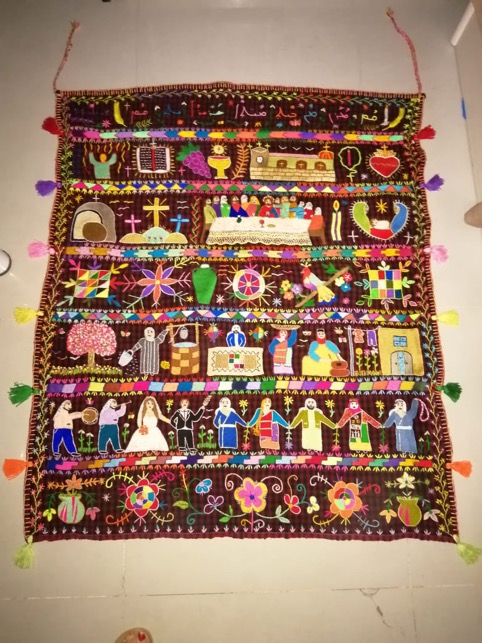
The TRC holds a small collection of Jordanian clothing, including various embroidered garments and samples. It was built up with the help of Madame Widad Kawar of the Tiraz Centre in Amman, Jordan. The blog below was written by Fatima Abbadi, who discusses the traditional dress for women from the north of the country.

Detail of a dress from Irbid, in the north of Jordan, from the 1930's. The neckline is decorated with satin stitch and rekme embroidery (TRC 2005.0140).Detail of a dress from Irbid, in the north of Jordan, from the 1930's. The neckline is decorated with satin stitch and rekme embroidery (TRC 2005.0140).

"Little is written about traditional Jordanian dress. Very often it is confused with Palestinian clothing and its predominant cross stitch embroidery. Recently I even met people associating it with Moroccan kaftans. It should be added that many modern Jordanians no longer recognise their local traditional forms of clothing and indeed, embroidery. This is because of many factors, such as the introduction of machine embroidery, garment extinction and the fact that local patterns and stitch types are being replaced with Palestinian forms. As a result, typical Jordanian traditional dress has almost disappeared, very soon only to be seen in a few museums and other collections.

At the end of the Second World War, Russian Mennonites fleeing west were allowed to temporarily stay in the Netherlands, provided that the Dutch Mennonite (Doopsgezinde) community would house, feed and clothe them. The Mennonites, who during the last few centuries spread all over the world, are named after Menno Simons from the village of Witmarsum in Friesland, in The Netherlands. He was a 16th century former Catholic priest whose first name was taken up by many of his followers inspired by his reformist ideas. The Amish in North America are an offshoot of this group, being followers of Jakob Ammann.

Display of quilts at the TRC Gallery exhibition 'Textile Tales from the Second World War'. The quilt on top is the twin of the missing quilt that was sent to Syria. The yellow quilt at the bottom of the rack was given to replace the missing quilt.Display of quilts at the TRC Gallery exhibition 'Textile Tales from the Second World War'. The quilt on top is the twin of the missing quilt that was sent to Syria. The yellow quilt at the bottom of the rack was given to replace the missing quilt.

Zoek in TRC website

Contact

Boerhaavelaan 6
2334 EN Leiden.
Tel. +31 (0)6 28830428  
office@trcleiden.org

facebook 2015 logo detail


instagram vernieuwt uiterlijk en logo


Bankrekening

NL39 INGB 0002 9823 59, t.a.v. Stichting Textile Research Centre.

Openingstijden

Het TRC is gesloten tot maandag 4 mei vanwege de verhuizing naar de Boerhaavelaan. We blijven bereikbaar via email (office@trcleiden.org) of telefoon: 06-28830428.

Financiële giften

Het TRC is afhankelijk van project-financiering en privé-donaties. Al ons werk wordt verricht door vrijwilligers. Ter ondersteuning van de vele activiteiten van het TRC vragen wij U daarom om financiële steun:

Giften kunt U overmaken op bankrekeningnummer (IBAN) NL39 INGB 000 298 2359, t.n.v. Stichting Textile Research Centre. BIC code is: INGBNL2A

U kunt ook, heel simpel, indien u een iDEAL app heeft, de iDEAL-knop hieronder gebruiken en door een bepaald bedrag in te vullen: 


Omdat het TRC officieel is erkend als een Algemeen Nut Beogende Instelling (ANBI), en daarbij ook nog als een Culturele Instelling, zijn particuliere giften voor 125% aftrekbaar van de belasting, en voor bedrijven zelfs voor 150%. Voor meer informatie, klik hier