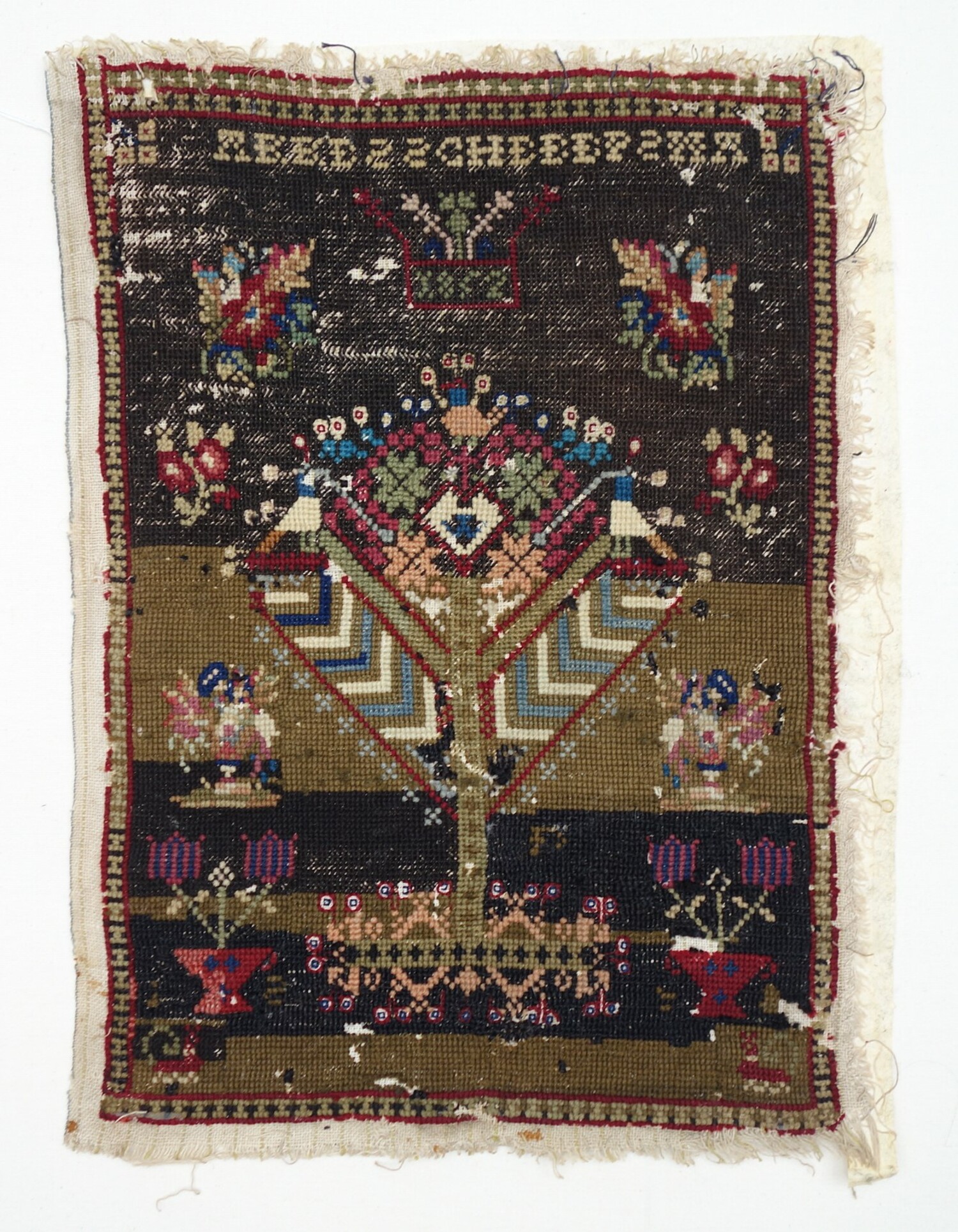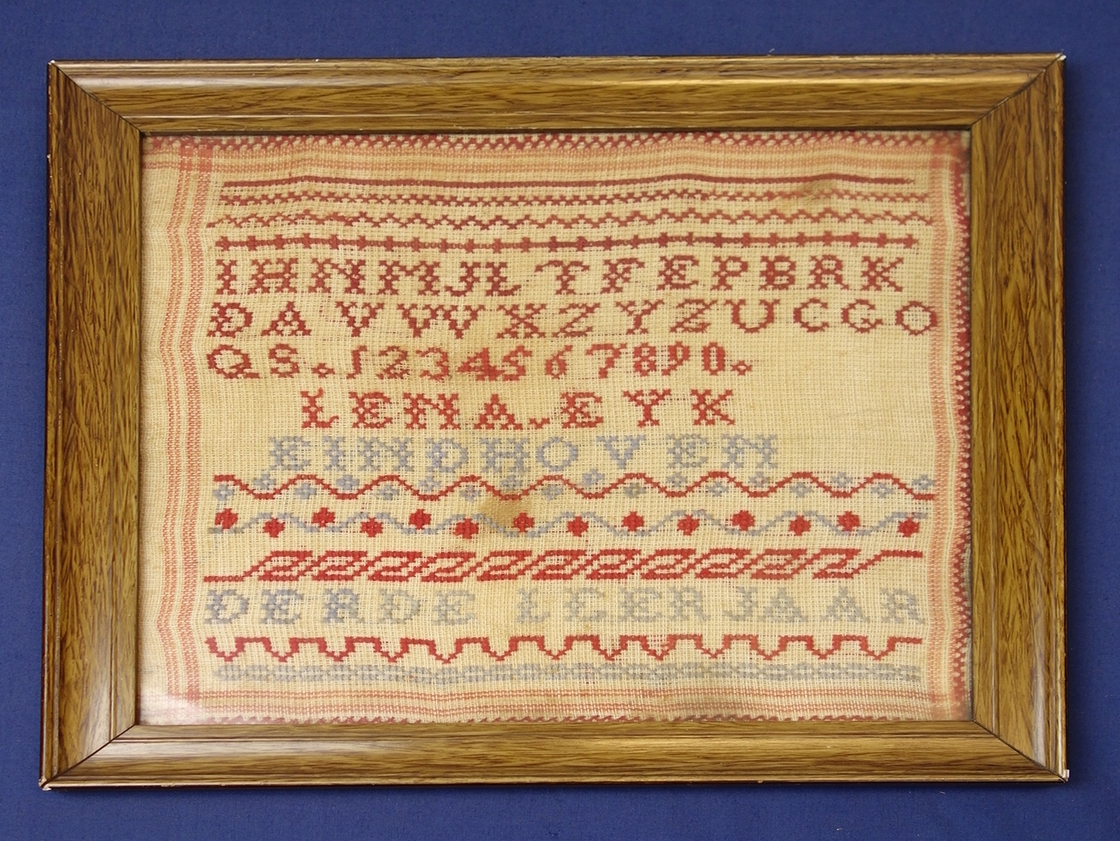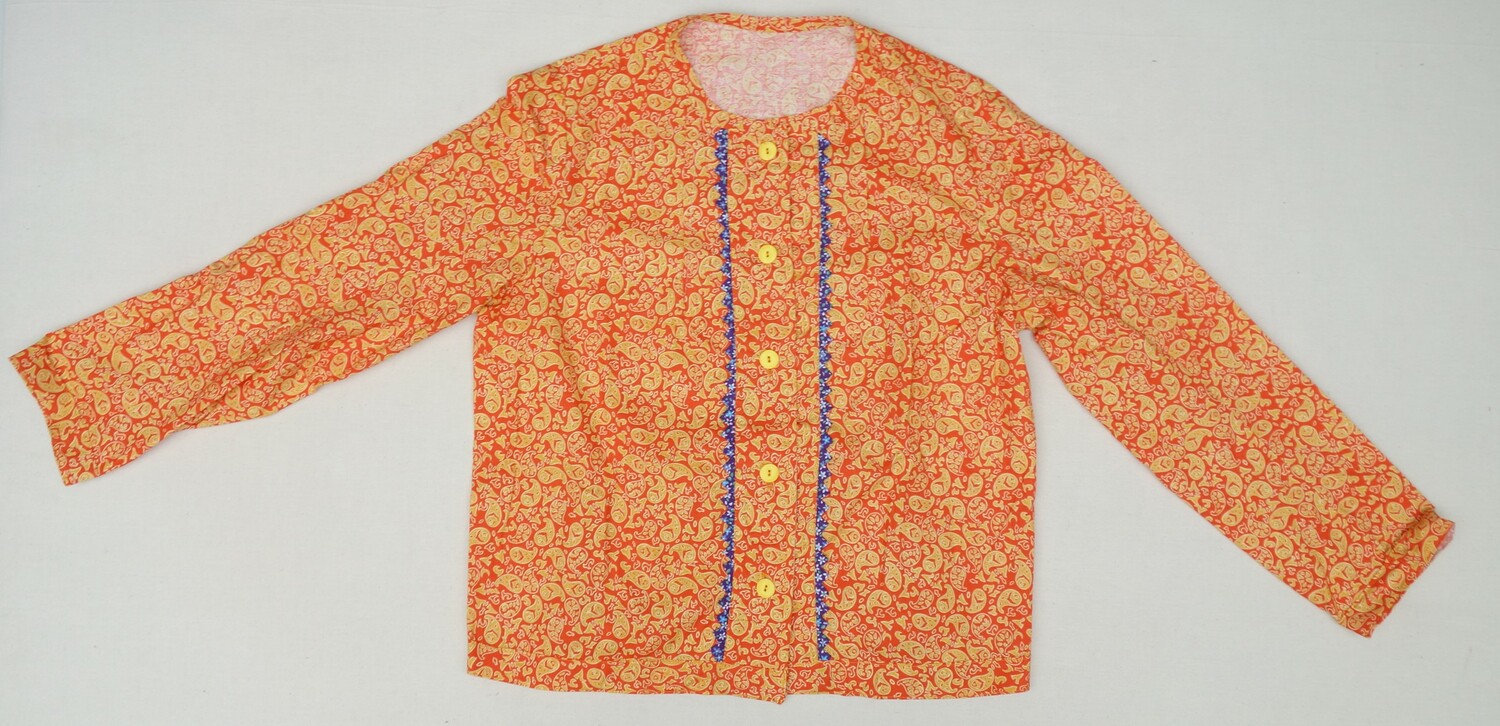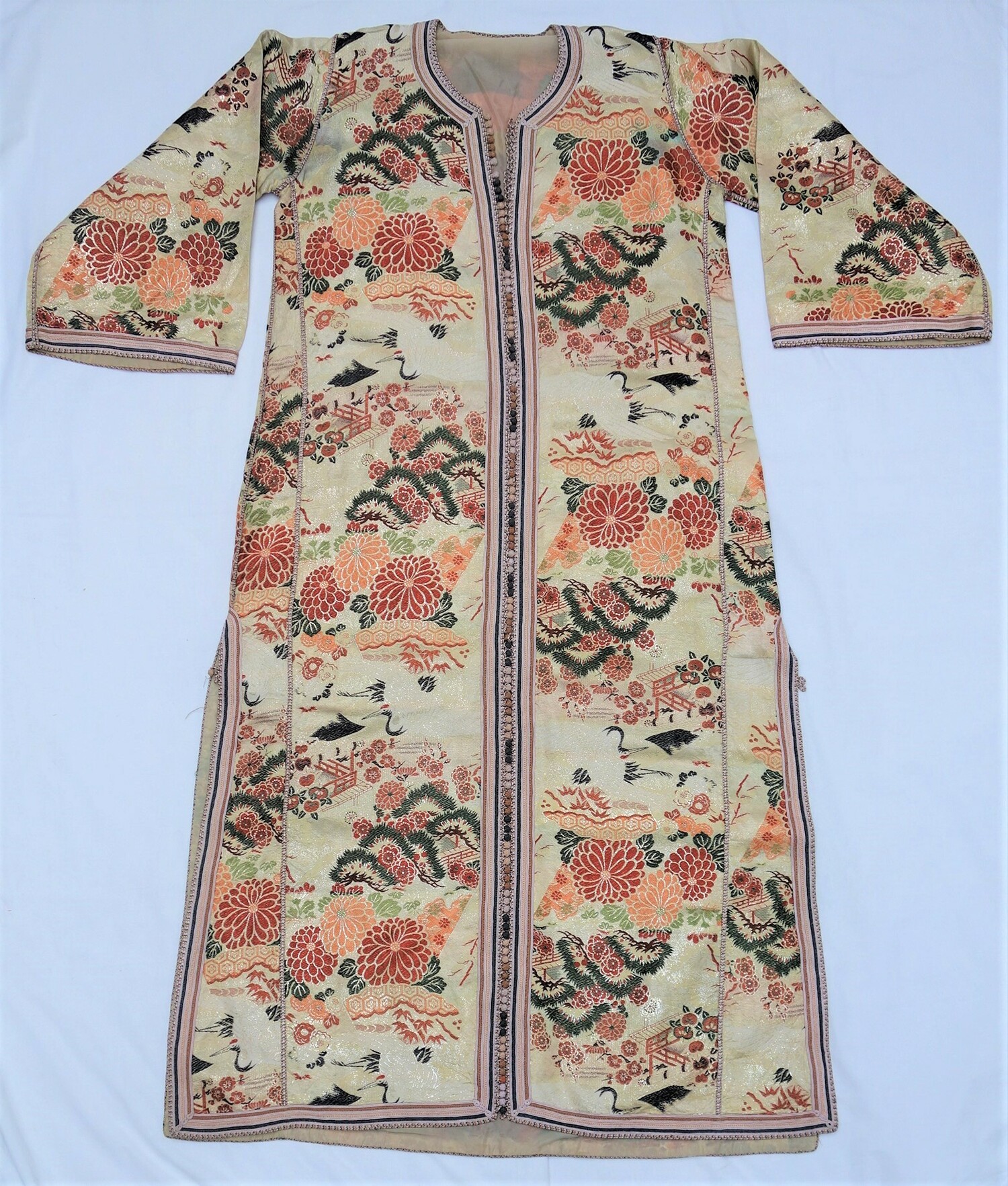
• F3
  • F4
  • F1
  • F2

Dress with paisley motifs that enclose an 'atomic' design. USA, 1960's (TRC 2021.0355). See detail below.Dress with paisley motifs that enclose an 'atomic' design. USA, 1960's (TRC 2021.0355). See detail below.In a previous TRC Blog we mentioned a dress from the 1960’s that is decorated with ‘atomic’ paisley. We have had several enquiries concerning what exactly is atomic paisley?

During the 1950’s and 1960’s many people were excited about the concept of atomic power and space travel. Artists and designers started to produce designs representing the new age of atomic power that was both exciting (the space age) and frightening (the atomic bomb).

In many of their works the connecting theme was exploding atomic particles. Numerous ‘atomic’ designs appeared, for example, in the 1951 Festival of Britain that was held in London. But perhaps one of the most iconic representations of the atomic art is the Brussels Atomium that was constructed to symbolise the Brussels World Fair in 1958. This movement helped to bring science into the lives of many ‘ordinary’ people.

Scientific designs included crystalline structures (such as that of mica), x-ray crystallography, as well as schematic drawings showing the appearance of organic substances, including hemoglobin and insulin.

Indian appliqué in the shape of an ornate paisley/buteh motif, hand embroidered in gold thread on a dark red velvet ground. Mid-20th century (TRC 2020.5154).Indian appliqué in the shape of an ornate paisley/buteh motif, hand embroidered in gold thread on a dark red velvet ground. Mid-20th century (TRC 2020.5154).It's raining paisley! Or so it felt the other day when six packages arrived at the TRC in Leiden, all at the same time. The parcels were from a variety of sources, and each one included one or more items covered with the paisley motif.

Paisley is that iconic Iranian/Indian motif (generally known as buteh) that was reproduced in the Scottish town of Paisley from the early nineteetnh century onwards. Hence the name. It is traditionally associated with Kashmir shawls, but the same motif can now be found everywhere.

The six parcels included a coat, a bikini, a line dancing outfit, a cocktail dress, a length of West African cloth and an Iraqi-style embroidery from near Rotterdam, all decorated with variations of the paisley motif.  In addition, a frequent visitor to the TRC has just donated an outfit that comes from the Estonian island of Kihnu, which, from the late 19th century, has developed a form of regional, daily dress dominated by paisley motifs!

All of these items were needed for and will be included in the TRC’s upcoming exhibition called From Buteh to Paisley: The history of a global motif.

It’s hard to feel glamorous stuck at home during lockdown. Wearing my usual sweatpants, I look longingly at some of the gowns in the TRC’s on-line collection, like the pale blue silk chiffon full-length evening dress (TRC 2021.0134) or the lacey, cream coloured, long sleeved wedding dress (TRC 2020.3882a).

Ann Cole Lowe (1898-1981)Ann Cole Lowe (1898-1981)I also look at some of the gowns of dress designer Ann Cole Lowe (1898-1981). Lowe made a name for herself by dressing high society debutants and wives. Her clients included some of America’s wealthiest families—the Roosevelts, the duPonts and the Rockefellers. Her perfectionism and attention to detail were legendary. She had begun sewing as a child, using the scraps her seamstress mother gave her. At 16, when her mother died unexpectedly, Ann finished all of her commissions—including a dress for the Alabama governor’s wife.

In 1917 she moved to New York City to take sewing classes. The only African-American in the segregated school, she was forced to work in a room alone. Upon graduation she began designing one-of-a-kind dresses for wealthy women, eventually creating her own label and opening a store on New York’s Fifth Avenue. One famous commission was for Jacqueline Bouvier’s wedding to then senator John F. Kennedy, in 1953.

Kanga from Tanzania, bought in January 2021, in support of John Magufuli who won the presidential elections in Tanzania on 28 October 2020 (TRC 2021.0289).Kanga from Tanzania, bought in January 2021, in support of John Magufuli who won the presidential elections in Tanzania on 28 October 2020 (TRC 2021.0289).The first exhibition at the TRC in its premises along the Hogewoerd in Leiden was about an iconic garment from Kenya and Tanzania: Kangas: An East African garment for women (November 2009 - February 2010). Below is an account of the kanga, written by Caroline Stone, a distinguished textile historian based in Cambridge, UK, and currently in Tanzania.

Kangas are lengths of cloth, 100% cotton and generally brightly patterned, worn by women in East Africa, especially Tanzania and Kenya, since the mid-19th century, and are a very typical element in Swahili culture. Sold as a pair of identical panels c.160 x 110 cm, kangas were traditionally worn with one half knotted above the breasts or over one shoulder, while the other half served as a shawl or head covering, or to carry a child slung on the back. More recently, probably because of religious influence, Muslim and Christian, it has become normal to wear the kangas over a blouse or other garment, to avoid leaving arms and shoulders bare. In the past, when kangas were less highly decorated, they were also worn by men, tied round the waist.

From Buteh to Paisley: The story of a global icon. TRC exhibition in the makingFrom Buteh to Paisley: The story of a global icon. TRC exhibition in the makingYesterday, Tuesday 2nd, we all heard the announcement by the Dutch government that the corona virus lockdown in the Netherlands will continue until the 2nd March (big sigh). So we have decided that (all being well) the TRC's next exhibition will open on the 3rd March! And we are working hard to get everything in order.

The exhibition is about the history of the paisley motif and called From Buteh to Paisley: The story of a global icon. It is not the story of the Paisley Shawl, but something much, much bigger. The paisley motif is actually one of the few non-geometric design forms that can be found throughout the world. It is worn by men, women, children of all ages, literally from the cradle to the grave.

From Buteh to Paisley: The story of a global icon. TRC exhibition in the makingFrom Buteh to Paisley: The story of a global icon. TRC exhibition in the makingMoreover, it is worn by people of many different ethnic and cultural backgrounds. It is also one of the very few motifs that are used to decorate garments ranging from underwear (male and female), through stockings, ties and blouses, to skirts, trousers, bikinis and beach hats. It can also be found on the attire worn by a Hell’s Angel biker, a Los Angeles gang member, a Steampunk Goth, to a respectable London banker and a granny who is knitting socks for the grandchildren, all without any comments being made.

The exhibition will include a wide range of textiles and garments from Iran, India, Japan, Indonesia, Africa as well as Europe, literally from Estonia to Italy, via Britain and Russia. There are also many printed textiles on display that reflect how the paisley has developed in the West during the 20th century.

From Buteh to Pisley: The story of a global icon. TRC exhibition in the makingFrom Buteh to Pisley: The story of a global icon. TRC exhibition in the makingThere will also be a digital version of the exhibition that will come online at the same time as the actual one. So, for whatever reason, if you cannot actually come and see this colourful and fun exhibition, you can at least get a glimpse and a feel of this amazing story. Be aware, however, once you become atuned to paisley you will see it everywhere. It is taking over the world.....

Gillian Vogelsang, director TRC, 3 February 2021

Scarf with a depiction of drones, Gaza, Palestine (TRC 2021.0282).Scarf with a depiction of drones, Gaza, Palestine (TRC 2021.0282).A recent donation to the TRC reflects the changing nature of tradition. The donation is a lovely black cotton scarf, 150 x 40 cm, from Palestine (TRC 2021.0282). The ends are embroidered in a traditional pattern from Gaza with stylized flowers, worked in cross stitch in red, light blue, yellow and green colours. Hovering above the flowers however, are the silhouettes of something new—surveillance drones.

The scarves are stitched as an income generating project by women who are hard of hearing, working in the Open Studio of the Red Crescent Hospital in Khan Younis. The scarf was designed by an innovative Palestinian group called Disarming Design, which also makes gowns out of keffiyehs and other ingenious designs.

Late 19th century military style jacket for a young woman, the Netherlands (TRC 2021.0191).Late 19th century military style jacket for a young woman, the Netherlands (TRC 2021.0191).The TRC in Leiden recently received from the Van Lonkhuijzen family in Haarlem, the Netherlands, a lovely late-19th century red cotton jacket (TRC 2021.0191). It is lined with white cotton and is fastened with buttons that sport a crown and anchor motif. The jacket has a military cut to it. Along with the naval inspired buttons, the jacket might have been worn by a Dutch woman or girl to show their patriotism.

Military-style clothing worn by civilians has a long, and lasting history. The TRC’s Dutch jacket might have been influenced by the British spencer, a short-waisted jacket worn by men and women in the late 18th and early 19th century. The name comes from George, the 2nd Earl Spencer (1758-1834), who reportedly started the style after the long tails on his jacket were burnt when he stood in front of his fireplace, so he cut them off. The style was adopted as a mess jacket for semi-formal occasions by the British military, and soon spread to other countries. It is still part of the uniform in many militaries today.

Erfgoed Alkmaar ('Heritage Alkmaar') publishes an excellent newsletter about the archaeology and history of this town in the north of the Netherlands. In its most recent issue (No. 59, winter 2020/2021) there was an interesting article on 17th century fans.

'De Modese Waayer' ('The fashionable fan'). Mid-18th century advertisement from Utrecht, the Netherlands, showing a fan and instruments to make and repair fans. Underneath the print is the text: FRANS BENEVELT Woont op het oude kerkhof Te Utrecht Childert, Maakt, Verstelt, en Verkoopt, alle soort van Waijers Soo Wel Engelse, Fransse als Heel Ivoore, bij het stuk en Doesijn Alles tot een Civiele Prijs. Utrecht: Centraal Museum, acc. no. 2127.'De Modese Waayer' ('The fashionable fan'). Mid-18th century advertisement from Utrecht, the Netherlands, showing a fan and instruments to make and repair fans. Underneath the print is the text: FRANS BENEVELT Woont op het oude kerkhof Te Utrecht Childert, Maakt, Verstelt, en Verkoopt, alle soort van Waijers Soo Wel Engelse, Fransse als Heel Ivoore, bij het stuk en Doesijn Alles tot een Civiele Prijs. Utrecht: Centraal Museum, acc. no. 2127.

Zoek in TRC website

Contact

Boerhaavelaan 6
2334 EN Leiden.
Tel. +31 (0)6 28830428  
office@trcleiden.org

facebook 2015 logo detail


instagram vernieuwt uiterlijk en logo


Bankrekening

NL39 INGB 0002 9823 59, t.a.v. Stichting Textile Research Centre.

Openingstijden

Het TRC is gesloten tot maandag 4 mei vanwege de verhuizing naar de Boerhaavelaan. We blijven bereikbaar via email (office@trcleiden.org) of telefoon: 06-28830428.

Financiële giften

Het TRC is afhankelijk van project-financiering en privé-donaties. Al ons werk wordt verricht door vrijwilligers. Ter ondersteuning van de vele activiteiten van het TRC vragen wij U daarom om financiële steun:

Giften kunt U overmaken op bankrekeningnummer (IBAN) NL39 INGB 000 298 2359, t.n.v. Stichting Textile Research Centre. BIC code is: INGBNL2A

U kunt ook, heel simpel, indien u een iDEAL app heeft, de iDEAL-knop hieronder gebruiken en door een bepaald bedrag in te vullen: 


Omdat het TRC officieel is erkend als een Algemeen Nut Beogende Instelling (ANBI), en daarbij ook nog als een Culturele Instelling, zijn particuliere giften voor 125% aftrekbaar van de belasting, en voor bedrijven zelfs voor 150%. Voor meer informatie, klik hier