
Beyond The Chador Regional Dress From Iran
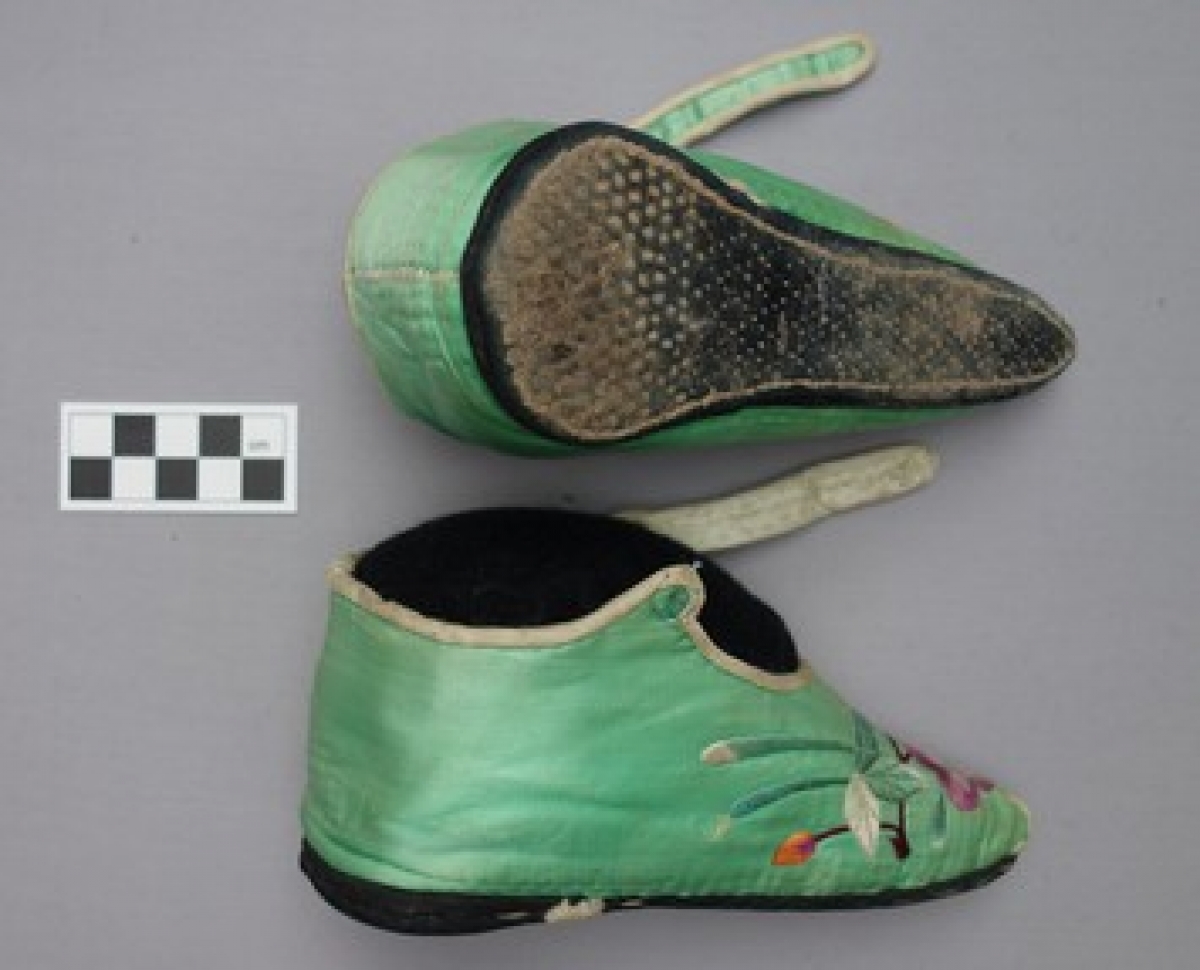
9. Twentieth century lotus shoes
As there was more and more Western influence in Chinese life in the early 20th century, so the shape of lotus shoes had also changed. Instead of a cotton base covered in silk for the uppers, many were made in leather with a cloth covering. Some were still embroidered, but others were made out of woven brocade materials that were purchased from outside sources.
 A group of peasant women with lightly bound feet (early 20th century; courtesy of the Library of Congress, LC-DIG-ggbain-08997).Shoes from the 1910 – 1930 period often included instep straps, sometimes fastened with buttons at the ankle, following contemporary Western fashions. In addition, other types of heels were used such as the low kitten heel and the Louis heel made from stacked leather rather than the traditional wood or cotton forms. The leather versions were often nailed onto the shoes rather than sewn. Another difference was that instead of cotton outer soles leather forms were more and more often used.
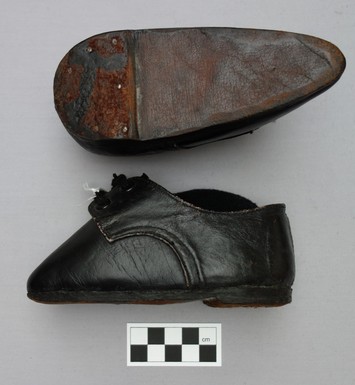 A pair of plain leather ‘Mao’ lotus shoes (mid-20th century; TRC 2013.0055a-b). With the coming of Communism in 1949 the use of colourful silk lotus shoes was forbidden and as a result many women wore plain leather shoes in public. These shoes had the advantage of not drawing attention to the tiny feet of the wearer. A very different attitude from that of the previous century. These continued to be produced in a small number of special factories until the 1990s.

8. Lotus shoe accessories
In addition to the lotus shoes themselves, there were various accessories that were regarded as essential elements in the complete ‘look.’ They were so important that many women would feel ‘naked’ if their ankles and feet were not properly dressed. The accessories included socks, sashes or wrappings, leggings and anklets. They were used to emphasise the lower part of the legs and in particular the tiny size of the feet.
 Chinese woman with small bound feet and leggings that are worn under her main, baggy trousers (c. 1905; courtesy of the Library of Congress, LC-USZ62-80735).Lotus socks
The shoes were sometimes worn with embroidered socks, which were worn during the day. They were usually made from either silk or white cotton and decorated with simple embroidery, usually with a simple floral or geometric design. The importance of socks can be seen by the fact that sixteen pairs of socks with raised and pointed toes and six pairs of shoes were found in the tomb of Huang Sheng (1227-1243) in Fuzhous, Fujian. Madame Zhou (1240-1274) had six pairs of shoes and six pairs of socks in her tomb at De’an Jiangxi.
Lotus bandages or bindings
Lotus bandages or bindings were worn over the top of the foot and up the leg. They were made of either silk or cotton and varied in size depending on their origin, but between about 300 x 5 cm in size was not uncommon. These were often woven to size on the loom. The bandages were wrapped around the legs in various ways. But basically, the foot and leg were wrapped between five and seven times.
Lotus sashes (jiaodai)
Over the bandages were wrapped lengths of silk cloth in various colours. Their colours were chosen to compliment that of the shoes. They were also used to define the lower part of the leg and to help support the foot.
Lotus leggings and anklets (outfu, ziku)
Leggings were used among some women to cover their leg bandages. They also made sure that only the tip of the lotus shoes could be seen. These leggings consisted of an open ended sheath made from silk lined with cotton. They were normally up to 10 cm wide and as long as 30 cm in length. They were usually made up of bands of coloured silk decorated with embroidery or woven braids and with a cotton lining.
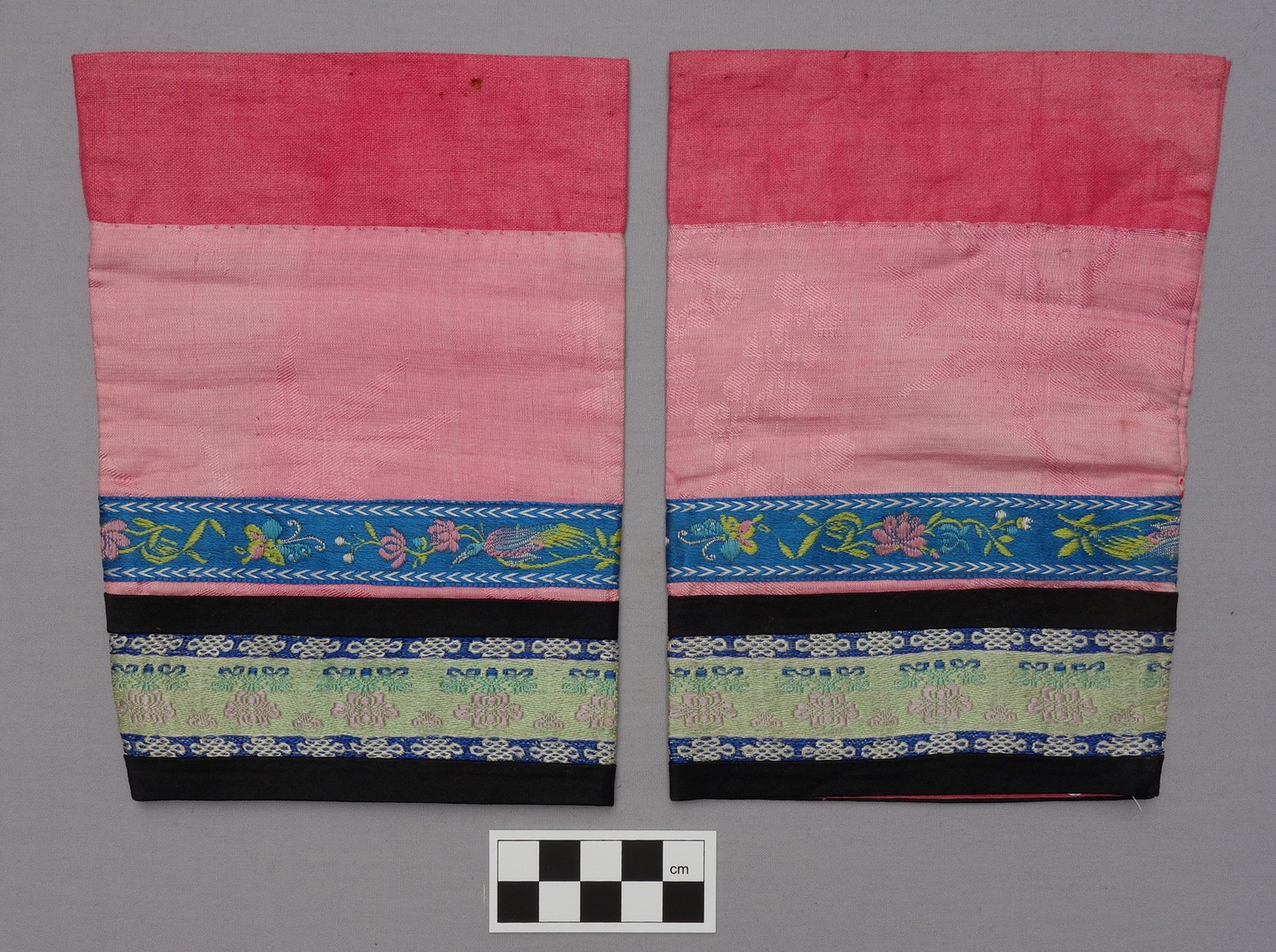 Pair of leggings worn with a pair of lotus shoes (late 19th century; TRC 2013.0063c-d).
Women from the northern regions would often tuck the leg of their trousers into the top of the leggings and then secure the two items with a long sash. The aim was to accentuate the slenderness of the lower leg and ankles. In contrast, southern women tended to wear the leggings underneath the loose trouser legs or they would wrap their ankle with a long strip of dark coloured cloth rather than wear a legging of some form. Sometimes the leggings were sewn to the top of a lotus shoe, turning it into a boot.
 An early photograph of a Han woman wearing leggings and lotus shoes (c. 1865; courtesy of the Library of Congress, LC-DIG-stereo-1s05251).
Separate heels
Sometimes round heels sewn onto a piece of cloth, were worn. It is not exactly clear exactly how the heels were worn and there are various theories, such as they were bound to the outside of a pair of lotus shoes to give extra height, or that they were worn inside a pair of lotus shoes for the same purpose. Another suggestion is that when a woman got out of bed she might wear these heels until she got dressed.

6. Main forms of lotus shoes
Throughout the ages and all over the country, there were always various main types of shoes, such as day time shoes, night shoes, wedding shoes, funeral and mourning shoes, as well as outdoor shoes for when the weather is bad.
Day time shoes and boots
These shoes and boots were made in various materials such as cotton, silk and wool and made in a variety of forms depending on where the woman’s family came from, how wealthy they were and what were the latest fashions. There were flat sole, low heeled, or high heeled forms, as well as wedged heel versions. Over the centuries fashions changed, so before the mid-17th century most shoes were flat, but after this date fashionable shoes had heels that gradually increased in size. Such heels had the effect of making a foot look even smaller. By the 19th century heels had become relatively high and at the same time binding became tighter to create even smaller feet.
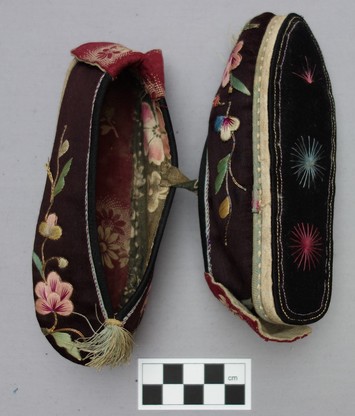 Pair of soft lotus shoes (early 20th century; TRC 2011.0048a-b).Sleeping or night shoes
These are similar to the daily flat shoes, but made out of softer material and with a soft-soles.
Wedding or bridal shoes
As the name suggests, these shoes were worn by the bride during the wedding ceremony. Normally they were predominately bright red in colour and made of silk or sometimes cotton. When they were decorated they had a simple embroidered or gold leaf decoration at the front of the shoe and sometimes on the soles. They were usually similar in shape to that of everyday shoes. The wedding shoes were worn by the bride during the festivities and in particular on her wedding night.
 Pair of pattens with iron studs (cleats) worn over lotus shoes during bad weather (late 19th century; TRC 2014.0133a-b). Bad weather forms
There were various types of shoes and boots for bad weather, usually made of thick materials such as felt or leather. There were special types for when it was raining and others for walking in muddy streets. The latter normally had wooden soles studded with little iron or wooden pegs (cleats). During the winter time pattens with iron spikes were fastened to the soles of the shoes so that the women could walk on icy paths.
Hill over-soles
In some areas special soles made of straw rope were made for walking in hills and mountainous regions. These over soles could be fitted to the underside of a pair of shoes or boots and provided extra grip.
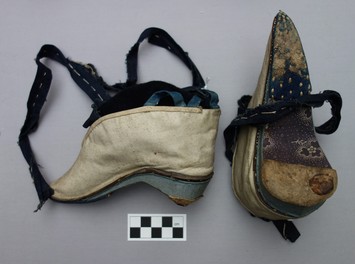 Pair of white, mourning lotus shoes with no decoration (late 19th century; TRC 2013.0058a-b).Mourning shoes
Special mourning shoes in white were worn by women after someone’s death. These were either pure white with a minimum amount of decoration, or white with white or grey embroidery.
Funeral shoes
Special shoes were made by women for their funerals. They were made out of dark blue cotton with no embroidery, except on the soles of the shoes. These were often decorated with an embroidered or painted lotus blossom, sometimes with a ladder. Together these forms symbolized a continual climb to heaven, with the lotus representing the concept of ‘continuity,’ and the ladder the ‘climb.’ These were usually kept in a safe place until required.

7. The main regional types of lotus shoes
As a generalization, Han lotus shoes can be divided into the four main regional forms, namely northern, western, eastern and southern, with various sub-divisions. Three of these regions are represented here.
Defining where a pair of shoes comes from is based upon their size, the shape of the vamp and heels, as well as the type and shape of soles, the style of embroidery and where it is placed on the shoe. But it should be stressed that it is very difficult to state that a pair of lotus shoes comes from a specific town or village, as there are numerous overlapping types. In addition, brides often travelled long distances bringing their own forms of lotus footwear to their new homes. These forms were often then amalgamated into the ‘local’ style of lotus shoes. The TRC Collection houses various examples from the north, east and south.
Northern China
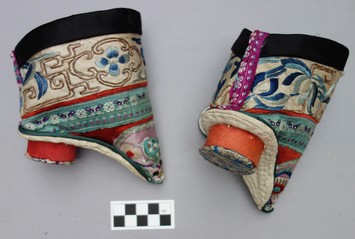 Pair of Shanxi-Jin style lotus shoes from northern China (20th century; TRC 2010.0351a-b).
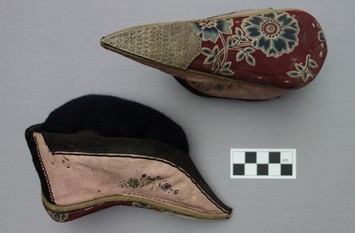 Pair of Shandong-style lotus shoes from north-eastern China (early 20th century; TRC 2013.0049a-b).
Eastern China
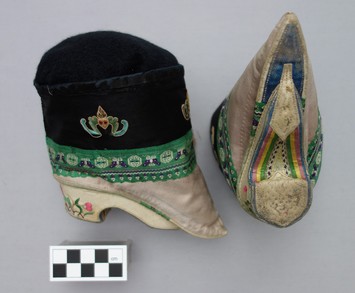 Pair of lotus bootees from theJiangsu and Zhejiang region of eastern China (early 20th century; TRC 2013.0050a-b).
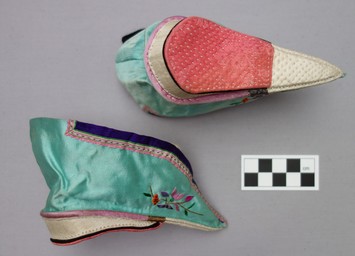 A pair of lotus shoes from the Jiangsu and Zhejiang region of eastern China. They have a characteristic ‘ladder’ fastening down the vamp (early 20th century; TRC 2013.0063a-b).
Southern China
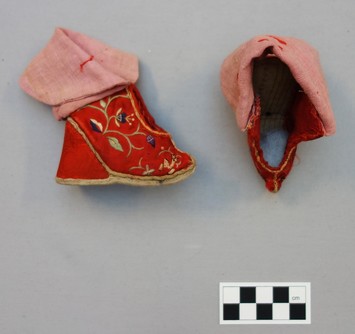 Pair of wedding lotus shoes from the Fujian/Taiwan region of south-eastern China (early 20th century; TRC 2014.0029a-b).
 Pair of wedding lotus shoes in the southern Chinese style (early 20th century; TRC 2013.0057a-b).

5. Colours and decoration
There are five main colour groups in China namely red (pink), yellow, blue (also green), black and white. Each colour had its designated purposes. Not surprisingly the same colour range was used for lotus shoes. Red, for example, is the colour of all festive occasions, such as weddings and New Year celebrations. It is also regarded as the colour of virtue. Red is used by a wide range of social groups, while being associated with younger people. In contrast, certain hues of yellow were specifically associated with emperor, empress and the heir apparent. Certain other forms of yellow were used by other members of the imperial family and certain court members. Non-imperial yellows were used by elite and wealthier men and women, and to a much lesser extent by poorer people.
Pair of daily lotus shoes with a design of flying bats for happiness (late 19th century. TRC 2013.0050a-b).There were no comparative rules with regard the use of blue (green and purples), and it could be worn on many different occasions and by all social groups. Middle aged men and women tended to wear more subdued colours such as combinations of blue-grey, blue-green and black. In general, black was regarded as the colour of old age. Although in the 1920s onwards, chic black became ‘in’ among fashionable ladies in the international city of Shanghai, from where it spread to other groups.
White was the colour of mourning in China and there were very strict rules concerning the wearing of white. There were five degrees of mourning depending on who had died, their relation to the wearer (father, mother, daughter, son) and when the death had taken place. Pure white clothing and shoes were worn following the death and funeral of someone, followed by white shoes with white or grey embroidery or other adornment . Later clothes and shoes changed to dull blue, black or grey forms. Mourning could last up to 27 months depending on who had died.
Decoration on lotus shoes
A wide range of symbols, objects, fauna and floral designs were used to decorate lotus shoes. Many of these represented good luck, good health, longevity and so forth, or they indicated when the shoe was to be worn (spring, summer, autumn or winter), or for a particular special festival. The floral symbols for the four seasons were plum blossoms (spring), peonies (summer), lotus (autumn) and chrysanthemums (winter). But other forms were used such as peaches, bamboo and pine trees. Birds were represented by, among others, cranes and phoenixes. While fauna designs might include cats, bats, butterflies, cats, tortoises and monkeys. In addition, the “five poisons” might be found, namely, toads, snakes, lizards, centipedes and scorpions, which were regarded as amulets against evil.
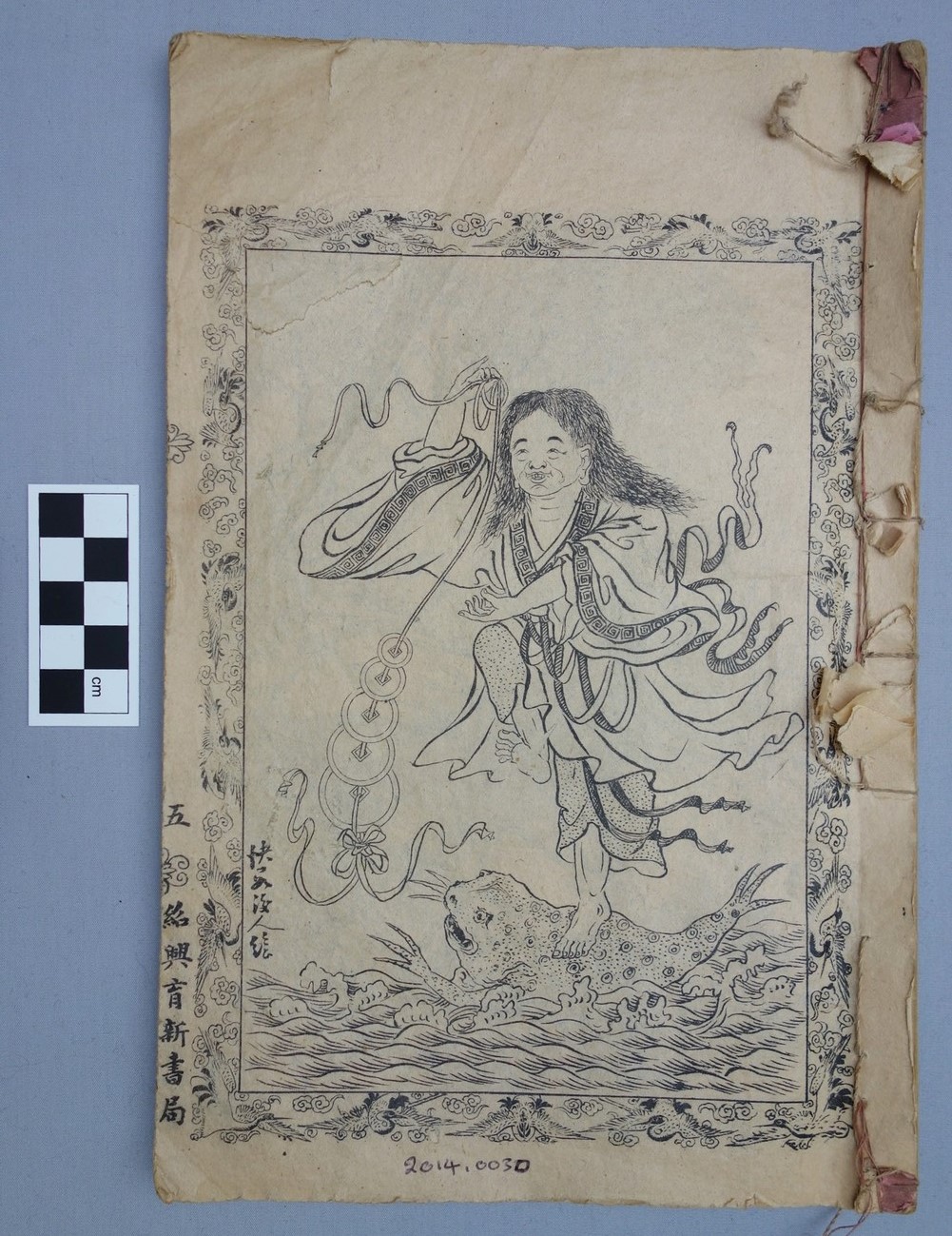 Embroidery pattern book with some lotus shoe designs, early 20th century (TRC 2014.0030).
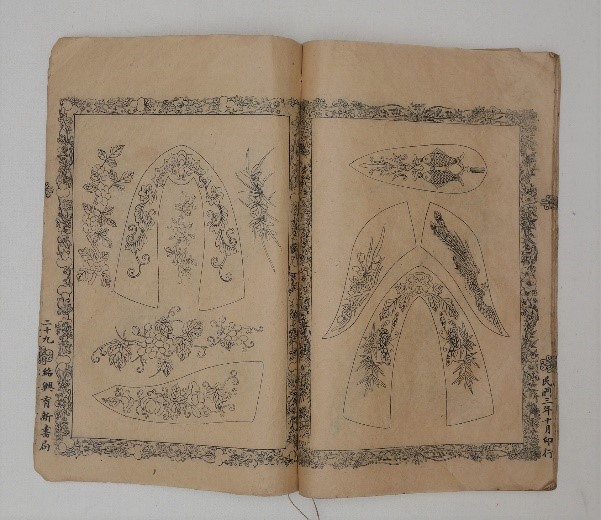 Lotus shoe designs from embroidery pattern book (TRC 2014.0030).
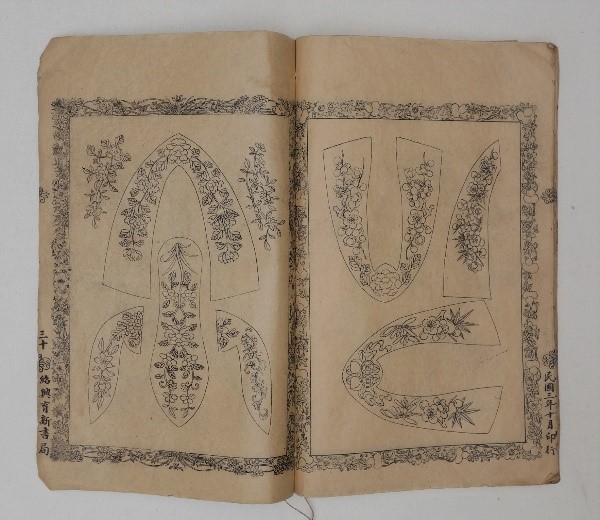 Lotus shoe designs from embroidery pattern book (TRC 2014.0030).
Another symbol that was often used was that of shou that has the meaning of longevity. It was often used for shoes intended for a wedding. Shou some cases it can also be found on the soles of funeral shoes. In this case the character shou has the meaning of long life in the sense of the lineage continues forwarded despite the death of someone.
Sole embroidery If the soles were made of layered cotton (rather than wood), they were usually quilted with small, running stitches in a variety of simple lines or geometric forms. Sometimes, ladies who received guest while sitting on a kang (bed) had elaborately embroidered soles decorated with intricate designs worked in silk. These were intended for pleasurable viewing, should (accidentally) the sole of the shoe face the visitors. Dancers also embellished their shoe soles with brightly coloured silk embroidery and sometimes small sequins to add to the complete visual effect.
4. Making lotus shoes
Because of their small decorative nature considerable attention is paid to lotus shoes worn on a daily basis and the stories behind them. But there was a also a range of items associated with these shoes, many of which were also highly decorative. As will be seen these items included bandages, socks, as well as leggings.
Lotus shoes were made both at home and by professional shoe makers. Many of the shoes and accessories were made by the girl’s themselves. Examples were often sent to prospective husbands to show their skill in embroidery, as well as the size of their feet. Materials and threads came for making these shoes and the accessories came from various sources including itinerant peddlers who specialised in the cheaper cloths, threads and braids. In addition, there were specialist shops that supplied the more expensive items.
In addition to domestic production there were shoe makers, ateliers and in the 20th century small factories that produced lotus shoes for sale to women with bound feet. The last of these factories the Zhiqiang Shoe Factory in Harbin (capital of the Heilongjiang Province in northwest China), in order to fill a gap in the market. Most of the shoes they made were plain as many women did not want to draw attention to their feet. This part of the factory was shut down in 1998. They continued to produce shoes for women with unbound feet within China, while lotus shoes were also produced for the tourist market.
Making a pair of lotus shoes
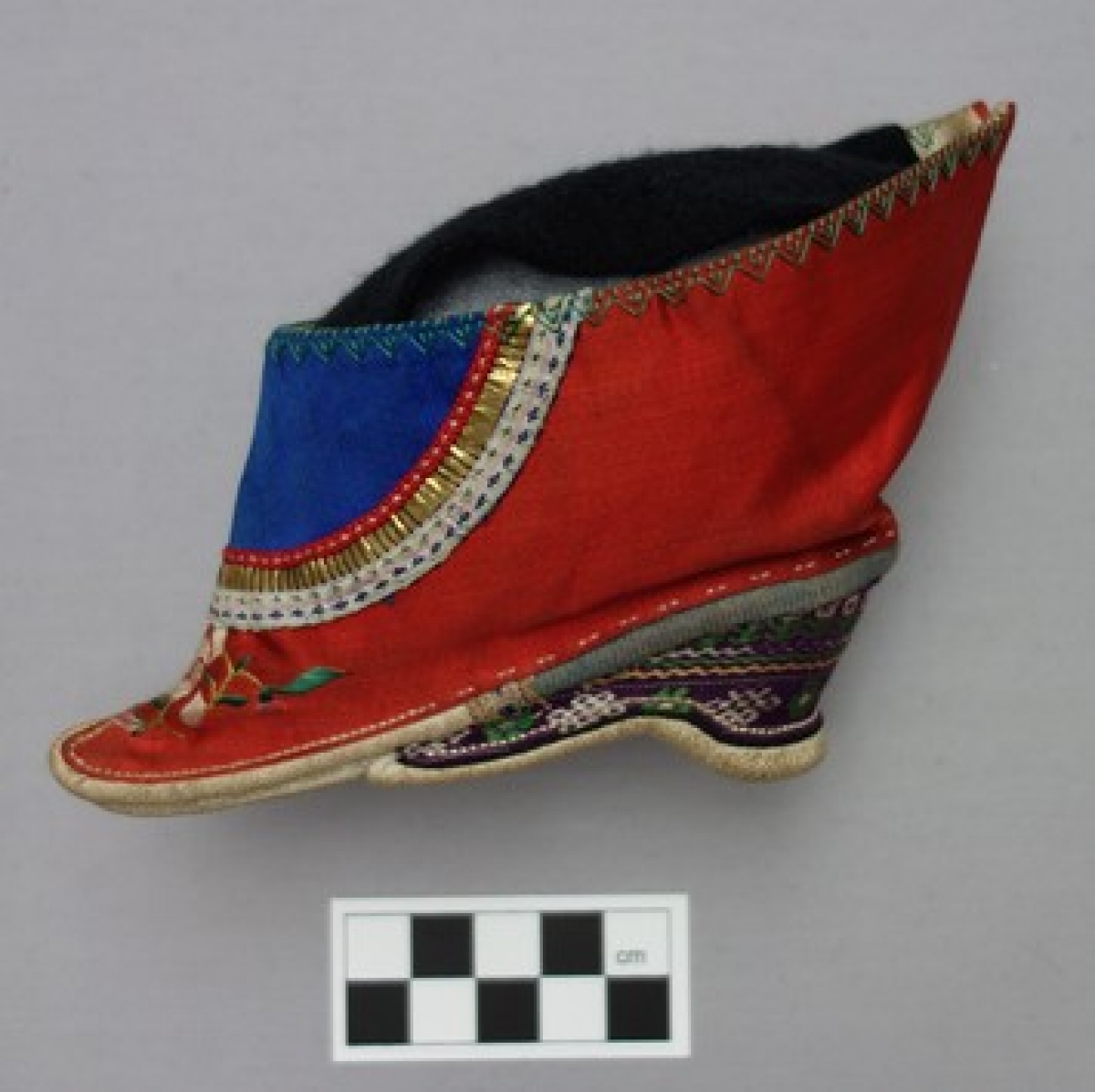
A basic pair of lotus shoe is made of various elements, namely, the vamp (upper), sides, heels and sole.
The first step in the preparation of a pair of shoes was to make the soles. These were generally made of a thick and somewhat rough cotton material. A (rice or wheat) flour based paste was spread on a wooden board, then one piece of the thick cotton was laid on the paste. The cloth was then covered with more paste. A second piece of cloth was placed on top of the first and again covered with paste. This process was repeated several times. Then the resulting ‘sheet’ was placed in a sunny spot to dry.
A paper pattern of the required sole was laid on the cotton cloth and the form cut out. The process was repeated until enough forms were prepared to achieve the required thickness of sole. Once cut out, the layers forming the sole were placed on top of each other and sewn together around the outside. The last step was to sew small stitches all over the sole, giving it a quilted process. This was carried out with a thick, cotton thread and a large needle. Sometimes a special tang was used to pull the needle through all the layers.
The cloth needed for the vamp included several thick white cotton stripes about 1.5 cm wide. The side panels were made from cotton or wool strips of about 2.5 cm wide. All these The cotton pieces were pasted together to provide a sturdy inner structure for the shoe. The same pattern pieces for the vamp and side panels was also used for the decorative silk panels that were visible on the outside. Any embroidery on the silk panels was carried out before the shoe was assembled. Pattern books were available with suitable embroidery designs, although some girls copied from older shoes. In some cases it would appear that a more creative soul created a totally new pattern or combination of traditional forms to suit a particular moment or event.
The shoes were often further decorated with one or more kinds of braid. These were sold by the braid peddler who went from one house to another.
When the embroidery was completed the top layers were ready to be glued to the heavier cotton structure, creating the top and sides of the shoe. The next stage was to sew the sole to the upper sections of the shoe
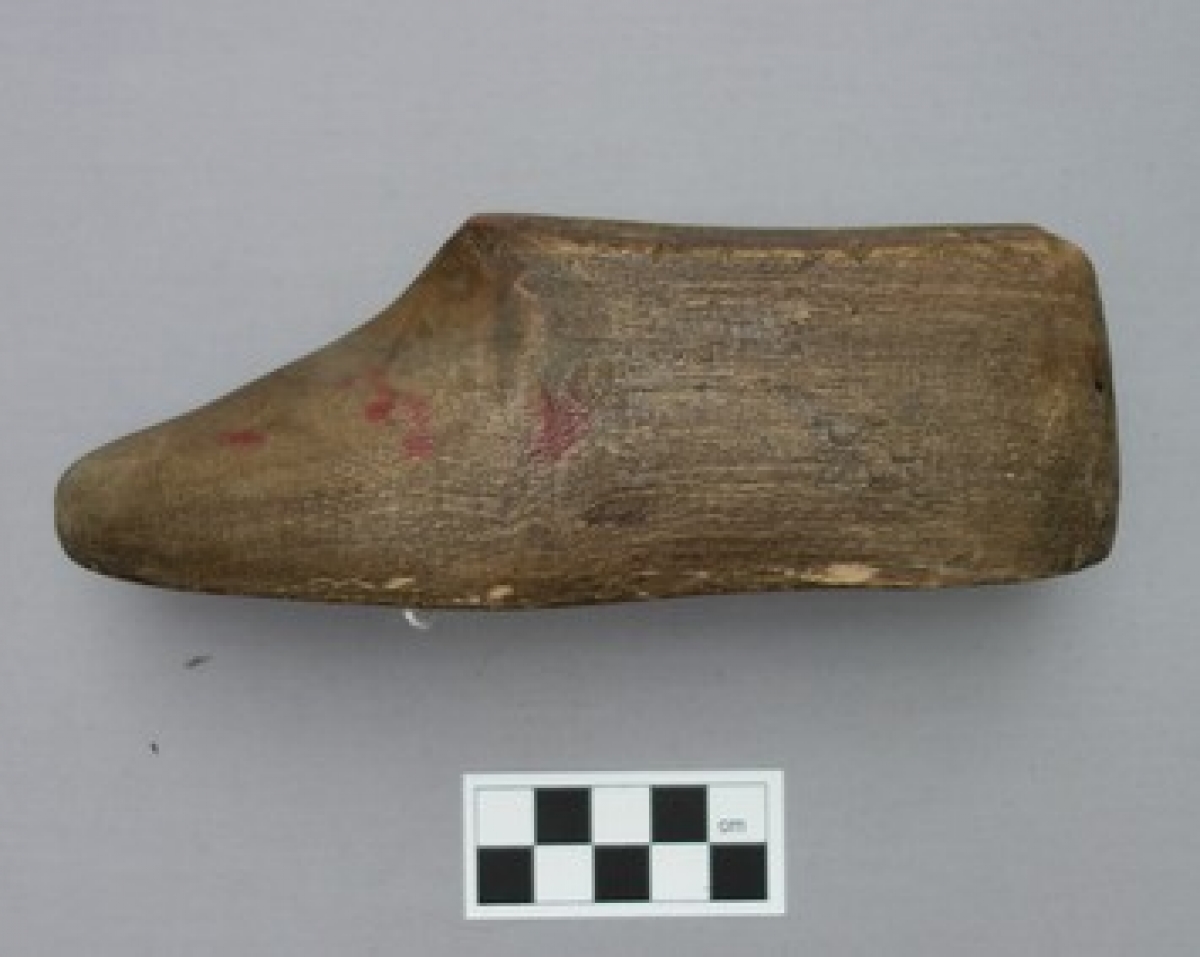
Women who could afford it had a life-size last or form of their feet carved out of wood. Poorer women would have a cloth last the size and shape of the foot, which was stuffed with cotton, beans or grain. These lasts were used to keep in place the top of the shoes and the sole while they were being sewn together.

3. The actual process
The process of foot binding started at between the ages of 5 and 8, when the arch of the foot was still soft and not fully developed. The entire process took from 2 to 5 years and caused extreme pain. It was generally an elder female member of the girl's family, her future mother-in-law or a professional foot binder who carried out the initial breaking and ongoing binding of the feet. This was considered preferable to having the mother do it, as she might be too sympathetic to her daughter's pain and less willing to keep the bindings tight. (Left) X-ray image of a normal foot, (right): X-ray image of a bound foot.
 (Left) X-ray image of a normal foot, (right): X-ray image of a bound foot.
Each foot would first be soaked in a warm mixture, which was to intended to soften the feet. The toenails were cut back as far as possible (or even removed) to prevent in-growth and any subsequent infections. To enable the size of the feet to be reduced, the toes on each foot were curled under, then pressed with great force downwards and squeezed into the sole of the foot until the toes bent or broke. The large toe was left unturned in order to help with balance. The toes were held tightly against the sole of the foot while the foot was drawn down straight with the leg and the arch forcibly bent upwards.
The long, cotton bandages (3m long and 5cm wide) were repeatedly wound in a figure-eight movement, starting at the inside of the foot at the instep, then carried over the toes, under the foot, and round the heel. At the same time the toes were pressed tightly into the sole of the foot. At each pass around the foot, the binding cloth was tightened, pulling the ball of the foot and the heel together, causing the foot to fold at the arch, and pressing the toes underneath.
 The difference between bound and unbound feet (c. 1902; courtesy of the Library of Congress, LC-USZ62-49138).
 A woman’s feet without the bindings (c. 1900; courtesy of the Library of Congress, LC-USZ62-71351).
The girl's bent feet required a great deal of care and attention and they would be unbound regularly. In some wealthier families the process of unbinding and re-binding with fresh bandages were carried out every day, while poorer families may do it twice or three times a week. Each time the feet were unbound, they were washed, the toes carefully checked for injuries and the nails trimmed. The feet were also massaged to soften them and to make the joints and bones more flexible. The feet were then soaked to cause any dead flesh to fall off. Then the girl's toes were folded back under and the feet were rebound. The bindings were pulled ever tighter each time this occurred.
Loose and symbolic binding
Loose binding is where a narrow, bow-shaped foot is required rather than the arched foot described above. This form of binding was associated with women in more remote regions where the weather and working conditions did not suit the tighter form of binding. It consisted of wrapping the toes under the sole, but with not enough pressure to break the bones. The aim was to create a narrow foot that gave the appearance of a bound foot.
Symbolic binding took place in some areas, so a woman may walk around unbound while working, but when approaching a town or for a festival she would bind her feet in the manner of traditional binding. Another form for girls was to have their feet slightly bound just before they got married and then the binding was undone after the wedding.

2. A brief history of foot binding
It is said that the practice of foot binding originated among court dancers in the early Song Dynasty (960-1279). The earliest relevant written records date to the 13th century and refer to the fame of the dancing girls with tiny feet and beautiful bow shoes at the court of the Southern Tang Dynasty (937-975) in southern-central China. Over the centuries foot binding was practiced by many elite families and later became widespread among all social levels. Many women with bound feet were able to walk unaided and work in the fields, albeit with greater limitation than women whose feet were not bound.
 An early tinted photograph of two wealthy Han Chinese women with bound feet (c. 1870; courtesy of the Library of Congress, LC- LC-USZC4-14686).It is estimated that by the early 19th century up to 40% , and possibly higher, of Chinese women had their feet bound. Among the elite women this would have been nearly 100%. Most of these women were Han, but other groups such as the Dungan and Hui peoples and some Cantonese practices this ‘art’ as well. Some families practiced variations of foot binding, such as loose binding, which did not break the bones of the arch and toes but simply narrowed the foot.
In contrast, since 1644 when the Manchu Qing Dynasty came to power in China, Manchu women were forbidden to bind their feet. Instead they invented their own form of shoe with a platform or central pedestal that meant they walked in a similar, swaying manner. These shoes were called “flower bowl” or sometimes ‘boat’ and ‘moon’ shoes.
The widespread acceptance and popularity of foot binding is reflected in the presence, during the latter half of the 19th and early 20th centuries, of troops of dancers with bound feet, as well as circus performers who stood on moving horses. The diaspora of Chinese families throughout the world in the 19th century, also meant that women with bound feet could be found in Europe, Asia, notably Hong Kong and Indonesia, as well as America.
 Pair of Manchu ‘flower bowl’ shoes worn in imitation of Han lotus shoes, c. 1910 (TRC 2013.0062).During the late 19th century Chinese, Western and Muslim reformers challenged foot binding, but it was not until the early 20th century that foot binding began to die out. This was due to concepts of ‘modernization’ (Westernization), changes in social conditions, as well as various active anti-foot binding campaigns. Some groups, for example, argued that foot binding weakened China as it disabled and enfeebled women, who in turn might bear weak sons. Others attack it as causing women suffering, but the latter seem to have been in the minority.
The Empress Dowager Cixi, a Manchu, issued an edict forbidding foot binding, but it was never seriously enforced. 1912 saw the fall of the Qing Dynasty and the introduction of the Nationalist government of the Republic of China. They officially banned foot binding, but with little vigour or success. It was not until the Communists came into power in 1949 that the practice was forbidden and remains officially banned in China to the present day.
1. Introduction
Chan zu (lit. “bound feet”) is the practice of binding young girls’ feet very tightly in order to prevent further growth and normal development. The tradition prevailed in China for about 1,000 years until the last reported case of binding in the mid-20th century. At first these tiny and re-modelled feet were merely fashionable for the elite, then they became socially acceptable. The next stage was when the concept of “lotus feet” (lian zu) became a custom and gained wider acceptance and eventually became an essential element in women’s life.
But there was never one type of lotus foot or shoe, instead there were many forms in which local and regional fashions and developments played an important role, namely in the size, shape and final appearance of the feet and their coverings. It was always the aim to create the appearance of a tiny foot. Only the shaped tip of the foot was placed in the shoe, the heel was normally supported by bandages and sometimes with strips of bamboo. The heel was hidden from public view by a series of wrappings, leggings and trousers.
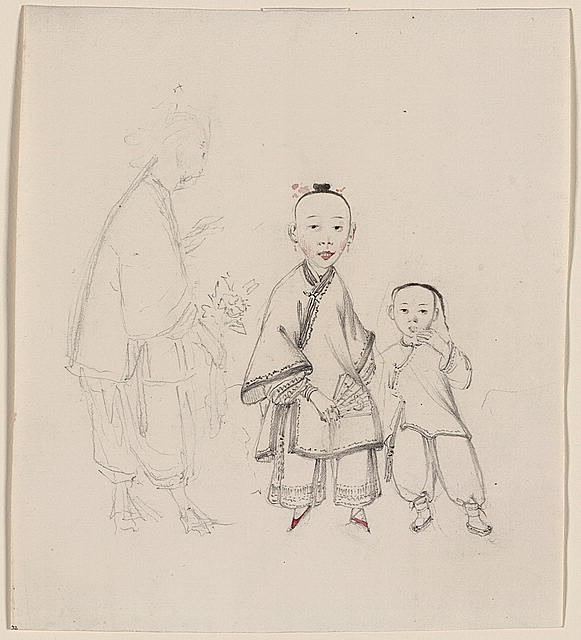 Boy with his elder sister who has bound feet (late 19th century; courtesy of the Library of Congress, LC-DIG-ppmsca-07450).Lotus feet were also a means of gender differentiation: boys did not have their feet bound, while girls did and in later life this had an effect on the different roles of men and women. Both men and women considered lotus feet aesthetically beautiful, with their own innate daintiness and symbolism. Such tiny feet also meant that a girl or woman would walk with a swaying movement called the lotus gait, which was regarded as sexually enticing to men. This gait was regarded as important for finding a suitable husband and by doing so increasing the position of the girl and her family. It also meant that, in many cases, it was difficult for a woman to walk, thus making her literally dependent upon her husband, family and servants.
 An early tinted photograph of a Chinese Han lady and her servant; both women have bound feet (c. 1870; courtesy of the Library of Congress, LC-USZC4-14684).
Throughout the centuries a marriageable girl was frequently chosen for the size of her feet and the quality of her needlework, especially for her footwear. A pair of shoes she had made and embroidered were sent to the home of a prospective husband to be judged by his family. Very small and elaborately decorated shoes were regarded as a sign of self-discipline, patience, fortitude and forbearance with extreme situations, as well as evidence of artistic creativity and household skills.
Many women, and their families, took great pride in their tiny feet, which were said to take the shape of a lotus bud with a wide and rounded base (the heel) going into a pointed tip (the toes). Hence their names of lily feet or lotus feet. The ideal foot length was about 7 cm, which was called the golden lily or the golden lotus. Between 7 and 9 cm was known as the “silver lotus.”
In some areas a woman’s unbound feet were called iron lotus, a term that was regarded as being insulting. Yet badly bound or shaped feet were seen by some as far worse than ‘long’ or unbound feet. Mis-formed bound feet were called names such as half-squeezed foot, half-blocked foot and little crooked bone
The pride and social necessity of ‘perfect’ lotus feet is reflected in the beautifully embroidered silk shoes and wrappings girls and women wore to cover and emphasise their feet.

11. Digital catalogue
The Textile Research Centre in Leiden houses eleven ancient Greek loom weights, and a small number of ancient Greek bobbins and spinning whorls.