
Beyond The Chador Regional Dress From Iran

1. Introduction
A continuous fascination with exotic and unusual textiles with different textures, colours and designs has for milleniia stimulated the trade in cloth and garments between Asia and Europe. This exchange began thousands of years ago and is still active today.
The most famous trade routes are the so-called ‘Silk Roads’, which stretched from China to the eastern Mediterranean, by land and by sea. This series of routes was used from about the 3rd century BC to the 14th century AD.
One of the main items carried along the Silk Roads were the silk textiles that were coveted by the rich and caused anxieties about ‘conspicuous consumption’ among the Romans. Silk is both valuable and portable, and makes an ideal medium for trade and exchange.
It should not be thought that objects travelled in one direction only: Persian textiles moved to the east along the routes to China, and influenced Chinese designs and weaving techniques. And although considerable attention in literature has focussed on the land routes going from east to west and vice versa, there were many trade routes that went from north to south, and south to north, and routes that went by sea around the coast of India to North Africa.
Not surprisingly, Asian-inspired motifs appeared on woven and printed textiles produced in Europe, some of which are direct copies of imports, others of which were ‘fantasy’ re-imaginings of the ‘exotic East’. These included Chinese, Indian, Persian as well as Ottoman imagery.
A wide range of textiles printed with Oriental motifs, for example, were popular in Europe in the late 18th century, and especially in the 19th century. Some of these found their way into Dutch regional dress, notably the chintz-based outfits worn by women in Hindelopen (Friesland), and the chest panels worn by girls and women from the island of Marken, Noord-Holland.
A parallel exchange took place in ceramic designs, with Delft wares imitating Chinese designs and China-made ceramics imitating European and Middle Eastern motifs.

7. Two pieces of black Chantilly lace
 Two pieces of black Chantilly lace. Left: TRC 2018.0098b, right: TRC 2018.0109 In this example we have two pieces of black Chantilly lace. They have a similar pattern with sprigs of flowers, which was fashionable in the second half of the 19th century. Both pieces are made out of dull black silk (grenadine).
The handmade lace (TRC 2018.0098b) is worked as a continuous-thread bobbin lace. The machine made lace (TRC 2018.0109) is made on the Pusher machine. Both examples are the same from front and back side.
Two pieces of black Chantilly lace. Left: TRC 2018.0098b, right: TRC 2018.0109 In this example we have two pieces of black Chantilly lace. They have a similar pattern with sprigs of flowers, which was fashionable in the second half of the 19th century. Both pieces are made out of dull black silk (grenadine).
The handmade lace (TRC 2018.0098b) is worked as a continuous-thread bobbin lace. The machine made lace (TRC 2018.0109) is made on the Pusher machine. Both examples are the same from front and back side.
Filling : In the handmade example, every circle has a independent structure of fillings. We can see pinholes inside the frame of the circle. The orientation of the threads adapts to the defined direction of the pattern, the half stitch is more open and regular in appearance. In both examples the circle is surrounded by the gimp. In the machine lace example, the half stitch has a more consistent and steady direction of the threads with a strong impression of parallel lines.
Gimp: In these two examples the gimp does look very similar because in machine made lace it was darned in by hand.
Ground: The Pusher machine perfectly imitates the ground of Chantilly bobbin lace/Lille ground. Differences of the ground can be noticed in the larger areas without the pattern. The ground of this handmade piece is more irregular, while the machine made example shows mostly identical meshes.
Side: The two examples look the same from both sides.
| Handmade lace: | Machine-made lace: | |
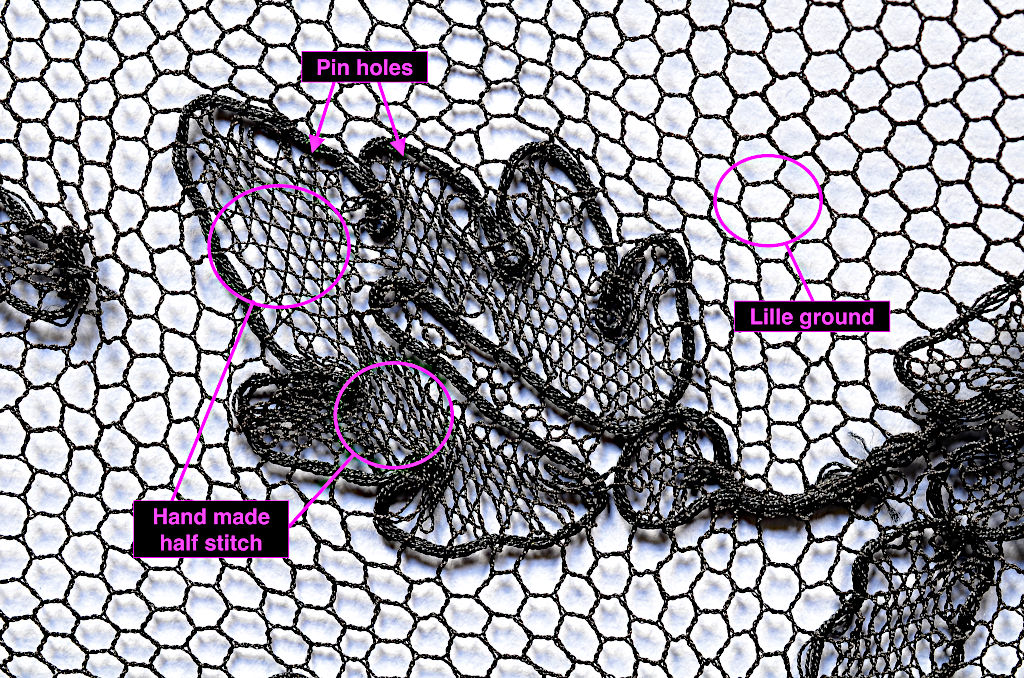 TRC 2018.0098b TRC 2018.0098b |  TRC 2018.0109 TRC 2018.0109 |

5. Two pieces of Venetian lace imitation
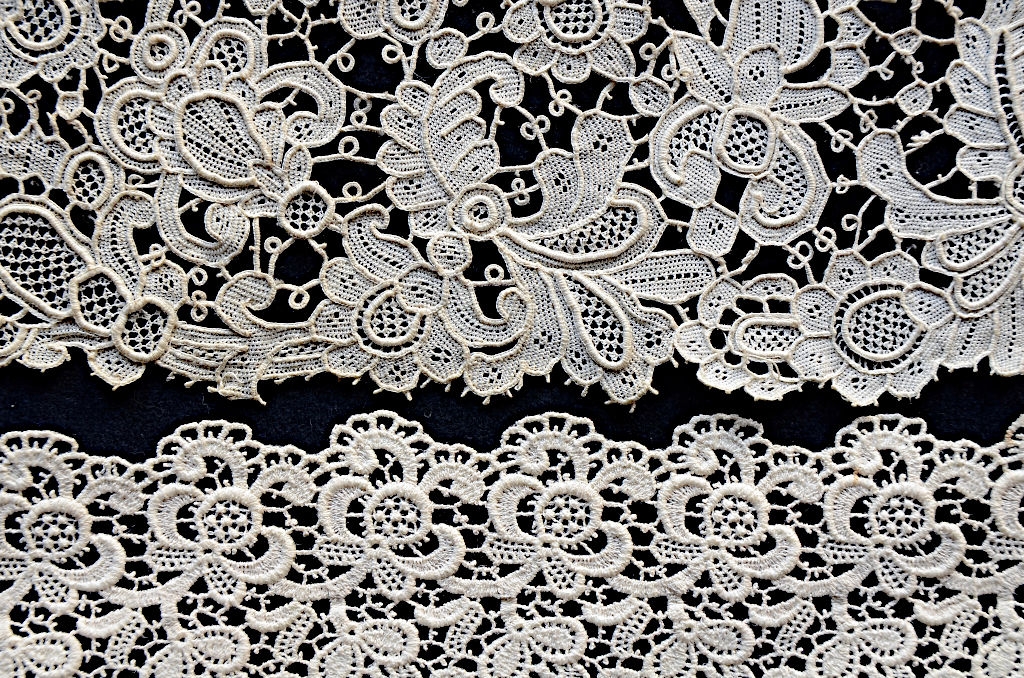 Two pieces of Venetian lace imitation. Top: TRC 2007.0559, bottom: TRC 2007.0595We have two lace examples from the beginning of the 20th century, which imitate the style of 17th century Venetian lace. The stylised flowers and leaves are joined by bars/braids to which picots are added. The handmade lace (TRC 2007.0559) is a needlepoint and the machine made example (TRC 2007.0595) is a chemical lace.
Filling: The floral pattern of the handmade piece is filled with several types of buttonhole stitches. The chemical lace is an embroidery on which we can clearly see machine lock stitches. This lace looks neat from a distance, but with magnification the outlines show a certain fuzziness.
Gimp: In the handmade pieces, the edges are decorated with a raised work and are worked as a separate layer on top of the filling. Various thickness is used to outline different parts of the flower. The raised work in the machine made lace is formed by rows of dense stitches that lie on the same surface as the rest of the pattern.
Ground: In both cases the floral motifs are connected by bars/braids. The bars of the handmade lace look solid and regular. The buttonhole stitches are clearly visible with even edges. In the machine made example the stitches of the bars are loose, and do not have a common structure.
Side: The front side of the handmade lace is decorated with raised work and the back side is flat. The machine made piece is equal on both sides.
| Handmade lace: | Machine-made lace: | |
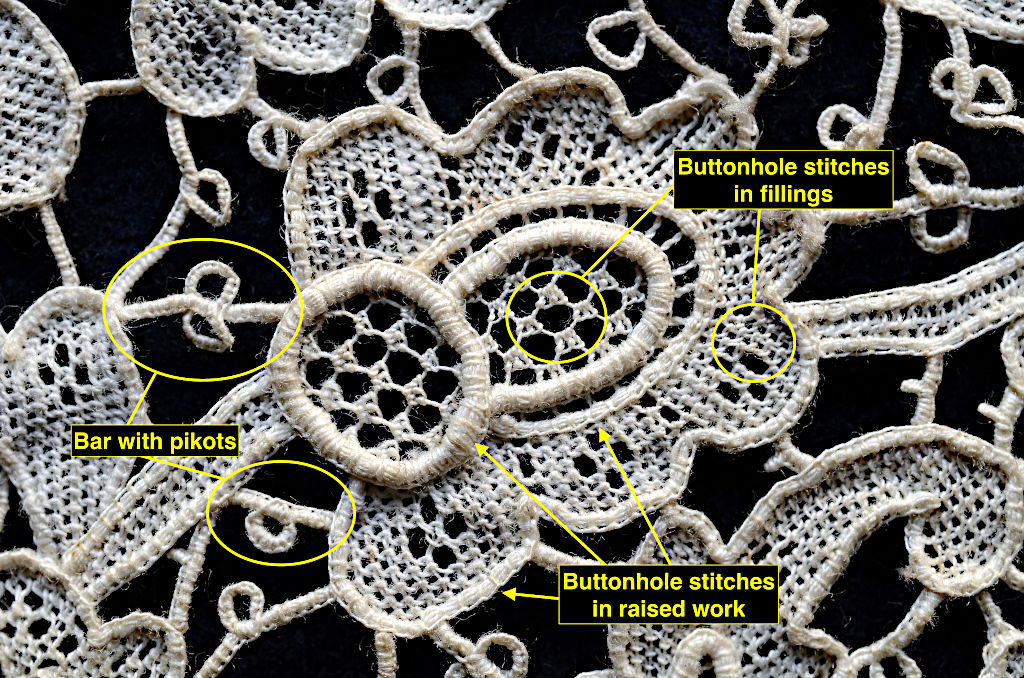 TRC 2007.0559 TRC 2007.0559 | 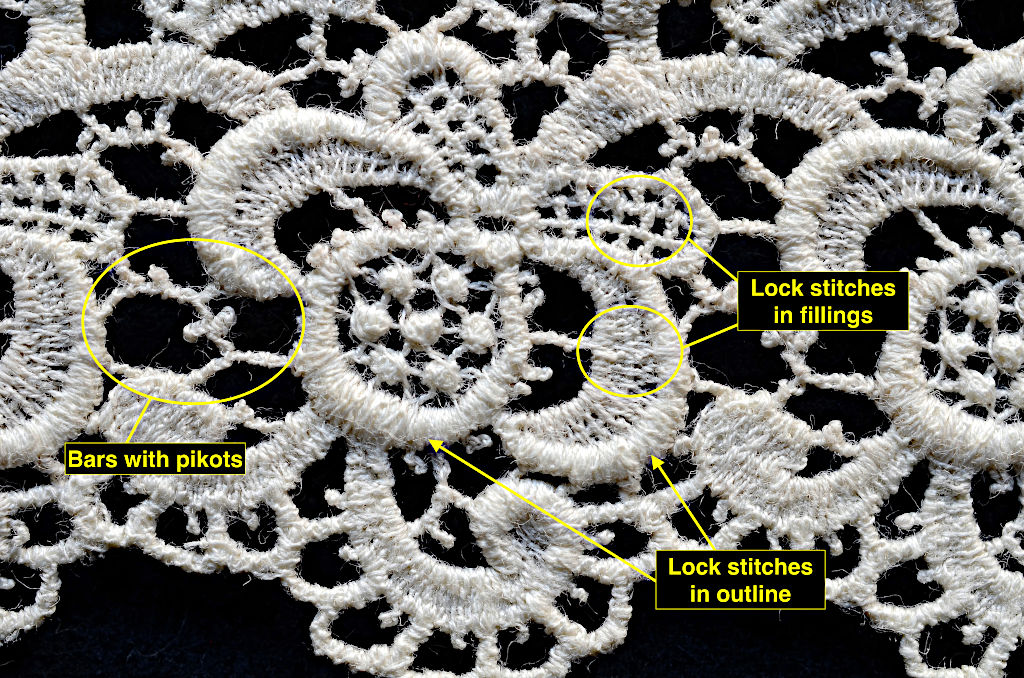 TRC 2007.0595 TRC 2007.0595 |
4. Two pieces of airy lace
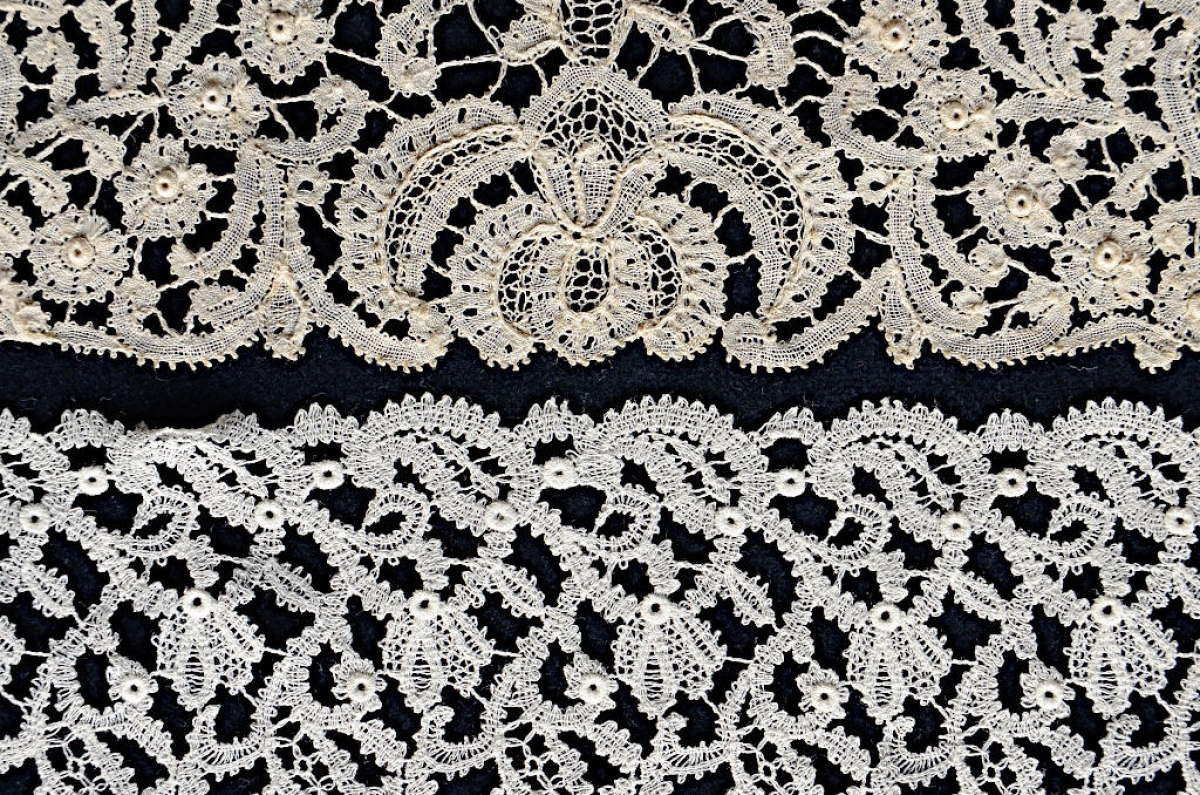
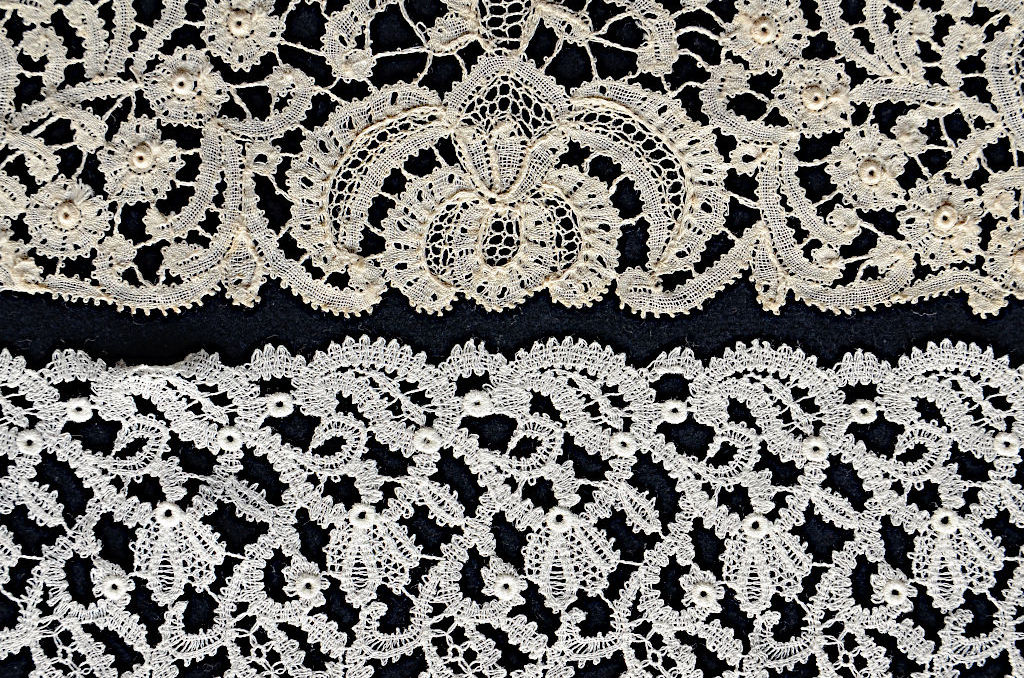 Two pieces of airy lace. Top: TRC 2015.0294, bottom: TRC 2017.0085Here we have two pieces of airy lace with a floral design in the style of Belgium rosalin lace, which were widely used at the end of the 19th / beginning of the 20th century. Both designs are composed of small motifs with crinkly edges and raised work, which is spread equally over the lace. The handmade piece (TRC 2015.0294) is a partial bobbin lace, the shapes are made separately and connected later. It is made out of linen thread. The machine made example (TRC 2017.0085) is a chemical lace made out of cotton.
Filling: Both examples have crinckly edges with tiny circular buds decorated with raised rings. In the handmade piece rings are made with a needle buttonhole stitches and added on top of the bobbin lace. In the machine made lace the raised work is executed together with the main pattern and the embroidery machine lock stitches are clearly visible.
Gimp: There is no gimp in both examples.
Ground: In both cases the floral motifs are connected between each other. In the handmade piece there is some space between shapes and they are connected by long bars. The machine made piece has almost no bars, therefore the motifs are tightly joined.
Side: The handmade lace has a raised work on the front, used mainly for the floral centres. The machine made piece has no specific front or back.
| Handmade lace: | Machine-made lace: | |
 TRC 2015.0294 TRC 2015.0294 | 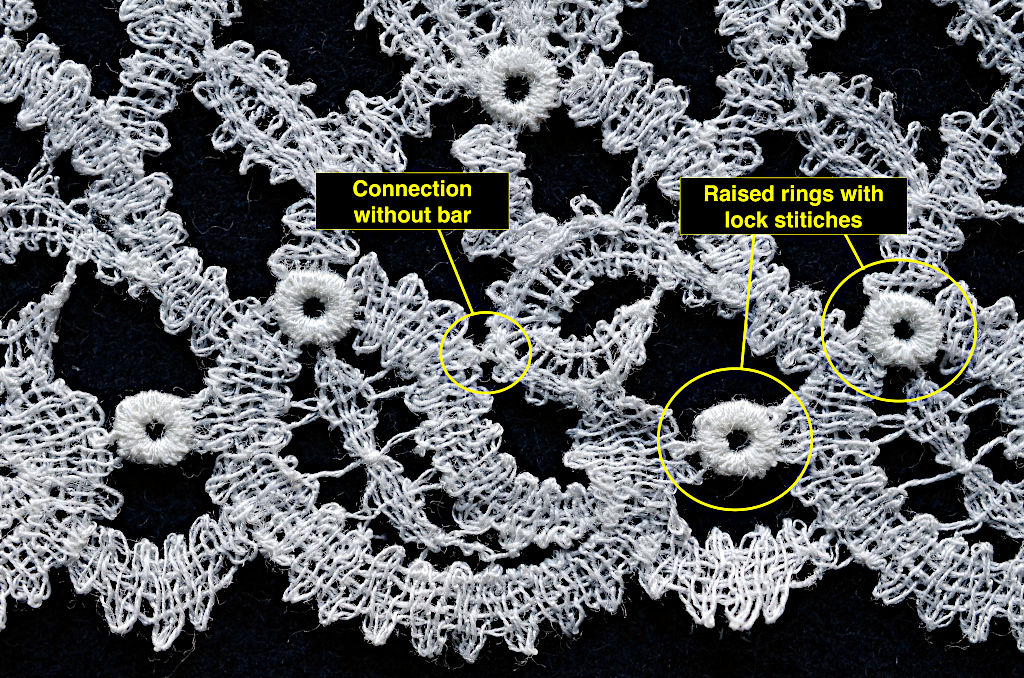 TRC 2017.0085 TRC 2017.0085 |
6. Two pieces of straight lace
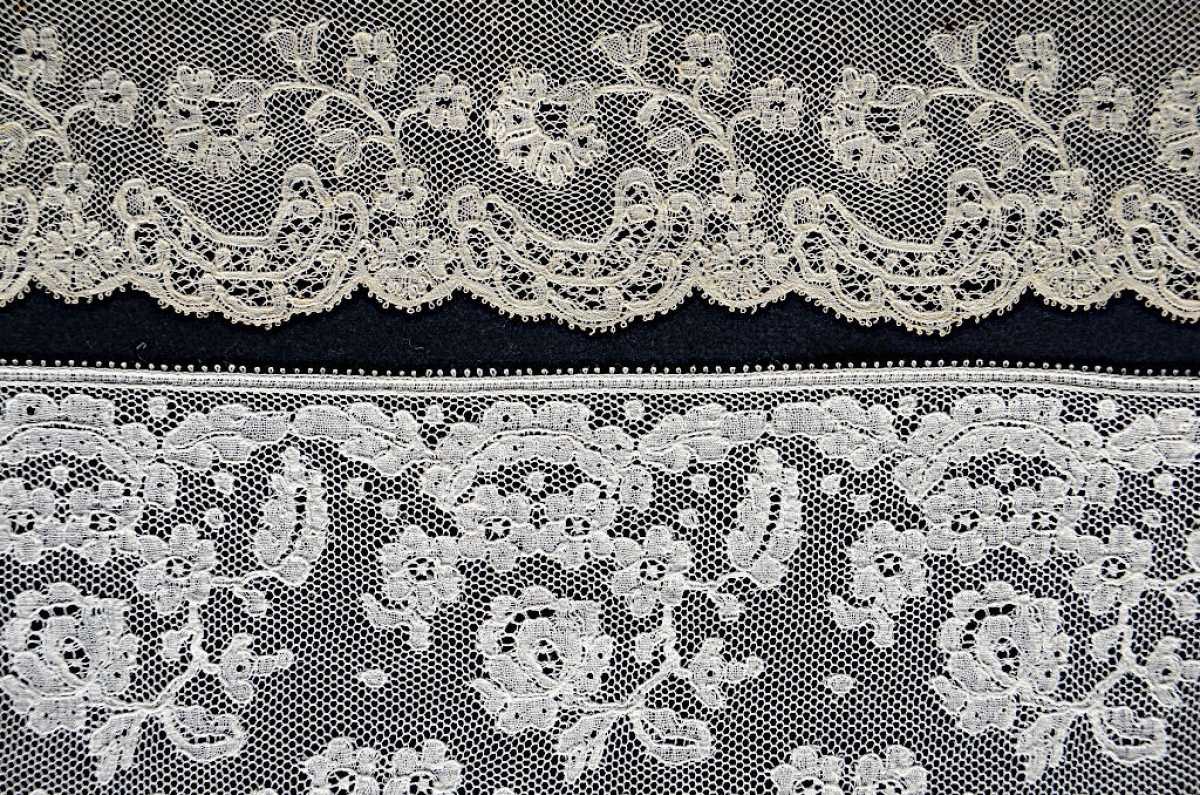
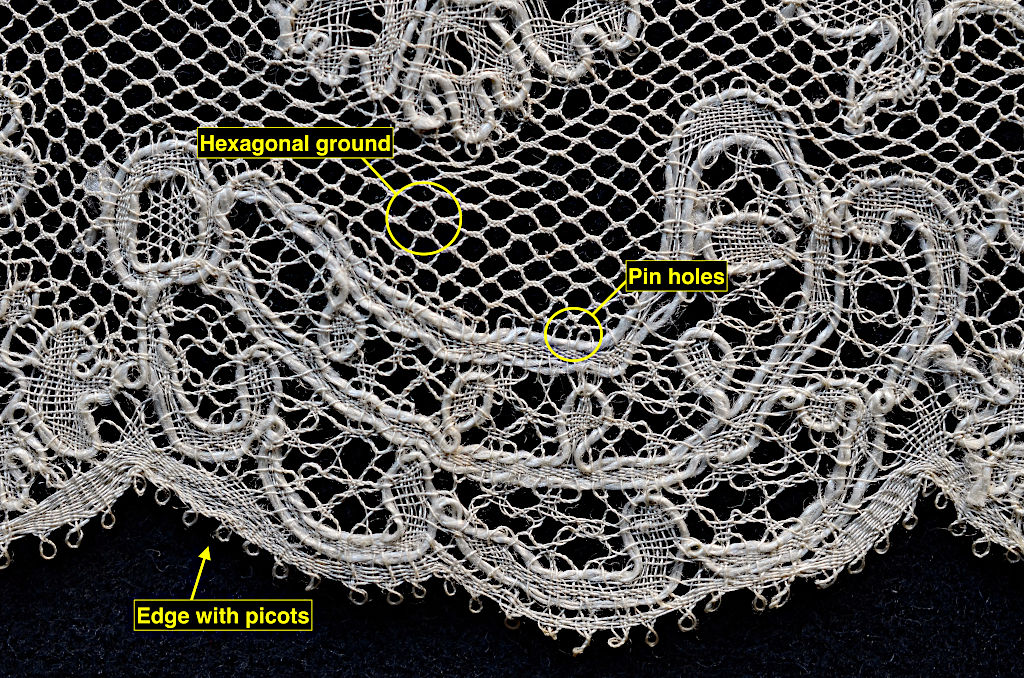
 Two pieces of straight lace. Top: TRC 2015.0250, bottom: TRC 2017.0070Here we have two examples of a straight lace with a similar hexagonal ground and floral pattern. The handmade piece (TRC 2015.0250) is a continuous-thread Mechlin bobbin lace in the typical style of the early 19th century, which was largely crafted in Belgium. The pattern consists of curved flowers with delicate blossoms. The machine made example (TRC 2017.0070) is a very good imitation of Mechlin lace produced on the Levers machine at the end of 19th / beginning of 20th century. The machine made piece has a with of 17 cm, the pattern has several rows of an repeating design that evolves from top to bottom. The handmade piece has more narrow width of 6 cm and only one decorative row of a floral pattern.
Filling: The fillings of the handmade piece has a cloth stitch structure with a few elements of half stitch. The solid parts have clear passage of threads in all areas and their edges are surrounded by pinholes. In the machine made piece the solid parts look very similar to the handmade filling, but the threads tend to have a more parallel structure, it is hard to trace the passage of threads and there is no indication of pin holes. The bottom line of the bobbin lace is decorated with so-called cartouches that are filled with fancy stitches. The machine made lace tries to imitate the cartouches of the handmade piece with concavely formed tendrils executed in a plain cloth stitch.
Gimp: In the handmade piece the gimp thread outlines the pattern. In the machine made piece the gimp looks very similar to the handmade, therefore it most likely was added by hand.
Ground: Both examples have a Mechlin type hexagonal ground, but in the machine made example the stitches are less even and precise than in the handmade lace.
Edge: Both examples have picots at the edges, but in the handmade piece the edge is scalloped and the picots were made together with the main piece. The edge of the machine made lace is straight. It was produced separately and added later.
Side: The handmade example is the sam on both sides, while the machine made lace has a distinct front and back side, as shown by the raised gimp threat on the front.
| Handmade lace: | Machine-made lace: | |
 TRC 2015.0250 TRC 2015.0250 |  TRC 2017.0070 TRC 2017.0070 |

8. Terminology
Beveren lace: Beveren is a town in Belgium where this specific type of lace was made in the nineteenth century.
Cantu lace: Cantu is a town in Italy, associated with a bobbin lace known as Italian Rosaline.
Chantilly lace: Chantilly is a town in France, known for the black continuous bobbin lace produced in the second half of the eighteen century.
Chemical lace: An embroidery with a cotton thread is stitched on a silk fabric, which is dissolved in a later working process. This technique is used to imitate almost any handmade lace.Filling: Stitches that fill the enclosed spaces of the lace representing flowers, abstracted forms, fruits, animals or people.
Cloth stitch: The thread is more closely woven with a cross-twist-cross forming a compact surface.
Edge: The finishing outlines of the lace.
Filling: Stitches that fill the enclosed spaces of the lace representing flowers, abstract forms, fruits, animals or people.
Gimp: The gimp is a thick thread outlining portions of the design, mostly apparent in bobbin lace.
Ground: The ground fills open spaces and supports solid parts.
Lace trim: narrow lace stripe used to decorate clothing or household goods.
Levers machine: This machine was invented by John Levers in 1813. The machine produces imitations of handmade bobbin laces.
Lille/Tulle ground: A fine net that can be made by machine or hand.
Half stitch: The Half stitch is more open, looking like a grill of intersecting threads. Made with a cross-twist movement.
Paris ground/Kat stitch: The ground is formed by hexagons and triangles creating a star-shaped look.
Point de Rose/Rosaline: This lace can be referred to a variety of laces, like Venetian needle lace or Brussels bobbin lace. It has an intensive flower design with raised parts.
Pusher machine: The Pusher machine was invented in 1812. The machine produces good imitations of bobbin lace, especially Chantilly lace.
Side: The side of the lace is indicated by its decorations, a raised gimp or any other indicator showing a front or backside.
Valenciennes ground: is a town on the French-Flemish border, known for its continuous bobbin laces.
Venetian lace: Is a needle lace specific to the region of Venice with the look of carved ivory and raised work.
.
3. Two lace collars
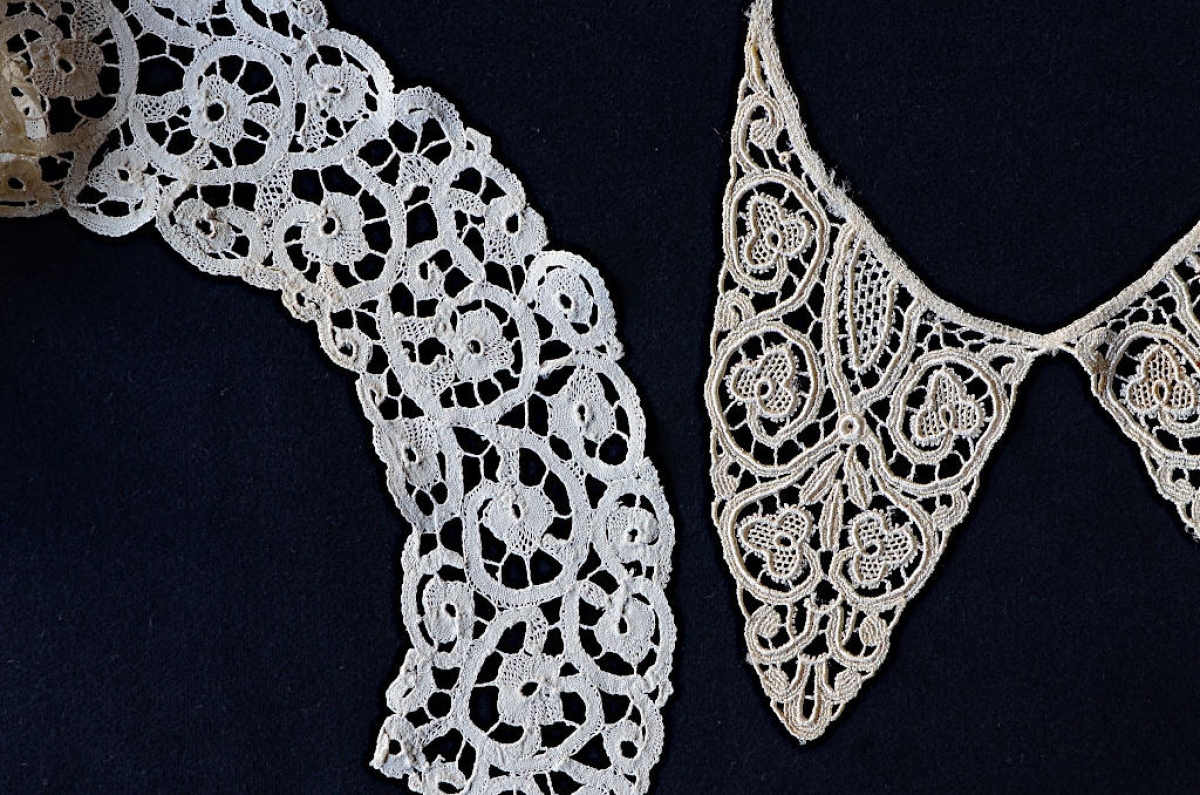
 Two lace collars. Left: TRC 2007.0568, right: TRC 2015.0137mmThe two laces illustrated here were used as a decoration around the neck. In both examples the pattern is formed by curved solid lines ending with buds. They are produced in the style of Italian bobbin lace, called Cantu or Rosaline, popular at the end of the 19th / beginning of 20th century. The machine made example (TRC 2015.0137mm) is a chemical lace made of synthetic threads. The handmade piece (TRC 2007.0568) is crafted from a linen thread.
Filling: In the handmade piece, cloth stitch and half stitch are used to form the stems and buds. The chemical lace is an embroidery on which we can clearly see machine lock stitches. This lace looks neat from a distance, but through magnification the outlines show fuzziness. Also, the half stitch used for buds imitates hand made forms.
Gimp: The handmade piece has no gimp. Some elements in the machine made lace are outlined by a brighter and more shiny thread.
Ground: In both cases the floral motives are connected by bars/braids. The bars in the handmade lace look solid and regular. In the machine made example the stitches of the bars are loose, and do not have a common structure.
Side: The handmade piece is equal on both sides. The machine made lace has a front and back side. The front side is indicated by dense and shiny stitches that outline shapes.
| Handmade lace: | Machine-made lace: | |
 TRC 2007.0568 TRC 2007.0568 |  TRC 2015.0137mm TRC 2015.0137mm |

2. Two narrow lace trims
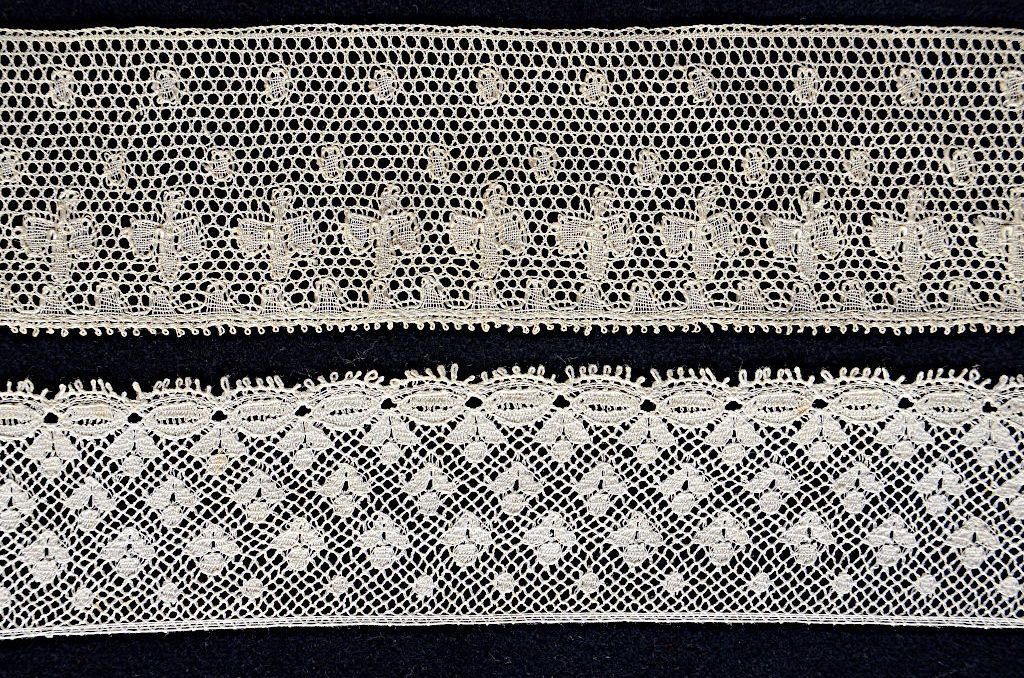 Two narrow lace trims. Top: TRC 2015.0249, bottom: TRC 2017.0159We have two examples of narrow lace trim from the first half of the 20th century, which were used for various types of decoration. They have a similar pattern, namely small circles and flower-like silhouettes. The handmade piece (TRC 2015.0249) is a continuous-thread bobbin lace made out of linen with a silk gimp. The machine lace (TRC 2017.0159) is made out of cotton on a Levers machine.
Filling: The handmade piece has a clear cloth stitch structure. You can see the pin holes around the shape of solid parts. The threads follow the flow of the pattern. The fillings in the machine made example are more solid, with multiple threads in a V-shaped movement.
Gimp: In the handmade lace the gimp outlines the pattern, while the machine made example has no gimp.
Ground: The handmade lace has a central hexagonal hole surrounded by six smaller triangular holes, called Paris ground or kat stitch. The machine made piece imitates the Valenciennes ground, which has a diamond-like shape.
Side: The handmade lace has no particular obverse or reverse, while the machine made example has a front and back side.
| Handmade lace: | Machine-made lace: | |
 TRC 2015.0249 TRC 2015.0249 |  TRC 2017.0159 TRC 2017.0159 |
1. Two lace bands
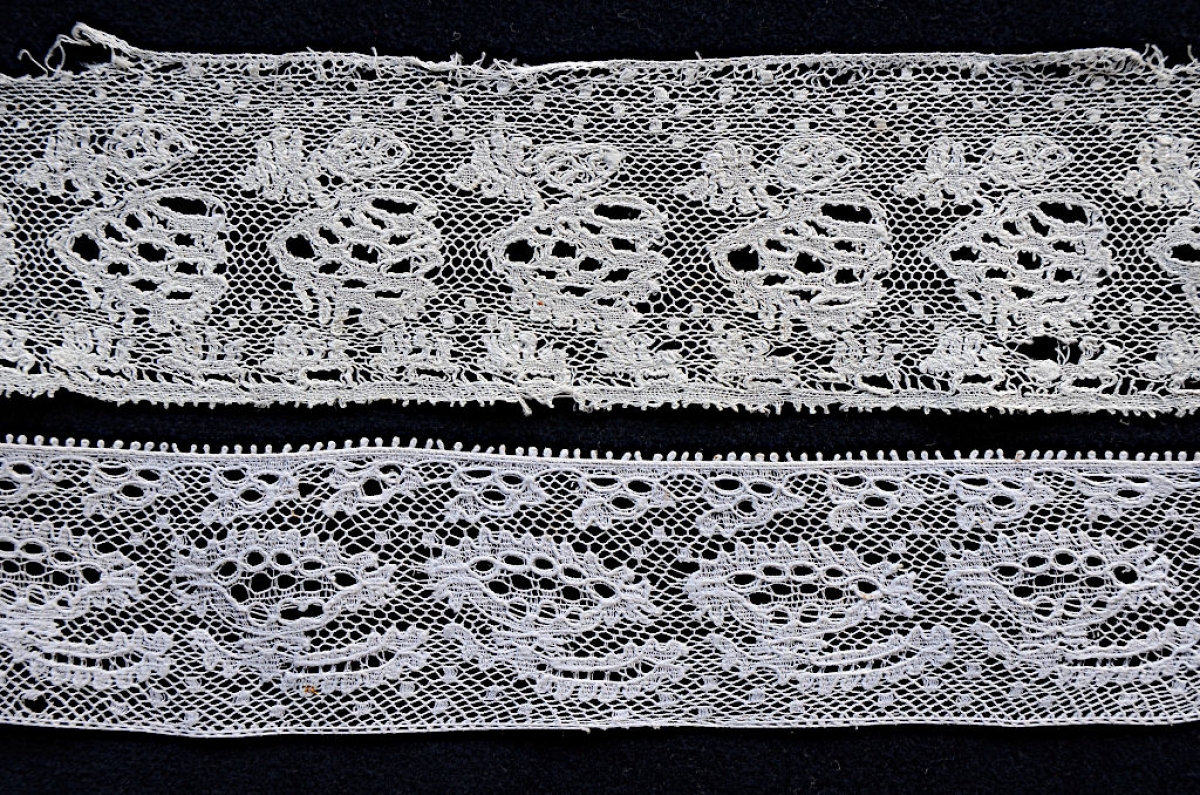
 Two lace bands. Top: TRC 2018.3173, bottom: TRC 2014.0921The illustration to the right shows two lace bands of a type that was used as a decoration for traditional Dutch caps in the early 20th century. Both examples follow the so-called Beveren lace design, which is a tulle lace with stylised flower motifs. The ground is made of an hexagonal mesh, often powdered with square tallies. The handmade piece (TRC 2018.3173) is a continuous-thread bobbin lace, and the machine made example (TRC 2014.0921) is manufactured on a Levers machine. Both examples are heavily starched, which indicates that they were used earlier, on another cap.
Filling: The handmade piece has a clear cloth stitch structure. You can see the threads of the filling being irregular, following the form of the gimp, which outlines the flower pattern. The fillings of the machine made example are more loose and have a regular and parallel structure with stitches in an obvious V-shape movement.
Gimp: In both pieces the gimp creates the outline of the floral motif. In the handmade lace it is visible on both sides. The gimp of the machine made piece is only visible at the front.
Ground: The ground for both pieces looks similar. The machine made lace has a good imitation of a tulle ground. An indicator to distinguish both laces are the stitches forming the ground. In the machine made example one side of the mesh is formed by a V-shaped stitch, while the handmade piece has a twist in the hexagonal structure.
Edge: Both examples have picots at the edges, but in the handmade piece the edge is created together with the main piece. The edge of machine made lace is produced separately and added later.
Side: The handmade piece is identical on both sides, while the machine made lace had a visible gimp on the front side.
| Handmade lace: | Machine-made lace: | |
 TRC 2018.3173 TRC 2018.3173 |  TRC 2014.0921 TRC 2014.0921 |

11. A selection of velvet textiles, garments and photographs from the TRC collection