
Beyond The Chador Regional Dress From Iran
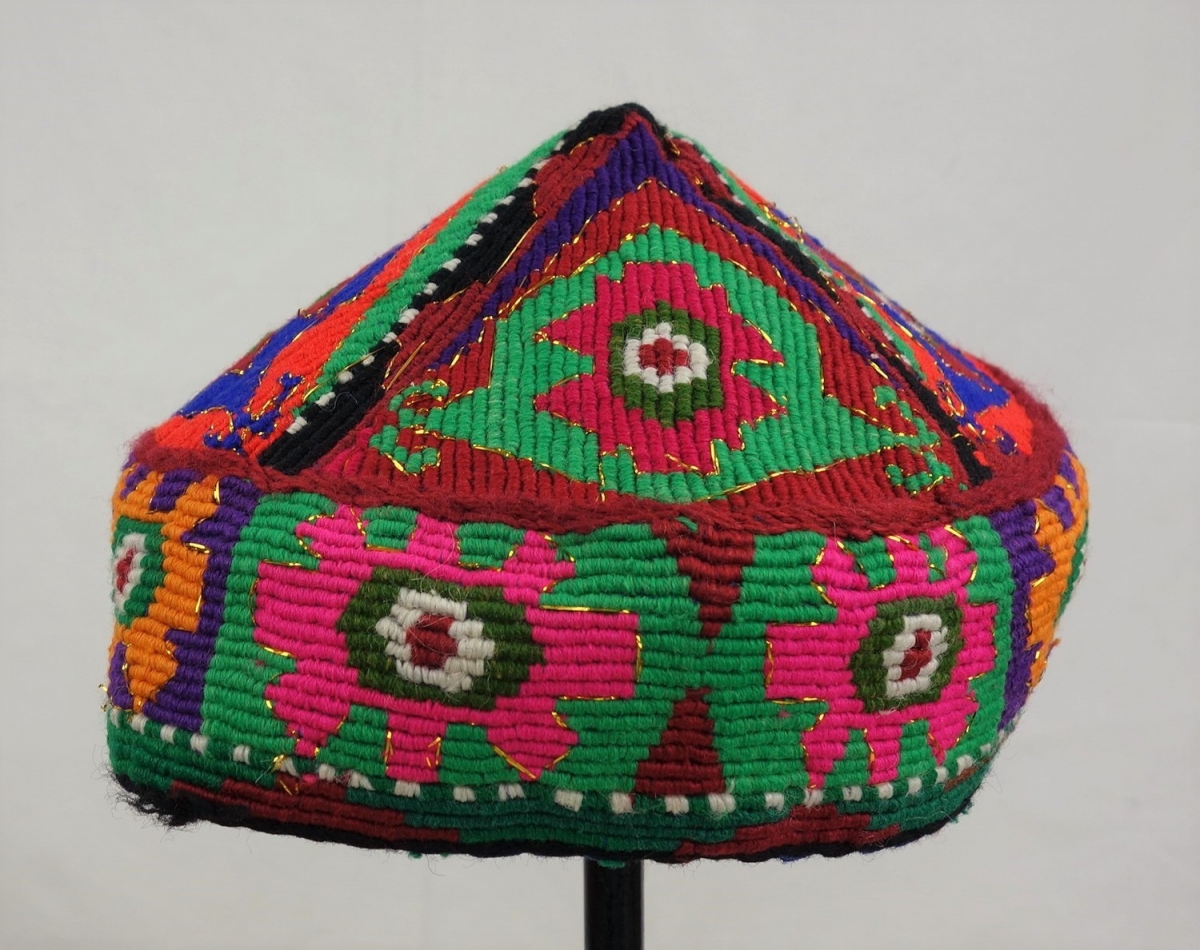
11. Uzbek traditional dress
The Uzbek are a Turkic people of Central Asian origin, and they live primarily in modern Uzbekistan, but there are large populations in northern Afghanistan, Tajikistan and Turkmenistan. A feature of both male and female Uzbek clothing is the use of ikats and embroidery.
In the past, Uzbek men were wearing cotton trousers and a long cotton tunic. The trouser legs and cuffs were often embroidered. One or more kaftans (chapan), often in ikat, were worn on top. The kaftan reached to just below the knees, so exposing the decorated parts of the trousers. The outer kaftan was fastened with a sash. The headdress consisted of a pointed skull cap with a (white) turban.
Modern Uzbek dress for men is basically a Westernized outfit consisting of a shirt with trousers. However, on special occasions, an Uzbek festival outfit is worn consisting of shirt and trousers, over which is worn an ikat or embroidered coat. The traditional Uzbek skull cap, which still often has a pointed crown, is characterised by its embroidered decoration.
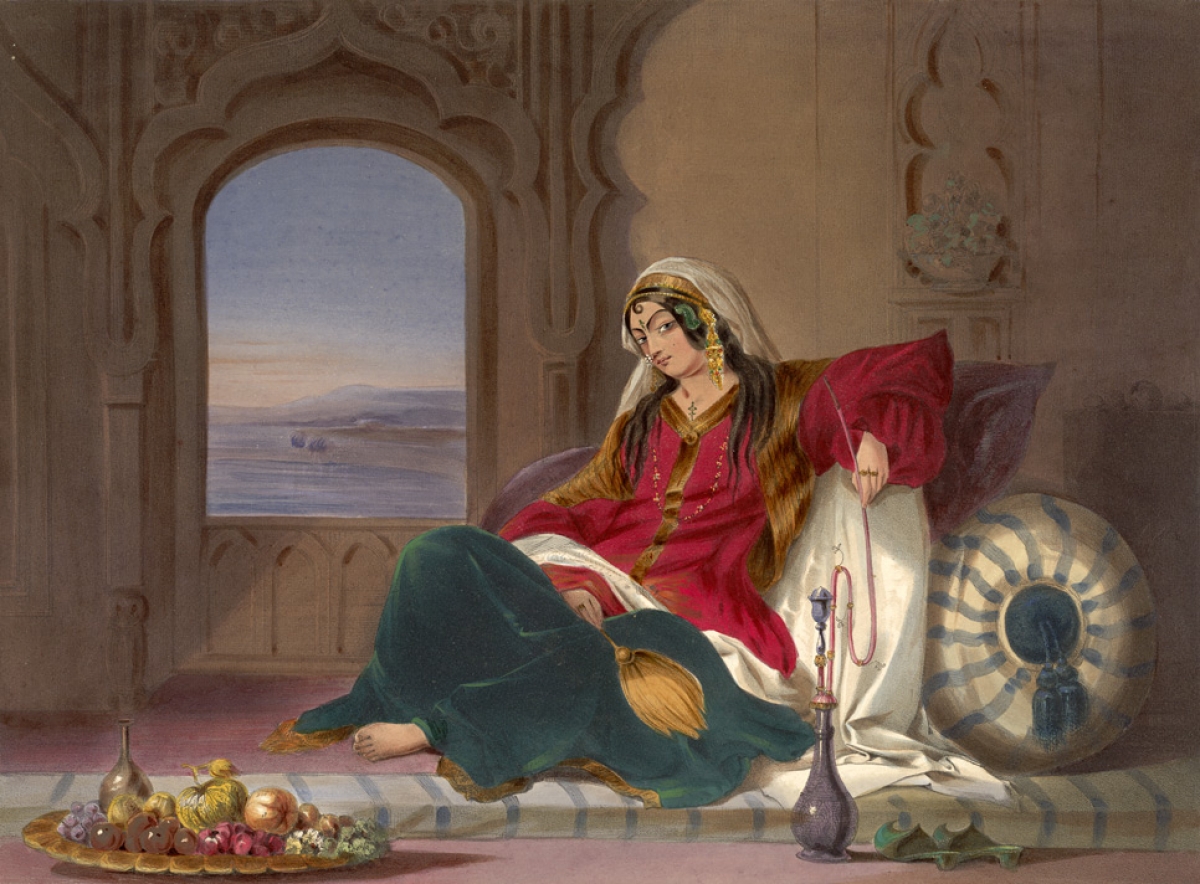
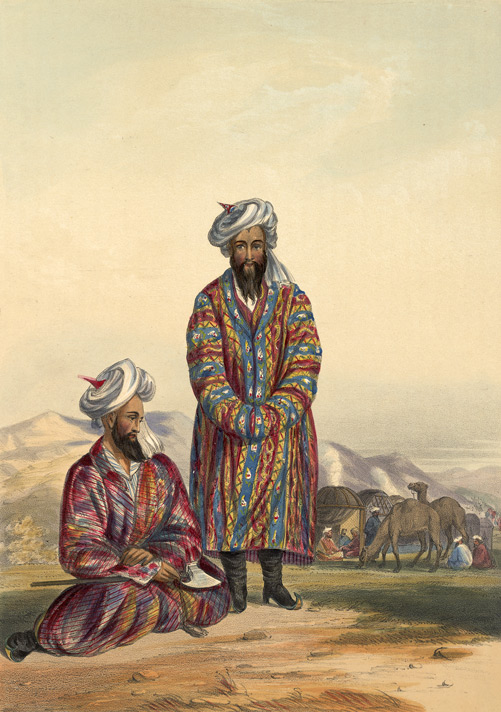 “Oosbegs of Mooraud Beg” Plate 20 of 'Afghaunistan' by Lieutenant James Rattray (1848).There are two main types of outfits traditionally worn by Uzbek women in Afghanistan. The first consists of a pair of ikat trousers and an ikat dress. The head covering for girls usually consists of a small cap, often in velvet. The headdress of a married woman is slightly more complicated and consists of headscarf or a cap covered with a large shawl, often of white or a pale colour. On special occasions a coat is worn over the dress, which is made from either ikat cloth or a plain material decorated with embroidery.
 Embroidered crown of an Uzbek-style skull cap for a man, Afghanistan, 1950s-1970s (TRC 2016.1802). For more information, click on the illustration.The second, more conservative outfit consists of baggy trousers and a wide dress embroidered with large, colourful floral motifs. This is worn with an open fronted coat with a defined waist. The main outer garment is a long coat with false sleeves that is draped over the shoulders. The outer coat is often embroidered, but not as vividly as the dress. A large shawl (chador) is used to cover the head and body.
For a TRC Needles entry on Uzbek embroidered clothing, click here.
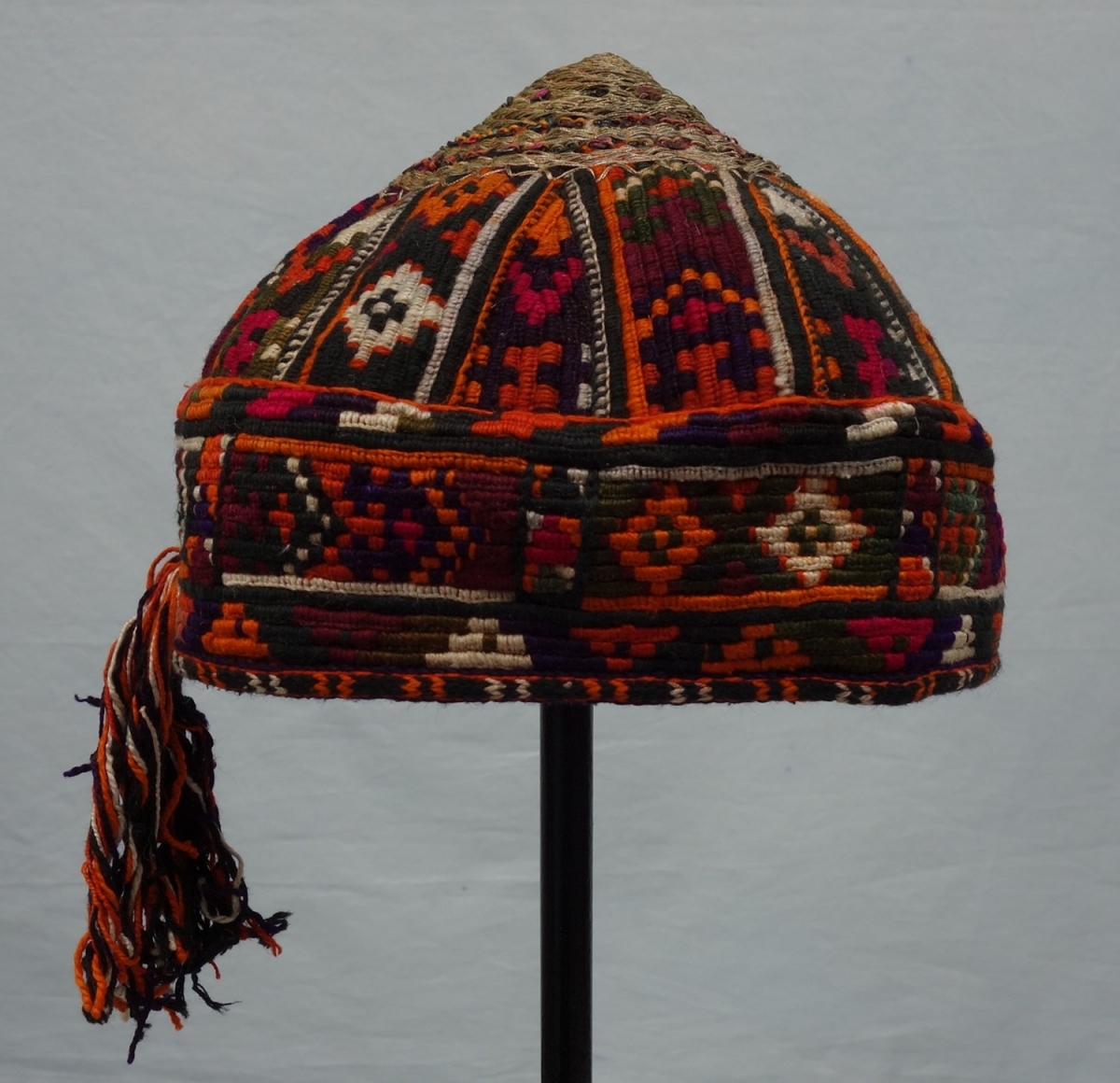
10. Turkmen traditional dress
The Turkmen are an ethnic group who speak a form of Western Ghuz (Oghuz) Turkic. Apart from Afghanistan, Turkmen also live in Iran, Turkmenistan and other parts of the former Soviet Union.
The basic costume for an Afghan Turkmen man traditionally consists of a pair of loose cotton trousers (balaq) and a shirt (koynek). Over these is worn a tight-sleeved robe (don) of striped silk. These garments are held together at the waist with a sash (qusaq). A man's headgear consists of a small skullcap (bork), sometimes with a turban or a cylindrical, black sheepskin hat (telpek). A smaller, and more expensive version is the karakuli, an astrakhan cap made famous by (ex-) President hamid Karzai.
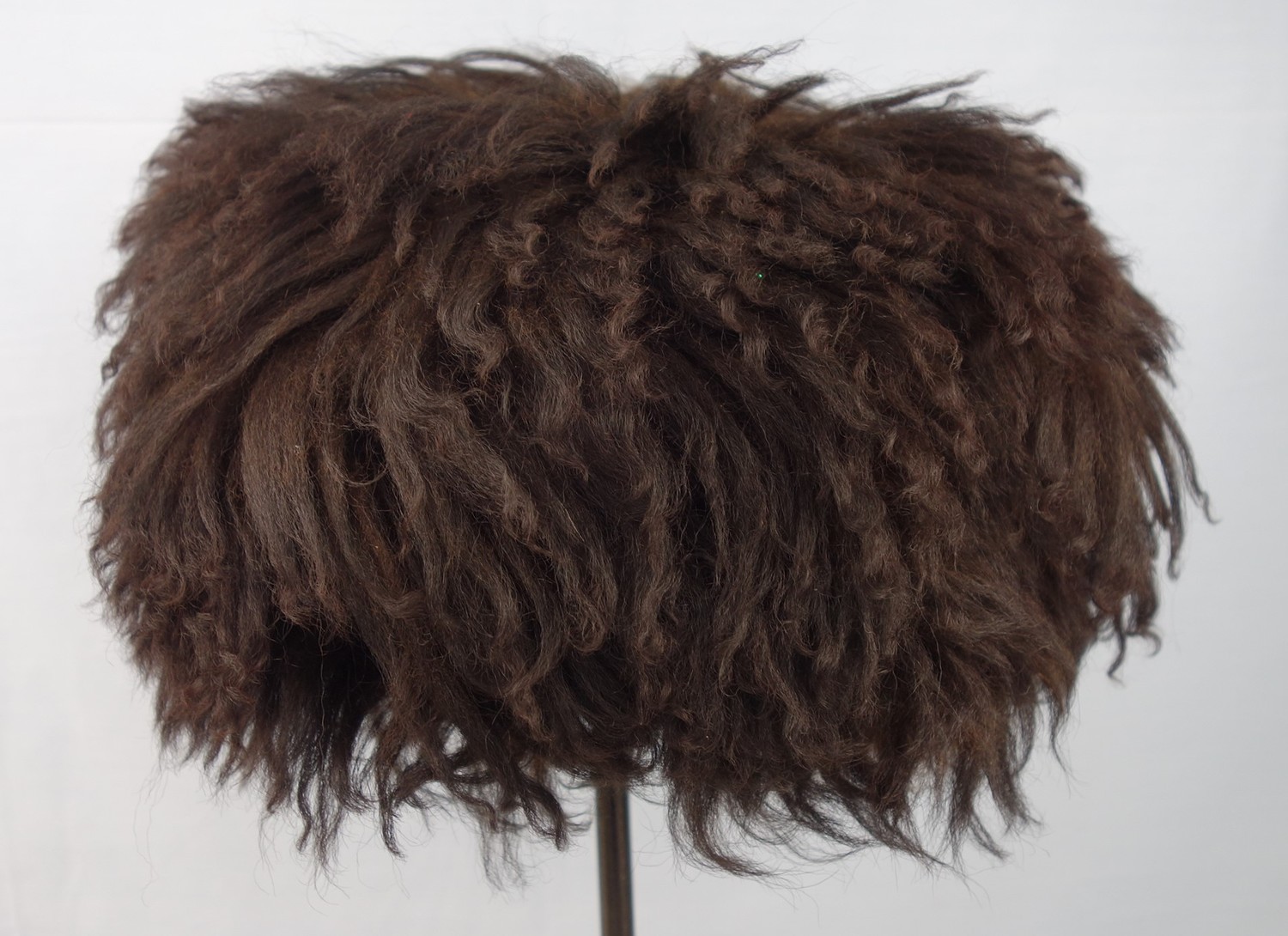 Turkmen headdress (telpek) from Iran, late twentieth century (TRC 1999.0136). For more information, click on the illustration.
The basic dress of a Turkmen woman traditionally consists of under trousers (balaq), a dress (koynek), and a headdress of some kind. In addition, some groups also have a face veil (yasmak), a sash (sal qusaq, bil qusak), an indoor coat (cabit or kurte), and for outdoor wear, a second coat (chyrpy).
 Turkmen woman's cap, Afghanistan, early twenty-first century (TRC 2008.0230). For more information, click on illustration.An important feature of Turkmen dress for women is the quantity of silver and, more recently, gold jewellery. Most of the jewellery is worn on the head, down the front and back of the upper torso and on the lower arms and hands, where it is very visible and people can see the social and economic status of the wearer.
An important element of Turkmen dress, of men, women and children, is the inclusion of amulets. They may take the form of a piece of cloth enclosing a text, which is sewn onto a garment. Such a text is usually taken from the Koran. Other amulets take the form of bracteates with a specific shape or with an impressed or engraved text. The amulets are meant to protect the wearer against the evil eye, diseases, evil spirits, and other negative influences.
9. Tajik traditional dress
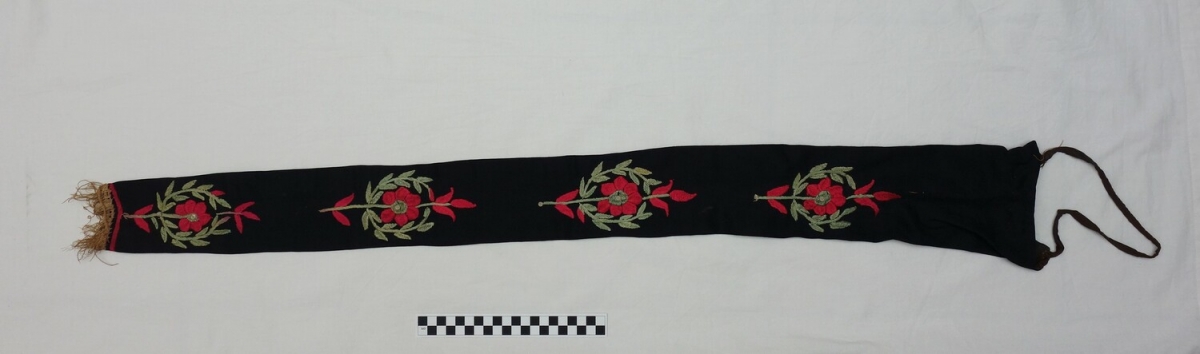
Tajik is the normal name for the non-Pashtun, non-Hazara, Persian (Dari) speaking population of the country. Many live in the main cities and in the northeast and west of the country. The basic man’s outfit consists of trousers (tomban) with a drawstring (tikke) and a knee-length shirt (pirahan or kamiz). The Tajik man’s headgear normally consists of an embroidered cap (kolah).
The outfit worn by Tajik women consists of trousers, dress and head covering. Tajik women’s trousers usually have straight legs and are made of white or pastel coloured satin, cotton or a synthetic material. Tajik dresses tend to have long sleeves and longish skirts. In general, they are not decorated with embroidery or metallic lace. Instead emphasis is placed on the use of different types of fabrics, often woven or printed with geometric and floral designs.
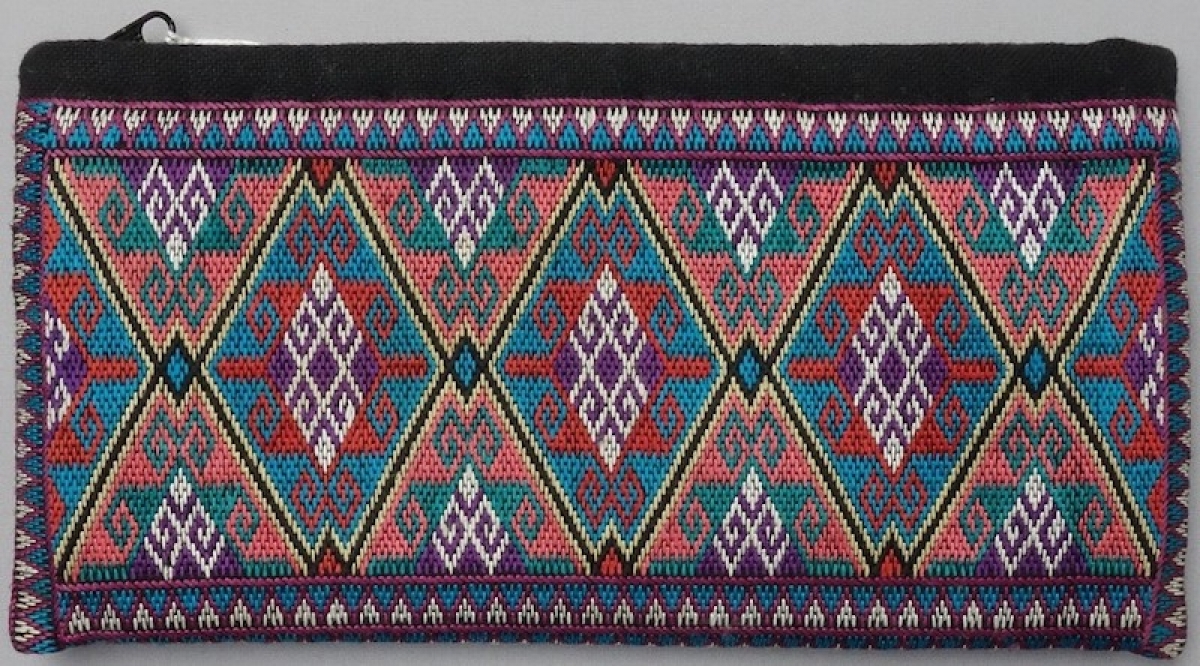
 Detail of a Tajik woman's plait bag, Afghanistan, 1960s-1970s (TRC 2016.1852). For more information, click on the illustration.Tajik women in Afghanistan are likely to wear an all-enveloping chadari (or burqa) or they wear a chador, which is normally about two metres in size and made from georgette or gauze and decorated with lace, crochet or needlepoint borders.
In some areas of northern Afghanistan, Tajik women wear an outfit that is similar to Uzbek forms. These include narrow ikat trousers, worn with a shiny, ikat dress. Tajik women often plait their hair into numerous long strands, put into an embroidered plait bag.
8. Pashtun traditional dress
The Pashtun constitute an ethnic group that lives along both sides of the modern Afghanistan-Pakistan border (the still disputed so-called Durand line of 1896). The traditional man’s outfit includes trousers (partug or shalwar) with a drawstring (partugghakh), a knee-length shirt (kamiz), and a waistcoat (waskat).
The Pashtun headgear is normally a cap (khwalay/rakhchina), often with a turban (pagray/lungay/langota) wrapped around it. In southern Afghanistan, the caps are often open in front, in imitation of the Baluchi caps. The outfit is completed with a large, rectangular blanket (chador [thin] or patu [thick]) worn over one shoulder or slung across both. The blanket is multi-functional and can be used for warmth, to sit upon and as a prayer mat.
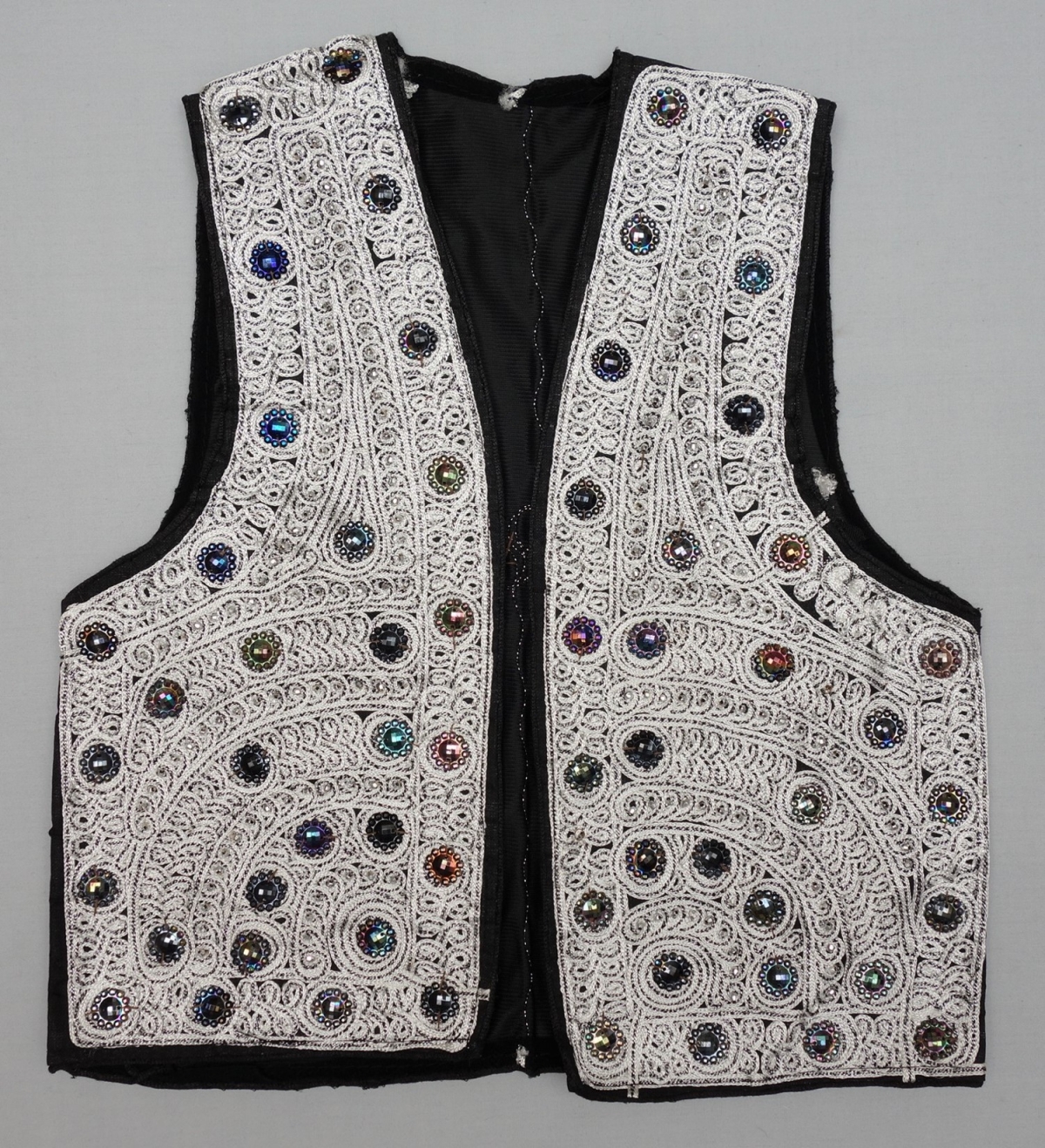
 Detail of a Pashtun woman's waistcoat (waskat), Afghanistan, early twenty-first century (TRC 2008.0298). For more information, click on the illustration.
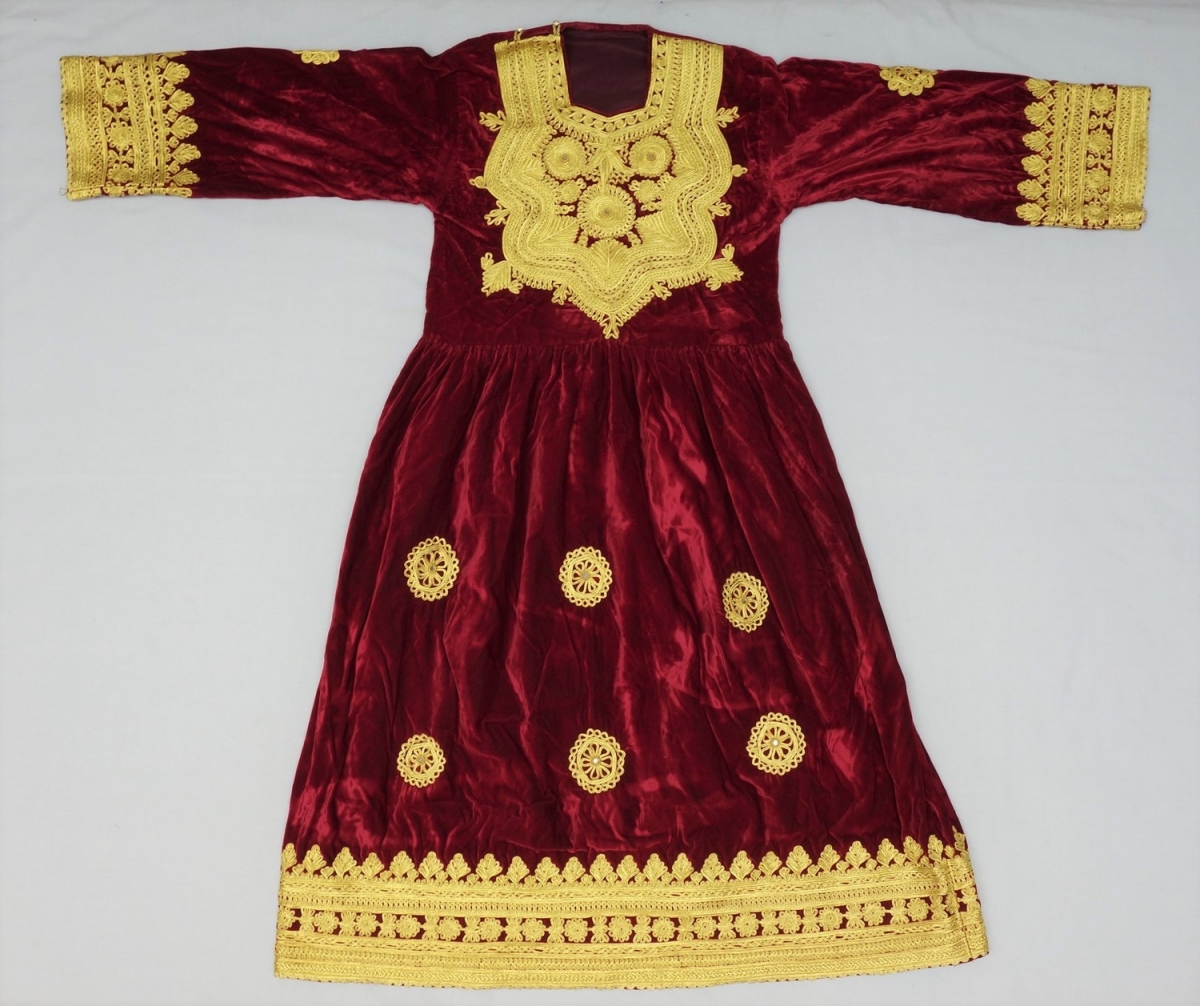
Pashtun women tend to wear a ‘standard’ Afghan outfit made up of trousers (partug), a dress with long sleeves and full skirt (kamiz), often a waistcoat (waskat) and some form of head covering (shal, chador). The trousers are usually made out of a contrasting colour to the dress and a common colour for the trousers is mid-green. Festival dresses are usually made out of silk or velvet in rich colours, especially deep red.
During the hot summer months, many women prefer to wear printed cotton and rayon fabrics in bright colours.
A feature of Pashtun dresses, both urban and nomadic, are the beaded panels at the shoulders and along the seam line between the front bodice and the skirt of the dress. These are usually made of multi-coloured glass beads. It is also common to have roundels (gul-i pirahan or gul-i peron in Dari) on the shoulders, chest panel and waist. They are made of felt and embroidered with symbols that are related to good luck, prosperity and fertility. They are applied in pairs, and sometimes also used to decorate other objects, such as bags and horse harnesses.
Kuchi is the popular name (among outsiders) for the, mainly Pashtun nomads and semi nomads that can be found all over the country. Inside Afghanistan they are generally known as the mal dar ('having herds'). In the past, they could move freely across the borders of Afghanistan, Pakistan and India, but since the early 1960s, border restrictions have limited their movements to within Afghanistan.
 Felt coat (kosai) from Uruzgan, southern Afghanistan, 2009 (TRC 2010.0087). For more information, click on the illustration.
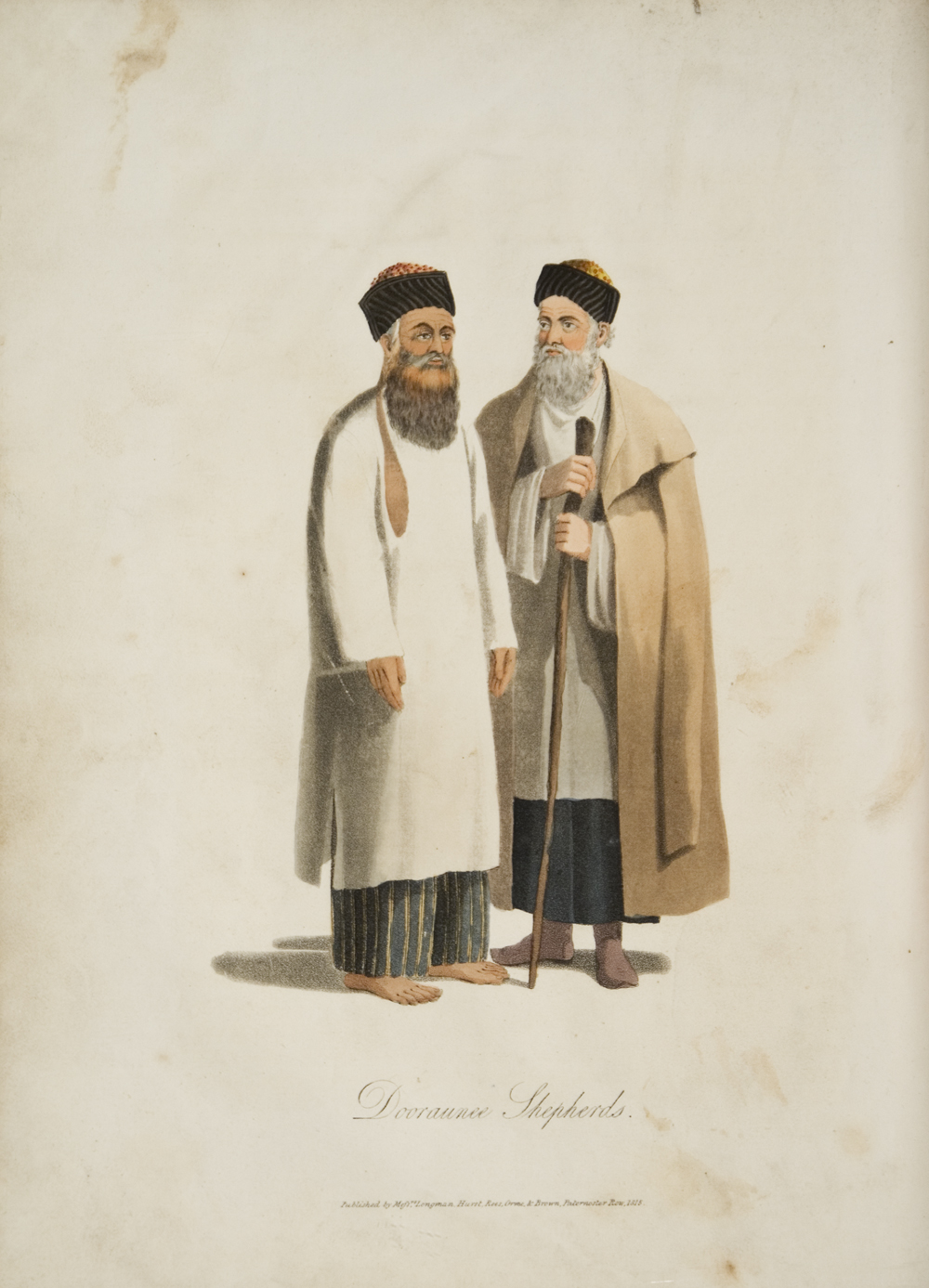 "Dooraunee Shepherds." The man to the left is wearing a kosai. Aquatint, from Mountstuart Elphinstone 1815, Plate II, opp. p. 239.Kuchi men normally wear trousers and a knee-length shirt. These are usually in white. The traditional Kuchi headgear for men is a cap covered with a large, white turban. The outfit is completed with a large, often white blanket that is draped over one or both shoulders (sharay).
An intriguing garment housed in the TRC collection is a so-called Kosai, a felt coat with long, empty sleeves, which was worn by nomads and villagers in southern Afghanistan. This example was acquired by Willem Vogelsang in Uruzgan, southern Afghanistan, in 2009.
Kuchi outfits for women are comparable to those worn by (settled) Pashtun women, but in general the colours tend to be darker. A Kuchi women's outfit traditionally includes a pair of trousers with tightly fitting ankle cuffs, a dress and a head covering of some kind.
Kuchi dresses have long and very wide sleeves, with very full skirts. The front of the bodice, skirt and sleeve hems are decorated with metallic laces that are couched down. Such dresses are also adorned with amulets, pendants, tassels and trinkets.
7. Nuristani traditional dress
The mountainous and ill-accessible province of Nuristan lies east of the capital Kabul. The area was formerly known as Kafiristan ('The Land of Non-believers'), which stretched eastward into present-day Pakistan. The name was changed to Nuristan ('Land of the Light') when the inhabitants were forcibly converted to Islam in the late nineteenth century.
Nuristan is a mountainous region and very cold in the winter, and both factors have influenced the range of clothing worn by both men and women. Nowadays Nuristani men tend to wear Western style garments or the local shalwar kamiz (baggy trousers and tunic). In the past however, many of them were were wearing goatskins, with the (black) fleece on the outside (hence their name as the siah-posh, 'black dress'). Others were wearing white, woollen trousers reaching to just below the knee, and with black leggings that looked like puttees. On top of these garments they wore a long tunic kept in place with a silver studded belt.
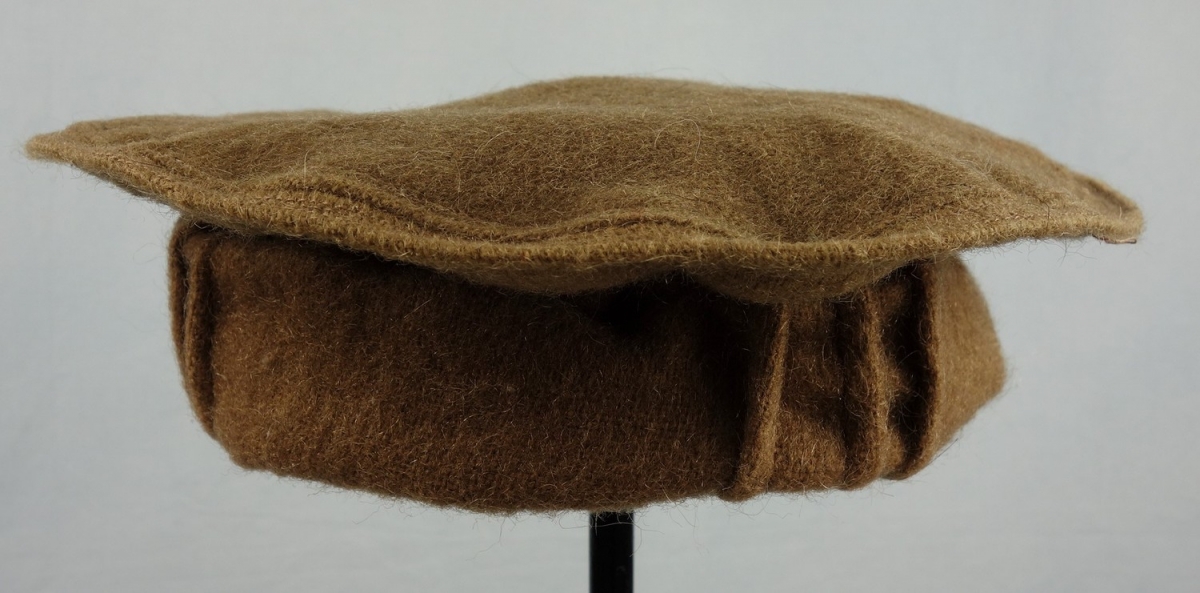
 "A Siah Posh Kafir", from the series of illustrations: “Natives of Dardistan and Kafiristan, Central Asia.” Illustrated London News, 26th September 1874.A distinctive feature of modern Nuristani dress is the pakol, a headcovering often also called a Nuristani or Chitrali cap. The pakol is usually made of fulled woollen cloth and consists of a flat crown with a rolled brim. This cap became very popular with Westerners living in Afghanistan in the 1960s. It was banned by the Taliban regime between 1996 and 2001 because of its perceived relationship to the armed opposition led by Ahmad Shah Massudi in the Panjshir Valley northeast of Kabul, bordering on Nuristan. Nowadays it is widely worn among the Pakistani Taliban, and has also been adopted by Salafist groups elsewhere, as among ISIS (Daesh) in Syria and Iraq.
In the past the pakol has been linked to comparable headwear worn by the soldiers of Alexander the Great, who with his army in fact passed through this area in the late fourth century BC, but this has been shown to be based on apparently romantic Western fantacies; the cap has its origins in similar headwear from the extreme north of modern Pakistan and was only introduced in Kafiristan/Nuristan in the late nineteenth and early twentieth centuries.
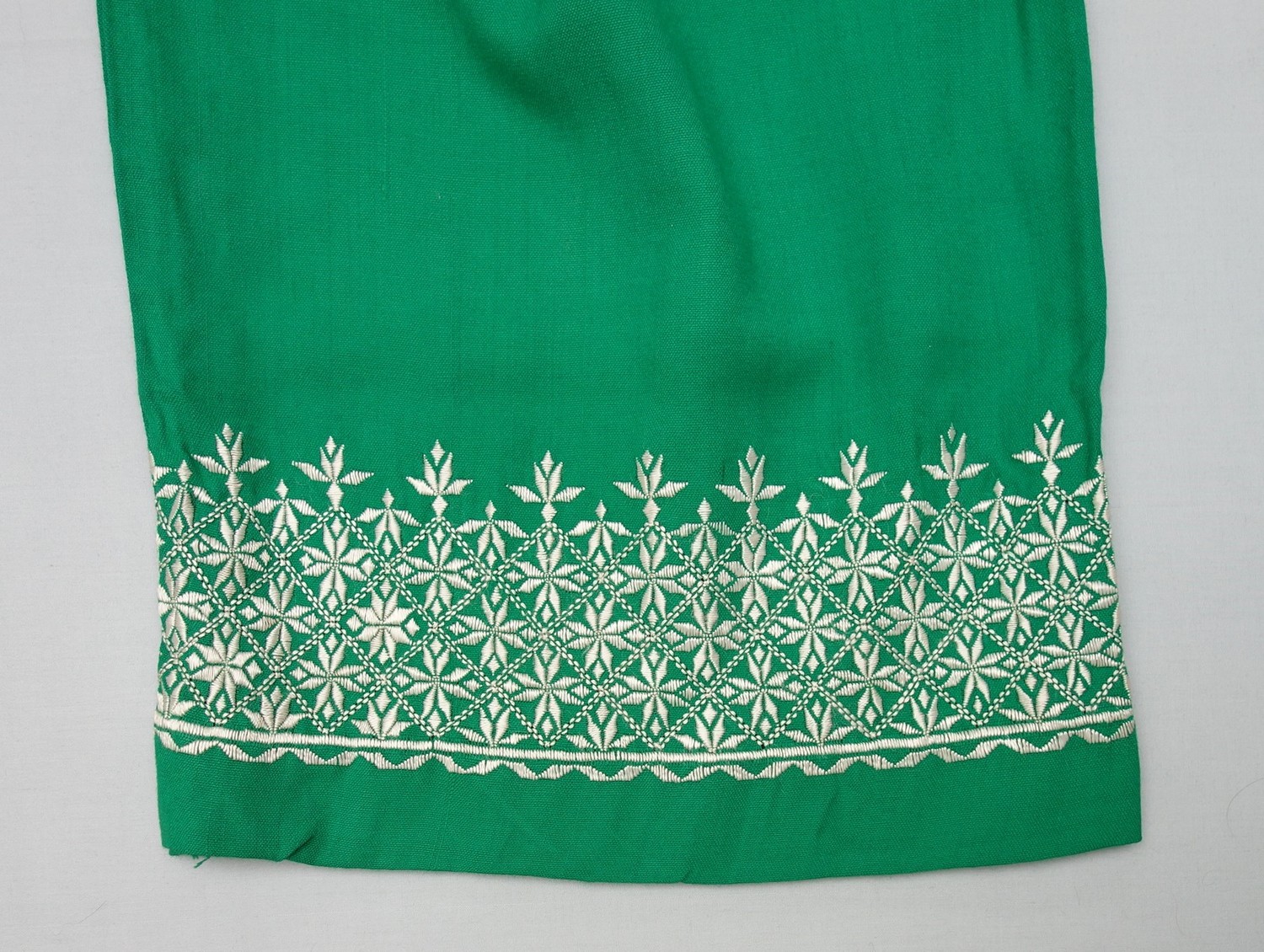 Detail of a Nuristani woman's pair of trousers, Afghanistan, 1970s (TRC 2007.1143a). For more information. click on the illustration.Nuristani women used to wear trousers and a dress with a front neck opening. These dresses were often made out of dark coloured silk or cotton and decorated around the neck opening with metal thread embroidery. Modern Nuristani women’s outfits consist of a waisted dress with a collar (exceptional in the Afghan context), with similarly coloured trousers, often embroidered along the cuffs, and a large chador or chadari.
6. Hazara traditional dress
The Hazaras claim to descend from the Mongol army that occupied the lands of what is now Afghanistan in the thirteenth century. Indeed, the (Persian) language spoken by the Hazaras still contains many Mongolian words. They used to occupy a much larger part of the country, but for centuries they have been pushed back into the mountains of Central Afghanistan (Hazarajat) by the Pashtuns, who gradually replaced them along the foothills of the Hindu Kush mountains.
In the West they became known by the novel The Kite Runner, by Khaled Hossaini (2003). Most of the Hazaras are Shi'ites, which sets them apart from most of the other ethnic groups in Afghanistan, who are Sunnites.
 Group of Hazaras, Afghanistan, 1916/17. From Niedermayer 1924, Abb. 185. The photograph was taken by the German mission sent to Afghanistan during the First World War with the express purpose of inciting the Afghans against the British rulers in India.Hazara dress for men traditionally included a pair of trousers (in the past made of barrak, a woollen fabric for which the Hazaras were famous), a cotton shirt (kamiz; pirahan), a coat or kaftan (often a form of the North Indian choga), and, from the mid-twentieth century, an embroidered skull cap. In the past, Hazara men used to wear a plain cap with a fur rim (see illustration). A belt (kamari) or cloth sash is often wrapped around the waist. The men may wear a turban (lungota) over the cap and a shoulder blanket of cotton (sal), or a soft fulled woollen material (sal-i hazaragi) depending on the season. They may also wear colourful, knitted socks.
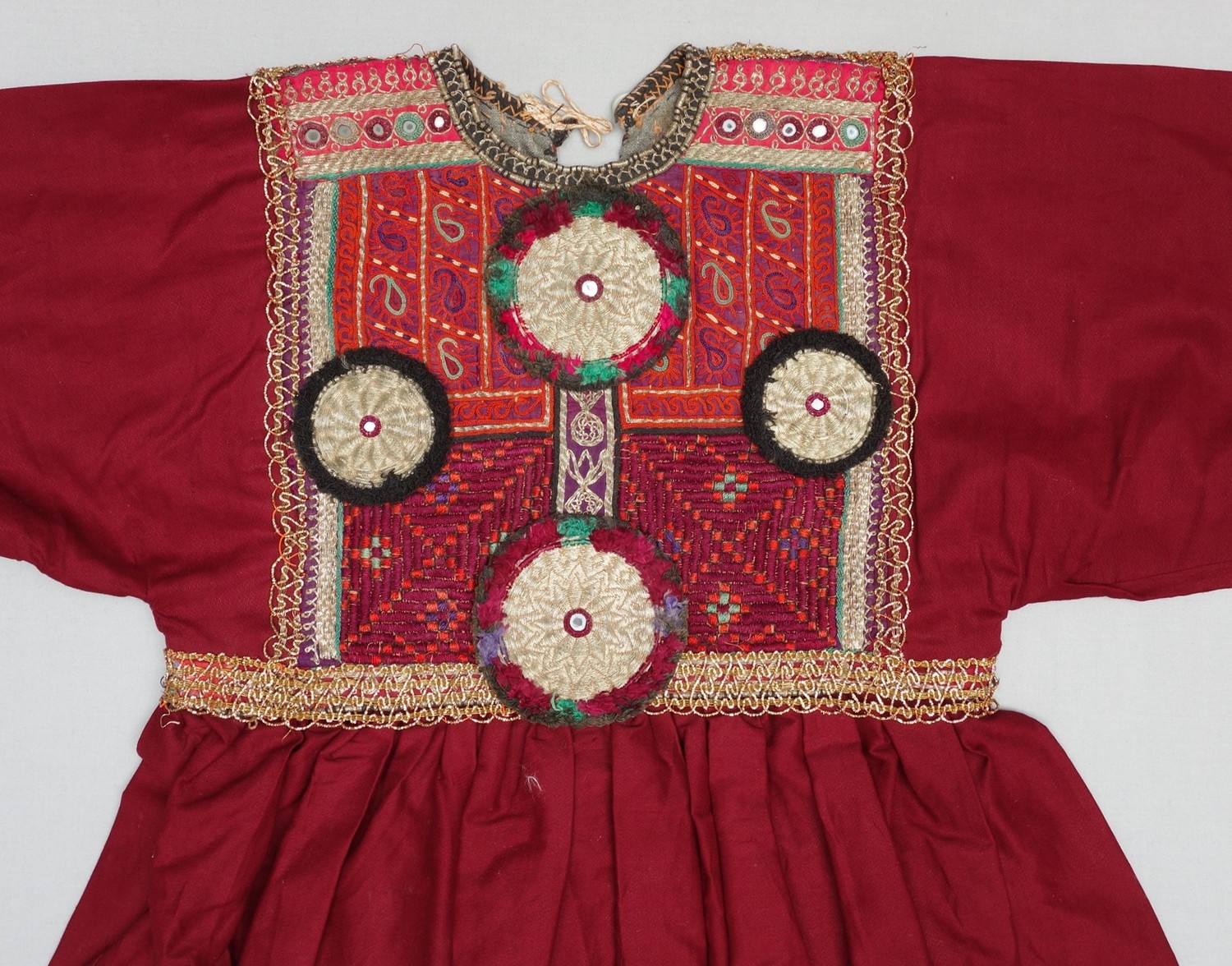 Detail of an Hazara woman's dress, Afghanistan, 1970s (TRC 2005.166). For more information. click on the illustration.
A traditional outfit for an Hazara woman consists of trousers, a calf-length dress with long, full sleeves, very wide at the waist, plus a head covering. Sometimes a waistcoat is worn, which is decorated with buttons, beads, silver coins and seashells. The head cloth is sometimes folded into a thick, flat pad on top of the head, with the ends forming a sort of veil at the back of the neck. In the past, some Hazara women would have covered their face with a ruband (face veil).
Modern Hazara dresses normally have sleeves with narrow cuffs and they end at the knee or halfway along the calves. Festival versions tend to be made out of purple velvet, but other colours (red) are also worn.
5. Baluchi traditional dress
The Baluch live in southern Afghanistan near the borders with Iran and Pakistan. Other Baluch live in Pakistan and Iran, and along the opposite coast of the Persian Gulf (especially in Oman). Traditionally their lands are known as Baluchistan. They settled in this part of the world in the medieval period, having migrated from what is now northwestern Iran.
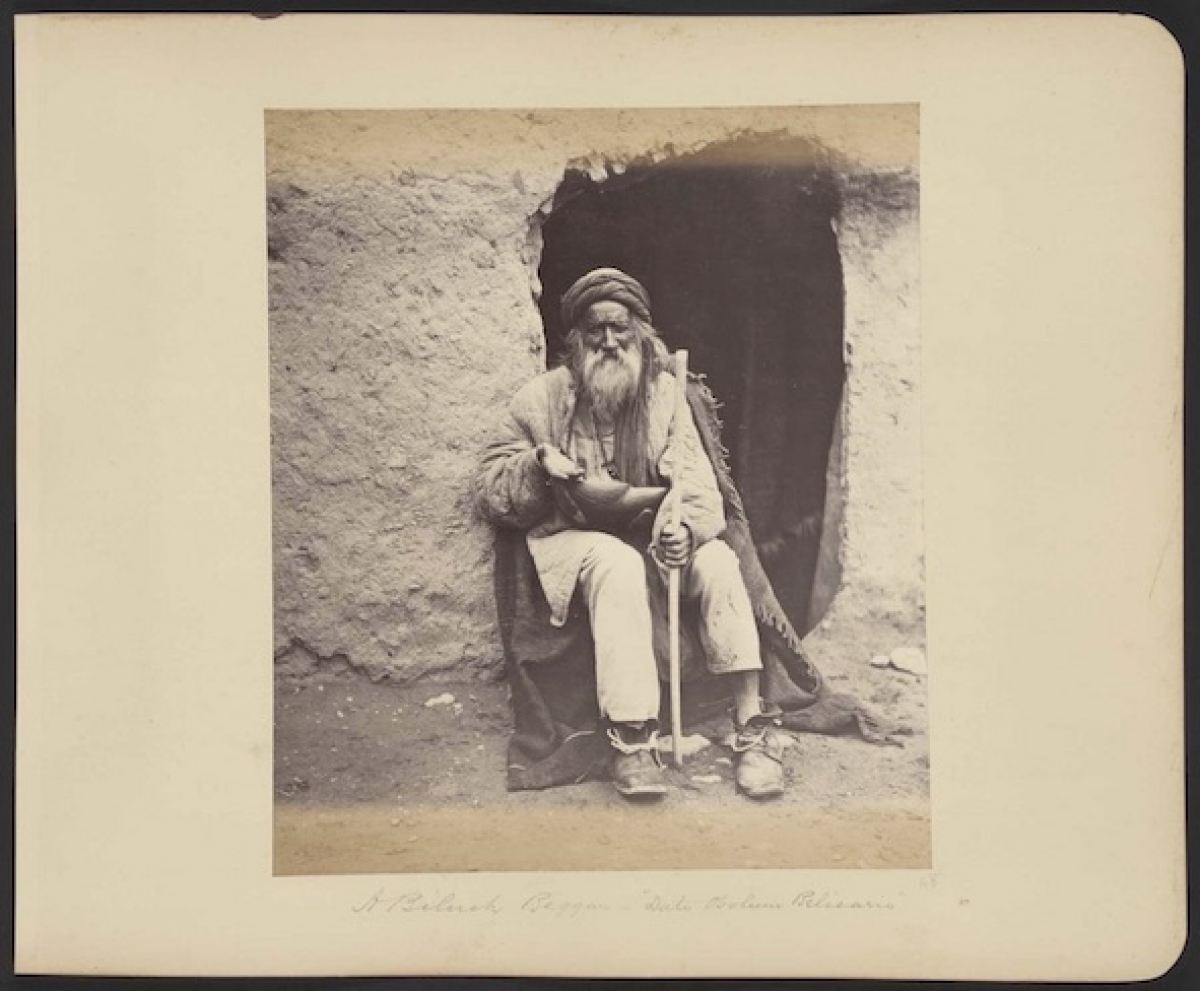
Many Baluch still live a nomadic or semi-nomadic life. In the past, Baluchi men were wearing white or indigo dyed trousers under a long shirt (jama), normally buttoned on the right shoulder. Over this was worn the kurti, a cotton robe of Indian origin, densely pleated at the waist and tied on one side with strings. Nowadays the main outfit for men consists of the shalwar kamiz, well-known from other ethnic groups living in Afghanistan and Pakistan, which is made up of trousers (shalwar) and a long shirt (kamiz) with a front opening. They often also are donned with a large, cotton shoulder scarf (pushti). In colder weather, they may wear an overcoat (qaba), a waistcoat (sadri), and a woollen blanket (sal).
 Detail of a Baluchi woman's dress from Afghanistan, early twenty-first century (TRC 2008.0229). For more information, click on the illustration.The headgear consists of a snugly fitting cap (topi) and a turban (pag; sometimes called a lungi). Baluchi caps are often made of cotton with fine silk or cotton embroidery, in floral or geometric patterns. They sometimes incorporate minute mirrors (shisha). The front of the topi is often shaped, because the Baluch are Sunni Muslims and require their foreheads to touch the ground when praying. Such caps are also worn by the Pashtuns in southern Afghanistan (especially in the Kandahar area). Baluchi turbans are normally wrapped in numerous, large rolls and the final appearance is quite different from the turbans worn by Pashtun men.
Women’s outfits all over the Baluchi world consist of ankle length trousers (shalwar), which are gathered at the waist; an ankle-length, loose fitting dress (paskh), and a large shawl or outer cover (chador). A feature of Baluchi women’s clothing is the embroidery, which once was largely hand worked, but in contemporary times made by machine. This decoration consists of four panels of embroidery, namely a large yoke covering the chest, two panels on the sleeve cuffs, and a large, narrow, rectangular pocket that runs from the waistline to the hem of the dress.
4. Basic forms of traditional dress
In Afghanistan there is a basic outfit for men, women and children. It consists of trousers gathered at the waist, a loose-fitting shirt or dress and some form of head covering. This is an old combination of clothing, which dates back to the early medieval period and the introduction of Islam, if not long before. It is found all over this part of the world and is regarded as an Islamically acceptable form of clothing that covers most of the body.
 Uzbek cap from Afghanistan, late twentieth century (TRC 2016.1799). For more information, click on the illustration.Over the centuries, however, numerous variations on this theme have developed. These differences reflect the ethnic and cultural origins of the wearer. Some garments are familiar to those who watch the Western media. Some garments are ubiquitous such as a skullcap, for example, which can be found among all groups and both genders. However, the shape, size and decoration of the caps signify with which group the wearer is associated. An Uzbeki cap, for instance, worn in the north of the country, looks very different from a Pashtun cap from the southern town of Kandahar. And many Pashtuns from along the borders with Pakistan wear a straw cap.
 Print from Punch, 6th March 1929, illustrating the Western perception of traditional Afghan clothing.Traditionally a wide array of footwear is worn, including pointed slippers (called Oriental, Turkish, Persian or Indian slippers), boots (especially among the Uzbeks in the north of the country), wooden sandals for in the bath house, other and sandals of various forms. Nowadays, rubber sandals are also worn, with soles made from car tyres.
The feet are also protected by socks. Most of them are knitted and very colourful, but there are also forms are worn (produced by a single loop technique), especially among the Tajiks. The knitted examples are comparable to socks worn in Iran. The Afghan socks were popular among the hippie community in the West, and became a symbol of Afghan resistance against the Soviet Union in the 1980's.
Certain garments have a special social significance. The turban, for example, is an important garment for men. Among the Pashtuns and Baluch, for instance, a boy may mark his passage into manhood by being allowed to wear a turban. Similarly, a girl will move from wearing a simple head covering, such as a scarf, into a more complex and larger form once she is of a marriageable age or married.
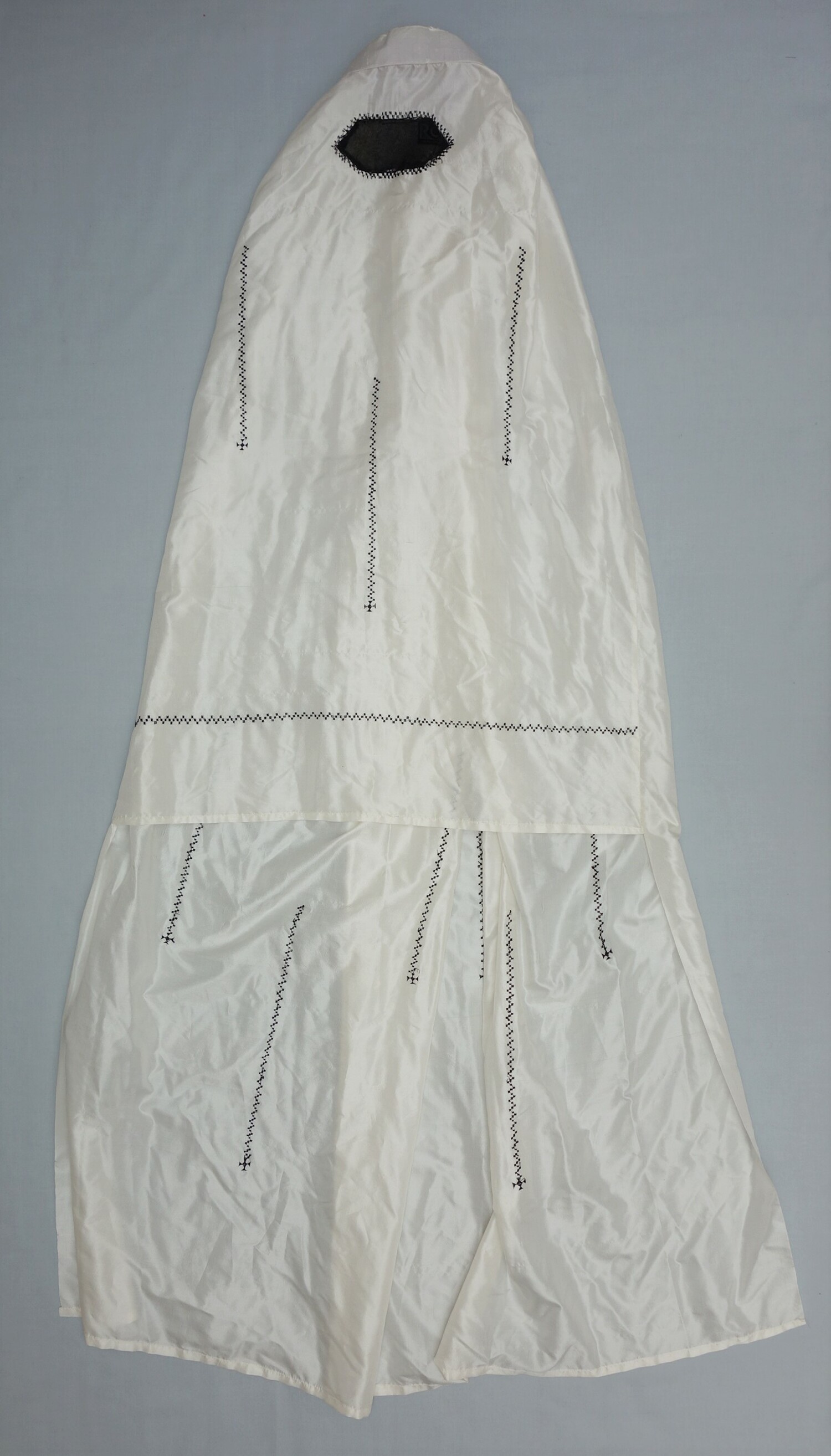 Chadari from Kabul, worn at the first Afghan fashion show in Afghanistan after the fall of the Taliban (TRC 2006.0261).Head coverings are prescribed for all women in Islam, and therefore most women in traditional and rural Afghan communities wear variations of a large or small rectangular headscarf/body covering, commonly called a chador. They are usually made out of fine cotton or a synthetic material.
A variation of the chador is the chadari, in the West commonly known as the Afghan burqa, which is composed of a close-fitting cap from which finely pleated, coloured silk, cotton or rayon falls, completely enveloping the body, with only an openwork embroidered grid over the eyes. Contrary to popular wisdom in the West, chadaris are not worn by all Afghan women, instead this garment is more generally related to urban life.
3. Hamid Karzai's dress and Afghan unification
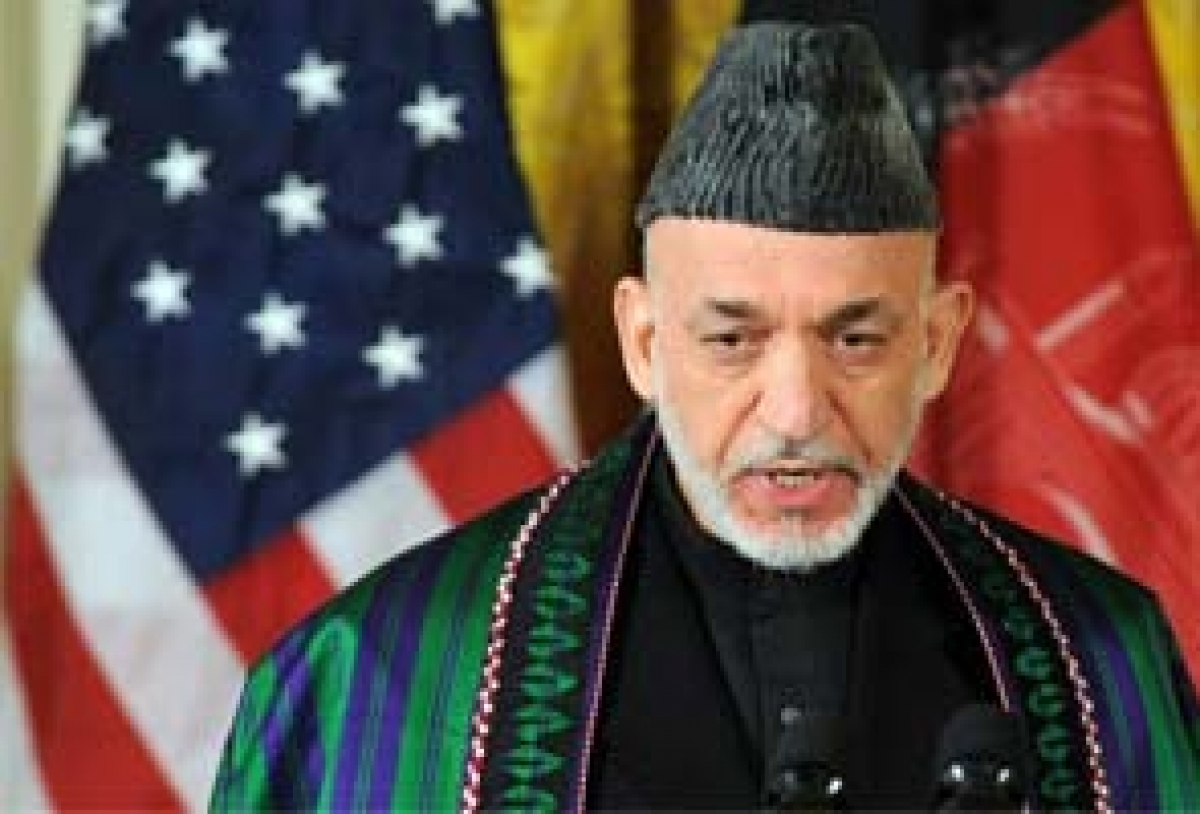
A good example of an attempt to create an Afghan national dress is demonstrated by the former Afghan president, Hamid Karzai.
Himself a Westernised Pashtun, when he accepted the position of President in late 2001, he chose to wear clothing that would make clear that he was president of all the peoples of Afghanistan, rather than a Pashtun leader.
Instead of the normal Pashtun costume, he opted to wear a chapan (a coat with very long sleeves, worn mainly by the Uzbeks in the north of the country). He also likes to wear the karakuli headdress, an astrakhan cap, which is worn all over Afghanistan by the rich and influential people, but is more closely linked with the Turkmen living in the northwest of the country.
 Man's coat (chapan) from northern Afghanistan, second half 20th century (TRC collection 2016.1853). For more information, click the illustration.In 2002, Afghan people were still laughing about this outfit, because it was completely made up and ‘fake’, as it combined garments from various different regions and groups. But as one elderly Pashtun from Kandahar noted: “he may look ridiculous, but the foreigners like it and they therefore bring in the money.” Tom Ford, by then (2001-2002) the creative force of Gucci, labelled him the "chicest [sic] man on the planet today".
2. Afghan peoples
The number of people living in Afghanistan is difficult to calculate, but it is assumed to be around thirty million (2017). Traditionally, they are divided into more than fifty different ethnic groups, the largest among whom are (in alphabetical order) the Baluch, Hazaras, Nuristani, Pashtuns, Tajiks, Turkmens and Uzbeks. But there are many more, and much smaller groups. Most of these entities, large and small, have their own language, culture and way of dress.
Many people, especially in the capital Kabul, tend to wear Western style garments, but overall, in the rest of the country, there is a strong tradition of wearing regional and ethnic clothing. Dress is often an important marker of ethnic identity, and people wear their ‘ethnic’ dress with pride.
 The main ethnic groups in Afghanistan.