
Beyond The Chador Regional Dress From Iran

6. Paisley and European regional textiles and dress
Given the popularity of the motif it is not surprising that it can be found on various forms of European regional dress. It occurs on Russian headcoverings and shawls for the babushka (‘grannies’), and on incidental garments in Scandinavia, Germany and the Netherlands. It is a popular motif among the garments worn by women on the Dutch island of Marken, and occurs in both children’s and women’s garments. Paisley motifs can also be found on some women’s bodices from Staphorst, also in the Netherlands.
Paisley features prominently among the regional dress of the island of Kihnu in Estonia. In particular, it is used for the aprons, jackets and headscarves worn by the women.
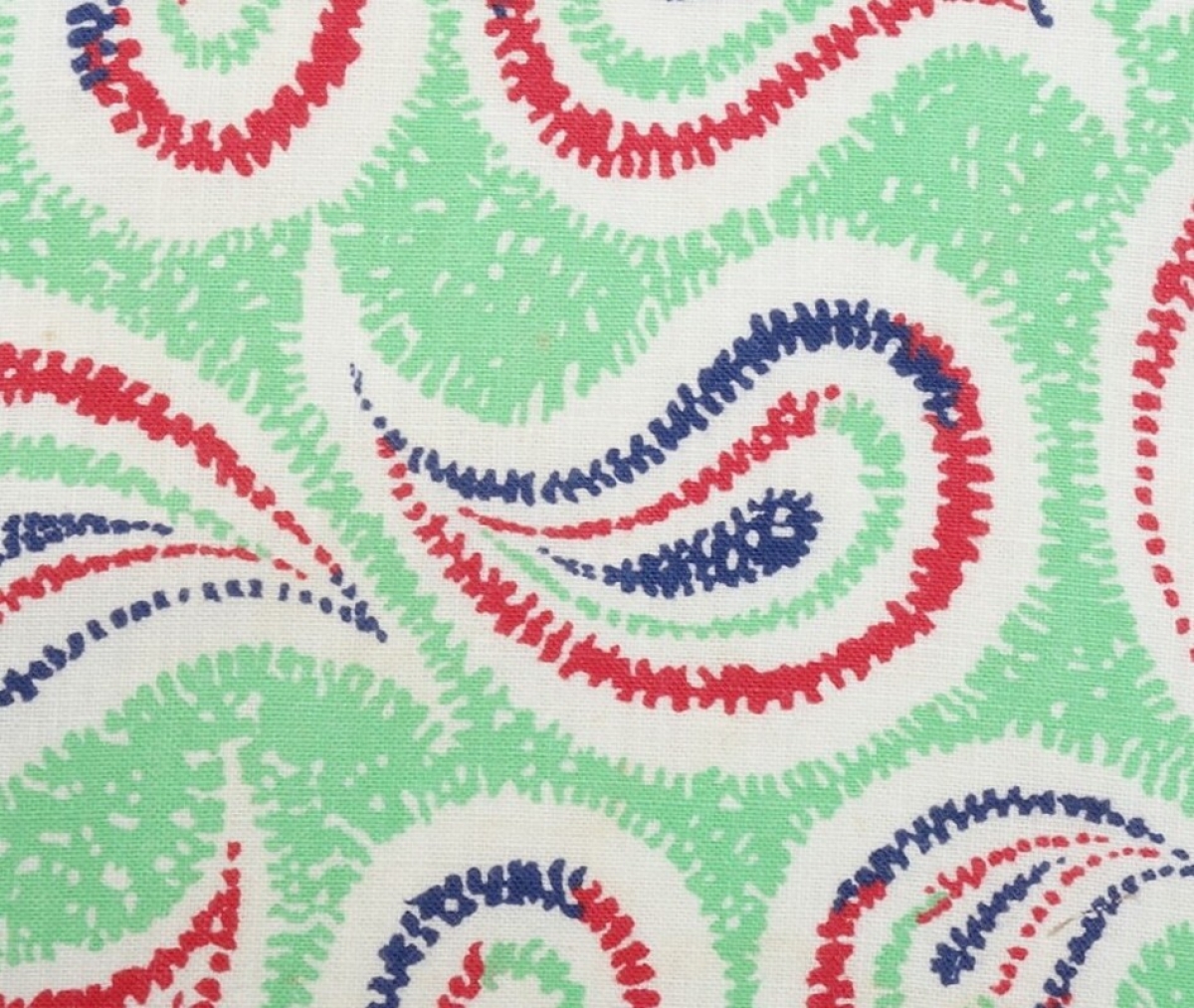
 Printed sample of Indienne cloth from southern France, with paisley motifs, c. 2020 (TRC 2020.3192).Paisley and Indienne
There has been considerable attention over the years for a typical type of Indian cloth generally called chintz (sits in Dutch), its European copies, and the popularity of these textiles in Europe in the 18th and 19th century. There is a specific form of these textiles that is still alive in southern France. It is known as tissu de Provence, tissu Indienne, tissu provençal, cotonnade provençale, or, briefly, simply Indienne. The production of these textiles, which still continues, is based on 17th and 18th century cotton chintz textiles that were initially exported from India to France and then copied in various southern French towns, notably Avignon, Marseille, Mulhouse and Rouen.
The designs used for Indienne have changed over the centuries and may include both Indian based motifs as well as ones that are designed to appeal to local people and tourists. European influence can be seen in the Regency style examples, which use broad bands or ‘ribbons’ in a single colour, alternating with small, sometimes chintz-like motifs. But the buteh is still an often recurring motif in these ‘Indian’ textiles from southern France.
5. Kashmir and paisley shawls
The paisley shawl originates in Kashmir, India, and in particular among the shawls being woven and sometimes also embroidered in the 18th century for the Mughal court of India and related elite groups. In the late-18th century, more and more of these shawls were being exported to Europe. They became very popular at various royal courts. Joséphine de Beauharnais, wife of Napoleon Bonaparte, for example, is said to have owned over 200 of these shawls.
By the beginning of the 19th century Kashmir-style shawls started to be copied on hand and later on mechanical looms, especially the Jacquard loom, in France and Britain. Although in Europe they never managed to mechanically reproduce the striking number of colour combinations of the original Kashmir shawls. One town in particular became noted for the production of ‘Kashmir’ shawls, namely Paisley, which lies just south of Glasgow (Scotland).
From the early 19th century, Paisley was an important producer of shawls for domestic and export purposes. By 1850, for example, there were over 7,000 weavers producing shawls. In addition, special versions of the ‘Kashmir’ shawl were being produced in Paisley and elsewhere in northern Europe that consisted of different pieces of the shawl being woven on machines and then being stitched together.
 Detail of a woven Kashmir-style shawl, produced in Europe, mid-19th century (TRC 2019.2029).The high demand for these fashion accessories/fabrics resulted in other forms of the mass-produced shawls being developed, such as embroidered versions (a development that also occurred in Kashmir) and very cheap examples that were printed. Mass production globally popularized the buteh under the name of ‘paisley’. As a result, for most people in the West, and indeed elsewhere, it has remained the paisley motif.
In addition, the motif began to appear on other garments, such as women’s bodices, jackets and skirts. The popularity of the paisley shawl started to decline in the 1870’s, following a change in fashion (especially the advent of the bustle, which meant that the shawls could not be draped to their best advantage), and at the same time shawls had become too ‘common’.
Dutch worteldoeken
In the 19th century Dutch manufacturers started to produce shawls and other items with a double weave design of flowers, leaves, and of course, paisley motifs. The Dutch version is much thicker than the French and British versions and regarded as much more hard wearing.
There are various suggestions why they are called worteldoek (‘carrot cloth’) - some say it is due to their predominantly orange colour, others that sometimes these cloths were used for carrying and storing root vegetables including carrots, but the most likely explanation is that the paisley motif looks a little like a carrot.
 Renfrewshire Council logo. The town of Paisley lies in Renfrewshire.This type of cloth was not just used as a shawl. They were also used to cover pianos, on mantle pieces, as well as protecting garments against damage from walls by hanging the cloth behind a coat rack.
Renfrew tear drop
The Renfrewshire Council (which includes the town of Paisley) uses a double version of what they called the ‘Paisley tear drop’ as their logo.
4. The world of paisley
The spread of the paisley/buteh motif around the world is closely connected with the vast trade in textiles from India which has been carried out for at least 2,000 years. From India the paisley/buteh motif has spread to countries as far apart as Ghana in West Africa and Japan in East Asia. In the 19th and 20th century, the production of paisley/butehtextiles (mainly woven and printed forms) in Europe, as well as India, was well developed, although by the end of the 20th century much cheaper items from China had taken over much of the market. Yet throughout these centuries the popularity of the paisley motif has not declined. If anything, it has become more diverse and became incorporated into the design heritage of many cultures.
The paisley motif and Southwest Asia
The use of the paisley/buteh motif started in Iran and became very popular in India, so it is not surprising that it remained popular in these and neighbouring countries. There are numerous examples of 19th century Qajar paintings from Iran, for instance, which include depictions of members of the various royal courts wearing garments with the paisley motif. In addition, household items such as prayer mats, wall hangings and towels, were often decorated with the buteh.
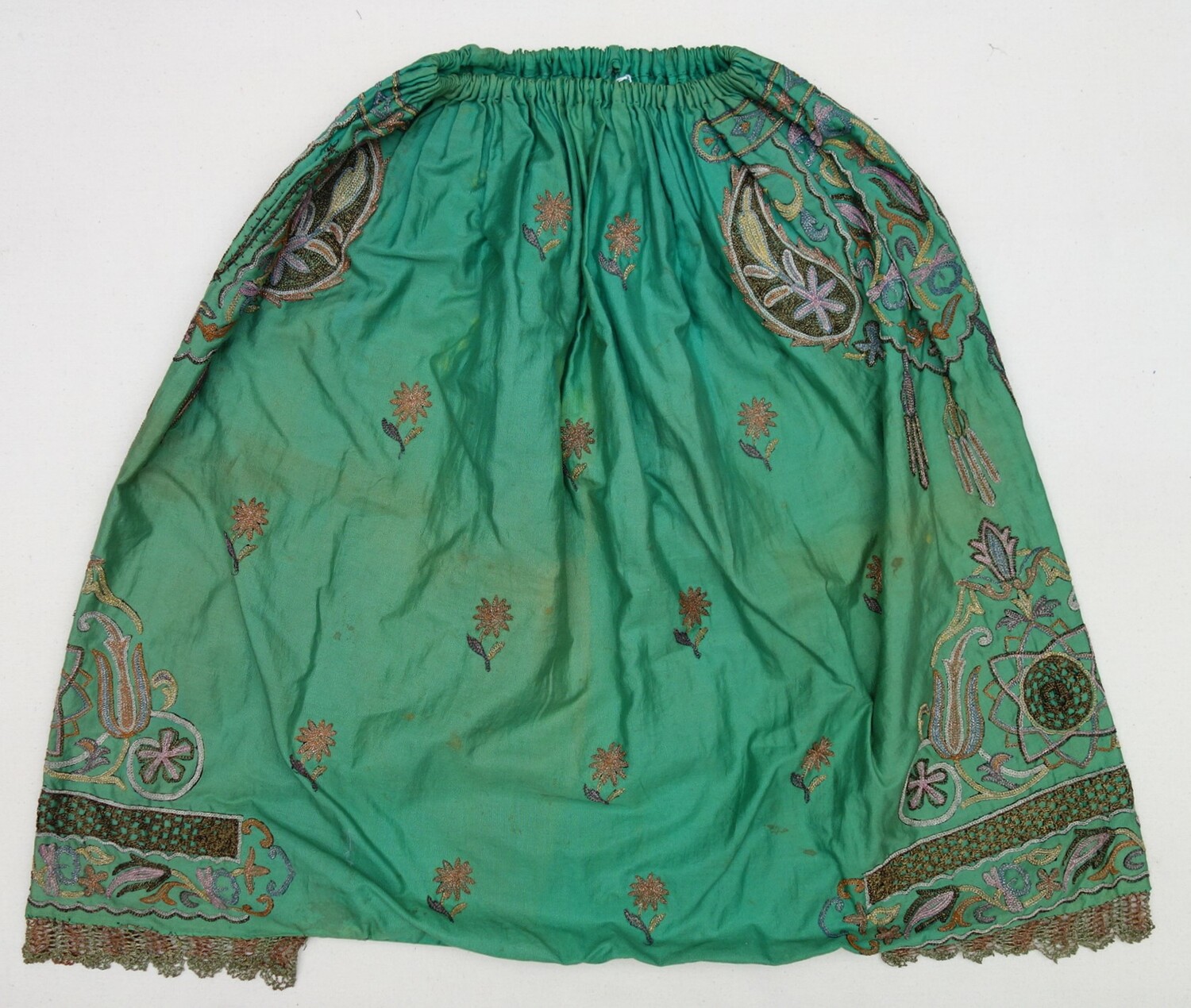 Pair of man's trousers from eastern Turkey, early 20th century, with paisley motifs (TRC 2005.0351a).By the end of the 20th century, buteh remained a popular motif and was used for both urban and regional clothing. It was used among urban, village and nomadic groups for both men and women’s clothing, including headwear and a variety of shawls and head coverings.
The paisley/buteh motif could also be found in Afghanistan and Central Asia and again it was popular for both men and women’s clothing. In particular it was used for headwear and items such as jackets and coats.
The paisley motif and Southeast Asia
The paisley motif appears to have arrived in East and Southeast Asia by at least the 19th century and came mainly via Indian textiles. It has remained a feature of various East and Southeast Asian countries, notably Japan and Indonesia. For some reason, while known in countries such as China, Malaysia and Thailand, it was not as popular as elsewhere.
 Pair of Japanese socks with paisley motifs, c. 2020 (TRC 2020.3933a-b).Japan
The paisley motif has been popular in Japan for at least 200 years. It is known as the skoukyumoyo or pinecone pattern. It appears to have been introduced by European and Indian merchants, especially those dealing in textiles and garments. It is regarded by the Japanese as being a typically British, or Scottish pattern. The paisley motif is now used for a variety of garments, including the kimono and obi (sash). In some cases, the motifs are small and discreet, on other occasions they may be large and loud.
Indonesia
For several hundred years, the paisley/buteh motif has been a popular form in Indonesia, especially in Java. It can be found mainly on batiks and takes on ornate forms. In Indonesia the buteh has become very popular among the Indian community. With the recent resurgence of Islam, wearing the buteh motif declined as it was seen as a Hindu motif, although, ironically, it originally derived from Iran, a Muslim country.
The paisley motif, Turkey and the Middle East
The paisley motif can be found in both Turkey and the Middle East. In particular, it was popular in Turkey during the 19th century and later, and it has survived in various parts of the country as part of regional dress, notably as decoration on headscarves and the resist-dyed aprons in eastern Anatolia.
In contrast to many other regions, the motif does not appear to have been so popular in the Arab Middle East. This may be due to a preference for geometric, rather than ‘organic’ designs. The paisley motif does occur, but it tends to be mainly in areas where there has been a strong European influence, such as in Algeria, Egypt and Lebanon, which had access to imported European materials, ribbons and bands.
 Wrap-around cloth (kanga) from Tanzania, 1960's, with paisley motifs (TRC 2014.0929).
The paisley motif and Africa
The paisley motif can be found on a variety of African objects, including the wrap-around garments for women known as kanga in East Africa, as well as on printed women’s headwear in West Africa. Many of these pieces used to be made in Europe and western India for the local markets, but more and more are being made in China. Sometimes these textiles have a mixed Chinese/African feel to the designs! As a result, sometimes the paisley motif can take on a more Chinese yin-yang design.
3. History of the paisley motif
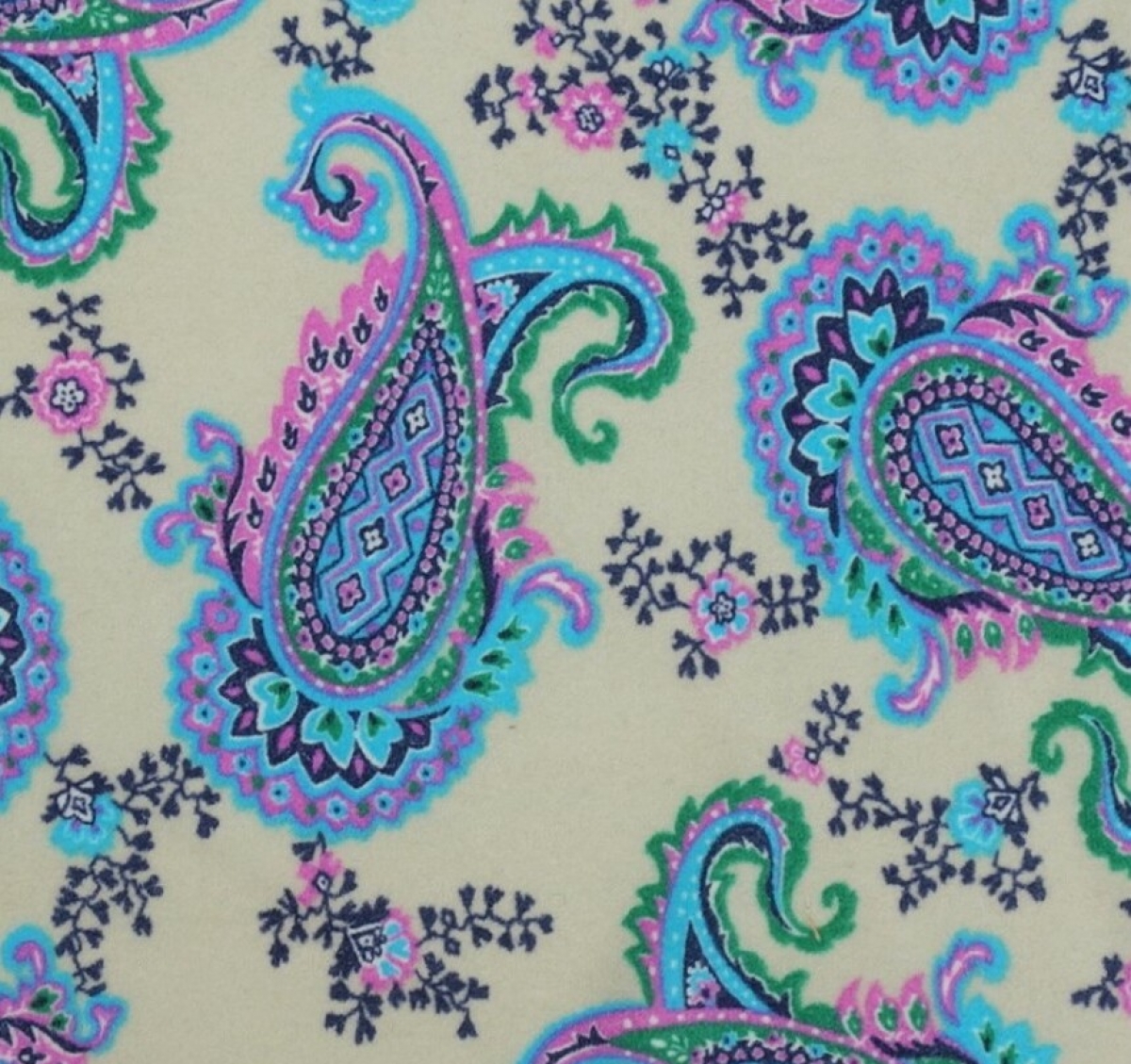
There are various theories about the early history of the paisley/buteh motif. It would appear that it originated in Iran during the early first millennium AD. At this date it was a bulbous, almond shaped form, which was often flowery, and more significantly, without a very prominent hook (right). In general, the motif was placed as an isolated bush, as flowers or sprigs, on a plain ground. This motif is specifically known as a buteh.
This form of the motif was used during the Sassanian period (224-651 AD) in architecture, on tiles, as well as on silk textiles. By the 9th century the motif can be found in various parts of the Iranian plateau, including Afghanistan, notably among the reliefs (left) in the Noh-Gumbad (Masjid-i Haji Piyadah) mosque in Balkh, in northern Afghanistan.
By the late Safavid period (1501-1736) the motif had evolved in Iran from the floral form into its more recognisable (modern) shape with a hook. This version of the buteh spread widely throughout the Iranian plateau and elsewhere. Technically the hooked variation of the motif is known as the kalga or kalga buteh, but nowadays it is generally simply called by the same term as the earlier version, namely the buteh.
 19th century bathwrap from Iran, with blockprinted decoration of paisley motifs (TRC 1999.0263).The end of the 17th century also saw the hooked buteh becoming a popular motif in Mughal India (c. 1526-1857), which maintained close cultural links with Iran. It was used especially on the fine woollen shawls that were hand woven in Kashmir in northern India. By the late 18th century the archetypal curved point at the top of an elliptical outline was being used on this type of shawl and other textiles.
At the same time, the motif travelled from India to Europe and especially Britain, as well as eastwards to Indonesia. And in doing so it became a global motif. In the late eighteenth century, the buteh/ kalga became even more popular as it was featured on the hand woven and sometimes also embroidered Kashmir shawls that were being exported in vast quantities to Europe and there copied on an industrial scale for the growing demand for this product.
2. But what is paisley?
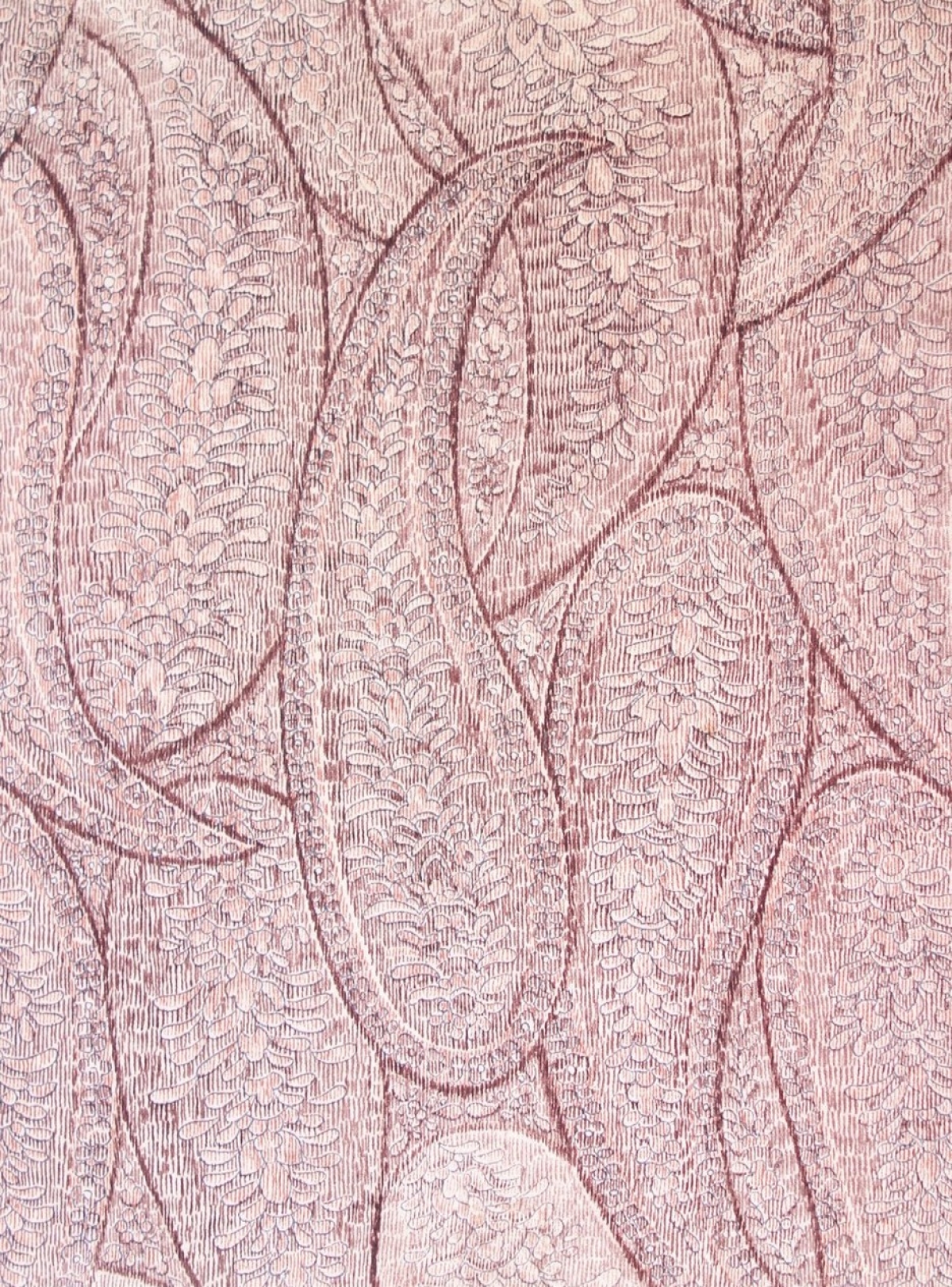
The paisley motif is a curved, tear-shaped design, which has become a classic form used in many countries throughout the world. It has been described, for example, as a ‘particular form of floral design in which blossoms are contained within a cone shape’.
The origins of the motif are generally thought to lie in Iran, where it is known as the buteh (Farsi: flower bud, sprig, bunch of leaves), from where it would have been introduced in India and became particularly associated with Kashmir shawls.
The same motif, different names
The motif goes by many names, including buteh (with variations such as buta), mangga (Indonesia), or skoukyumoyo (‘pinecone’; Japan), but it is more widely known in the West by the name of paisley. This name derives from the Scottish town of Paisley (near Glasgow), where factory woven imitations of Kashmir shawls decorated with buteh were produced for much of the 19th century.
Iran: buteh
Afghanistan: Bota
India: In various Indian and related languages the word for this pattern refers to the word for the mango fruit:
- Bengali: kalka
- Hindi/Urdu: carrey, keril (‘flower’, ‘unripe mango’)
- Marathi: koyari (‘mango seed’)
- Punjabi: ambi (‘of the mango’)
- Tamil: mankolam (‘mango’)
- Telugu: mamidi pinde (‘young mango’)
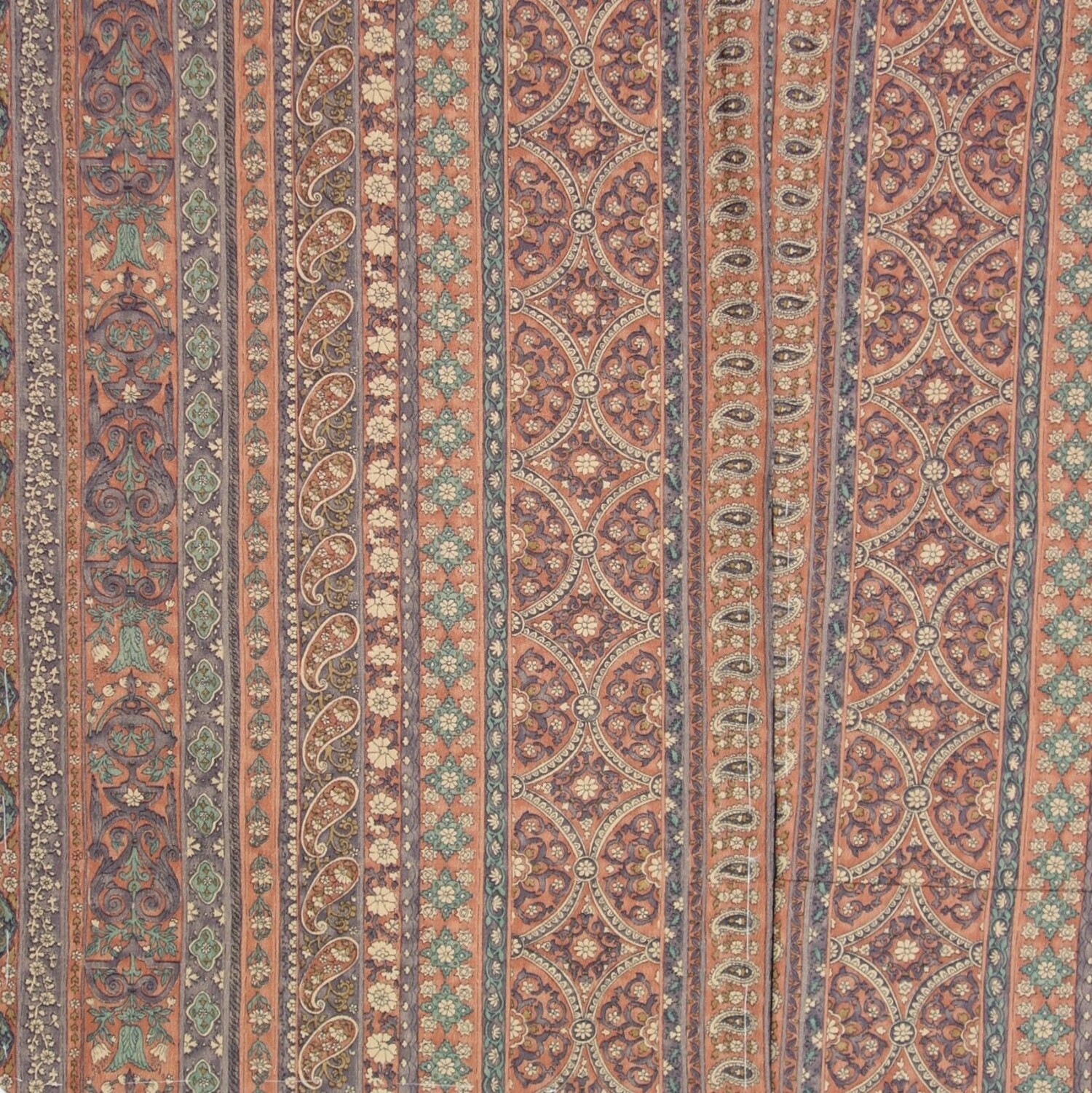 Detail of a late 20th century kimono from japan with paisley motifs (TRC 2021.0062).East and southeast Asia
- Han Chinese: huǒtuǐwén (‘ham hock’)
- Indonesia: buteh (with variations such as buta), mangga
- Japan: skoukyumoyo (‘pinecone’), magatama, or simply paisley
Western languages
- American quilters: ‘Persian pickle’
- France: boteh, cachemire, palme
- Italian: paisley, motivo cachemire
- Netherlands: 'paisley,' or 'buteh'
- Russian: огурцы (cucumber, or sometimes ‘Turkish cucumber’)
- Spain: estampado Bulgaro
- Welsh quilters: 'Welsh pear'
1. Introduction
We all know the motif, that cone-shaped curvy form which is so pleasant to look at and feels so peaceful. The eye is taken from the side to the top and down again, all with a feeling of balance. It is so well-known that it is generally accepted as just being one of those patterns that have always been there.
But does anyone ever think about its origins, and why it is so popular all over the world? If they do, they would soon find out that there is more to this ‘simple’ motif than meets the eye.
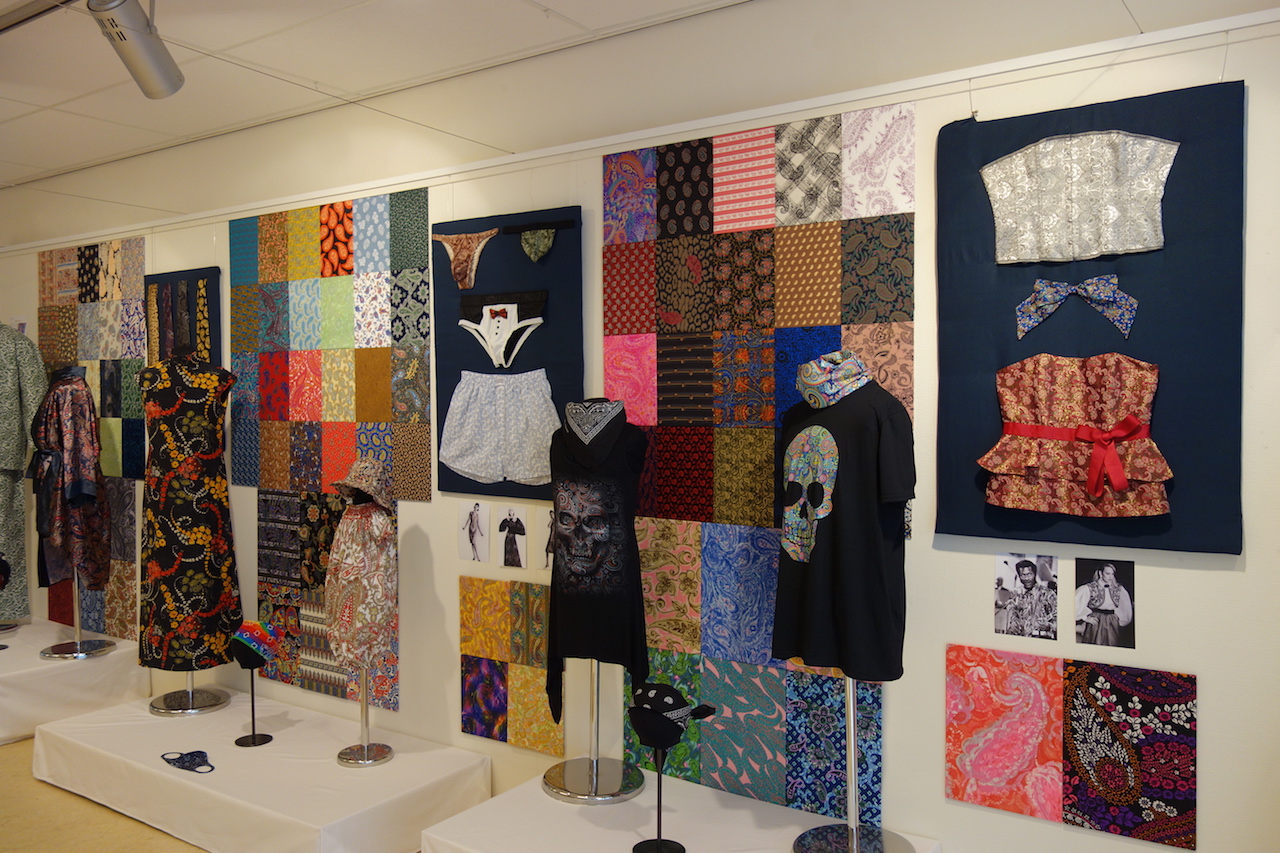
This TRC Leiden exhibition explores the history of the paisley motif, its ancient origins and its development to the present day. It also looks at how it is currently used for a wide variety of textiles and garments all over the globe.
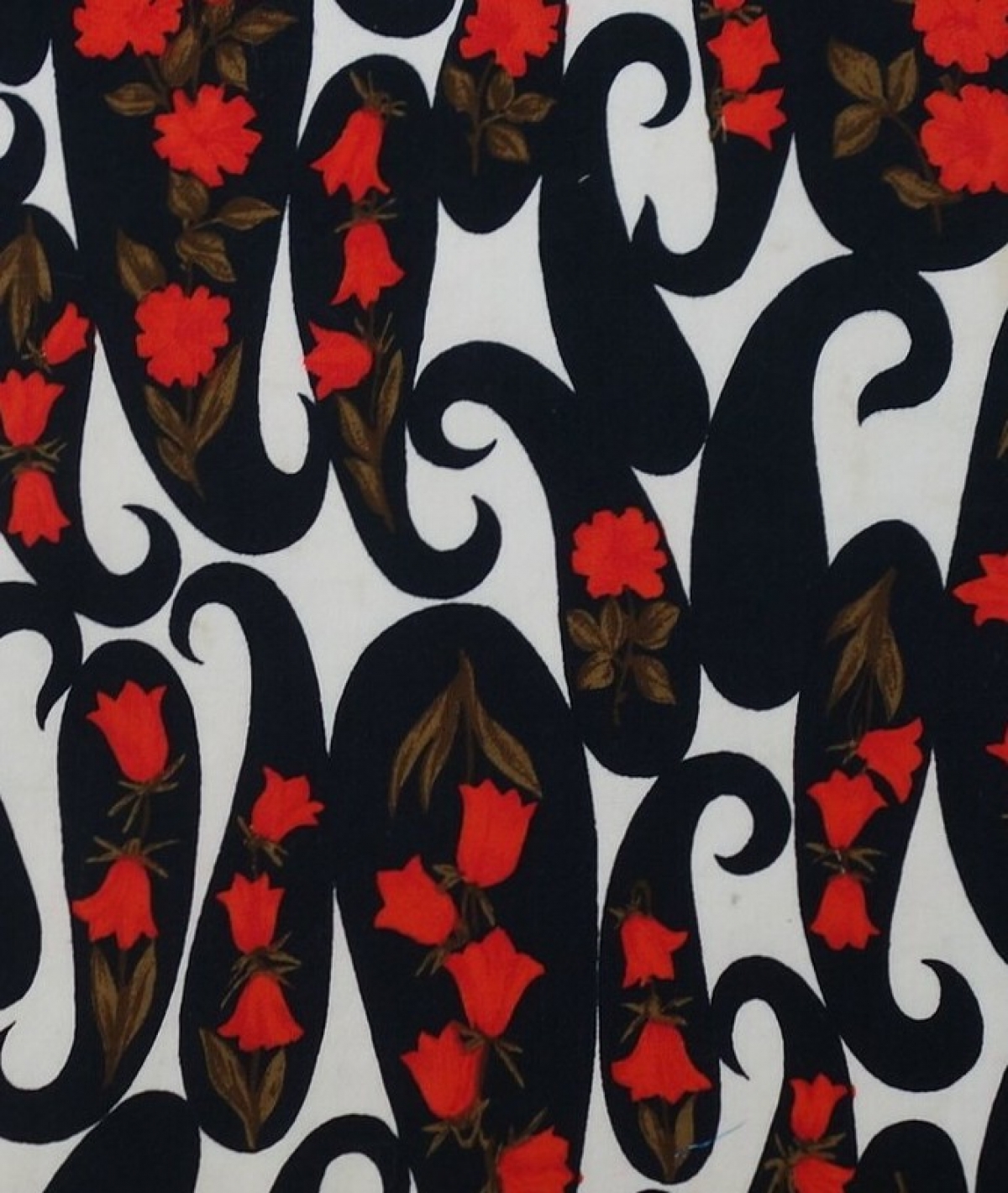
The paisley motif is actually one of the few non-geometric design forms that can be found throughout the world. It is worn on the garments of men, women and children of all ages, literally from the cradle to the grave. Moreover, it is worn by people of many different ethnic and cultural backgrounds. It is also one of the very few motifs that are used to decorate clothes, ranging from underwear (male and female), through stockings, ties and blouses, to skirts, trousers, bikinis and beach hats.
 Woman's T-shirt with depiction of a skull filled with paisley motifs. Produced in Bangladesh for British market, 2020 (TRC 2020.4204).The motif can also be found on the attire worn by a Hell’s Angels biker, a Los Angeles gang member, a steampunk goth, a respectable London banker, or a granny who is knitting socks for the grandchildren, all without any comments being made.
Some say the motif was inspired by the poplar tree, others that it was the cypress tree, or perhaps the ‘bent’ cedar. Others have suggested that it derives from an almond or perhaps a cashew nut. It is also regarded by some people as representing life and eternity, while others describe it as a symbol of strength with modesty.
In India the paisley motif is often said to be derived from a mango (genus Mangifera), because of the similarity in shape. Mangos are regarded as a symbol of fertility and fecundity in various Indian, as well as East African cultures.
And, of course, for many people the motif has no meaning whatsoever, only that it is a favourite form that can be worn by anyone whenever and wherever they want.

0. Cover page
The present online exhibition is based on an onsite event that was opened in March 2021 in the gallery of the Textile Research Centre, Leiden, the Netherlands. Because of the corona pandemic, few people could at first enjoy the actual exhibition. We hope that this online display with accompanying texts will give a good impression of the range, versatility and uses of the buteh/paisley motif.
For this online exhibition:
- Author: Gillian Vogelsang-Eastwood
- Research: Erika Riccobon
- Web-design: Joost Koopman
- Online exhibition design: Willem Vogelsang
- Publisher: TRC Leiden.
- Year of publication: 2021.
Copyright: All illustrations of objects housed in the TRC collection and included in the current online exhibition can be used free of charge for non-commercial purposes (please go to the TRC catalogue for high-resolution images), but please add to the caption: "Courtesy Textile Research Centre, Leiden" and the pertinent accession number of the object. For commercial purposes, contact the TRC (This email address is being protected from spambots. You need JavaScript enabled to view it.).
Acknowledgements: The exhibition has been set up with the assistance of an enthusiastic group of MA students of Leiden University and other volunteers, including Augusta de Gunzbourg, Tchi Ridley, Kaja Sobczyk, and Joshua Verkerk. In addition, help was given by Els Bonte and Merle Ernits. Many thanks!
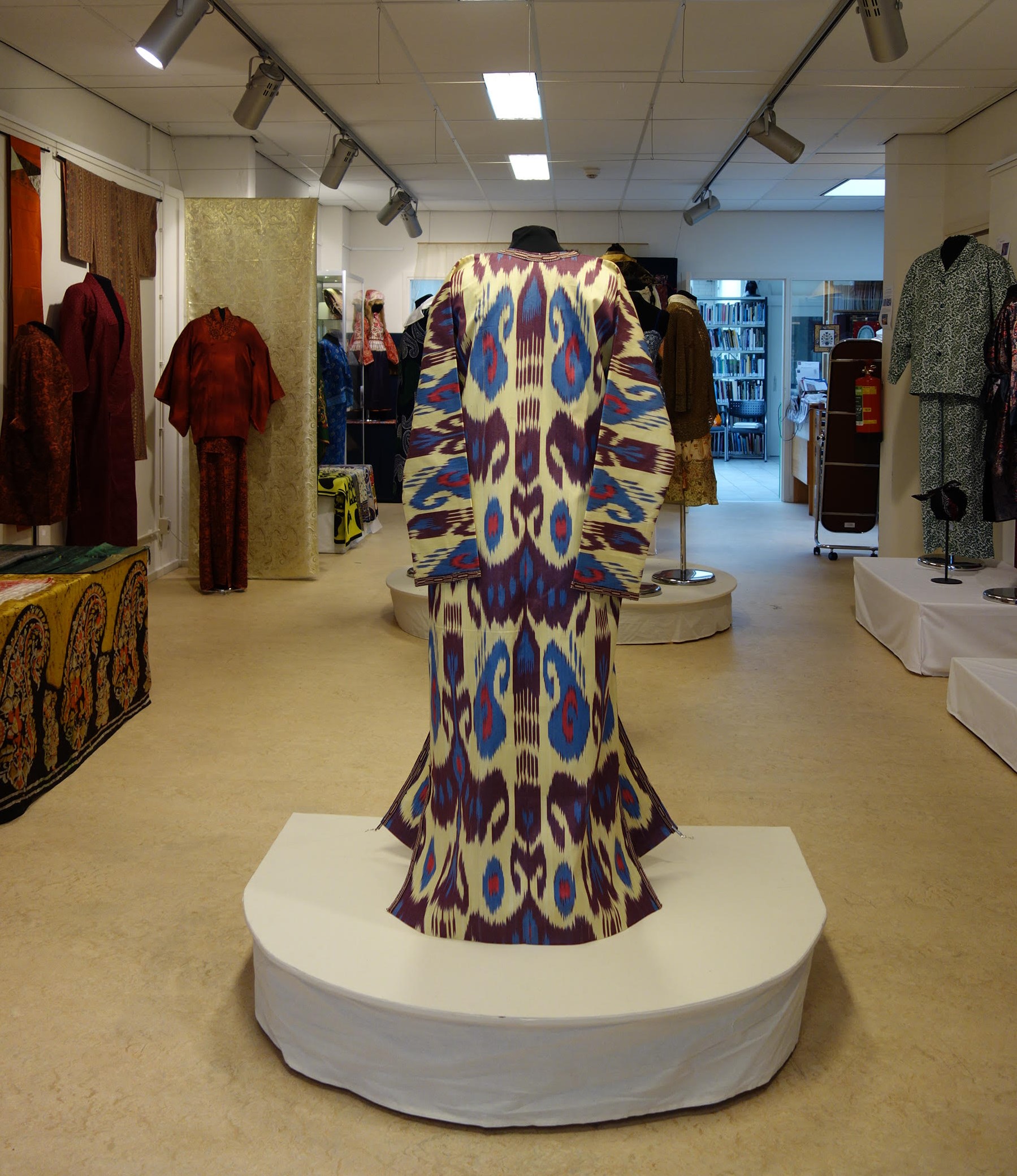
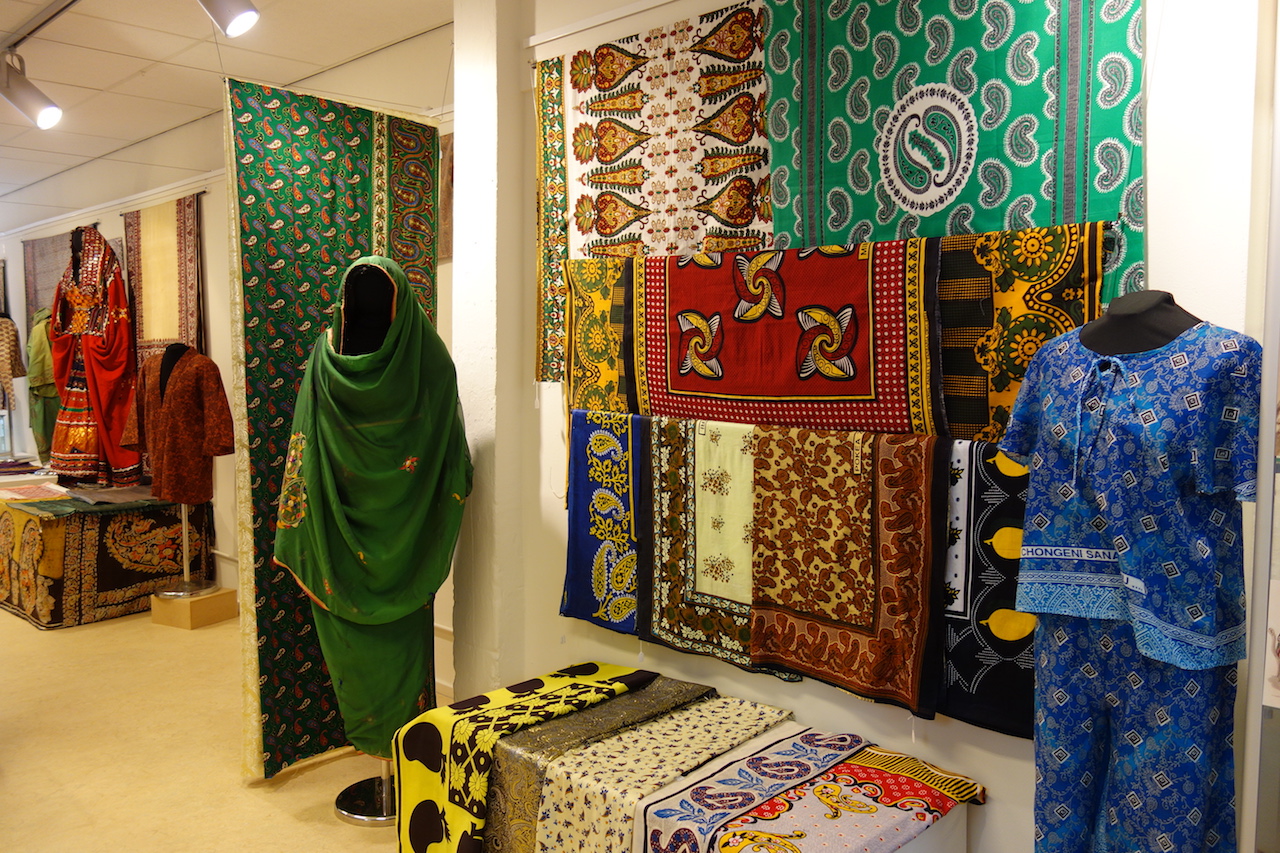
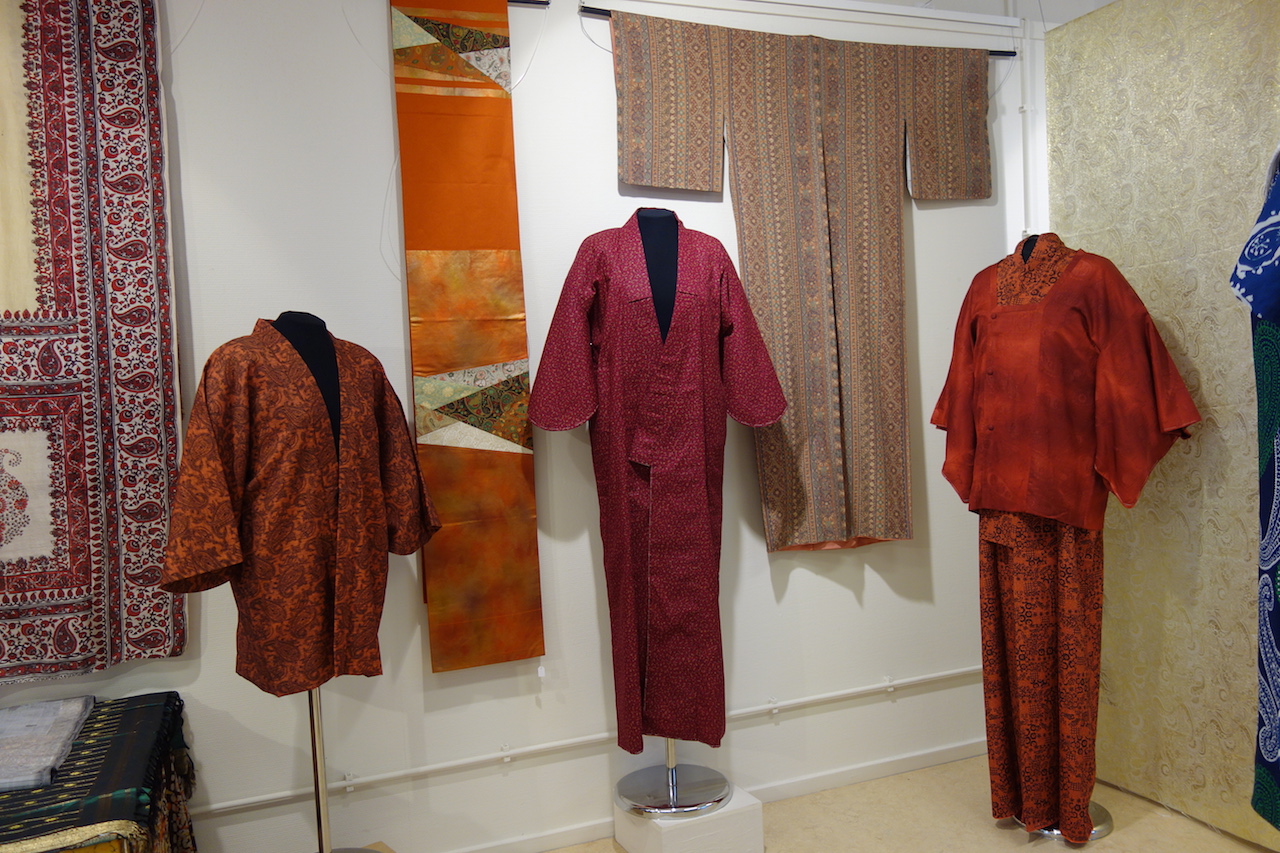
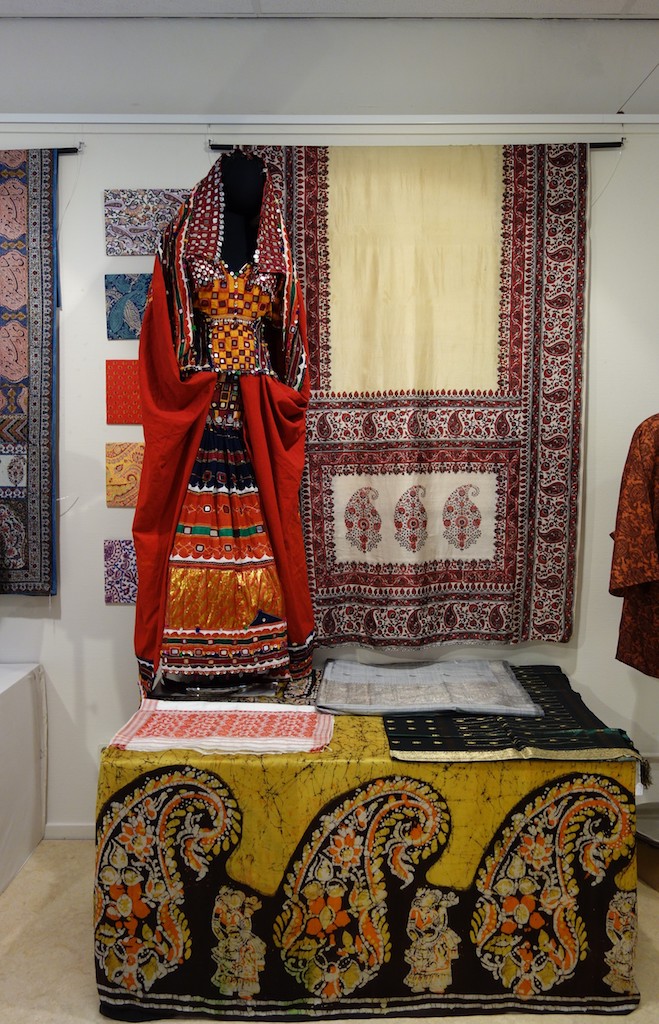
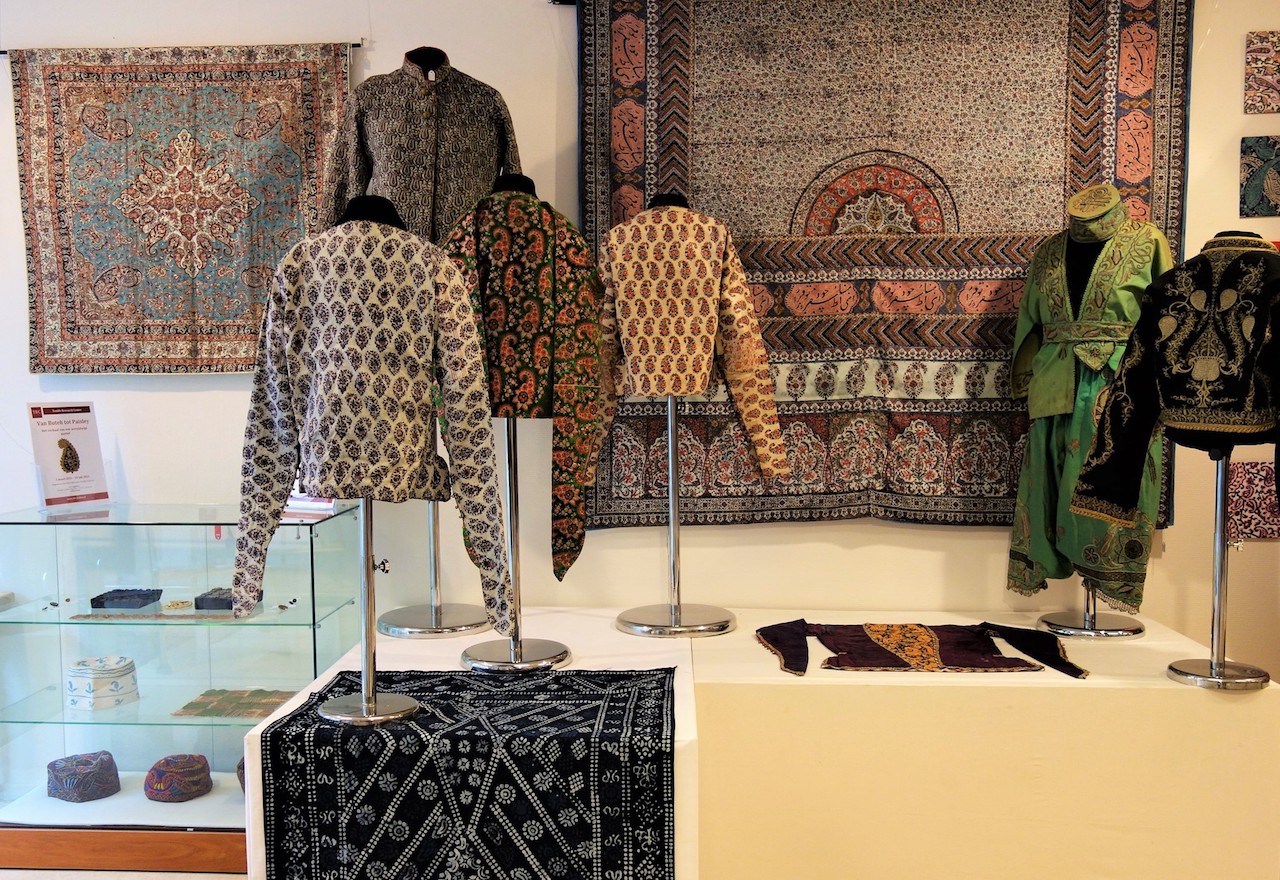
Below: Photographs of the gallery exhibition at the Textile Research Centre, Leiden, the Netherlands, March-August 2021. These photographs were taken by Augusta de Gunzbourg.
9. Northeastern Iran
Eastern Kurdish dress
In the area of Khorasan, in the northeast of Iran, around the towns of Bojnurd and Quchan, are various Kurdish groups. The history of these people is not clear, but it would appear that their ancestors were forced to migrate from the west to the eastern regions of the country, sometime in the late seventeenth or early eighteenth century. By the end of the twentieth century it was believed that there were about 17,000 nomadic Kurds in the region and an unknown number who were semi-nomadic
In the 1960s, the typical male costume included trousers of calico or other cotton, which were constructed with a gusset. This was worn with a shirt of red or white silk, without a collar and with either a front opening or a slit on the shoulder, fastened with buttons and loops. Over it was worn a jacket (panjak) or, for wealthier men, an ankle length over coat (kot) made of brown or black lamb’s wool with a wide collar and an opening in front. The headgear included a tasselled black cap, around which a shawl was wrapped, or an expensive type of hat made from lambskin. By the end of the twentieth century most of these garments had virtually vanished and men, especially the younger ones, were wearing a mixture of Iranian and Kurdish style garments or pan-Iranian style clothing, with trousers, belt and shirt.
The basic female outfit of the Eastern Kurds consists of a plain cloth tunic (shalita), with long sleeves, the front of which is decorated with zigzag patterns. In addition, some women will also wear a waistcoat. Under the tunic is worn a knee-length skirt, which may be made from up to ten metres of cloth. A variety of materials are used for the skirt (tomban), depending upon age, status and clan. For instance, an unmarried girl from the Topkanlu tribe wears a velvet skirt decorated with seven colours, while an older woman would wear a plain, red skirt. Among the Sifkanlu tribe, however, an unmarried girl will not wear velvet at all, but cotton decorated with flowers. Nowadays, white socks or stockings are often worn with the skirts.
The headdress consists of three elements: a cloth (bonhani) directly covering the hair; a white shawl (charqad) consisting of a piece of unsewn cloth, and a kerchief, which is worn on top of the head over the charqad. All married women normally veil their mouths by pulling part of the white charqad across the lower part of their face.
Kazakh dress
Small groups of Kazakhs live in northeastern Iran especially around the cities of Bojnurd and Gurgan. The Kazakhs are said to be related to the people from Kazakhstan in Central Asia, but their style of dress is quite different from that found there and has more in common with the traditional dress of people from southeastern Russia. Their origin thus remains a moot point, and their ancestors may be linked to the Kozaks from southern Russia. The basic outfit for a woman consists of a pair of baggy trousers, a white, embroidered dress and a white headdress with matching embroidery. By the end of the twentieth century this style of outfit was usually reserved for special occasions, such as weddings,
Turkmen dress
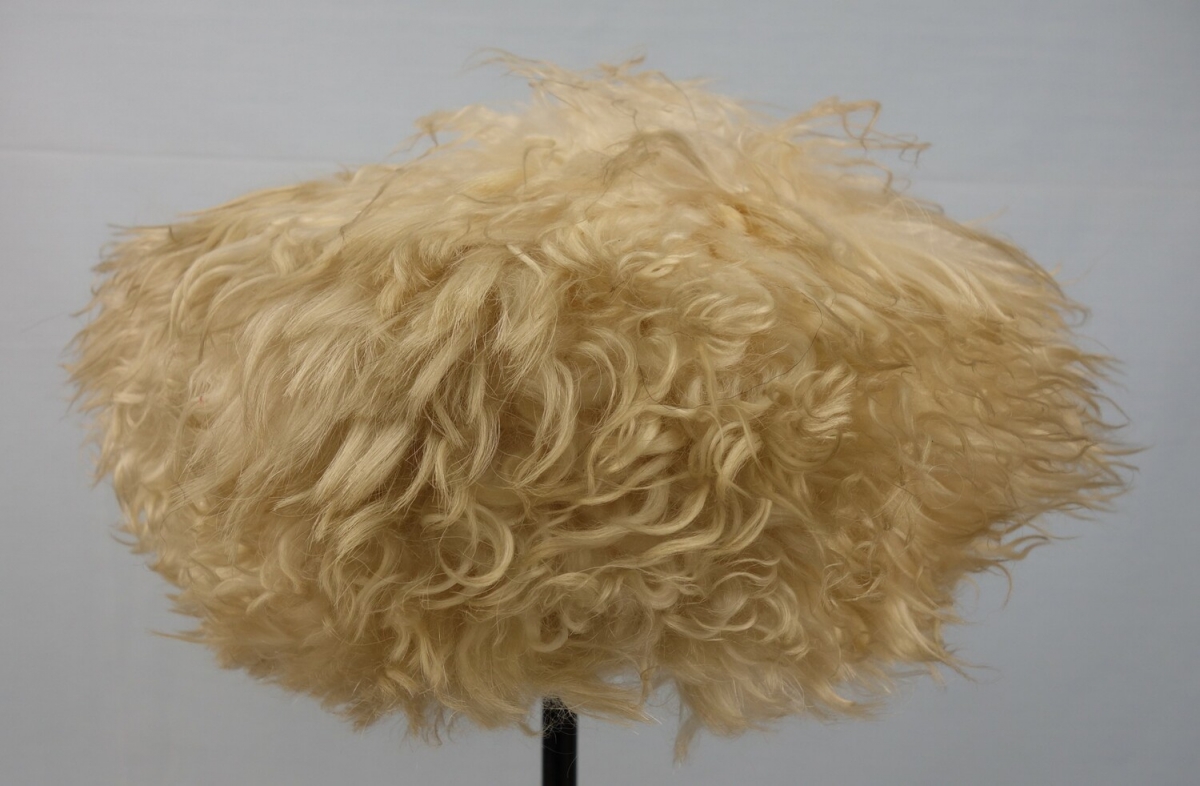
The Turkmen form a separate ethnic group living in northeastern Iran, northwestern Afghanistan, and in the modern republic of Turkmenistan. They are Sunnites, and speak their own, Turkmen language. Traditionally they are divided into many tribes, and there used to be a considerable difference between the dress worn by male Turkmen from the various groups living in Iran. This difference, however, is virtually gone, as major changes have taken place in men's clothing since the mid-twentieth century. The daily outfit for most men is based on the pan-Iranian style of dress. On special occasions, however, a more traditional form of clothing is adopted. This consists of a shirt with the front opening coming from the right shoulder, a long robe or gown (don), and a small, embroidered skullcap (bark). The cap may be covered by a neat turban, which is made out of a square of cloth, folded diagonally and then wrapped around the head. Another form of headgear associated with the Turkmen is the telpek. This is a large, fluffy cap made from black or white sheepskin. It would appear that it is now mainly worn on special occasions.
The basic dress of a Turkmen woman consists of under trousers (balaq), a dress (koinak), and a headdress of some kind. In addition, some groups have a face veil (yasmak), a sash (shal qusaq, bil qusak), an indoor coat of some kind (chabit or kurti), and for outdoor wear, a second coat (chirpi), which is often worn over the head. Some Turkmen women wear a broad, cloth sash around their indoor coats in order to keep the garments from opening, especially while they are working.
Various forms of headdress are used by married Turkmen women, depending upon which group they belong to and whether it is a daily or more formal occasion; for the latter they tend to wear an elaborate headdress decorated with various scarves, while on a daily bases the head covering is much simpler. At the end of the twentieth century, for example, a Yomut Turkmen woman's headdress tended to be based upon a headring (aldarij, alan dangi) covered by a large shawl (yagliq or chargat), which was folded diagonally in half and then draped over the head and upper body of the wearer. In contrast, Turkmen Tekke and Goklan women often wear a headdress which is c. 20 cm high and made up of a cloth (qiniach uchi, yasmak) wrapped around a framework. The framework may be made out of a variety of materials, such as rushes, twisted cloth, leather, felt, or cardboard. Sometimes the cloth is used as a veil to cover the lower part of the face.
One of the main features of the dress of a Turkmen woman used to be her jewellery, as it played an important role, namely that of 'life insurance' giving financial security. The jewellery included diadems (ildirgich); tiaras (igme); temple pendants (adamlik); earrings; necklaces and collars (boquw); collar studs (gol yaqe, guliaqa); armbands and bracelets (bizilik); and finger rings. These are usually worn en masse and can weigh a considerable amount; a young bride, for instance, may wear up to seven kg in silver jewellery during her wedding festivities. By the end of the twentieth century, however, smaller quantities of more expensive, gold jewellery were rapidly replacing the older, silver forms.
8. Southeastern Iran
The Baluchis
The Baluchis constitute the main ethnic group of southeastern Iran. Their habitat, generally called Baluchistan, stretches across the border with Pakistan a far as the Indus river. Many Baluchis live further north, in the south of modern Afghanistan. The Baluchis speak their own, Iranian language. They are Sunnites, as opposed to the mainly Shi'ite population of Iran. Most Baluchi men wear the kamiz or long shirt, worn with simple, drawstring trousers (pajamak). Other elements of the male dress include a long scarf or shoulder wrap (pushtin), a close fitting skullcap (sopi) over which is wrapped a turban (pag). In addition, during colder weather other garments are added, including a waistcoat (sadri) and an overcoat (kaba). Occasionally a woollen blanket or shawl (shal) is worn. The typical Baluchi skullcap (sopi), over which the turban is tightly wrapped, is usually made of cotton with fine silk or cotton embroidery in floral or geometrical designs and incorporating small, round mirrors.
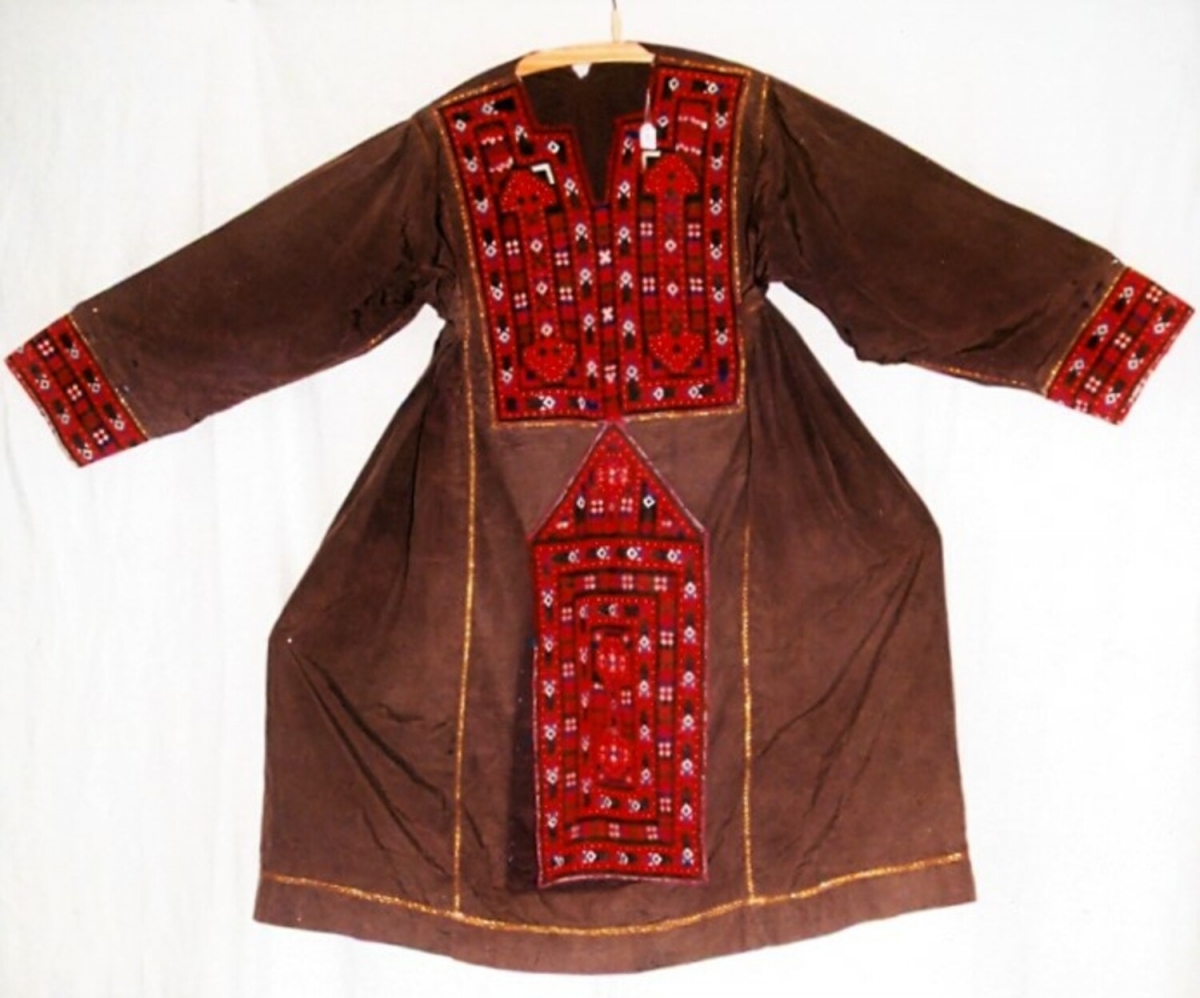
The basic elements of a Baluch woman’s dress include of a pair of baggy trousers. The older trousers of striped silk fabric are called kanavez, while the modern trousers, which match the dress, are called shalvar. Other dress elements are a knee-length dress (pashk) with pleats (chin) at either side of the waist, and finally, a large, rectangular shawl or head covering (sarig). Nowadays, the trousers and the dress are made in the same material, with a complementary coloured head covering. Traditionally, the dresses are decorated with four specific panels of embroidery (duch). These panels are a large yoke covering the chest (jig), a long, narrow rectangular pocket (pado, pandohl) and two sleeve cuffs (banzari). These used to be hand stitched, with each group having their own form of patterning. Nowadays, however, machine embroidered decoration is much more common. Sometimes, embroidered panels from worn-out dresses are cut off and re-sewn onto new garments.

7. The southern plains and the Persian Gulf
The range and styles of dress in the southern regions of Iran vary quite considerably. As with other parts of Iran over the last century, considerable changes took place in the style of local dress traditions. Many men and women are now wearing pan-Iranian style clothing and want to be associated with this form of dress, which is regarded as modern. As a result, in some regions regional dress has vanished and is regarded as an anachronism. Nevertheless, in other areas, such as in and around the port of Bandar Abbas and the nearby village of Minab, there is still a strong sense of local identity and the wearing of ‘Bandar’ dress is still prevalent.
Arab dress from Khuzistan Province
There are many Arab groups living in southwestern Iran, the largest of which lives close to the Iraqi border. Over the centuries, there have been numerous migrations of Arabs from the other side of Tigris River and the Gulf region in general. In addition, trade has brought other Arabs to the region.
Unlike Arabs living further to the west, Iranian Arab men tend to wear under trousers (šalvār), rather than a hip wrap (lungi). The summer version of these trousers is made from thin cotton, while the winter versions are made from thicker, knitted garments. Over this is worn a gown (dishdasha). The summer version is made from a light weight cotton, while the winter form, again, is of a much heavier material. The basic headcovering consists of a square of cloth folded diagonally and draped over the head. The Iranian Arabs do not wear a headrope (`aqal), so commonly found elsewhere among Arab communities. One of the most distinctive items of Arabic dress is the so-called cloak or aba. Two forms are worn here, namely a light summer version made from loosely woven cotton, and a heavier winter version made out of camel hair (best quality) or wool. As a generalisation, the wearing of an aba is generally regarded as something older men do, especially in the winter time.
The basic outfit of an Arab woman consists of under trousers (shalvar), a long dress (libas); a loose overdress (sob); a head covering (shelaq/shila) and an outer covering (abaya). The most characteristic element is the sob or over dress, which is worn over the normal dress. A basic sob is made from a large rectangle of cloth with a hole cut out for the head. The sides of the garment are sewn together, with holes left for the arms. The Iranian sob is virtually identical in construction to the tob worn by women in the eastern parts of the Arabian Peninsula. The basic headgear or shelaq is made up of a large rectangle of cloth, which is wrapped around the head, covering the neck and hair. Various forms of cloth are used, but most tend to be made from a light-weight cotton. Younger women tend to wear a light colour shelaq, while older women normally wear black versions. Finally, on top of the indoor garments, Arab women often wear a cloak-like garment called an abaya when out-of-doors. In Iran, these garments are worn over the head in the Iraqi manner, rather than on the shoulders as is common in, for example, Saudi Arabia.
Bandar dress from the Province of Hormozgan
The people living along the Iranian shores of the Persian Gulf are often loosely known as Bandaris, from the Persian/Arabic word ‘bandar’ for port or harbour. The Bandaris tend to be of Arab, African, Baluchi, Indian, Iranian or even European descent. Bandar garments are sometimes closely related to dress styles from parts of the west coast of the Arabian Peninsula. This is not really so surprising, as the Ras-al-Jibal promontory of Oman is only 85 km across the Persian Gulf. There have always been very close trading links between India, Iran and Oman for centuries.
Men’s dress from Bandar
The traditional male dress in the Bandar region is very similar to Baluch style clothing, from further inland, and consists of a shirt (juma) that reaches below the knee and is fastened with buttons on the right side of the neck. The shirt is worn over loosely cut trousers (shalvar). On the head is worn a small white or coloured cap (kulah) and over this is wrapped a length of cloth (lang, languta) which is about two metres long. Older men tend to use white (ratrah) or striped cloth, while younger men use coloured material.
Women's dress from Bandar
The Bandar region is famous for the embroidered trousers (shalvar) worn by the women. The trouser cuffs used to be decorated with hand embroidery, and the design used to reflect the locality where the wearer came from, but nowadays most women wear whatever design they prefer.
The basic garment worn over the trousers is a dress (kondura). The older style dresses are made in coloured cotton, which are either waisted (gavan style) or cut full (dara'a). The head covering is normally made up of a rectangular (c. 70 x 100 cm) scarf of thin black material (makna). Over all these garments, women generally wear a large, semi-circular chador, which is made from a very light weight cotton.
Perhaps one of the most widely known aspects of Bandar dress are the various types of face coverings. The type of face veil worn by a Bandar woman depends in the main on three factors, namely (a) her religious background (Sunni or Shi`ite), (b) her ethnic origins, and (c) where she lives. Many Shi`ite women in the Bandar region, for example, wear bright red, rectangular masks of the battulah construction that only covers the part of the face around the eyes, locally known as a burqa`, and decorated with various patterns. Originally these were hand worked, but nowadays most are decorated using machine embroidery. The colour and designs provide information as to which ethnic group the wearer derives from. Sunni women of Arab origin in the Bandar region sometimes wear a type of battulah. The main form of battulah that they use is squarish and rather long in shape. It is made out of black cotton or black velvet, or cotton cloth smeared with indigo and then polished until it adopts a golden hue. This golden coloured type of (Sunni) veil is similar to that worn in parts of Qatar, on the other side of the Persian Gulf.
Some Sunni women in the Bandar region wear a black niqab style face veil. They are usually in a loosely woven, black cotton material. They are made from two layers of material with a small slit for the eyes. These veils are very similar in form and size to the more pan-Islamic niqab.
Lamerd
The town and district of Lamerd lies in Fars province, not far to the north of the Persian Gulf. Because of the nearby natural gas resources recently discovered, it is now at the centre of attention and economic development. However, it used to be just a small village near the southern port city of Bushire. Consequently, local clothing shows influences both from the Bandar region along the Persdian Gulf in the south, and from the nomads in the north. Women’s clothing includes the black (Sunni) headscarf worn by the Bandar women and Arabs, while the colourful dress with long slits on both sides is similar to that worn by the women of the nomadic tribes. The very distinctive garment of the Lamerd area is their long skirt with special decoration on the lower part.