
Beyond The Chador Regional Dress From Iran
5. The southwestern mountains of Iran
There are three main ethnic groups living in western and southwestern Iran, namely the Bakhtiyaris, Luris and the Qashqai. The first two groups are closely related, both with respect to their Iranian language and their culture. This link can also be seen in their clothing, especially that of the women. The main difference in their appearance lies in the style of their headgear. The Qashqai are a Turkish group and wear their own distinctive dress.
Bakhtiyari dress
The Bakhtiyaris form a conglomeration of various groups, of some 600,000 people, living in the valleys of the central Zagros in western Iran. As with the other nomadic tribes, dramatic changes took place in the garments worn by the Bakhtiyaris during the twentieth century. Some of these changes were the result of deliberate national policies during the reign of Reza Shah (r. 1925-1941). The reason for other changes, however, are not so obvious. Women's modern 'traditional' clothing, for instance, has little in common with the garments worn at the end of the nineteenth century. There has been a dramatic change in the cut of the garments, the garment combinations, as well as in the range of colours used. All of these differences reflect changes in the social and economic life of the wearers, but the reasons behind these changes remain a moot point.
A distinctive part of Bakhtiyari male dress are the trousers (dabit), which are black and cut very wide (120 cm around the leg). They are usually worn over long under trousers. The trousers are held in place by a leather belt or a large sash or rolled white cloth (sal). Bakhtiyari men are famous for their piano-striped jackets called chuqa, which are made out of natural and indigo dyed wool. Each tribe has its own design, making the identification of a person from a distance much easier.
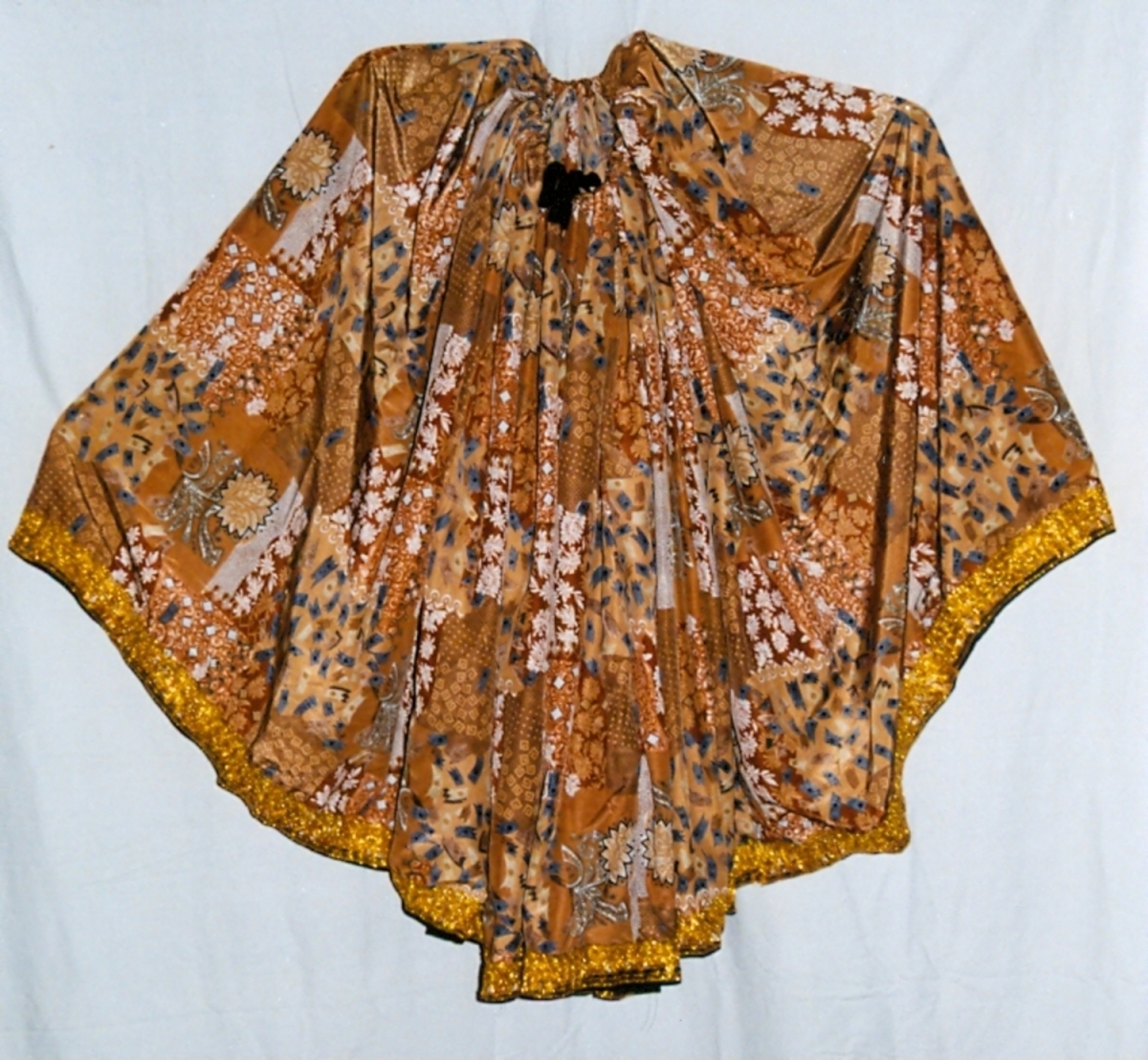
The basic outfit for a Bakhtiyari woman consists of a pair of under trousers (shalvar), worn with a long, full skirt (tumun qiri), which is usually made of between 8-10 metres of cloth. The material in the skirt is gathered at the waist. Over the skirt is worn a knee-length tunic (jowa), which is slit at the sides in order to accommodate the full skirt. Bakhtiyari women normally wear a small cap (lachak), to which a veil (miyna) is pinned in such a way as to frame the face without hiding it. The hair is normally parted in the middle and arranged in two braids that are joined together under the chin.
Luri dress
Currently, there are about 500,000 Luris living in the so-called Luristan-i Kuchak region of western Iran. At the end of the twentieth century, many Luris lived in villages and towns, but there were still a substantial number who followed a nomadic way of life.
The basic man’s outfit consists of long trousers of varying degrees of fullness, a shirt, a vest, sandals (give) and a felt cap (saw-kolah). A feature of Luri male clothing is the chuqa, a straight, knee-length sleeveless coat of natural wool with vertical indigo stripes. These are hand-woven in various villages. It is often worn over a western style jacket (kot). At the end of the twentieth century the chuqa is widely associated with the Bakhtiyari, but it seems to have spread to this group from the Luristan in the 1940s, when it replaced the (traditional) Bakhtiyari cloak (qaba).
Many Luri women wear a pair of trousers (shalvar) under a long dress (sardari). In addition, they often wear a waistcoat decorated with amulets made from coins, pendants, beads and plaques. Many women wear a kind of turban (tara), made by wrapping a scarf around the upper part of the head, and while allowing their hair to flow free at the back.
Qashqai dress
The Qashqai are a Turkic speaking people who originally come from Central Asia. During the medieval period they settled in the mountains of southwestern Iran. Most of the nomadic Qashqai are herders of sheep and goat, and they traditionally migrate between summer and winter pastures in the Zagros Mountains and beyond. There are about 400,000 settled and nomadic Qashqai. Nowadays, Qashqai men usually wear urban styles of dress (long-sleeved shirts in dark colours), although they continue to wear the distinctive Qashqai hat called a do-gushi cap (“two-eared”), which is regarded by many as being THE garment that identifies a Qashqai man. The cap is made of orangey beige, tan or grey felt and as its name suggests, it has two flaps on either side just above the ears.
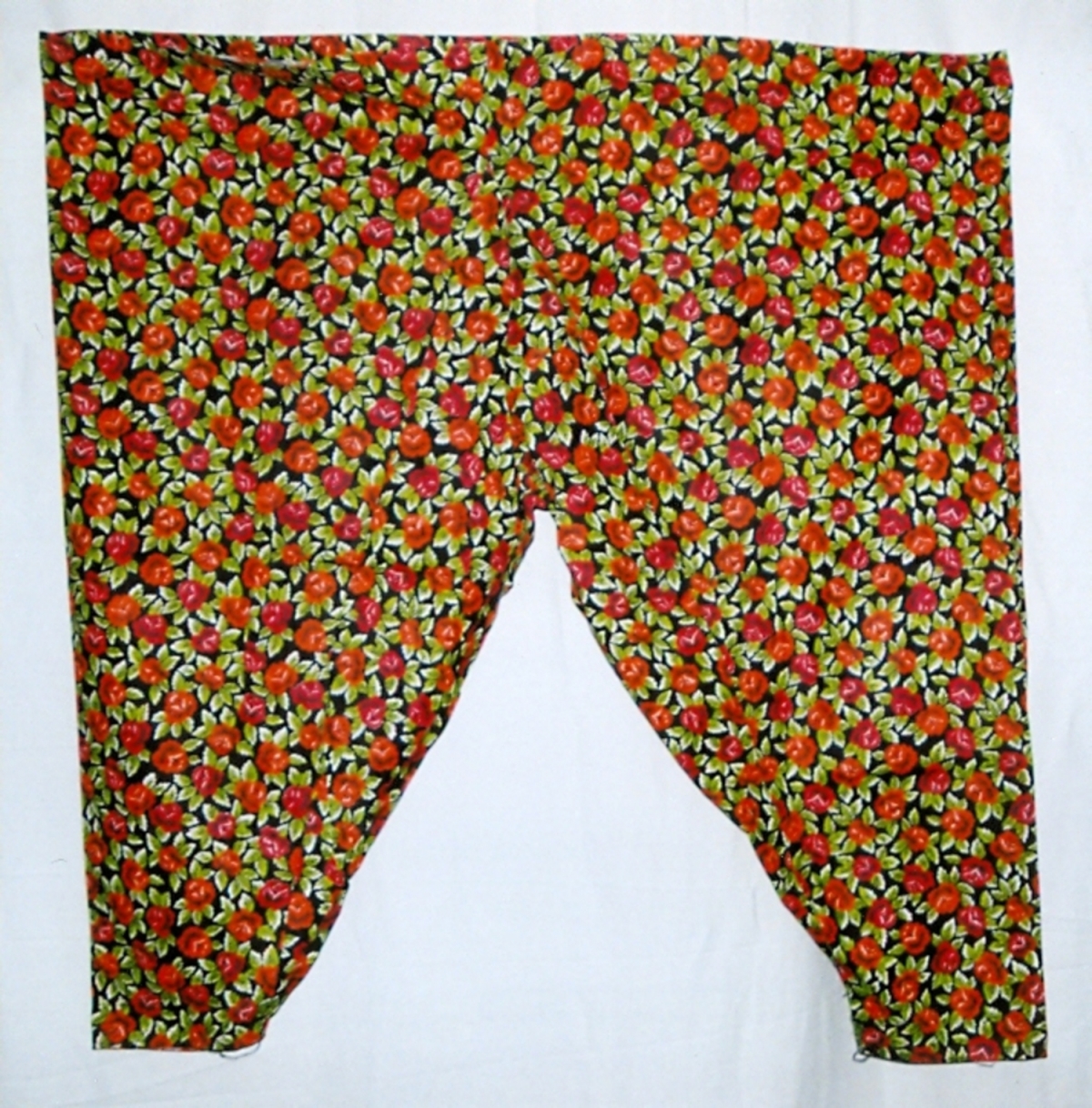
In contrast to the men’s clothing, the Qashqai woman’s outfit is much more flamboyant and consists of baggy trousers (tumban), which are cut very wide at the top, gathered onto a drawstring at the waist and tapering to ankle cuffs. Over these are worn two to twelve underskirts (tumban-i zir), again with a cord at the waist. The greater the number of these skirts the higher a woman’s social status. Over the underskirts is another, more flamboyant skirt (tumban-i ru), which is usually brightly coloured and made from finer materials. Between two to fifteen metres of cloth may be used for making each of these skirts. Over the skirts is worn a long tabard or dress (keynak), which has a high, round neck and long sleeves. These dresses are slit at the sides from the thigh downwards, in order to make room for the various skirts. A waist length fitted jacket (yal-i arsin fosol), is sometimes worn by wealthier women at festivals and weddings.
The headgear worn varies according to age, status and tribal affiliation. The basic form, however, consists of a small cap (kulahcha), worn with one or more diaphanous triangular veils or kerchiefs. These are often made out of net trimmed with sequins. The veils are fastened under the chin with a brooch or fastener (asmaliq, chapa), of some kind. Over the veil is worn a band or fillet (yaqliq) of chiffon, silk, or net, which is usually brightly coloured. Unmarried women normally wear their hair outside the veil, at the front, while married women tuck it inside.
The same range of clothing is worn on a daily basis as well as at weddings and other festivals. Even while on migration, women will wear their splendid skirts while sitting astride their camel, horse or donkey.
4. The Kurds of Western Iran
In the west of the country rises a huge mountain range, called the Zagros, which runs from north to southeast, and separates the Iranian Plateau to the east from the lowlands of modern Iraq, ancient Mesopotamia, to the west. Throughout the Zagros there are mountain valleys with rich pastures, which are used by various urban, village and nomadic groups, including the Kurds.
Dress of Kurdish men
By the end of the twentieth century there were three distinctive dress forms that were worn by both urban and nomadic Kurdish men in western Iran. These were based on traditional costumes with some modern adaptations. These forms are the shal-sipik, the peshmerga, and the rank-o-choukhah.
The shal-sipik is one of the oldest forms of Kurdish male dress in Iran. It consists of trousers (rank) and a V-necked jacket, called a choukhah. The best quality examples are made out of striped mohair. This traditional men's dress is rather expensive and tends to be worn by wealthy, elderly Kurds. However, since the 1970's the influence of Kurdish refugees from Iraq has led to the preference for the so-called peshmerga dress. The suit is made up of a matching jacket (kava) and trousers (shalvar) in black or brown, which is worn with a coloured sash (pishtvin). The turban (pak) of a fringed dark print is normally folded diagonally to leave a triangle at the back of the head.
The third type of male dress is the rank-o-choukhah, which is often worn by elderly Kurds. It is less expensive than the shal-sipik. It consists of a shirt (kiras) with a round neck and either straight sleeves or, less frequently now, pendant or funnel sleeves (sorani). Over this is worn a plain, long sleeved jacket buttoned down the front, in a range of solid colours such as brown, cream, beige, black, or grey. An unbuttoned version of this garment has an open neckline. The jacket is worn with matching trousers, which are baggy and gathered at the waist while tapering to the ankles. A long cotton sash (pishtvin) is normally wrapped tightly around the torso.
Throughout the region the main headgear is based on a variation of a skullcap (kulaw) with a large cloth used as a turban. The colours and material used for these turbans can vary, including green for sayyids, white or black for sheiks and mullahs, while burgundy, grey, black and white are used by other men. Turban cloth used by 'ordinary' Kurds usually has a small printed design on it, which is often based on flowers.
Dress of Kurdish women
There are five basic types of costume worn by Kurdish women in Western Iran, namely those from around the cities of (from north to south) Maku, Urumia, Mahabad, Sanandaj, and Kermanshah. Additionally, a specific type of female dress (the s-called sorani dress) has developed which is worn all over the Kurdish region.
Maku:
The basic traditional outfit of the women living in and around Maku consists of trousers (darpi), a long, very full dress (kiras), an apron (mizar), a long-sleeved coat (der), sleeve puffs, and a headdress which is usually made up of a single headscarf (dastmal) for an unmarried woman and two or more scarves for a married woman.
Urumia:
The basic Urumia outfit consists of baggy trousers, a plain, shaped under dress or petticoat that reaches to just above the knee, and a dress that is often made out of sheer material. The dress usually has a gathered waist and long sleeves, sometimes in a pendant shape. Over this is worn a long-sleeved coat, with a wide scoop front. The sleeves of the dress are usually tied behind the back so that the woman can more easily work.
Mahabad:
The Mahabad outfit consists of a shift, balloon-shaped trousers (darpi), which can be up to six metres wide and fitted at the ankles, and finally a long, pleated dress (kiras), which has a hem width of four to five metres. The dress normally has a round neckline and long sleeves that may terminate in pendants (sorani). These extended sleeves are normally either wrapped around the wrists or tied behind the neck. Over the dress is worn a short waistcoat. Finally, a cotton sash (pishtvin) is normally wound loosely around the hips. This sash is made from three to six metres of patterned cloth. The traditional headdress is a low, cylindrical cardboard cap (tays-kulaw) covered with velvet or brocade. The version worn by girls has a chin chain decorated with coins or, more commonly, plastic discs. The cap is normally wrapped in a long triangular shawl (dastmal), which is worn with the points of the triangle crossed over on the chest, and the main point dangling down the back.
Sanandaj:
Sanandaj women's dress is made up of baggy trousers, a long dress and a waistcoat. It is very similar to the dress worn by Kurdish women further south, in and around the city of Kermanshah, but not as full or decorative. The main form of head covering from this region is called a kalaqi, and consists of a domed cap decorated with sequins or beads and wrapped with one or two scarves. Sometimes the cap is held under the chin with a beaded chain. Until comparatively recently, all married women used to wear a turban over the cap, made from numerous scarves and tasselled lengths of fabric.
Kermanshah:
Women from the Kermanshah region tend to wear various layers of clothing, including long trousers (shalvar jafi), under a long, full dress. Over the dress is a waist-length bodice or waistcoat, which is often in velvet and covered in sequins. The basic headdress consists of a sequined cap (kutir) wrapped with one or several scarves. The cap worn by younger women and girls is usually decorated with either sequins or embroidery, while those of older women are normally of plain velvet or decorated with small, black beads.
Pan-Kurdish dress:
During the latter half of the twentieth century, a pan-Kurdish style of female dress developed called the sorani. The outfit is made up of trousers, a petticoat (optional), a full-length dress with long sleeves (the sorani, either straight or pendant shaped), a short waistcoat, which may be separate or attached to the garment, and either a coat or jacket. The headgear worn with the sorani outfit can vary considerably depending on the wearer’s age; younger women tend to wear headscarves while older women have elaborately constructed turbans. At the end of the twentieth century, however, more and more women are wearing urban style headscarves. In addition, while travelling from village to village or when visiting towns, many women will wear the Iranian chador, but these are not worn at home or in their local villages
6. The deserts of Central Iran
Central Iran is a large, dry desert region that is sparsely populated, but along its fringes there are the main Iranian cities, including Tehran, Isfahan, Yazd and Kerman. Until the 1930s many of the major cities had their own characteristic regional dress. However, most people living there now wear pan-Iranian dress and their local origins cannot be seen on the basis of their clothing. There are two main exceptions, namely the outfits worn in the village of Abyaneh and its surroundings, and those worn by Zoroastrian women in the city of Yazd.
Abyaneh dress
Abyaneh is situated at the foot of Mount Karkas, about 200 km south of Tehran. Because of its mountain location, the village is relatively cool during the summer months, while in the winter it is extremely cold. Until comparatively recently, the region around Abyaneh was virtually cut-off from the rest of Iran. The building of new roads in the region at the end of the twentieth century meant that the village became more accessible and modernised. Abyaneh has been recognised by UNESCO as a place of special cultural interest and is officially protected.
Traditional men and boys' clothing in the region is based upon late nineteenth century style garments, namely a shirt (pirun), a gown (qaba), a sash (shal), baggy trousers (tumun), cloth shoes (give), and some form of headgear, such as a cap (kolah) or a turban (mandil). By the beginning of the twenty-first century, the remaining traditional feature are the loose fitting trousers made out of a black, shiny material. The cuffs of the trousers are often decorated with lines of hand or machine embroidery.
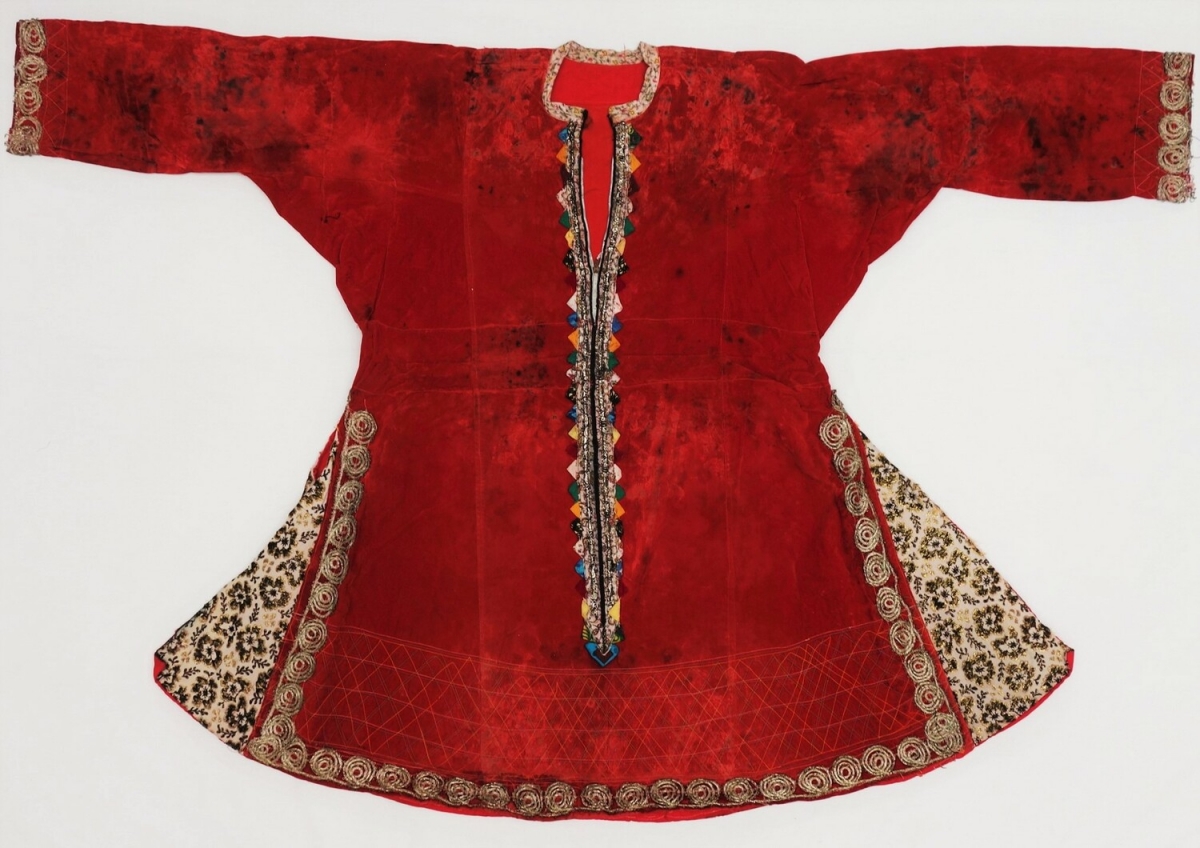
The dress of both girls and women is based on three items: a tunic (pirun), knee-length ‘skirt’ (tumun) and a large head shawl (churgat). The ‘skirts’ are not actually skirts, but extremely wide trousers. These garments are made out of at least eight metres of pleated black cloth. The Abyaneh headscarf is made out of a large square of cloth, which has a light coloured background with small colourful motifs. It is folded diagonally and then fastened under the chin.
Zoroastrian dress
The Zoroastrians are followers of the main religion across the Iranian Plateau prior to the introduction of Islam in the seventh century AD. Zoroastrians are followers of the prophet Zoroaster, who lived, so we assume, at some point in the early first millennium BC. He introduced a monotheistic religion that is based around an omnipotent god called Ahura-Mazda. By the end of the twentieth century the Zoroastrians are a minority group concentrated around the city of Yazd; their co-religionists are the so-called Parsis from India, especially from Mumbai and surroundings.
For centuries Zoroastrian men have been barely distinguishable from their Muslim neighbours and as a result there is no special clothing for them. In contrast, however, Zoroastrian women have developed and preserved their own distinctive form of dress. Up to the latter half of the twentieth century the basic dress of a Zoroastrian woman in Yazd consisted of a pair of baggy trousers (shalvar), a panelled dress (qamis), and various forms of headgear. By the end of the century, many women were choosing to wear pan-Iranian garments, and within a short while this form of clothing will no longer be regarded as everyday wear, although it may survive for festival occasions.
The traditional trousers worn by Zoroastrian women are large, baggy trousers, but women now tend to wear narrow, knee-high trousers that can just be seen below the hem of the dress. The dress includes a long skirt made out of green/brown or green/purple panels. The bodice section is usually plain and in a contrasting colour to the skirt section. The traditional headdress can be quite complex and consists of various elements that can be worn together or by themselves, including a small, triangle cap (lachak) with a chin band; a large headcover (makni) made up of three metres of cloth placed under the chin and then folded over the head, and finally, in the winter time, a large, diagonally folded shawl (charqat), which is often draped over the top.
Afshar dress
Nowadays there are various nomadic and semi-nomadic groups living in the Kerman Province of southeastern Iran, including the Afshar. Traditionally, it is believed that the Afshar are descended from Afshar, a chief of the Turkmen Ghuzz tribe. It would seem that they migrated towards their present habitat during the fourteenth to fifteenth centuries. Nowadays, the main activity of the Afshar is animal husbandry, especially that of sheep. The Afshar are also known for their handicrafts, which are used as trade items.
Nowadays, men’s clothing is based on pan-Iranian forms, including Western style trousers, shirt, waistcoat and jacket. The main feature of their outfit is the Homburg style hat that was introduced in the 1930's following the dress reforms of the king, Reza Shah. A similar hat is worn by Shahsavan men in northwestern Iran.
The clothing worn by Afshar women is based on the combination of a pair of trousers worn under a skirt or dress. The headgear is usually made up a large white scarf, which is used to cover both the head and shoulders of the wearer. This is kept in place with a long black headscarf that is wrapped around the head like a turban.
3. The Turkic lands of Northwestern Iran
In the northwest of Iran lies Azerbaijan. The region is comparable to neighbouring districts of Turkey to the west, and the modern republic of Azerbaijan to the north, with respect to ethnic origins of the local people, their culture and their local language.
In addition to the large settled groups of the local people, the so-called Azeris, there are a number of nomadic and semi-nomadic groups living in this part of Iran. The most important are the Shahsavan.
Azeri dress
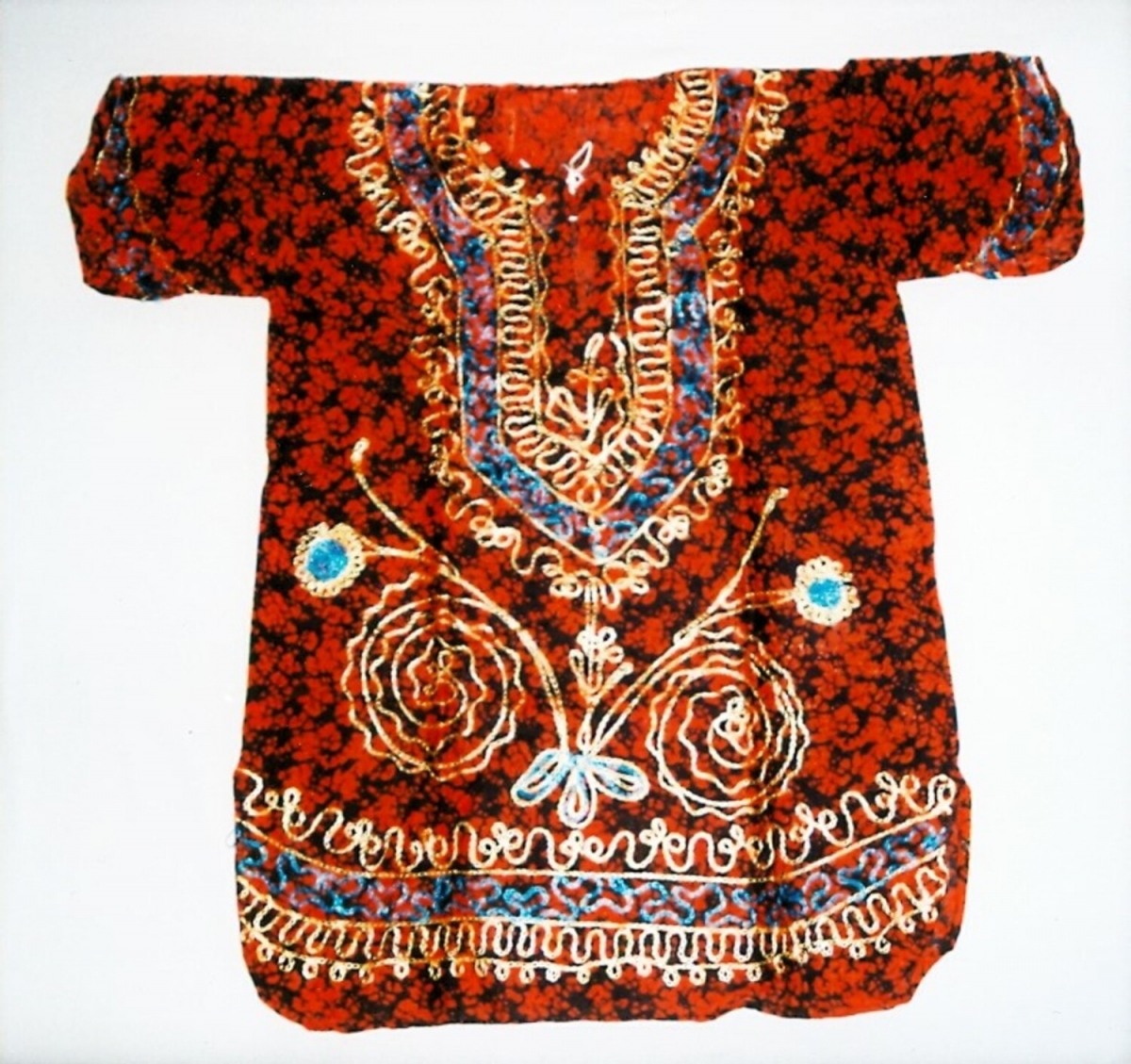
In general, older men tend to wear suits made up of waistcoats, jackets and trousers, with either a skullcap or a flat cap of some kind. In contrast, younger men tend to wear pan-Iranian style clothing, notably, a light coloured shirt with trousers and a belt, and no headgear at all. The garments worn by Azeri women usually consist of narrow under trousers, which tend to be black for older women and a darkish blue or brown for younger women. Girls, in contrast, often wear bright and colourful under trousers. Skirts and a top of some kind, or in the case of older women a mid-calf length dress, are worn over the trousers. The most distinctive feature of these outfits is the headscarf fastened in what is locally regarded as the Turkish manner, namely, with the knot at either the top of the head, or at the nape of the neck, rather than in front as is common in the pan-Iranian way.
Shahsavan dress
The name Shahsavan is given to various tribal groups who mainly live in northwestern Iran. Most are descendents of Turkish Oghuz or Ghuzz people who came to Iran from Central Asia about 1,000 years ago, together with other Turkic groups, some of whom settled further west in what is now called Turkey. At the end of the twentieth century there were about 300,000 Shahsavan, most of whom are settled, although there are about 6,000 families who remain nomadic.
A distinctive item of men's clothing are their hats. Indeed the Shahsavan hats are generally regarded to set them apart from non-Shahsavan. There are two types. The official Iranian dress reforms of the 1930's meant that men had to adopt to Western style clothing, including Western styles of headgear. As a result, Homburg hats (shapo, compare the French chapeau) became fashionable among the Shahsavan. After the Second World War (1939-1945), younger men began to wear the peaked Jamshidi-style cap, while older men continued to wear homburgs. The Jamshidi is now regarded by the Shahsavan as the tribal hat.
A woman’s outfit consists of five main elements: a full-length tunic (kuynak), a tailored waistcoat, several wide full-length underskirts (dizlik) gathered at the waist, and a small skullcap, and two headscarves (yaylik and kalayagi). The bell-shape appearance of the women’s dress is achieved by wearing at least two or more full length underskirts, while on special occasions up to five skirts may be worn. The waistcoats worn by younger girls tend to be made out of red material decorated with braids, buttons and coins. The waistcoats of married women are normally more sombre, and are often made out of men’s suiting.
The headdress is one of the most important elements of the dress worn by a married woman. Its shape, size, colour and complexity are used to denote the wearer’s status. The basic headdress is created with two scarves, both of which are made of hand printed silk. The large scarf (yaylik) is about 150 cm square and decorated in a variety of colours. The most common combination for the yaylik is white, yellow and orange, patterned with darker colours. The smaller scarf (kalayagi) is smaller and is normally the darker of the two. It is rolled diagonally and tied tightly around the large scarf and the skull cap in order to keep them in place. As a rule, Shahsavan women will partially veil their faces in the presence of unrelated men. This is done by bringing part of the yaylik across the lower part of the face covering the nose, mouth and chin.
2. Caspian coast
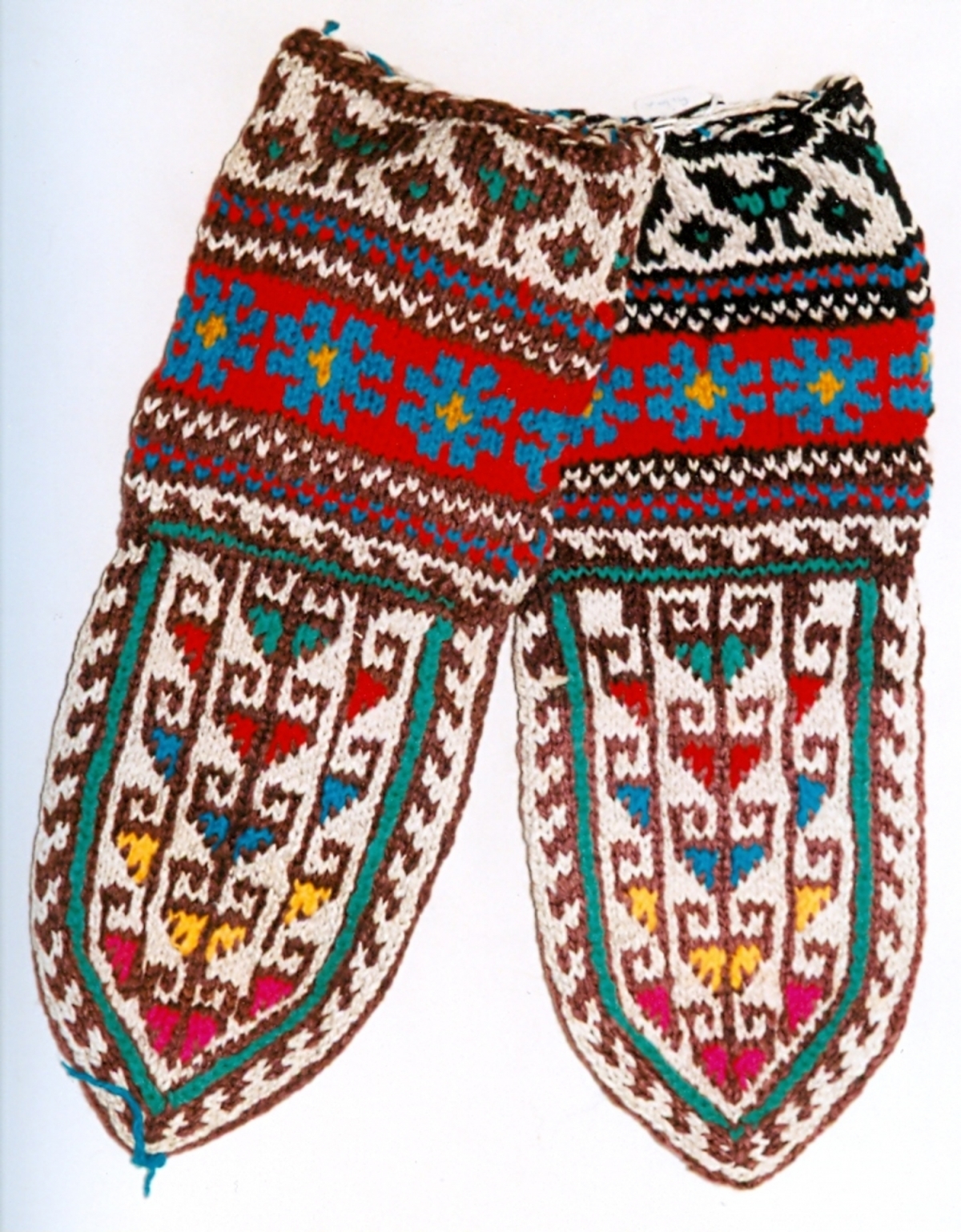
Along the southern shores of the Caspian Sea, in the north of the country, stretch the coastal plain and mountain slopes of what is generally called Gilan. The traditional dress for men in Gilan consists of a short tunic (pirahan) or, more commonly, a Western style shirt. On top are worn waistcoats, which are often made of sal, which is a locally made woollen cloth, and a Western style jacket (kut). Many men used to wear a type of trousers (sal-shalvar) made of sal or thick cotton, which reaches to the ankles. At the end of the twentieth century, however, it is usually only the shepherds who wear such trousers. Similarly, puttees made from bands of cloth (patava) used to be wrapped over the trousers up to the knees and were regarded as a distinctive feature of Gilani male costume. The puttees were necessary as a protection against the thorny bushes, which abound in this region. Nowadays, however, few men wear patava, as their protective function is now being filled by thick, hand knitted socks (jurab), which cover the trousers up to mid-calf height.
By the turn of of the twentieth and twnty-first century, the basic outfit of a Gilani woman consists of close-fitting, ankle length trousers (bapare), over which are worn a full skirt (tuman), gathered at the waist. Women normally wear two or three skirts together, one on top of each other. The length of the skirt is often used to indicate the age of the wearer: a younger woman will have a calf-length skirt, while an older woman’s version may reach the ankles or the ground. In addition, in the eastern parts of Gilan, the skirt reaches to the thighs or even to the knees, while in the west it may come down to the ankles.
Over the skirt is worn a tunic (shiy). There are two slits at either side of the garment to allow for the fullness of the skirts. A waistcoat is normally worn over the shiy. As a generalisation, dark grey or black waistcoats are worn on a daily basis, while those for special events are normally in bright colours and ornamented with braids, beads and coins. Another distinctive regional garment is the sash (charshu), which is a rectangular piece of cloth folded into a triangle and worn knotted around the waist with the point at the side or back.
At home a woman may wear a scarf (lachak), which covers only the top of the head. In the eastern part of Gilan these tend to be made of plain black cloth, folded into a triangle. Elsewhere the scarf may be white or with a plain, lightish colour. Outside the home, women normally wear a white shawl (dasmal). It is made from a square piece of material, folded into a triangle and then knotted or crossed under the chin.
The traditional shoes (chumush) from the region, for both men and women, are made from cow's leather and basically consist of soles that are large enough to envelop the lower part of the foot. They are kept in place with a system of thongs that are pulled tightly, so bringing the leather upward and enclosing the foot.
1. Introduction
For many Westerners, Iranian dress is made up of black chadors for women and shirts with no ties for men. Yet there is much more, very much more in fact, to Iranian dress than this image may give.
Iran is a large and ancient country that lies at the crossroads between Central Asia and the Middle East. Over the centuries numerous different peoples have crossed the country and settled down. As a result there are currently about 100 different ethnic and religious groups (both Muslim and non-Muslim) living in Iran. The country’s diversity is reflected in many aspects of Iranian culture, notably its literature, architecture, as well as its traditional dress, especially that worn by women.
Although rapidly vanishing in some areas due to national pressures and globalisation, many aspects of these dress traditions can still be found throughout the country. Dress often is an ethnic marker, indicating which ethnic group the wearer belongs to. There is a huge difference between, for instance, the traditional clothing of the Shahsavan in the northwest of the country, and the Baluchis in the southeast. Differences in clothing, such as the quantity or the type of material used, can sometimes also be used to indicate a special status within one particular group. This difference in status may reflect personal wealth, or a person's political, religious or social standing. Or, on a more obvious level, clothing marks the difference between the genders: In most societies there are significant differences between female and male clothing. But within that there can be differences in marital status within the same gender; different and specific garments or headdresses may be worn by unmarried, married, divorced, or widowed women.
An important aspect of status identification is the use of colour. Within the context of Iran, for instance, an unmarried girl will often wear bright colours, while married women tend to wear more subdued hues. Women who are past child bearing age usually wear even more sombre colours, often black, dark blue or dark purple. So, dress can be used to indicate a person's age and gender, their status within a family or regional group, as well as their 'ethnic' identity on a national and international level.
Another factor which has to be taken note of is that of religion. Most Iranians are Shi'te Muslims. However, in Iran there are other religions, or different branches, such as that of the Sunni Muslims, especially in the southeast of the country. There are also various groups of Christians (such as Assyrians, Armenians and Nestorians), as well as the followers of Zoroastrianism, the pre-Islamic religion of Iran.
The exhibition that was displayed at the Textile Research Centre in 2013, and which is replicated online here, includes over sixty outfits for men, women and children, in addition to individual garments. It presents regional outfits from all four corners of the country, including garments for Arabs, Bakhtiaris, Bandaris, Baluchis, Gilanis, Kurds, Luris, Qashqai, Shahsavan, Sistanis, various Turkmen groups, Zoroastrians, as well as for people from the picturesque and traditional village of Abyane in Central Iran.
The majority of these garments were collected during research in Iran between 1999-2003 and they are now housed in the TRC collection.
0. Cover page
For many Westerners, Iranian dress is made up of black chadors for women and shirts with no ties for men. Yet there is much more, very much more in fact, to Iranian dress than this image may give.
Iran is a large and ancient country that lies at the crossroads between Central Asia and the Middle East. Over the centuries numerous different peoples have crossed the country and settled down. As a result there are currently about 100 different ethnic and religious groups (both Muslim and non-Muslim) living in Iran. The country’s diversity is reflected in many aspects of Iranian culture, notably its literature, architecture, as well as its traditional dress, especially that worn by women.
This online exhibition is based on an onsite exhibition that was displayed at the Textile Research Centre in Leiden in 2013. It includes outfits for men, women and children, in addition to individual garments. It presents regional outfits from all four corners of the country, including garments for Arabs, Bakhtiaris, Bandaris, Baluchis, Gilanis, Kurds, Luris, Qashqai, Shahsavan, Sistanis, various Turkmen groups, Zoroastrians, as well as for people from the picturesque and traditional village of Abyane in Central Iran.
The majority of these garments were collected during research in Iran by Gillian and Willem Vogelang between 1999-2003 and they are now housed in the TRC collection.
For this online exhibition:
- Author: Gillian Vogelsang-Eastwood
- Web-design: Joost Koopman
- Exhibition design: Willem Vogelsang
- Publisher: TRC Leiden.
- Year of publication: 2021
- Copyright: All illustrations of objects housed in the TRC collection can be used free of charge for non-commercial purposes, but please add to the caption: "Courtesy Textile Research Centre, Leiden" and the pertinent accession number of the object. For commercial purposes, pleaase contact the TRC at This email address is being protected from spambots. You need JavaScript enabled to view it..
2. Guipure lace
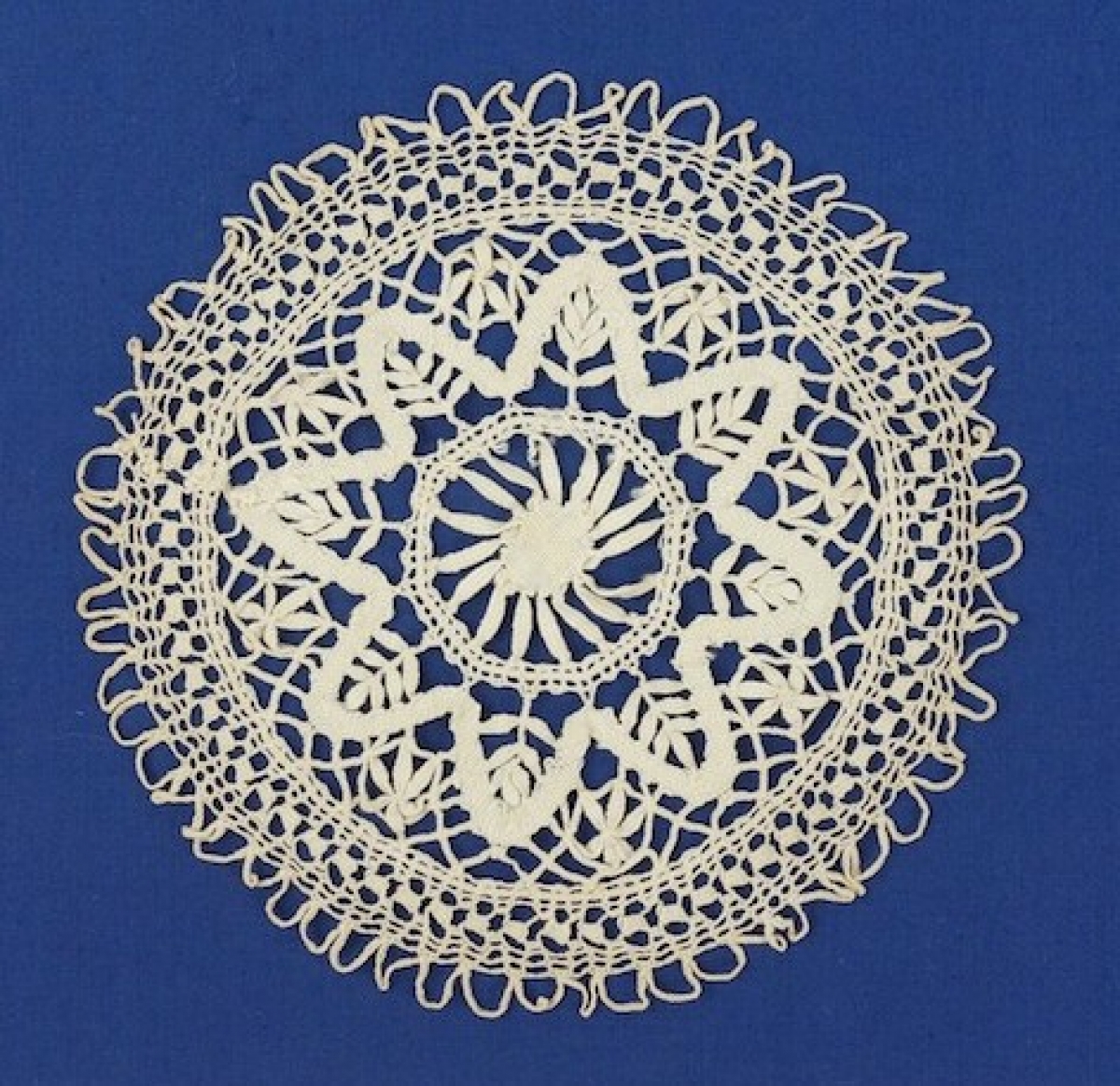
Maltese (bobbin) lace is also a form of guipure lace. Guipure lace is marked by the sprigs or motifs being connected with bars or bridges (or 'brides'), and not with a mesh or net. It is also known as Venetian lace. The sprigs, placed closely together, were often outlined with a thick thread (gimp), which gave it an almost three-dimensional, raised appearance.
Other traditional forms of guipure lace are Cluny lace and Yak lace. The development of Maltese lace in the 19th century was strongly influenced by Genoese lace, which also is a guipure lace. Bedfordshire lace, which was developed in Britain in the later 19th century under the influence of Maltese lace, is consequently a form of guipure lace.
In fact the term guipure lace covers an enormous wide field of laces, and, according to Pat Earnshaw (1984:76), thereby lost its usefulness. She mentions 'new guipure laces' and lists, within this category: Brussels duchesse, Bruges, Honiton, Beds Maltese (Bedfordshire lace), Irish crochet, Youghal, Carrickmacross and (French) Le Puy.
1. Bobbin lace
Maltese lace is a form of bobbin, or pillow lace, which itself is a form of needle lace. Bobbin lace is the product of a modified weaving process that takes its name from the way it is made, namely using a series of bobbins on a lacemaking pillow. The warp threads on a loom are represented by the threads that hang straight down, weighed by the ‘passive’ bobbins. The weft threads on the loom are represented by the ‘worker’ or ‘weaver’ bobbins that go over and under the passive bobbins, so creating a piece of woven cloth.
The process to create bobbin lace mostly uses a pattern that is drawn on a piece of card (the so-called parchment or pricking card), which is attached to the pillow. The parchment has a series of holes literally pricked into it (with a pricker), following the lines of the design. Pins are put into the start of the design, from which enough threads with attached bobbins are hung. While interlacing the 'worker' and the passive threads, the lace maker follows the lines of the holes in order to create the desired design. While progressing, new pins are added to keep the developing weave in place.
There are two main types of bobbin lace, namely the continuous form, whereby the ground and motif are worked in one go, and the non-continuous form, whereby 'sprigs' (individual motifs) are made in one operation and then they are linked together with small braids or bridges (or ‘brides’) or by sewing the sprigs onto a mesh ground. Honiton lace is a good example. Maltese (bobbin) lace is a continuous form, whereby the motifs (sprigs) are made together with the braids or bridges that bring them together.
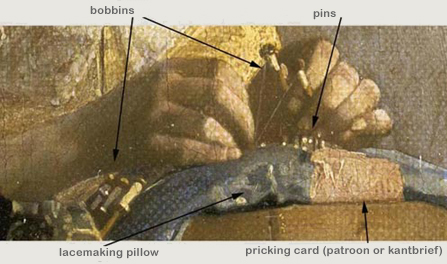 Detail from The Lacemaker, by Johannes Vermeer.Actual evidence for the production of bobbin lace in Europe dates back to the 16th century, although there are vague written references and what might be representations of bobbin lace dating to the 15th century. One of the earliest known bobbin lace pattern books is called Le Pompe, which was produced by the Sessa brothers in Venice in 1557. This was quickly followed by other books, such as the Nüw modelbuch allerley gattungen däntelschnür so diser zyt in hoch tütschlanden geng und brüchig sind...erstmals in truck verfergket durch Rr. M. by Christoph Froschauer, which was printed in Zurich in 1561.
From that moment onwards, there is considerable evidence in the form of actual, written and visual objects for the production of bobbin lace. Over the following centuries many different forms have been developed. These are often called after the place where they are said to have originated or where produced on a large scale. One of these local forms is Maltese lace.
Bobbin lacemakers have always been a popular subject for painters. One of earliest actual images of someone producing bobbin lace is by the Flemish painter, Maerten de Vos (c. 1534-1603), in a series of etchings called The Seven Ages of Man (c. 1580-85). The series is based on the planets and in the print called Venus, there is a young girl working on a lace pillow.
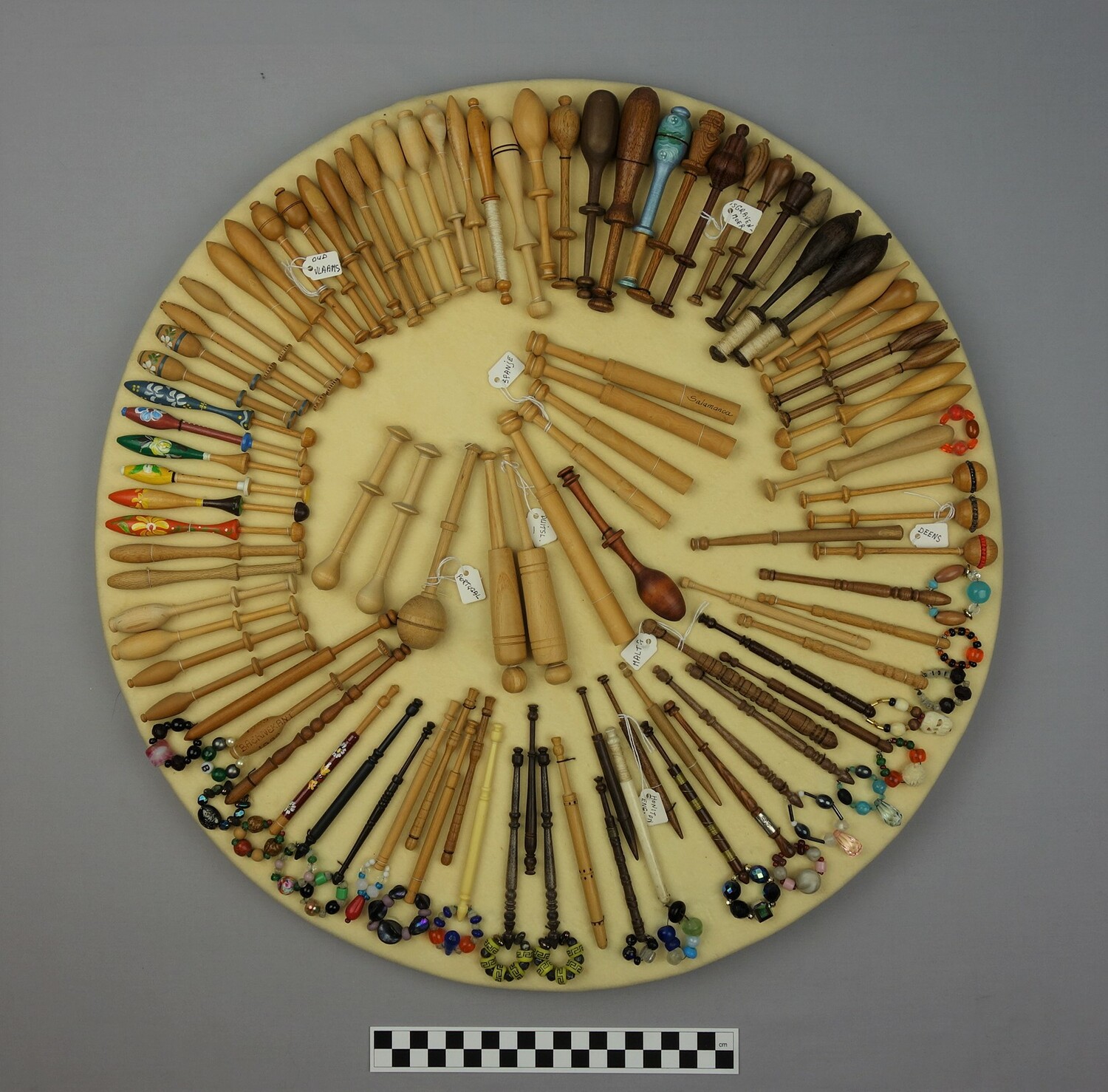 Board with lace bobbins from different countries (TRC 2007.0494).
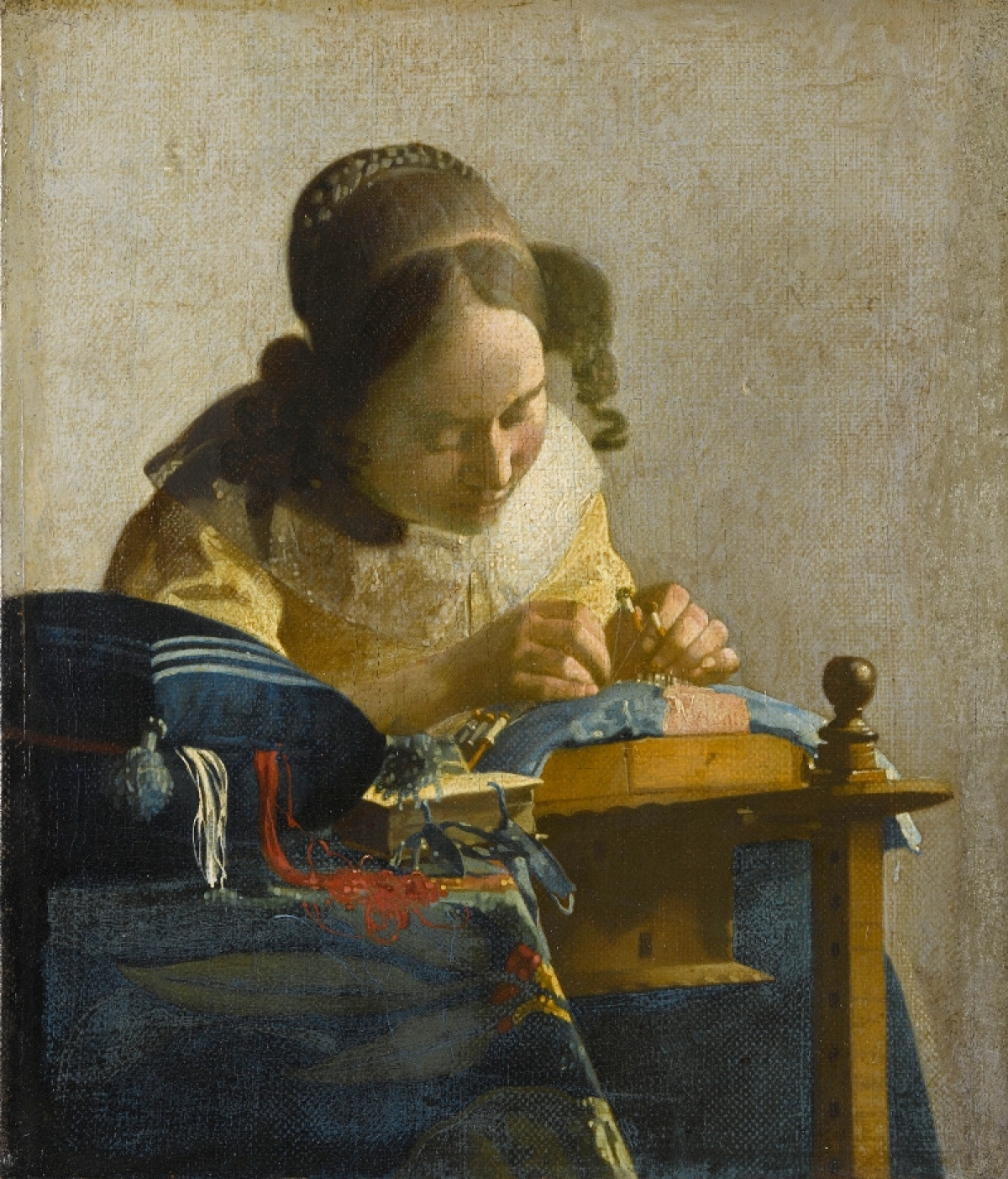
In about 1670 Johannes Vermeer produced his famous The Lacemaker, now in the Louvre Museum in Paris. Caspar Netscher painted his Lacemaker in 1662 (Wallace Collection, London). Another Dutch master, Louis de Moni produced The Lacemaker with a Boy Blowing Bubbles in 1742. The painting is now housed in the Mauritshuis in The Hague, and Giacomo Geruti painted his Women Working on Bobbin Lace (private collection) in the mid-18th century.
5. Maltese lace in the TRC collection
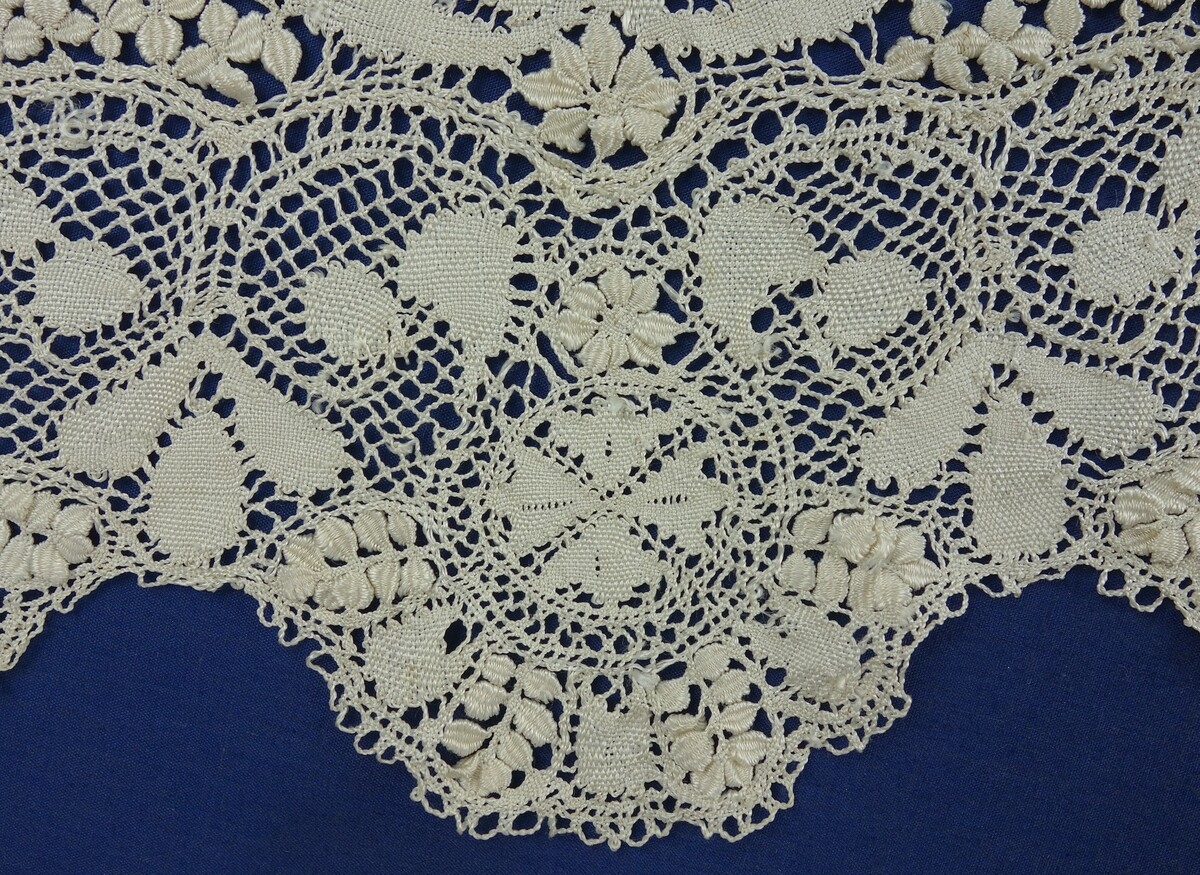
There are various examples of Maltese lace in the TRC Collection. These include collars as well as small mats and samples.