
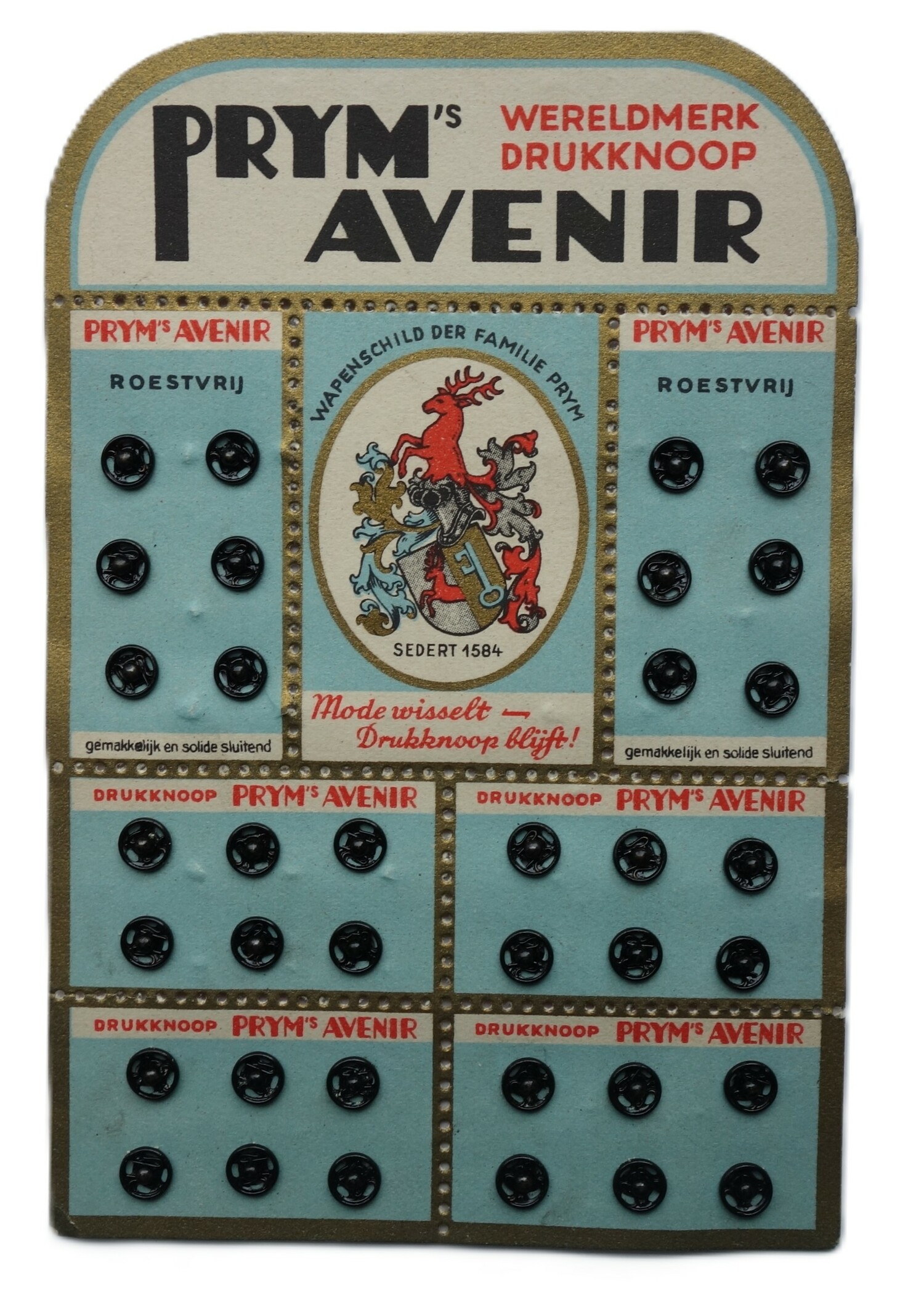
 Fig. 1. Card with 6x six black press studs. There is a printed text that states: "PRYM'S AVENIR WERELDMERK DRUKKNOOP", Germany, produced for the Dutch market, early 20th century (TRC 2026.2008).(Gillian Vogelsang, 9 Sept. 2026) Over the years I have become intrigued with some ‘strange’ items in the TRC collection, but I never expected to become interested in that everyday item, the press stud! Perhaps I was drawn to this subject when I realised that, in 2021, I wrote a blog about medieval hooks and eyes now in the TRC Colleciton.
But back to the press studs. I am currently cataloguing various forms of fastenings, not only the press studs, but also hooks and eyes, and buttons, that were given to the TRC by Hennie Stevan-Bathoorn and Sjoerd Stevan of the former Museum voor Naaldkunst, Winschoten, here in the Netherlands.
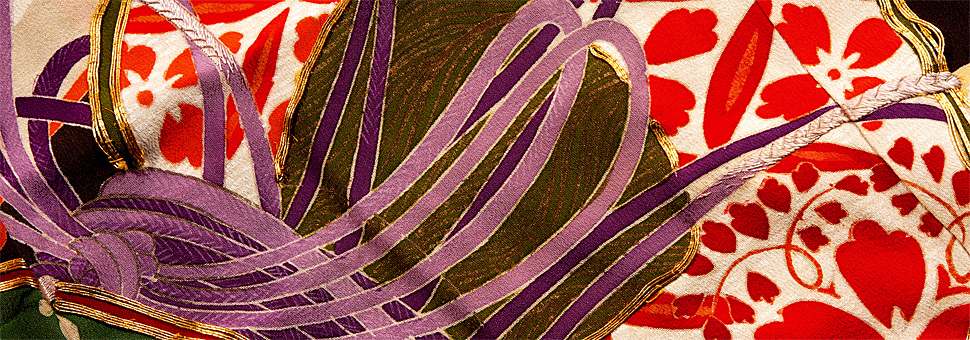
Press studs are often used instead of buttons to fasten various items, including soft furnishings, as well as a wide range of garments from underwear, to blouses, aprons, trousers, coats and skirts, headwear, gloves and footwear (Fig. 1). They are a hidden form of fastening, and easy to use. There are different grades of press studs, from those suitable for a child to military grade forms used for parachute harnesses, etc. Press studs are also sometimes used to decorate items. In the TRC Collection, for example, there is a child’s embroidered cap from Pakistan that is embellished with buttons, coins and press studs (compare TRC 2026.1897).
The donation includes a folder with various cards of press studs that were produced by different manufacturers. I have never really looked in detail at these small, but useful items before, but I started to wonder about the history of these items as well as looking again at the press studs in the collection, and at a range of garments that are fastened with such studs.
Well, to start with, the press studs (UK) have different names in the (English-speaking) world. In the US, for example, they are called snap fasteners, snaps, or snap buttons. Elsewhere they are sometimes called poppers, tich buttons or dome fasteners.
A typical press stud is made up of two basic elements, namely a circular disc with a protrusion or knob that fits into a well or groove on a second, corresponding disc. These two discs are sometimes called the male and female parts, stud and well, stud and disc, or knob and well.
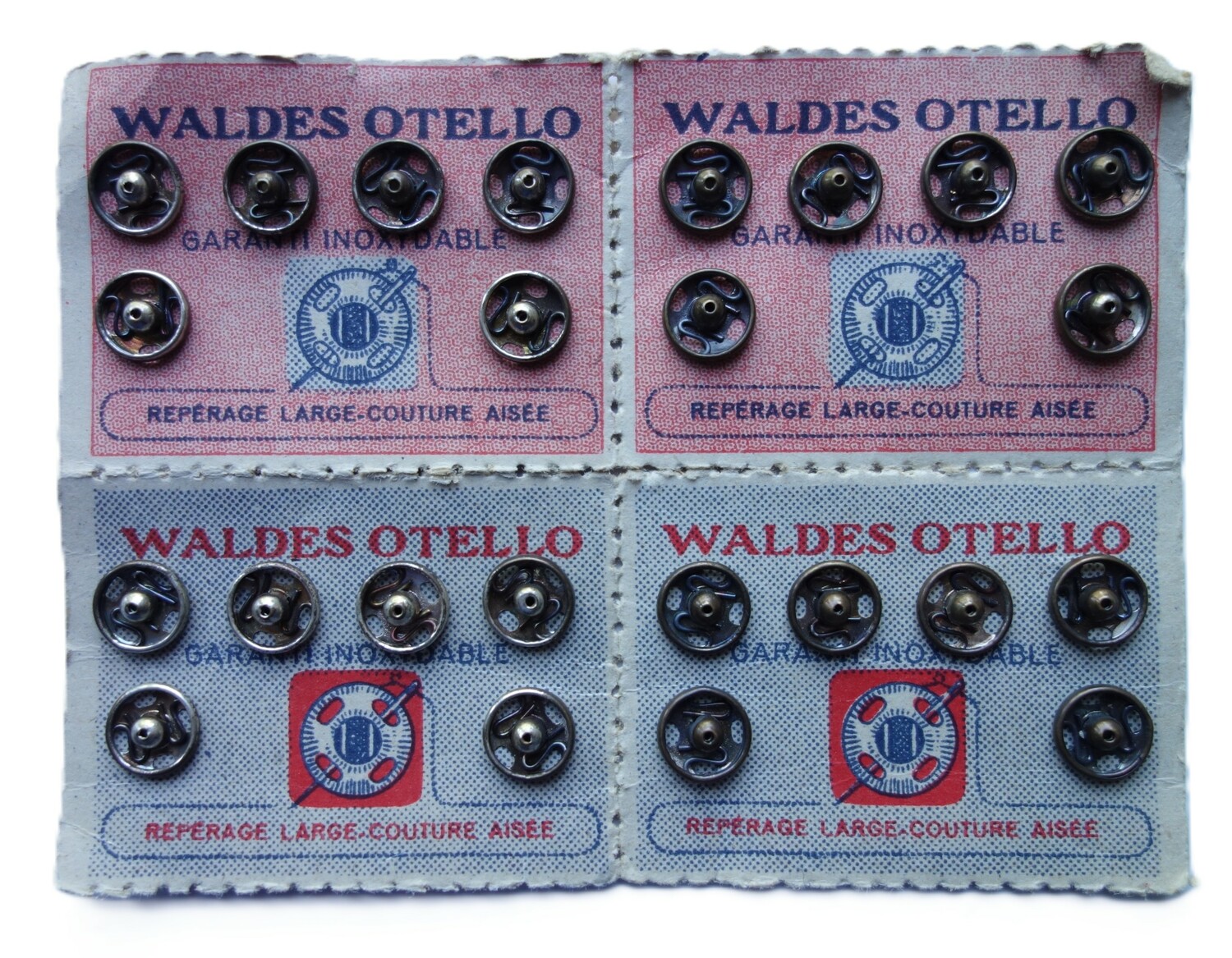 Fig. 2. Card with Waldes press studs with spring, c. 1910 (TRC 2026.2091).Different sizes of press studs are made, for example, for a baby’s garment (very small), bras (small) or jackets (large). They were originally produced in black or silver coloured metals, but by the end of the 20th century a range of coloured metal versions, or even transparent and opaque plastic examples became available, as well as stylised floral forms and a range of ornate geometric shapes.
History
It would appear that press studs were first patented in March 1885 by an inventor from Pforzheim in southwestern Germany, called Herbert Bauer. The patent describes them as a Federknopf-Verschluss ('spring-button-closure'). The Bauer studs were regarded as an interesting device but with some basic problems, such as rusting and opening inadvertently at inconvenient moments.
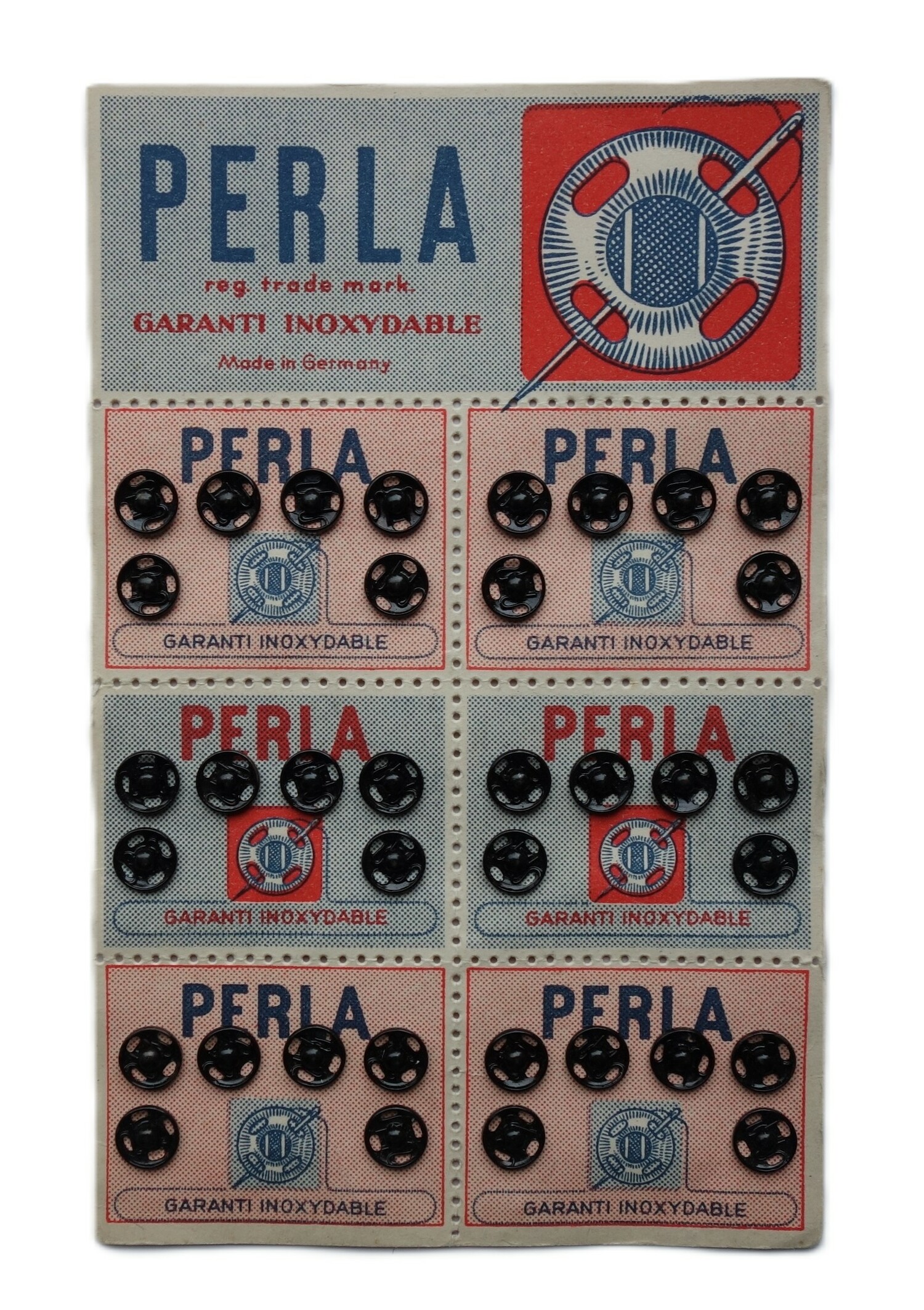 Fig. 3. Card with 6x six black press studs. Germany, early 20th century (TRC 2026.2018).Over the next few years various other patents were applied for, including one by a French engineer called Albert-Pierre Raymond. In 1886 he designed a version that was specifically intended for glove makers. In 1903, a German industrialist, called Hans Friedrich Prym (1875-1965), devised a press stud with a double S-spring (see below). It is this form that is used for many press studs to the present day and which is sold all over the world.
Following Prym's invention, the modern ‘male’ part of press studs usually has a small, ring-shaped spring that creates tension around the knob when the two halves of the stud are pressed together. Nowadays, many press studs have such springs, while others have a groove instead. Some press studs are sewn to a ground material via holes cut into the discs (Fig. 3), while others are attached to a cloth, felt or leather ground with a form of rivet (the rivet form will be the subject of a blog in due course).
Based on the advertisements for early press studs, people were concerned about springs and studs rusting as a result of washing garments, etc. They also were aware of the metal sewing holes cutting and fraying the sewing thread, and the edges of the discs tearing the ground material. The ‘fact’ that press studs are rust-resident is proudly advertised on many cards used to sell press studs.
From the early 20th century, numerous companies, next to Prym (which is still active) started to produce press studs. In some cases they were sold in small paper packages, while others were in small boxes. But most companies produced a card that was divided into six sections with six studs. This apparently reflects British influence, with a system based on groups of 12, rather than the continental system of 10.
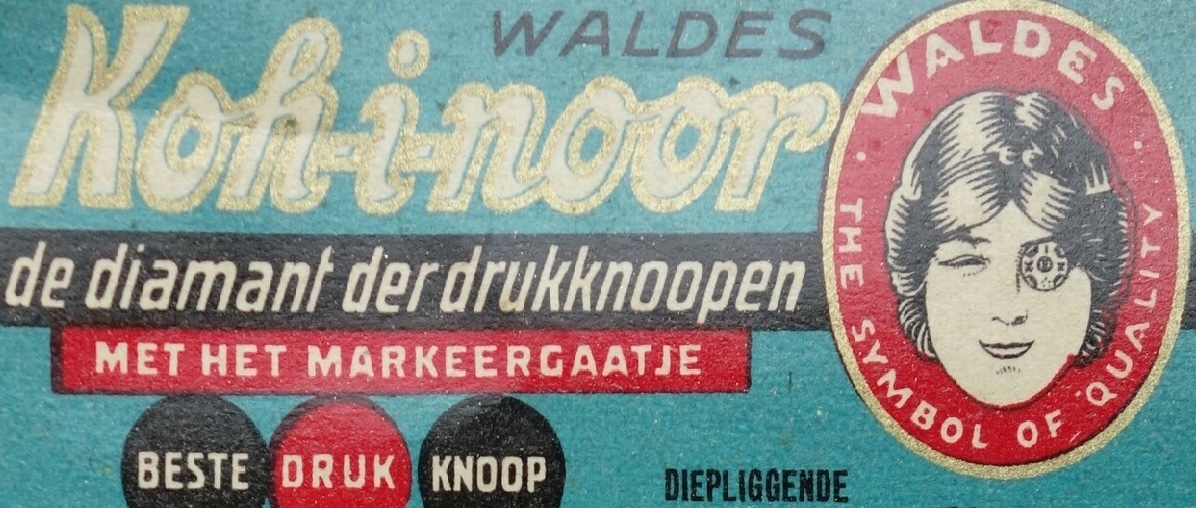 Fig. 4. Detail of a card with six black press studs and the (Dutch) text: "WALDERS Koh-i-noor. De diamant der drukknoopen", with the Koh-i-Noor logo, Miss KIN: a woman with a press stud in her left eye. Produced in Czechia for the Dutch market, before WWII (TRC 2026.2090).
Miss KIN and a press stud monocle
The press studs recently added to the TRC catalogue include some examples from the Koh-i-noor series. They were made by the Czech company of Waldes, which was set up by engineer Hynek Puc and salesman, Jindřich Waldes (Fig. 2). It was based in Prague. Its activities contiue under the name of Koh-i-Noor. It started producing press studs in the 1890s, under the trade name of Koh-i-noor (KIN) after the famous diamond that is now part of the British crown jewels.
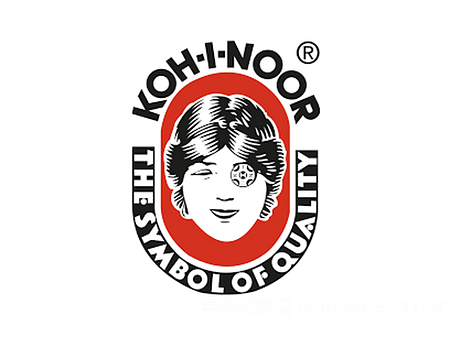 Fig. 5. The modern logo of Miss KIN.Prior to c. 1912, the Koh-i-noor press studs had no specific logo. From 1912, however, a feature of Koh-i-noor press studs was the inclusion of a motif featuring a young woman (Miss KIN), whose left eye is a press stud (Figs. 4-5). Before the Second World War (1939-1945), the Waldes company produced press studs for many European and American countries, including France (KIN Paris), Germany, the Netherlands, Spain (KIN Barcelona) , and the USA. The various cards were produced in the relevant languages, with different versions of Miss KIN.