• F4
  • F3
  • F1
  • F2

Girl with child from Walcheren in Zeeland, in the southwestern part of the Netherlands, in local costume. Photograph was taken in 1929.Girl with child from Walcheren in Zeeland, in the southwestern part of the Netherlands, in local costume. Photograph was taken in 1929.The TRC Leiden has just been given a small photo album that dates from 1929. It depicts daily life in Zeeland just before the Second World War. A way of life, including many of the garment types that have now vanished. The album includes 39 photographs taken during the holiday of Mr and Mrs N.G.J Schouwenburg from Amsterdam. They and their young daughter, Gera, then aged one, were in Zutphen in Overijssel, in the East of the Netherlands, and in Oostkapelle in Zeeland (in the south) for a holiday. It would appear that they were part of the vicars and elders associated with the Dutch Reformed Church (Nederlands Hervormde Kerk), as they stayed with Mr. van Paassen (Zutphen) and Mr. Gijsman (Oostkapelle), both of whom were vicars of that particular Protestant denomination. The album contains both family images of the Schouwenburgs and Gera (she regularly appears in the photographs).

With respect to the TRC interest in dress and identity, the images in this album present a fascinating glimpse of life for a middle class urban family (the ladies are wearing some wonderful cloche hats), who were clearly interested in the regional dress still worn on a daily basis by men, women and children in Zeeland.  We are now working hard on identifying all of the regional dress forms represented in the photographs.

These photographs can be found at the TRC Digital Collection under the numbers 2017.3322 (a-z, and za-zo), or by typing in Schouwenburg. One of the aims of the TRC is to present online a range of photographs and other images relating to textile and dress history from around the world. If you have any photographs that you know the date, place and perhaps even the people depicted, and you would be willing to donate to them TRC can you please let us know at Dit e-mailadres wordt beveiligd tegen spambots. JavaScript dient ingeschakeld te zijn om het te bekijken.. Many thanks!

Gillian Vogelsang, 31st October 2017

Stevengraph showing Queen Victoria, woven in Coventry (England) in 1841.Stevengraph showing Queen Victoria, woven in Coventry (England) in 1841.I first became interested in Stevengraphs after the TRC acquired several examples (see TRC 2013.0419 and 2013.0462 via the TRC’s digital collection). Stevengraphs are pictures woven from silk. Originally in shimmering white, silver and black threads, designers later used coloured silks to create pictures. Stevengraphs are named after the English weaver, Thomas Stevens, who developed the process.

Stevens began producing silk bookmarks and greeting cards in the 1860s, using mechanical looms and punch cards. These affordable silk pictures became very popular in Victorian England, and gradually became larger and more detailed. It was a delight, then, to discover a museum dedicated to Stevengraphs.

The National Silk Art Museum in Weston, Missouri (USA) has some 300 silk pictures on display, ranging from small souvenirs of various World Fairs, to portraits of celebrities and royalty, to large reproductions of paintings by Rembrandt, Goya and Raphael. There is also a special display of embroidered post cards of World War I, similar to those in the TRC collection. The majority of the pictures, especially ones depicting religious or sporting scenes, are from France, not England, produced by firms such as Neyret Freres.

The exhibition opens with a display (post cards, photographs and stereoscope slides) on the history of silk production, with an emphasis on 19th century American involvement in silk. In 1603, silk worm eggs and mulberry seeds were sent to the British colony of Virginia, by order of the English king, in the hope of establishing a silk industry that could compete with French and Italian silk production. Crops like tobacco and indigo, however, proved more commercially successful. There were many silk mills, mostly in the eastern USA, during the latter half of the 19th century and early 20th.

Stevengraph showing Joan of Arc.Stevengraph showing Joan of Arc.In the 1830s there was a get-rich-quick craze (similar to the 17th century ‘tulip mania’ in the Netherlands), which involved planting hectares of mulberry trees in order to raise silk worms. The craze ended in failure, and most American mills imported raw silk from elsewhere.

The collection of the National Silk Art Museum began as a sort of craze, too, according to the curator John Pottie, who has put together the collection. “I collected sports memorabilia. In 1980 I bought a small engraving of French billiard players. When I got it home I realized it was silk, not an engraving.” Pottie fell in love with the way silk pictures change in light. “It’s almost as if they are breathing,” he said. Everything about Stevengraphs, from the way they look to the way they are produced, fascinates him. It is easy to see why after seeing the collection on display.

Shelley Anderson, 25th October 2017

Mormon modest clothing for a temple visit, Utah (US).Mormon modest clothing for a temple visit, Utah (US).Earlier this year, the British BBC reported on an unexpected but growing fashion trend: modest clothing. While reporters found many different ideas about what constituted modest clothing, there was agreement that the trend is being fueled by younger Muslim women who do not want to compromise either their faith or their sense of self-expression through what they wear.

But modest fashion, with dress hemlines below the knee and higher necklines, is also important to many other people. Among these are members of the Church of the Latter Day Saints (LDS or Mormons), a Christian religious group that began in the USA in the 19th century. There are approximately 15 million Mormons around the world today, with over half living in the US. “Our bodies are sacred, so we need to clothe it appropriately,” one American Mormon told me. “We dress modestly in order to not call attention to ourselves. This means not exposing our bodies, so no see-through or sheer clothing, but also not wearing loud colours. I think it boils down to showing respect for myself and my body.”

Both Mormon men and women should dress modestly, she said. “In an everyday situation you probably won’t be able to spot an LDS member. Maybe at the beach, because men would wear longer swim trunks, and women would be in a one piece bathing suits—no bikinis.” Clothing worn to Sunday church services is mostly a personal “matter of taste,” she continued. “I have a long red dress. It’s modest, but I don’t wear it to church because it’s loud.”

Mormons who are initiated and make additional spiritual commitments also go to a temple. The clothing worn to temple must be all white, which symbolizes purity. Women wear white dresses with long sleeves, which are either mid-calf or ankle length, and white shoes. Men wear white suits and ties and white shoes. Larger temples may rent out this clothing, which is considered sacred, or believers can buy the clothes at LDS clothing centres.

Other clothing that is considered sacred is special underwear. Called ‘garments’, these are available at LDS clothing centres only for Mormons who have made certain personal commitments. “Garments remind us of the spiritual promises we have made. They’re sacred. The only time you don’t wear them is in the shower, or swimming, or when you are being intimate.” Garments are always white—except in the case of Mormon military personnel. The LDS and the US military have agreed that Mormon service members can wear camouflage garments.

While I was allowed to photograph the modest clothing for sale at a LDS clothing centre in Utah, I was not allowed to photograph the sacred garments.

Shelley Anderson, 8th October 2017

Joost Kolkman photographing Father Antonios of the Syriac Orthodox Church in the St. Ephrem monastery, Glane, the Netherlands. Thursday, 5th October 2017.Joost Kolkman photographing Father Antonios of the Syriac Orthodox Church in the St. Ephrem monastery, Glane, the Netherlands. Thursday, 5th October 2017.The last few months we have been helping with a small exhibition about the life and work of His Eminence, Mor Julius Yeshû Çiçek, the former Syriac Orthodox archbishop for Central Europe, at the St. Ephrem Monastery in Glane, in the Netherlands. On the 5th November there will be a memorial service at the monastery in honour of the bishop, who died on the 29th October, 2005, and was laid to rest at the monastery on the 5th November.

Thanks to the help of the Volkenkunde Museum in Leiden, two large showcases can be used to present items relating to the life of Mor Julius Yeshû Çiçek, including his calligraphy equipment and amazing artwork. There will also be three outfits that he wore and other items, such as his slippers (worn during services) that are decorated with pearls. Joost Kolkman, our indefatigable TRC photographer and web designer, Willem and myself were busy at the monastery on Thursday, sorting out items, dressing mannequins in the bishop's clothing, taking photographs of objects, buildings, statues, etc. We really enjoyed the day, working together with the ever so friendly, helpful, and very resourceful members of the community.

We also worked on the next Syriac project, which is about monastic and liturgical dress. Joost took beautiful photographs of some of the priests and monks, and their clothing.

The photograph shows the team in full swing: Joost takes a photograph of Father Antonios, I am holding up a piece of foam board to redirect the light, and Willem took this picture. In the background you can see one of the large showcases on loan from the Volkenkunde Museum in Leiden.

Gillian Vogelsang, 8th October 2017

Just had a few days in Brighton on the southern coast of England. I was attending a one-day meeting on Fashioning Africa, which is a project organised by the Royal Pavilion and Museums. The Project is about looking at, talking about and collecting African fashion, both traditional/classic forms as well as items made by specific fashion designers in various countries, including Ghana and Nigeria.

The meetings were very well attended, with colleagues, students and other interested people from all over Britain (and one from Holland) attending and taking part. There were two sessions, one with lectures and an afternoon session focusing on objects. For the first time ever I was described as a global textile specialist! I quite like the title.... now to make it true. Anyway, going back to the morning talks, it was fascinating hearing from the various speakers and how they approached the subject, the question of ethical collecting, and why should a British museum collect African garments? However, the question was turned around by referring to the large Afro-British population here, therefore why would you NOT collect items that represent their cultural background?

The afternoon session was spent looking at various groups of objects and explaining some of the different ways of looking at them, why were they made, what are they saying, etc. Participants moved from one table to another. There were tables with woven, dyed, and embellished forms, and some specialists explaining. At my table (embellished), I was not sure whether I had said the same things to all the groups, or had missed things out, let alone talked about all the objects. But the questions, comments and suggestions kept me going. There were some really interesting points made.

There was also a mystery object that the museum had put on my table..... Anyway, it turned out to be an Egyptian appliqué, something I know a little about as we had an exhibition on this subject at the TRC some years ago (for the TRC digital Egyptian appliqué exhibition, click here). Quite a relief.

One thing that was clear is that people's knowledge of fashion was good, but lacking in how to recognise basics, such as what is made of cotton, what is hand sewn, different types of weaves and embellishments. It has made me really think hard about a 5-day intensive textile course just on African textiles. If you are interested let me know and I will see what we can arrange with Brighton.

It was good having the chance to talk with colleagues, see people I had not seen for a while (including several who had been to Leiden on the normal 5-day intensive textile course), and to meet with students and enthousiasts with a passion for textiles and the stories they can tell.

Gillian Vogelsang, 1st October 2017

Four of the nine frames illustrating the various stages in binding and dyeing an ikat cloth.Four of the nine frames illustrating the various stages in binding and dyeing an ikat cloth.The last few days have been spent sorting out, tidying up and getting on with cataloguing and updating items for the TRC Collection, following the very busy week we have just gone through. Among some of the items registered is a wonderful series of frames made by the ikat weavers from Kalimantan (Borneo), who were at the TRC in August. The nine frames illustrate the various stages of setting up, binding and dyeing a set of warp threads (‘web’) using the ikat (resist, binding) technique before the coloured threads are woven into a piece of cloth.  At the same time the TRC acquired a loom used in the making of an ikat cloth, as well as an example of the finished product. All of which can be viewed on our collection online (nos. TRC 2017.3127- 2017.3129).

The design chosen by the weavers for these pieces (both on the frames and the finished item) is a stylised boat, symbolising the journey through life - both for me and the TRC. This symbol led me to think about one of the functions of the TRC, namely as a ‘Cultural Ark’, a title we were given by the Yemen Ambassador a few years ago when he came to see our Yemeni dress collection, while talking about the current civil war in the country that is causing so much havoc in so many directions.

Basically the TRC Leiden is a ‘boat’ that is home to examples of different production techniques, textiles, garments, and so forth that are not only stored here, but equally important, these items can be viewed, researched, published and exhibited, so that everyone around the globe can see them (actually or digitally), as well as preserving these objects for the future. The library, lectures and workshops are all part and parcel of the TRC experience and journey to becoming one of the most accessible cultural heritage resources (anywhere).

Over the next few weeks we are going to highlight various aspects of the TRC Collection, things that are old, new, large, small, smelly….. but all with a story to tell. Not bad for a ‘little’ institute in Leiden!

Gillian Vogelsang, 20th September 2017

Amish apron, Jamesport, Missouri, USA, 2017 (TRC 2017.2999).Amish apron, Jamesport, Missouri, USA, 2017 (TRC 2017.2999).Jamesport, Missouri (USA), is a small farming town surrounded by hectares of maize fields. Its official population is approximately 500 people. There is one other thing you should know about Jamesport, which made it perfect for my mission of expanding the TRC’s collection of North American textiles.

Jamesport is home to the largest community of Amish people west of the Mississippi River. Some 165 Amish families live and farm around the town. You can see them driving horse-drawn buggies on the roads (the use of cars and electricity is considered too worldly). They worship according to their Anabaptist beliefs and still speak the German dialect their ancestors did when they first came to North America in the 1700s. They also wear a distinctive form of clothing that they call ‘plain’ or ‘simple’ dress.

I wanted to buy some examples of this clothing for the TRC. Amish clothing is unadorned, in muted colours. The women wear ankle-length dresses, with an apron and bonnet; the men long trousers with shoulder straps. The clothing appears old fashioned in the 21st century and immediately distinguishes the wearer as a community member.

Pair of trousers for an Amish man, from Jamesport, Missouri, USA, 2017 (TRC 2017.2986).Pair of trousers for an Amish man, from Jamesport, Missouri, USA, 2017 (TRC 2017.2986).It was easy to find Amish quilts for sale in Jamesport. This distinctive style is immediately recognizable: dark colours (except for the pattern known as Star of Bethlehem or Broken Star), no checks or prints, with a centre dominated by an abstract motif, frequently of bars or stripes or blocks, with wide, unadorned borders. Amish quilts are also very collectible and sell for USD 1000 to USD 2000.

Amish clothing, however, wasn’t so easy to find. Fortunately, two shops in Jamesport gave me the same advice: drive down the hill for three miles, cross the railroad tracks, and look for the first building on the left. The directions were spot on: inside this shop were rows and rows of used Amish clothing, plus pickles, preserves, and other home goods for sale.

All the clothes were of a synthetic mix (except for a few pairs of denim trousers), and were of factory woven material. The clothes were also all skilfully home made, except for the men’s long sleeved white shirts (TRC 2017.2981), which were factory-made. Male trousers (TRC 2017.2982, 2017.2986) had a buttoned fall-front flap, with pockets and shoulder straps in the same material. While trousers for adult males and younger boys had buttons, some clothes for infants (TRC 2017.2984 and 2017.2983) used metal snaps. Many Amish consider zippers too worldly and will not use them.

While the male clothes showed no personal embellishments, there were small differences in some of the adult women’s dresses (TRC 2017.2995a, 2996, 2998). Almost all were loose fitting and ankle length, in solid pastel colours (primarily blue, grey, and green), with no prints or checks. Some featured a yoke or bib in the same material and most had a pocket. Sometimes an apron was made of the same material as the dress. While all the sleeves reached below the elbow, some women had made close-fitting cuffs, others loose. On some dresses a thin strip of the dress material has been sewn around the cuffs, a discreet embellishment. I did find one unfinished woman’s white dress with thin stripes (TRC 2017.2997), which made me curious about its story. All the clothes can be seen in the TRC’s on-line catalogue at www.trc-leiden.nl.

18th September 2017, by Shelley Anderson

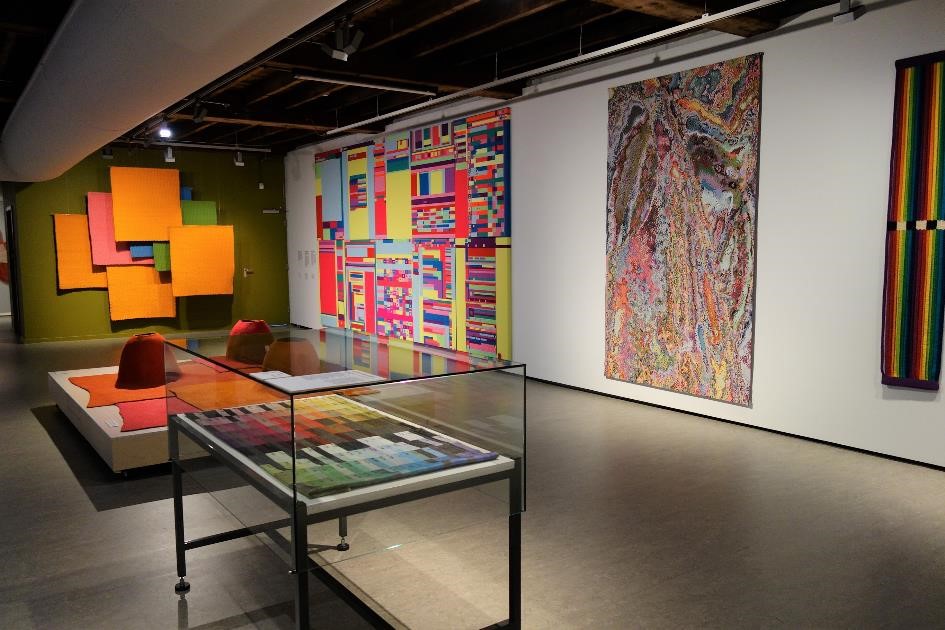
Opening of the TRC exhibition "Dressing the 'Stans', 12th September 2017, by Prof. Peter Frankopan.Opening of the TRC exhibition "Dressing the 'Stans', 12th September 2017, by Prof. Peter Frankopan.This last week has been extremely busy thanks to a wide range of activities taking place at the TRC Leiden. Monday was spent putting the last touches to our new exhibition called Dressing the ‘Stans’: Textiles, clothing and jewellery from Central Asia. This exhibition was created as part of the Asia Year celebrations in Leiden that culminated in the opening of the Leiden University’s new Asia Library by H.R.H. Queen Maxima of the Netherlands.

The TRC exhibition (which was not opened by the Queen), was in fact opened on Tuesday by Prof. Peter Frankopan, Oxford University and author of the now famous book The Silk Roads (2015). Prof. Frankopan gave a short, but very much to the point, talk about the important role of textiles, especially silk, in linking cultures and groups together over the centuries. The exhibition will be on display until mid-December, so you will have ample chance to see it. In addition, in a few weeks’ time a digital version of the exhibition will appear on the TRC digital exhibition list (which is getting longer and longer with a range of very different exhibitions!).

Dressing the 'Stans' exhibition, from 12th September until 22 December 2017.Dressing the 'Stans' exhibition, from 12th September until 22 December 2017.Anyway back to Tuesday, the opening was followed by a light buffet, which gave everyone the chance to talk with Prof. Frankopan and to see the exhibition. Various guests promised items from home for the TRC Collection. Speaking of which, we were offered some Dutch regional dress items from one family from Nieuwland (Nieuw- en Sint Joosland) in the south of the Netherlands. Thanks to the generosity of one of the ‘Friends of the TRC’ who was at the opening, these items will be coming to the TRC next week and will enhance our growing Dutch regional dress collection.

Wednesday was spent with visitors to the exhibition, sorting out administration and getting my lecture ready for the following day. Thursday was spent meeting people at the Pieterskerk Leiden, following the opening of the Asia Library by Her Majesty. I was also able to talk with more people about the TRC (including the new British Ambassador to The Netherlands). Networking and getting the message about the TRC known to a wide range of people is important! And yes, we were offered as a donation some more textiles by an elderly lady whose father and mother collected embroideries and other items from Asia.

In the afternoon I gave a lecture as part of the Opening celebrations. To my surprise, it was a full house and people were standing (well one person was, but as it was Peter Frankopan, I am not complaining!). It was fun to talk about the exhibition and what we are doing to such an interested group.

Friday was spent tidying up, photographing and cataloguing some items from Turkey related to the Syriac Orthodox Church, as well as Afghan garments and textiles kindly given by May and Rolando Schinasi from Nice in France (all these are now online, see our catalogue). We also sorted out and sent off a grant proposal to the Prins Bernhard Cultuur Fonds. This proposal is all part of a really exciting project that the TRC recently got involved in – if you are a knitting fanatic and interested in a challenge, please keep an eye on the TRC website! I can say no more at the moment, but it's BIG.

And now to find twice as much space and four times the amount of money to house, present and enjoy everything! But before all of that happens, a cup of tea and a biscuit are required.

Gillian Vogelsang, Saturday 16th September 2017

Zoek in TRC website

Contact

Boerhaavelaan 6
2334 EN Leiden.
Tel. +31 (0)6 28830428  
office@trcleiden.org

facebook 2015 logo detail


instagram vernieuwt uiterlijk en logo


Bankrekening

NL39 INGB 0002 9823 59, t.a.v. Stichting Textile Research Centre.

Openingstijden

Het TRC is gesloten tot maandag 4 mei vanwege de verhuizing naar de Boerhaavelaan. We blijven bereikbaar via email (office@trcleiden.org) of telefoon: 06-28830428.

Financiële giften

Het TRC is afhankelijk van project-financiering en privé-donaties. Al ons werk wordt verricht door vrijwilligers. Ter ondersteuning van de vele activiteiten van het TRC vragen wij U daarom om financiële steun:

Giften kunt U overmaken op bankrekeningnummer (IBAN) NL39 INGB 000 298 2359, t.n.v. Stichting Textile Research Centre. BIC code is: INGBNL2A

U kunt ook, heel simpel, indien u een iDEAL app heeft, de iDEAL-knop hieronder gebruiken en door een bepaald bedrag in te vullen: 


Omdat het TRC officieel is erkend als een Algemeen Nut Beogende Instelling (ANBI), en daarbij ook nog als een Culturele Instelling, zijn particuliere giften voor 125% aftrekbaar van de belasting, en voor bedrijven zelfs voor 150%. Voor meer informatie, klik hier