• F1
  • F3
  • F4
  • F2

As a follow up to my visit to the Fowler Museum, Los Angeles, in April/May of this year, and my blog about the visit, I thought the TRC’s blog readers might be interested in having further details about the textile activities of the Museum and in particular about the Fowler Museum Textile Series (as far as I could see this series is not listed on the Fowler Museum website).

The series was started in 1998. It contains a series of well-illustrated monographs about the history and types of textiles and garments from around the world. These books are written by specialists in the various fields of textiles studies.

The Fowler Museum Textile Series includes the following titles. Copies of many of these books have recently been donated to the TRC:

  • Roy W. HAMILTON (1998), From the Rainbow’s Varied Hue: Textiles of the Southern Philippines (ISBN: 978-0930741655).
  • Doran H. ROSS (1989). Wrapped in Pride: Ghanaian Kente and African American Identity (ISBN: 978-0930741693).
  • Patrick DOWDEY (1999), Threads of Light: Chinese Embroidery from Suzhou and the Photography of Robert Glenn Ketchum (ISBN: 978-0930741716).
  • Anne SUMMERFIELD (1999), Walk in Splendor: Ceremonial Dress and the Minangkabau (ISBN: 978-0930741730).
  • Sharon Sadako TAKEDA (2002), Japanese Fishermen’s Coats from Awaji Island (ISBN: 978-0930741860).
  • Gloria Granz GONICK, Yo-ichiro HAKOMORI and Hiroyuki NAGAHARA (eds, 2003), Maturi! Japanese Festival Arts (ISBN: 978-0930741914).
  • Chapurukha M. KUSIMBA, J. Claire ODLAND and Bennet BRONSON (eds; 2007), Unwrapping the Textile Traditions of Madagascar (ISBN: 978-0930741945).
  • B. Lynne MILGRAM and Roy W. HAMILTON (2008). Material Choices: Refashioning Bast and Leaf Fibers in Asia and the Pacific (ISBN: 9780974872988).
  • Rens HERINGA (2010). Nini Towok’s Spinning Wheel: Cloth and the Cycle of Life in Kerek, Java (ISBN: 978-0977834426).
  • Roy W. HAMILTON (2012). Weavers’ Stories from Island Southeast Asia (ISBN: 978-0977834495).
  • Elizabeth Wayland BARBER and Barbara Belle SLOAN (eds; 2013). Resplendent Dress from Southeastern Europe: A History in Layers (ISBN: 978-0984755035).
  • Elena PHIPPS (2013). The Peruvian Four-Selvaged Cloth: Ancient Threads/New Directions (ISBN: 9780984755059).
  • HAMILTON, Roy W. and Joanna BARRKMAN (eds., 2014). Textiles of Timor: Island in the Woven Sea, Los Angeles: Fowler Museum Textile Series no. 13. ISBN 978-0930741501.

All of these books are well worth having, as they provide detailed information about the use of textiles and dress in various parts of the world. In particular the colour illustrations make these volumes special. Over the next few months the Fowler Textile Series books now at the TRC will be described separately in the column Books Showcased.

Gillian Vogelsang, 28th May 2017.


Impression of the exhibition at the Musée de Lyon, France.Impression of the exhibition at the Musée de Lyon, France.Lyon, France, is proud of its textile history. This begins in the city’s airport, where mannequins in designer clothes are scattered throughout the arrival hall. Their plaques state that Lyon has been the Silk Capital of France since the 16th century, and continues to produce luxury silks, taffetas, velvets and laces for top fashion brands. Then there’s a Metro line called “La Soie” (“Silk”) and glossy advertisements for a candy named “Le Coussin de Lyon” (the “Cushion of Lyon”, after a silk cushion in front of a local statue of the Virgin Mary).

It is Lyon’s Textile Museum, however, that really showcases the city’s love affair with silk. The Museum has one of the world’s largest textile collections with some two and a half million objects, spanning 4000 years. The collection was begun in 1864 by the city’s Chamber of Commerce, which still runs the Museum. Herein lies a problem: several years ago the government cut its subsidies for Chamber of Commerces by 40 percent. The Lyon Chamber of Commerce decided it could no longer afford to keep the Textile Museum and its sister collection, the Museum of Decorative Arts.

Museum staff and supporters are working hard trying to secure private funding to keep the Museum open. If they do not succeed, the Museum may close at the end of this year and the collection will be divided up. Given that the Museum also houses a conservation and documentation centre and is headquarters, since 1954, for the prestigious Centre International de’Etude des Textiles Anciens (CIETA), this would be a blow to textile research.

It would also be a blow to the average textile lover, if the Museum’s most recent exhibition “The Genius of Industry” is an indication. It is a stunning exhibition of 18th and 19th century Lyonnaise fabrics, mostly used to decorate walls and furniture in wealthy homes or in palaces such as Versailles. The exhibition opens with a 19th century wood and iron dryer, beautifully decorated on the outside with Chinese images of silk production. The dryer was used to dry samples from silk bales. Silk can absorb up to one-third of its weight in water. Using this machine, prospective buyers were assured they were getting as much silk as possible.

And then come the stunning textiles: three metre long, beautifully preserved panels, many from silk and linen, often embellished with gold and silver thread. One such panel portrayed peacock feathers, bouquets of big flowers and broad ribbons, and used 48 different colours. This fabric decorated Marie-Antoinette’s bedroom walls. I was surprised at the narrowness of the panels, until I saw the exhibition’s Jacquard loom, with its width of about 40 centimetres. Because of meticulous record keeping, the names of the designer and the weaver (and, in the case of embroidery, the embroiderer) are often known. Each panel was accompanied by detailed technical information, unfortunately (for me) only in French. This is an exhibition that deserves to be seen—and a Museum that deserves to stay open.

By Shelley Anderson, 23rd May 2017

See also the blog of 22 May 2016. 

The text and designs on the damask serviette woven for the wedding of Philip V of Spain and his wife, Queen Maria Luisa of Savoy, in 1701.The text and designs on the damask serviette woven for the wedding of Philip V of Spain and his wife, Queen Maria Luisa of Savoy, in 1701.The TRC has just acquired a large linen serviette (115 x 88 cm) that has a fascinating history. It is made from a damask weave and was designed to celebrate the marriage of King Philip V of Spain and Maria Luisa of Savoy in 1701. The cloth depicts the King and Queen, as well as the arms of both royal houses. The representations on the right hand side are a mirror image of those on the left hand side.

At the top of the cloth is the text VIVANT ET REGNENT PHILIPPUS V HISPANIARUM REX ET CONIUX EIUS LUDOVICA REGINA ('MAY PHILIPS V, KING OF THE SPANISH, AND HIS WIFE QUEEN LUISA LIVE AND REIGN LONG') set inside a laural wreath.

The reason why serviettes in this period were so large is because women's dresses were particularly grand and a large piece of cloth was needed to protect the garments during meals.

Philip V (1683-1746) was the grandson of Louis XIV of France. His accession to the Spanish throne in 1700, which led to close dynastic links between France and Spain and the shifting of the balance of power in Europe, resulted in the War of the Spanish Succession, which was concluded in 1713 with the Treaty of Utrecht (and the occupation by Great Britain of Gibraltar, and the port of Antwerp being permanently blockaded by the Dutch). His wife was fourteen years old when she married. She died in 1714 of tuberculosis. 

Gillian Vogelsang, 10th May 2017


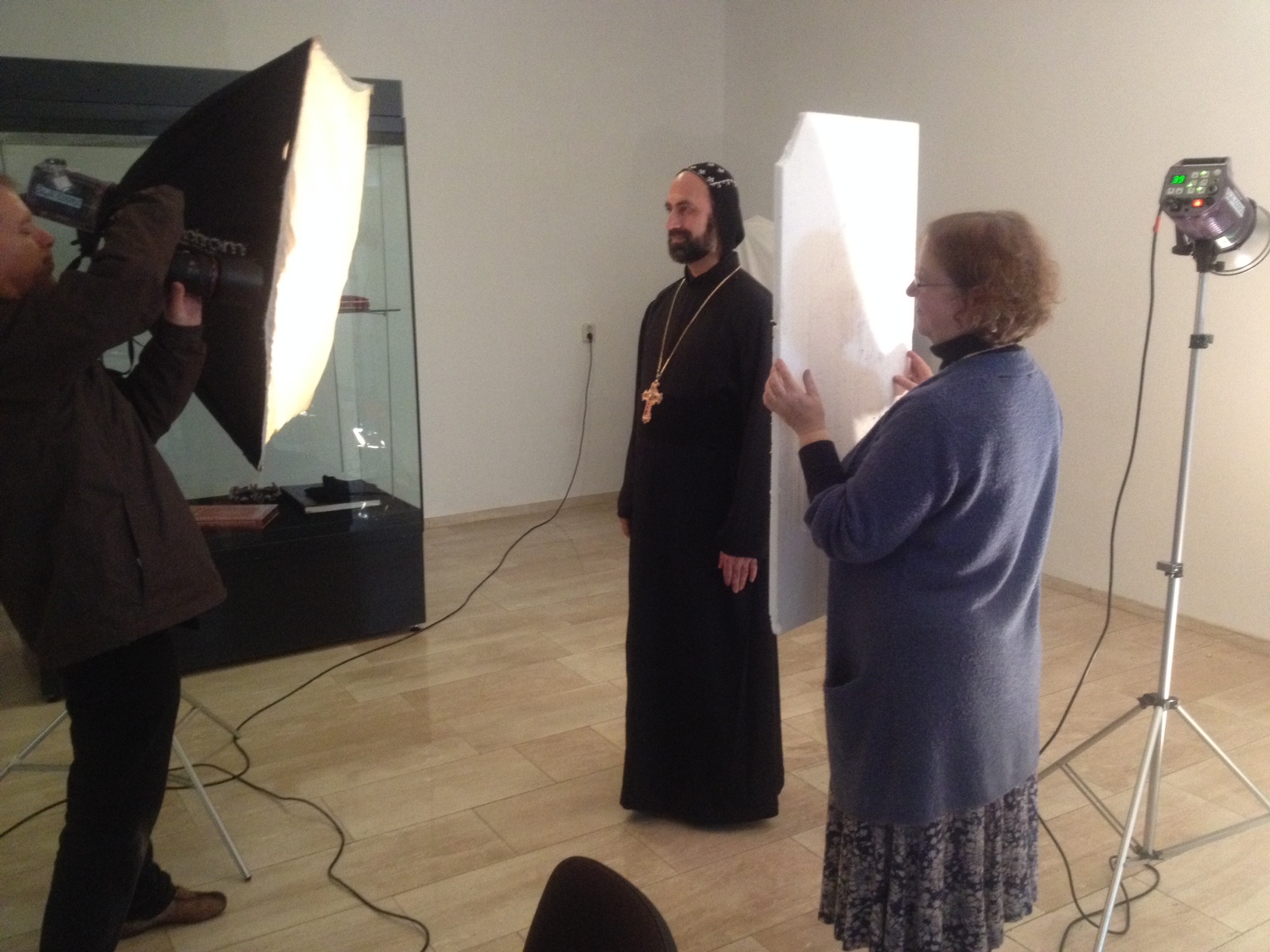
Fowler Museum, Los AngelesFowler Museum, Los AngelesFor the last week or so I have been in sunny Los Angeles, soaking up ..... textiles. I was asked by the Fowler Museum, UCLA, to comment on a collection of Syrian garments they are in the process of being given by a private collector. The garments are a spectacular group and all being well will feature in an exhibition at the Museum in about 18 months from now.

I left Leiden on the Thursday in order to get over jet lag in time for work on the following Monday and to see some friends. Friday saw a visit to the Getty Museum, and the chance to see four hundred years of European paintings. Including some, but not as many as I had hoped for, with embroidered garments. It was worth it though, just to experience the Getty and its architecture.

On Saturday afternoon, I gave a lecture about embroidery in the Arab world to the Textile Museum Associates of Southern California (TMA/SC) based in Los Angeles. Despite a change of venue and time there was a full house and extra chairs had to be sought. The lecture was called "1001 Embroidered Tales" and looked at the social and economic stories behind individual pieces and groups of embroideries in the Middle East. At the end of the meeting various members of the public displayed and talked about items they had brought with them. It was great fun. I also had the chance to talk about the work of the TRC and several people offered their help in obtaining pieces and thinking who might be willing to financially help the TRC. A special guest was Professor Olaf Kaper from Leiden, board member of the TRC, and presently in Los Angeles upon the invitation of the Getty.

We later also briefly discussed the possibility of setting up a non-profit society called "American Friends of the TRC." More about this in due course. One lady in particular, Marge Gajicki (The Folk Motif) went out of her way (literally as she lived in Long Beach about 50 km away) to get items of Hispanic and Western clothing, including a bolo tie that was given by her brother-in-law and several shirts of different styles, including Western, Hispanic and Hawaiian forms. Many thanks Marge! It means that I can face Shelley and Maria (two American volunteers at the TRC) with a calm heart when I get back as they want to build up the American dress collection at the TRC and I was given a shopping list, always an interesting moment.

Monday saw work start on the collection at the Fowler and the next few days were spent in photographing, cataloguing and A woman's outdoor coat from Uzbekistan, donated to the TRC by David and Elizabeth Reisbord.A woman's outdoor coat from Uzbekistan, donated to the TRC by David and Elizabeth Reisbord.discussing the collection, as well as talking with the exhibition and the publication committees. On Wednesday evening I gave a talk to the Fowler Textile Council at the Museum, with the chief curator of the Museum, Matthew Robb as my 'assistant'. One of the guests was Willeke Wendrich, now Professor of Egyptology in Los Angeles, who was one of the first Board members of the TRC in Leiden. She and her husband have been friends of long standing ! My talk was about the garments I was working on and the audience was given a sneak preview of an exhibition that does not (yet) exist. All I can say is that if and when the paper work is in order it will be a colourful and surprising display of Syrian garments, most of which date to the early 20th century.

While at the Fowler Museum it was mentioned that they had a series of books about textiles and clothing (well worth looking into). So on behalf of the TRC Library I went into begging mode and Marla Berns, the director of the Museum, very kindly agreed that the TRC could have any books on textiles and dress in their various series. This amount to 22 titles! Not only that, but the Museum paid for their postage to Leiden as they were far too heavy for me to take back in my (small) suitcase. This is a very generous gift and one which is greatly appreciated. The books will appear in the TRC Books Showcased over the next few months, we may even have a special issue dedicated to Fowler books.

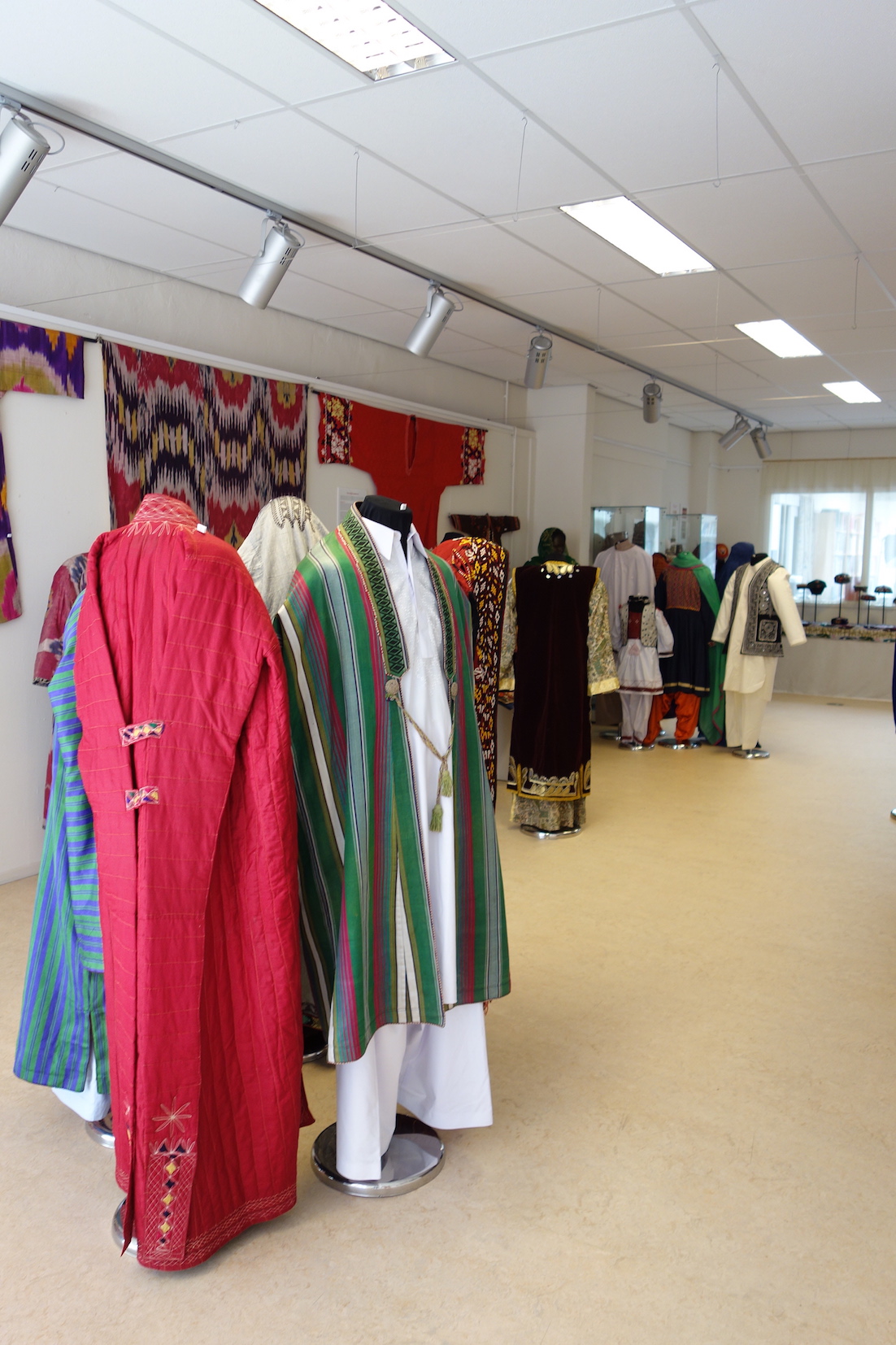
The next few days prior to leaving were spent with friends, David and Elizabeth Reisbord, looking at their textile collection and dreaming of what the TRC could and should do in the future. They very kindly gave the TRC a group of Guatemalan textiles and garments and Indian embroideries. The latter will be used in the TRC's forthcoming encyclopaedia about embroideries from Iran, Central Asia and the Indian subcontinent. In addition, the TRC was given several textiles and a woman's coat from Uzbekistan (TRC 2017.0785), which can be seen in our forthcoming exhibition called "Dressing the Stans" that opens in September 2017 at the TRC Gallery.

Before signing off I would like to thank various people for making my trip to LA particularly memorable, notably David and Elizabeth Reisbord, Marla Berns (director of the Fowler Museum), Matthew Robb (senior curator of the Fowler Museum), the dedicated members of the TMA/SC and those of the Fowler Textile Council, many of whom belong to both groups. There is certainly a lot happening within the textile and dress field in the LA district and more is coming. Well worth keeping an eye on.

And the highlight of my trip to LA? Paddling in the Pacific Ocean with Elizabeth….

Gillian Vogelsang, 9th May 2017

Watteau in the Teylers Museum, Haarlem.Watteau in the Teylers Museum, Haarlem.“Watteau” is an exhibition now at the Teylers Museum in Haarlem. There is much to interest anyone with a love for fashion and textiles at this exhibit. Jean-Antoine Watteau (1684-1721) was an influencial French painter, famous for his depictions of prosperous people enjoying themselves at the theatre, dances, hunts and in nature. Watteau himself was fascinated by costumes and fashion. Clothing is prominent in the many prints and chalk sketches on display.

During his life time, French dress was changing from a heavy and ornate style, espoused by King Louis XIV, to less restrictive and simpler wear. This trend was influenced by a revival of interest in ancient Rome and Greece—and in what 18th century Europeans thought the ancients wore. Silk, velvet and brocade were popular materials in 18th century France and a lighter material, a mix of silk and cotton called bombazine, was also coming into fashion.

Watteau’s passion for dress is clear from the dozens of etchings, prints and paintings on display. He drew peasants and soldiers, but also Persians (an official Persian envoy reached Paris in 1715), merchants and aristocrats, always highlighting their clothing. Watteau also drew fashion plates himself. These were commissioned, not by fashion houses, but by publishers who wanted to profit from the public’s eagerness for fashion.

A very clear idea of contemporary French style emerges: men in flared coats and breeches, women in long gowns with wide hips made using metal paniers or hoops. Both men and women’s clothing is beautifully embroidered, details which Watteau meticulously represents in his work. The patterns reminded me of many designs in TRC’s Van Gerwen collection of 16th to 18th century European silks and velvets.

Fortunately there is also a real 18th century woman’s dress on display at the exhibit, loaned by the Rijksmuseum in Amsterdam. This is a beautiful cream-coloured silk dress, dated around 1760, worn for both day and evening wear. The dress is damask, with woven stripes and tendrils, and decorated in a multi-coloured pattern of flowers. There are deep box pleats from shoulder to floor at the back. Watteau painted this type of gown so often that this style is actually called pli Watteau.

In an age without mass communication, Watteau’s paintings and drawings helped to spread ideas of fashionable wear. Also on display are masks and costumes, futuristic and whimsical in turn, created specifically for the exhibit by fashion students of the Rietveld Academy. Watteau is still inspiring fashion today.

“Watteau” is on until 14 May at the Teylers Museum: www.teylersmuseum.nl

Shelley Anderson, 25th April 2017

British wounded soldiers sewing for Syrian/Palestinian refugees.British wounded soldiers sewing for Syrian/Palestinian refugees.We just came across a remarkable photograph housed in the Library of Congress. The photograph is particularly poignant considering the current situation in the Middle East. But it also illustrates an old relationship between sewing, embroidering, and the military.

The Red Cross caption card tells the following: "British soldiers sewing for the Syrian refugees. A favorite pastime which has excellent results is the work of the convalescent soldiers now recuperating in Egypt... The men are busily making clothes for the destitute inhabitants of Palestine." The photograph probably dates to the period 1917-1920.

Sewing and working embroidery were often used in the past to help soldiers recovering from war-time wounds and traumas. TRC Needles provides some examples. Compare for instance the Bradford Khaki Handicrafts Club, which was established in 1918 in Bradford, West Yorkshire, UK, to provide occupational therapy and employment for men returning from the First World War (1914-1918).

Another example is a piece of embroidery made by Major Alexis Casdagli during the Second World War (1939-1945). He was captured in 1941 and remained a POW until the end of the war. While in The Casdagli sampler, 1941.The Casdagli sampler, 1941.captivity, he worked an embroidery that contained hidden messages worked in Morse code ("God save the King", and "Fuck Hitler"). During his captivity, Casdagli also ran a needlework school for other officers in the POW camps. He later said that the Red Cross saved his life with food parcels and letters, but his embroidery saved his sanity: “If you sit down and stitch you can forget about other things, and it’s very calming.”

Finally there is private Thomas Walker, who was wounded in 1854 during the Crimean War. He was painted by Thomas Wood while sewing triangles from pieces of military uniforms. The Morning Chronicle tells us the following:

Tuesday, December 25, 1855: The Queen has forwarded to Private Thomas Walker, 95th Regiment, a present of £10. On her Majesty's last visit to Fort Pitt she was struck with a quilt brought to her notice as the work of Walker, and desired that it might be forwarded to her Majesty, which has recently been done through Colonel C. B. Phipps.


Private Walker, by Thomas William Wood, 1856.Private Walker, by Thomas William Wood, 1856.Monday, March 3, 1856
: An artist is engaged in the Military Hospital, Fort Pitt, Chatham, completing an oil painting of Thomas Walker, 95th Regiment, who has been an inmate at the hospital for fourteen months, during which period the entire top of his skull has been removed by skilfull operation at different periods by Mr. William Perry, surgical operator. The painting, which is intended for an exhibition, represents Thomas Walker in bed, busily engaged sewing together pieces of different coloured cloth, for the purpose of making the quilt which the Queen, upon seeing, was pleased to order to be sent to the palace. A part of the pattern is represented in the picture lying outside the bed. It was at the battle of Inkerman this youth received his wound, by a shell bursting directly over his head, which it fractured in the most extraordinary manner, causing insensibility for several days, until a piece of bone which pressed on his brain was removed.

Gillian and Willem Vogelsang, 25th April 2017


Detail of a cowgirl shirt embroidered with horse rider. TRC 2017.0267Detail of a cowgirl shirt embroidered with horse rider. TRC 2017.0267Pepin van Rooijen of Pepin Press, Amsterdam, recently donated many boxes of textiles to the TRC. Among them are some welcome additions to our North American collection: cowgirl clothes. Sometimes called Western wear, these items include long sleeve, plaid shirts (TRC 2017.0252 and TRC 2017.0253) and shirts with distinctive piping around the yoke and snap buttons (TRC 2017.0269 and TRC 2017.0264), sometimes embroidered with horses or red roses (TRC 2017.0257, TRC 2017.0267, TRC 2017.0253). There is an iconic buckskin-like jacket with fringes and an accompanying leather skirt with fringes on the hem (TRC 2017.0274 and TRC 2017.0275).


Western wear evolved during the nineteenth century in the American West for work in harsh conditions. There were many influences: buffalo skin coats, moccasins (worn before the mass production of boots) and decorative fringes on leather garments came from Native Americans; broad-brimmed hats, heavy belts decorated with silver, and leather chaps originated from Spanish and Mexican riders, as did the custom of embroidering red roses on shirts. Chaps evolved from a sort of leather apron, split in half in order to wrap around the legs to protect valuable cloth trousers from being damaged by cacti or dirt.
Leather and snakeskin 'cowgirl' boots. TRC 2017.0272a-b.Leather and snakeskin 'cowgirl' boots. TRC 2017.0272a-b.

The story of Western wear is also the story of American business: the use of plaid, or tartan, supposedly arose from Scottish
traders exchanging such cloth for goods by Native Americans. The iconic ten-gallon hat was invented by a hat maker from New Jersey, who moved to the West for his health. John B. Stetson fashioned a felt hat with a wide brim to keep off the sun; he gave his hat a water proof lining so he could also use it as a water bucket. Westerners liked his invention: he started mass producing hats in 1865. Shoemaker Charles Hyer of Kansas is said to have created the cowboy boot in the mid-1870s, getting inspiration from the boots that soldiers wore during the American Civil War (1861-1865). Also in the 1870s, a German immigrant named Levi Strauss started marketing tough work trousers made of blue denim, reinforced with rivets for more strength.


Detail of a cowgirl shirt embroidered with horserider. TRC 2017.0267Detail of a cowgirl shirt embroidered with horserider. TRC 2017.0267Last but not least, many of the Western wear garments recently acquired by the TRC carry the brand name Roebuck. This brand was launched in 1949 by one of America’s biggest retailers, the Sears Company, to advertise their blue jeans. By the 1950s, films and television Westerns had made cowboy wear popular in all parts of the USA. The Sears’ jeans were advertised as “friendly fittin’ as a western saddle.” The brand continues today as Sears’s line of work clothes. You can see more images of the TRC’s collection of Western wear at the TRC’s on-line catalogue.

Shelley Anderson, 12 April 2017


In the March 2017 issue of TextielPlus there was a long article about the TRC, its origins, work and the people who run this amazing place (if I may say so myself….). TextielPlus also helped organise a special day (8th April) at the TRC for its subscribers. This event consisted of two groups, one in the morning and one in the afternoon, of textile lovers, who had the chance of a guided tour of the TRC and its latest exhibition about dress and identity in the Middle East.

Both sets of visitors were very enthusiastic and enjoyed the visit to the storages, workshop, shop, as well as the exhibition. No one within the group had ever been to the TRC before, so it was a welcome opportunity to get to know each other. People had the chance to see some embroideries from the recently acquired Pepin Collection, which have featured in an earlier TRC Blog, namely a First World War flour bag embroidery, and a Gudetenland [sic] embroidery dating to the beginning of the Second World War. Two embroideries with two very different stories behind them.

The forthcoming Banjara Embroidery Crowd Funding was also discussed (starting on the 10th April 2017) and the ‘thank you’s’ were shown, including various examples of hand embroidered panels made by a group of nomadic Banjara women in southern India. These are beautiful pieces and are definitely textile ‘wants’. I suspect several donations will be coming via this talk!

A wide range of questions were posed about the running of the TRC, donations (object wise and financial) as well as its future. A number of people also signed up to become Friends of the TRC and offered help in various manners, which is much appreciated.

It was fun having the TextielPlus visitors, a group who are very familiar with the world of textiles and use this medium for various art forms. It was clear that they also understood and appreciated the TRC and what we do. It is our intention to have more open days at the TRC in the future. The next one will be on the 28th May 2017 and is being organised with the Dutch group Merkwaardig and will be about samples and samplers.

Gillian Vogelsang-Eastwood, 9th April 2017

Zoek in TRC website

Contact

Boerhaavelaan 6
2334 EN Leiden.
Tel. +31 (0)6 28830428  
office@trcleiden.org

facebook 2015 logo detail


instagram vernieuwt uiterlijk en logo


Bankrekening

NL39 INGB 0002 9823 59, t.a.v. Stichting Textile Research Centre.

Openingstijden

Het TRC is gesloten tot maandag 4 mei vanwege de verhuizing naar de Boerhaavelaan. We blijven bereikbaar via email (office@trcleiden.org) of telefoon: 06-28830428.

Financiële giften

Het TRC is afhankelijk van project-financiering en privé-donaties. Al ons werk wordt verricht door vrijwilligers. Ter ondersteuning van de vele activiteiten van het TRC vragen wij U daarom om financiële steun:

Giften kunt U overmaken op bankrekeningnummer (IBAN) NL39 INGB 000 298 2359, t.n.v. Stichting Textile Research Centre. BIC code is: INGBNL2A

U kunt ook, heel simpel, indien u een iDEAL app heeft, de iDEAL-knop hieronder gebruiken en door een bepaald bedrag in te vullen: 


Omdat het TRC officieel is erkend als een Algemeen Nut Beogende Instelling (ANBI), en daarbij ook nog als een Culturele Instelling, zijn particuliere giften voor 125% aftrekbaar van de belasting, en voor bedrijven zelfs voor 150%. Voor meer informatie, klik hier