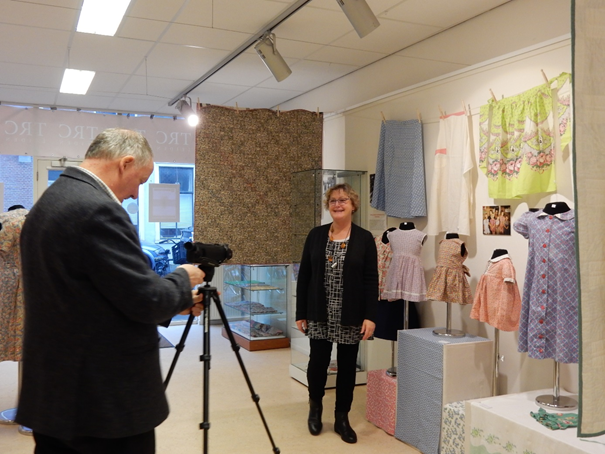
 Andrew Thompson interviewing Linzee McCray, 1st February 2018. Photograph by Shelley Anderson.We have just had a very busy, noisy and instructive week at the TRC. From the 30th January to the 3rd February it was feedsack and quilting week at the TRC. It was organised as part of the TRC’s current exhibition about American feedsacks, their social and economic context and how they helped clothe and warm (literally) thousands of Americans between the 1920’s and 1960’s. The week was made possible by Linzee McCray, author of the book Feed Sacks: The Colourful History of a Frugal Fabric (2017). The week was originally organized so that Linzee would give the lectures and workshops, while I would give the guided tours. However, it quickly became apparent that Linzee felt very much at home with the Dutch and so she offered to give all the guided tours as well.
Tuesday (30th January): Linzee gave a lecture on the history and use of feed sacks to a full audience (this lecture was the first of the activities to fill up very quickly). The participants heard the multi-faceted and at times complex story of feedsacks.
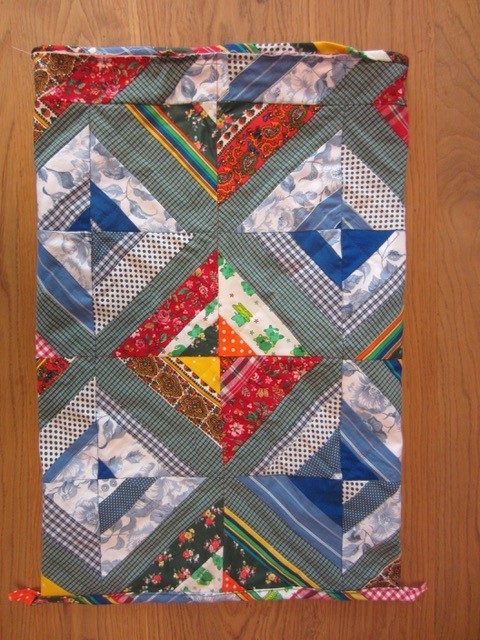
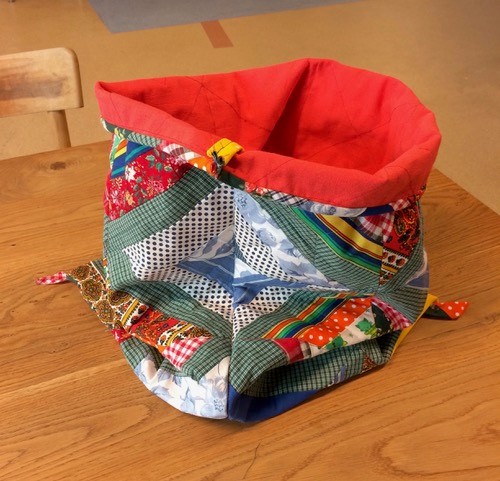
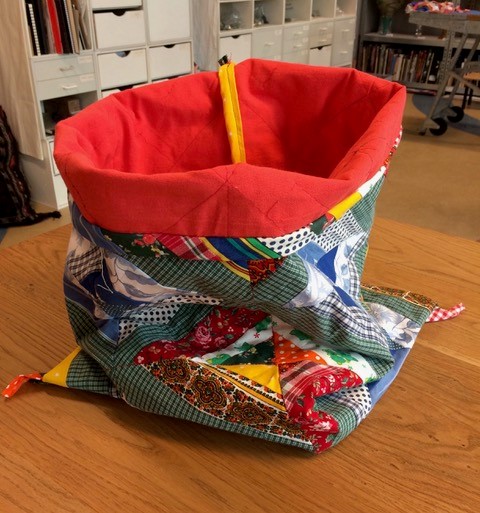
Wednesday (31st January): There was a workshop on string piecing, the use of strips of cloth to produce enough blocks to create a quilt. Again the workshop was full so the group was divided into those with sewing machines and those who wanted to hand sew. The TRC workshop is a large room and flexible, so it was easy to accommodate the 16 people who had signed up for this fascinating event. Cloth, thread, people quietly chatting, as well as the hum of sewing machines filled the TRC. During the Wednesday afternoon, Andrew Thompson came to the TRC to make a film about the feedsack exhibition and to talk with Linzee about the history of feedsacks. This film can be seen on YouTube.
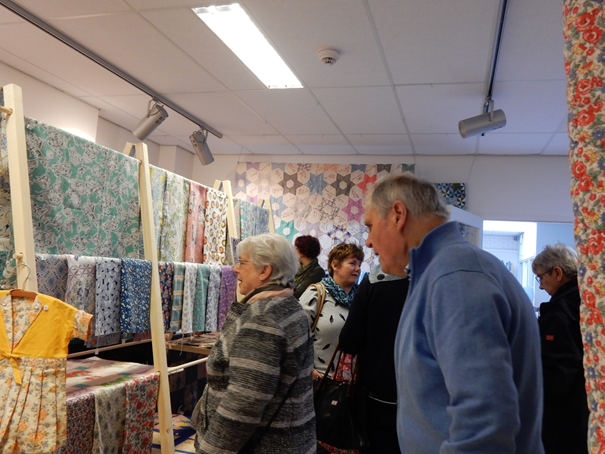 Participants to the feedsack and quilt week, inspecting the items on display. Photograph by Shelley Anderson.Thursday (1st February): This day saw Linzee giving a talk about Art quilts of the Midwest. This was based on her experience with making various art quilt exhibitions, with the central question: ‘what is quilting’ (the American definition of three layers of cloth stitched or fastened together in some manner was used), followed by ‘what is an art quilt’? It was clear that some people were in agreement with the term art quilt, while others were not. What everyone agreed with is that this type of quilting takes the technique of quilting towards a new direction.
Friday (2nd February): Friday included the second workshop on Stitch-and-Flip, a quilting technique for using every single last scrap of cloth in various colourful manners. Again the workshop was filled by enthusiastic quilters, some of whom came to every single event on each day of the quilting week.
Saturday (3rd February): Today was a question-and-answer day about American feedsacks and quilts and various people came with suitcases filled with both! There was a lively discussion concerning the history and nature of the objects brought for discussion. And in between the quilt questions, Linzee was able to give two guided tours. Before we knew it, it was half past three and nearly time to stop.
During some of the discussions that took place during the feedsack and quilting week, there was a call made for creating an International Quilting Centre that could act as a source of inspiration and knowledge about quilting – the mainstay would be American quilts, but the whole world (literally) of quilting would be included, ranging from European, Middle Eastern, Indian to other Asian items. The TRC is ready to accept this challenge! However, it would require considerable funding and space to make this idea into a reality. On the other hand we have already been offered, as donations, several quilt collections from the US and the Netherlands to ‘kickstart’ such a centre. Linzee and Sherry Cook in the US have also offered to talk with friends and collectors to help make this International Centre a reality.
The feedsack and quilt week was a great success thanks to all the TRC colleagues, Linzee McCray in particular, and the financial support of the American Embassy, The Hague. The exhibition can be seen until 28th June.
Gillian Vogelsang-Eastwood, Sunday 11th February 2018


 Bolivian woman’s hat with sequins and beads from the Tarabucco region of Bolivia (TRC 2018.0600; v/d Bijl collection).During the 1990’s Yvonne van der Bijl was travelling through Bolivia and Peru as part of her work as a travel guide author. During her visits she started to make a small collection of Bolivian and Peruvian hats for women. She used these in her books and articles, as well also as part of a gallery exhibition about South American headwear held at the LAC Gallery, Amsterdam in 1998.
 Woman’s hat with sequins and beads for an Aymara woman, Tarabuco region of Bolivia (TRC 2018.0602; v/d Bijl collection).Yvonne van der Bijl is now downsizing and tidying up and as a result a few days ago twenty Bolivian and Peruvian hats for women arrived at the TRC ! Over the next few weeks the TRC will be sorting out, cataloguing and photographing the hats, but if you know of any books and articles in which there is detailed information about the different types of Bolivian and Peruvian hat styles for women can you please get in contact with us at: Dit e-mailadres wordt beveiligd tegen spambots. JavaScript dient ingeschakeld te zijn om het te bekijken.
  Peruvian woman’s hat with deep red fringe from the Checaspampa region (TRC 2018.0593; v/d Bijl collection).
 Peruvian woman’s embroidered hat from the Cabanacone region, Colca Canyon region (TRc 2018.0603; v/d Bijl collection).