

Opus Anglicanum and Underside Couching

Opus anglicanum is a form of metal thread and silk embroidery carried out in England during the later medieval period. For the production of opus anglicanum, two or three main layers of cloth were used, firstly a strong, linen lining and secondly a ground material. If a velvet was used, a third layer of cloth was used with a design drawn upon it. This was placed over the velvet and tacked in place.
Steeple Aston Cope

The Steeple Aston cope dates from c. 1320. It is an example of opus anglicanum. It is decorated with coloured silks with silver and silver gilt thread on a fawn silk ground, woven in a twill weave. The remains of the cope belong to the Steeple Aston Church (Oxfordshire, England) and are now on loan to the Victoria and Albert Museum, London, since 1905.
Pienza Cope

The Pienza cope is a medieval ecclesiastical cope now in the Cathedral of Santa Maria Assunta, Pienza (Tuscany, Italy). The cope is believed to date from the early fourteenth century (1315-1335 according to the Princeton Index of Christian Art) and was given to the cathedral by Pope Pius II (r: 1458-1464). The cope has a broad orphrey and the remains of a hood.
Bologna Cope
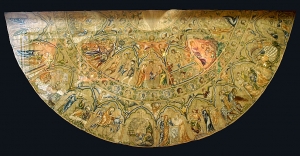
The Bologna cope is a late thirteenth to early fourteenth century cope that used to be in the church of San Domenico, Bologna (Italy), but is now in the Museo Civico Medievale, Bologna. The cope proper is still intact, but the orphrey and the vestigial hood are missing. It is 323 cm at its widest point and 147 cm high. It has been linked to the Dominican Pope, Benedict XI (r. 1303-1304)
Maltese Cross

The eight-pointed Maltese cross is in Italy also known as the Amalfi cross. The motif is associated with the Knights Hospitaller (the Knights of Malta). The shape of the cross is allegedly based on the crosses worn since the First Crusade in the late eleventh century. It has widely been used as an embroidery motif (compare Maltese lace).
Guilloche Stitch

The guilloche stitch is a composite border stitch, named after an architectural term that refers to a ornamental band with two or more interwoven, wavy lines. The two outer lines are made with stem stitch. In between, groups of three satin stitches are worked. These are threaded in two journeys, without entering the ground material, creating (irregular) circles. In the middle of each circle a French knot is made.
Threaded Chain Stitch
The threaded chain stitch is a variation on a chain stitch.
Lotus Shoes Sole Embroidery
The soles of lotus shoes (small shoes for bound feet of Chinese women) were sometimes made of layered cotton (rather than wood).
Archaeological Examples of Lotus Shoes, China
A number of ancient lotus shoes (small shoes for bound feet of Chinese women) are still extant.