

Duffel

Duffel is the name of a thick, compact woollen cloth that originated in the fifteenth century in and around the Brabant (Belgium) town of Duffel. From the late sixteenth century it was introduced to Leiden in the northern Netherlands by refugees from what is now Belgium.
Parham
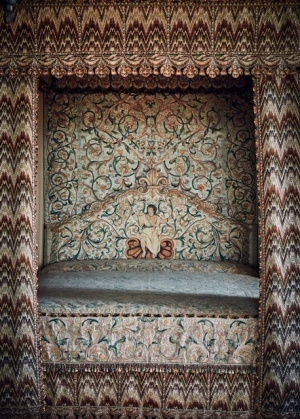
Parham is an 875-acre estate in Pulborough, West Sussex, England, which is now owned by a Charitable Trust. The land was given to Robert Palmer of Henfield by Henry VIII, and the foundation stone of the House was laid on 28 January 1577. It was sold by Robert Palmer to Thomas Bishopp, whose family remained in possession until 1922, when it was sold to Clive an Alicia Pearson. The House has since been restored.
Stitch Stories, by Cas Holmes

Stitch Stories: Personal Places, Spaces and Traces in Textile Art was written by Cas Holmes. It helps the reaxder to use his or her personal experiences, sketchbooks, photographs etc. to create personal narratives that can be used for stitched textiles.
Paulus Fürst's Embroidery Model Book
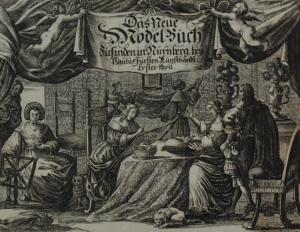
The library of the Textile Research Centre in Leiden holds an original copy of a 17th century embroidery pattern book published in Nuremberg, Germany, in 1666, by Paulus Fürst.
Chantilly lace
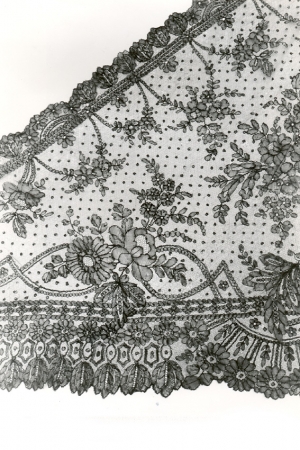
Chantilly lace is a form of handmade bobbin lace that originated in the seventeenth century in Chantilly, France. It was copied in the nineteenth century in Bayeux, also in France, and in Geraardsbergen, Belgium, but also elsewhere, such as in Gent and Brussels.
Warp
Warp was a type of woollen cloth known from the Netherlands (including Leiden, where it was one of the seven textile neringen [industry] ) from the late Middle Ages.
Angora wool

Angora wool is made up of the under hair (wool) of the Angora rabbit. Because of the hollow core of the fibres, the wool provides more warmth than ordinary (sheep's) wool. It is also much lighter. The fibres are also thin, which produces the fluffiness for which Angora wool is best known. The fibres are normally plucked rather than shaven, which reduces the amount of outer, or guard hairs in the wool.
Mohair
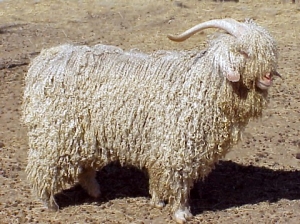
Mohair is the hair produced by the Angora goat. It is a durable fibre that has a high sheen. Mohair fabrics provide warmth in winter, and coolness in the summer. The fibres are easily spun, and take dyes relatively easily. The scales of the fibres are shallow, and the hairs are therefore generally combed, rather than carded. Mohair fibres are often mixed with other, cheaper fibres.
Hessian

Hessian is a rough, plain weave fabric made from jute fibres, generally left undyed. It is also known, in the USA and Canada, as burlap. The name is linked to the German principality of Hesse, and to the uniforms of its soldiers. Hessian cloth was first exported from India in the early nineteenth century.
WV, 22 March 2022