

Flagellation Scene
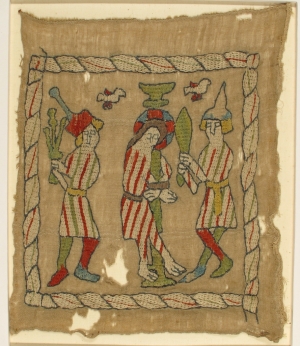
A fourteenth century embroidered panel from Lower Saxony, in what is now Germany, depicts a haloed figure, perhaps representing Christ or a saint. He is tied to a pole and is being beaten with a whip and club by two men wearing striped garments and parti-coloured hoses and shoes. There is a cup-like object (possibly the top of the column) above the haloed figure, and two birds.
Kloster Block
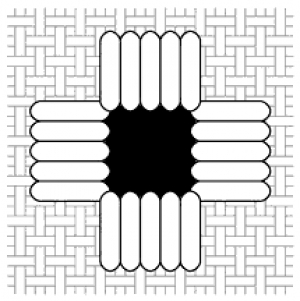
The kloster block constitutes the foundation of Hardanger embroidery. It is worked with satin stitches or straight stitches. Five of these stitches are made to cover four even-weave fabric threads. The block designs thus created are placed along the border of the area that is cut away. The stitches of the kloster blocks serve to hold the threads of the uncut parts of the fabric together.
Couching Stitch
A couching stitch fastens the laid thread to the ground material, using a couching thread. WV
Convent stitch
See Kloster stitch.
Kloster Stitch
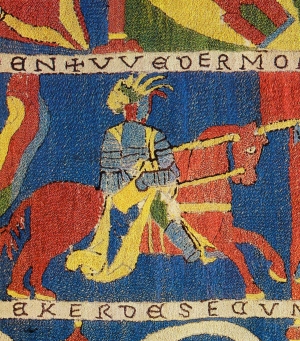
Kloster stitch is a form of couching used during the medieval period in Northern Europe (especially in what is now Germany). The Kloster stitch is especially associated with monastic establishments (known in German as a Kloster), hence the name of the stitch. It is a form of a single thread couching stitch, which is now also called Bokhara couching.
Braid Stitch
See Gordion knot stitch.
Pakko Work
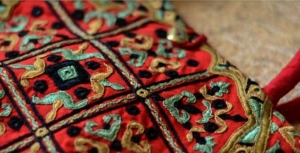
Pakko work is carried out by women of the Sodha, Rajput and Meghwal communities in the Kutch area of Gujarat, Northwest India. The motifs are generally geometric and floral, sometimes with stylized figures of peacocks or scorpions. The motifs are traditionally first drawn with mud, and then worked in maroon or red, dark green, white, or yellow, often with buttonhole stitch. Outlining is done in black, white or yellow, using a chain stitch.
Peking Knot
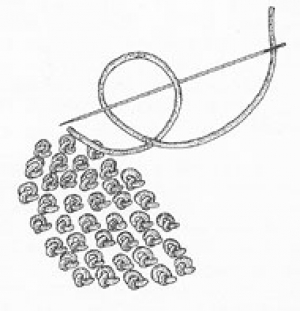
The Peking knot is characteristic for much of Chinese traditional embroidery in silk, whereby rows of these fine stitches are used to fill in the motifs. Other, more romantic names for this stitch are the blind stitch and the forbidden stitch.
Beregi Embroidery
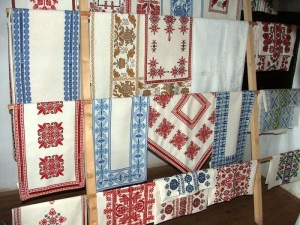
The region of Bereg lies in what is now northeastern Hungary and the adjoining parts of Ukraine. Its recent history is complicated. Until the fall of the Austro-Hungarian Empire in 1918, the capital of the region was Berehove (Beregszász). In 1920 much of the region was ceded to Czechoslovakia, with the southern part remaining in Hungary.