

Holár Vestments, Iceland
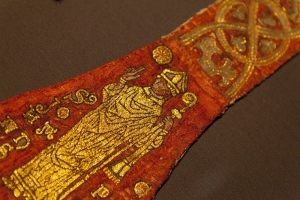
The sumptuous set of Hólar vestments, now housed in the National Museum of Iceland, are an example of the famous opus anglicanum, which during the medieval period formed an important English export product. The luxuriously embroidered garments, including an amice apparel), a stole (two fragments) and a maniple (two fragments), orginally belonged to the Cathedral church at Hólar.
Butler-Bowdon Cope
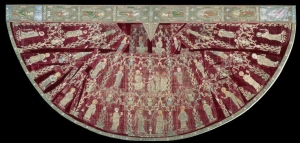
The Victoria and Albert Museum, London, houses a medieval cope, traditionally called the Butler-Bowdon cope, which dates to the first half of the fourteenth century. The cope is a prime example of opus anglicanum. It measures 165.5 by 34.5 cm.
Masterpieces of English Medieval Embroidery
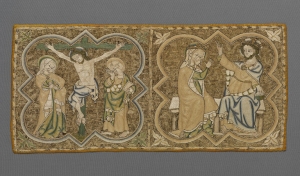
The exhibition 'Opus Anglicanum: Masterpieces of English Medieval Embroidery' opened on 1 October 2016 in the Victoria and Albert Museum, London. The exhibition focuses on one of the most famous medieval (export) products of England, namely the opus anglicanum. The exhibition of these beautifully embroidered garments is supported by the embroidery firm of Hand & Lock.
Fame at the Tomb of Shakespeare
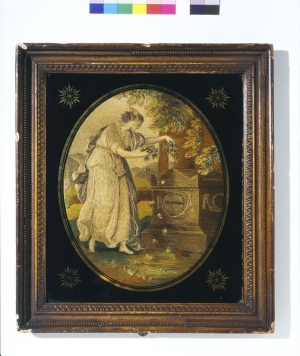
The Victoria and Albert Museum in London houses an embroidered picture that represents 'Fame at the tomb of Shakespeare', or in full: 'Fame scattering flowers at the tomb of Shakespeare'. It was made in England and dates to the late eighteenth century.
Winchcombe St Peter's Church, Altar Frontal
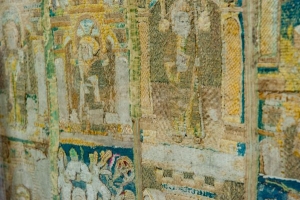
St Peter's Church in Winchcombe, Gloucestershire, England, is one of the major wool churches in the Cotswolds. It houses an altar cloth that has been linked to the first wife of Henry VIII, namely Catherine of Aragon (1485-1536), who is thought to have stitched the cloth while she resided at nearby Sudeley Castle.
Faemne aet hyre bordan geriseth
Faemne aet hyre bordan geriseth is a passage from the tenth century Exeter Book (line 63). Many of the texts contained in the book, written in Old English, are much older.
Chemise de Sainte Balthilde
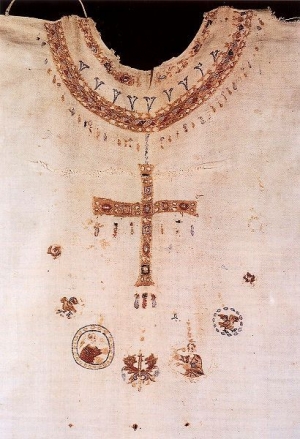
The so-called 'Chemise of St Balthild' is preserved at the Musée Alfred Bonno, Chelles (Seine et Marne, near Paris), in France. It dates to the mid-first millennium AD and is attributed to an Anglo-Saxon slave girl who became the wife of the Frankish king, Clovis II. Balthild of Ascania died c. 680 in a convent that she had founded at Chelles (the later Abbaye de Notre Dames des Chelles).
Kempston Anglo-Saxon Embroidery
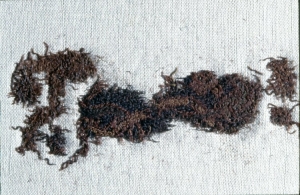
A woman's grave excavated 1863-1864 at Kempston, Bedforshire, UK, contained a relic box (Box. No. 141) that yielded a fragment of purple, woollen embroidery, dated to the seventh century AD. It has been classed as the earliest extant piece of Anglo-Saxon embroidery. The same grave also contained the so-called Kempston Beaker.
Hedeby Textiles
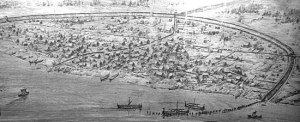
Hedeby, or Haithabu in German, is a site located in Schleswig-Holstein, in the extreme north of Germany, along the Danish border. In the Viking age it was an important maritime centre. Excavations at the site started in 1900. Finds from the site are exhibited in the Wikinger Museum Haithabu. The site yielded many fragments of textiles, but no clear evidence of decorative needlework.
Sutton Hoo Decorated Seam

Sutton Hoo, in East Anglia, England, is the site of two sixth and seventh century burial places, one of which contained an undisturbed ship burial, which was excavated in 1939. The burial chamber in the ship included many textile fragments, possibly from blankets, cloaks or hangings. The hem of a pillow cover was decorated with a strip reminiscent of the decoration of the woollen cushion from Mammen in Denmark.