
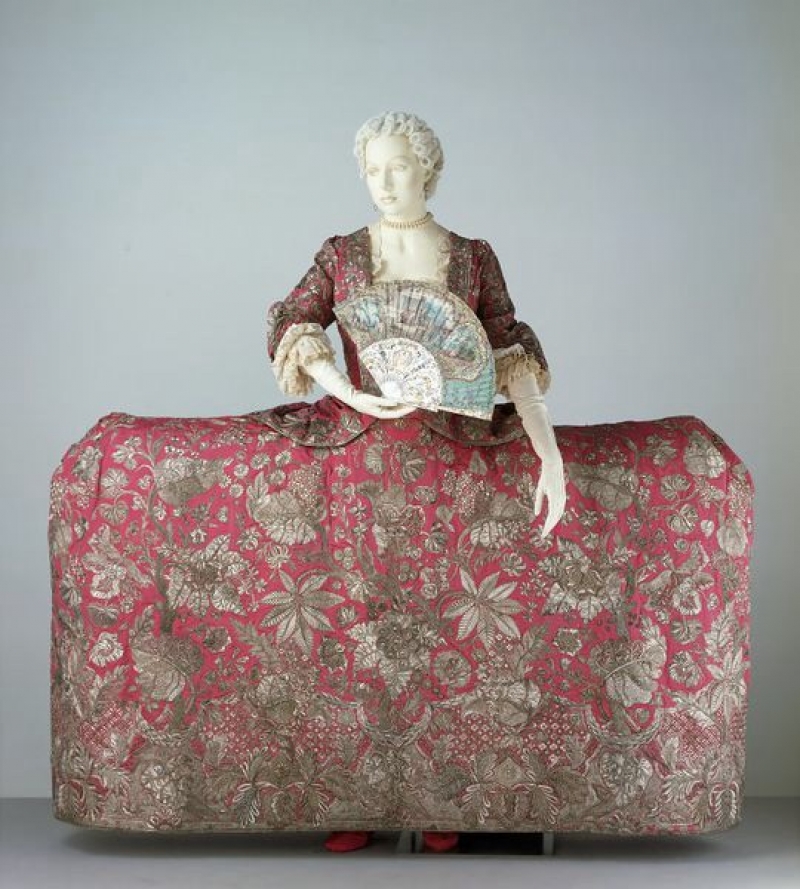
This form of outfit became popular in the late seventeenth century and remained in fashion until well into the eighteenth. During this period it gradually became more and more formalized in style and construction and by the mid-eighteenth century the skirt section had achieved enormous proportions with an emphasis on the amount of (expensive) cloth used.
This particular mantua dates from between 1740 and 1745. It is decorated with a complicated Tree of Life design worked in silver thread embroidery on a purple silk taffeta ground. The embroidery was carried out in couching with satin stitch. There is an inscription on the underside of the train that reads: "Rec’d of Mdme Leconte by me Magd. Giles.” It is likely that the designer was Madame Leconte, who was a Huguenot (French Protestant) embroideress working in London from 1710 to 1746. Magd. Giles was Magdalene Giles, a London embroideress.
During the 1920' s this mantua was purchased from a dealer by Lady Cowdray, in order to be worn at a fancy dress ball. To make sure it fitted Lady Cowdray, the bodice of the outfit was altered slightly. It was given to the Victoria and Albert Museum in 1970 by the Cowdray family.
Sources:
- DORE, Judith (1978), 'The Conservation of Two Eighteenth Century English Court Mantuas,' Studies in Conservation, volume 23, pp. 1-14.
- ROTHSTEIN, Natalie (ed.) (1982, reprinted 1992), Four Hundred Years of Fashion, London: Victoria & Albert Museum, no. 6, pp. 21 and 122.
- STEELE, Valerie (2010): 'Mantua,' The Berg Companion to Fashion, London: Berg, pp. 496-497.
V&A online catalogue (retrieved 4 June 2016).
GVE